
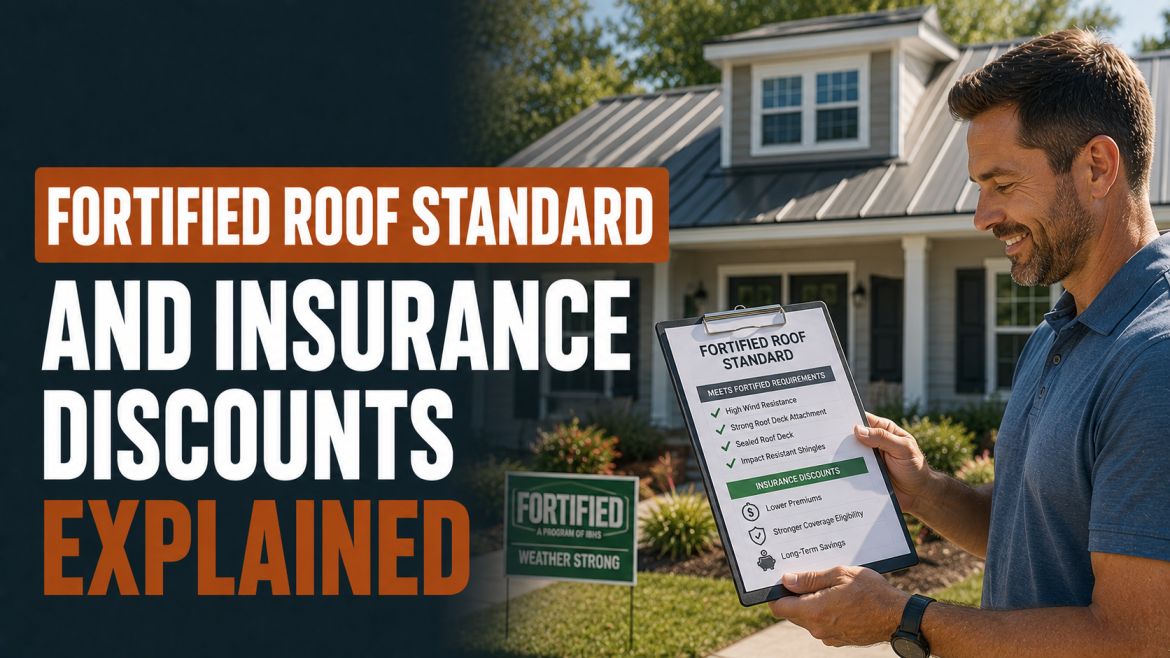
Most articles about the FORTIFIED roof standard quote a number that scares homeowners away. Ten to twenty-five thousand dollars sounds like a lot. That number describes a full retrofit on a roof that already exists, not the cost of adding FORTIFIED to a scheduled project.
The real number most homeowners actually pay looks nothing like that. When a re-roof happens anyway, adding FORTIFIED compliance to the same project can cost a few hundred to a couple thousand dollars. The discount that follows, sometimes 25% to 55% depending on the state, makes that incremental cost one of the better returns in home hardening.
Roof replacement services and storm damage repair can build FORTIFIED compliance into a scheduled project. The services directory covers every available option nationally as well.
What Is the FORTIFIED Roof Standard?
FORTIFIED is a voluntary construction standard developed and maintained by the Insurance Institute for Business and Home Safety. It sets specific, detailed requirements for wind and hail resistance well beyond standard building code minimums.
Where This Fits Within Roof Insurance
FORTIFIED connects directly to the broader roof damage insurance guide covered elsewhere on this site. It is one specific path to the largest wind and hail discount most carriers offer anywhere in the country.
What Makes FORTIFIED Different From Standard Code
Standard Code | FORTIFIED Requirement |
|---|---|
Basic fastening patterns | Enhanced fastener spacing and type |
Standard underlayment | Fully sealed roof deck with secondary water barrier |
Code-minimum wind rating | Wind-rated shingles or metal for higher sustained speeds |
No specific eave detail | Sealed roof-to-wall connections at eaves and rakes |
In practice: FORTIFIED evaluates the roof as one complete system working together, not simply a checklist of individual approved products. A Class 4 impact-rated shingle alone does not qualify a roof for the designation. Every component needs to work together as a tested assembly.
What Are the FORTIFIED Tiers?
The program uses a tiered structure. Each tier builds on the one before it, and a homeowner can stop at any level.
The Three FORTIFIED Levels
Tier | What It Covers | Typical Added Cost |
|---|---|---|
Bronze (Roof) | The roof system alone: deck sealing, fasteners, wind-rated covering | $700 to $1,700 incremental, $8,000 to $25,000 full retrofit |
Silver | Bronze plus load path connections between roof and walls | Adds $4,000 to $10,000 |
Gold | Silver plus impact-resistant windows, doors, and garage doors | Adds $8,000 to $25,000 or more |
Bronze is the most common designation nationally and the standard entry point for every higher available tier in the program. It also holds the strongest cost-to-discount ratio for most homeowners, since the incremental price stays low relative to the savings.
What Does FORTIFIED Actually Cost?
Cost depends heavily on one factor. Does the work happen during a scheduled replacement, or as a standalone retrofit on an existing roof?
Incremental Cost at Time of Replacement
An IBHS analysis of several Alabama sample projects found the added cost of FORTIFIED compliance during a scheduled re-roof ran between $700 and $1,700 depending on size. A separate third-party evaluator fee, required on every certified project regardless of size, typically adds another $300 to $600 on top of that base figure.
Full Retrofit Cost on an Existing Roof
Roof age and insurance underwriting rules covers a related consideration. An aging roof already facing a carrier's age threshold is often a better candidate for a full replacement with FORTIFIED built in, rather than a standalone retrofit. A retrofit on an existing roof, without full replacement, costs considerably more.
Why Does Certification Require a Third-Party Evaluator?
There is no self-certification path in the FORTIFIED program. An independent evaluator must document compliance before IBHS issues the designation.
What the Evaluator Actually Confirms
The evaluator inspects the completed work against the specific FORTIFIED checklist for the chosen tier. This includes fastener spacing, underlayment type, and connection details that are not visible once the roof is fully finished and covered. Photos taken during installation, before the covering goes on, are what the evaluator relies on most.
CSLB licensing for California roofing contractors covers a related credentialing concern. As of the 2025 FORTIFIED standard, the roofing contractor performing the work must also hold specific FORTIFIED certification, not just a general contractor license.
How Much Does FORTIFIED Actually Save on Insurance?
Discount size varies enormously by state, tier, and carrier. A single national figure does not exist.
Typical Discount Ranges by Region
Region | Typical Discount Range |
|---|---|
Southeast coastal states (AL, FL, LA, NC, SC) | 25% to 55% |
Other states offering the discount | 5% to 25% |
Storm damage repair across Florida operates in one of the states where this discount matters most. Hurricane exposure and aggressive carrier discount programs both drive that value.
Why Some States Mandate the Discount by Law
North Carolina requires carriers to offer a FORTIFIED discount by statute, guaranteeing savings regardless of which carrier a homeowner uses. Louisiana's Act 533 similarly ties public reporting requirements to FORTIFIED discounts insurers file each year, adding regulatory pressure toward consistent, transparent savings.
Where Does FORTIFIED Matter Most?
Geography drives the value of this certification more than almost any other factor in the decision.
States Where FORTIFIED Has the Highest Impact
Roof replacement services in Alabama sits in the state where the program originated, following repeated hurricane seasons that exposed standard construction failures. Storm damage repair across Louisiana operates under a state law specifically tracking and reporting FORTIFIED discount data annually.
Emergency roof repair in North Carolina benefits from the state's mandatory discount law, making certification a guaranteed savings regardless of carrier choice. Roof replacement services across South Carolina sees comparable value given the state's coastal wind exposure.
Where FORTIFIED Matters Less
A homeowner in a low-wind, low-hail region may find the discount too small to justify the added cost, even at the modest incremental price point. The specific discount a local carrier actually offers is worth confirming before assuming the investment pays off.
How Does FORTIFIED Interact With a Storm Damage Claim?
A FORTIFIED roof does more than earn a discount. It changes how a roof actually performs during the storm the insurance exists to cover.
Why This Matters Beyond the Premium Itself
Hail damage and wind-driven damage are exactly what FORTIFIED construction is engineered to resist. IBHS testing has documented FORTIFIED homes surviving Category 4 hurricane-force winds with little or no roof damage, while code-built neighbors in the same storm suffered significant loss. Hail damage roof repair and wind damage roof repair address the two perils this standard is built to resist.
Why roof insurance claims get denied becomes less relevant on a well-documented FORTIFIED roof. The certification paperwork itself provides strong evidence of the roof's condition and installation quality at a specific point in time.
Can a Homeowner Pursue FORTIFIED Without Any Insurance Discount at All?
Yes, and some homeowners do exactly this, valuing the actual storm resistance independent of any premium reduction.
Why Some Homeowners Choose FORTIFIED Regardless
A homeowner staying in a high-wind area long term may value the reduced risk of catastrophic roof failure. That matters more than any current discount percentage. Discount programs can change over time as carriers adjust underwriting models. The physical construction improvement remains in place regardless of what any single carrier decides.
In practice: the insurance discount is a genuine financial benefit, but it is not the only reason this standard exists in the first place. IBHS created FORTIFIED specifically to reduce actual storm losses, and the discount followed as carriers recognized the reduced risk.
Which States Handle FORTIFIED Discounts Differently?
Discount structure, mandatory status, and typical savings vary meaningfully by state given different legislative approaches.
Roof repair services in Texas offers FORTIFIED discounts through some carriers, though without the mandatory statutory requirement found in North Carolina. Hail damage roof repair across Colorado sees growing interest in FORTIFIED given the state's severe hail exposure, though the program remains newer to this specific market.
Storm damage repair in Georgia navigates FORTIFIED adoption shaped by coastal wind exposure similar to neighboring Southeast states, with growing carrier participation each year. Roofing services across Mississippi sees FORTIFIED value tied closely to the state's Gulf Coast hurricane risk profile.
How Long Does FORTIFIED Certification Take to Complete?
Certification timing depends on whether the roof is new or existing, and on evaluator availability in the local market.
The Typical Certification Timeline
A certification completed during a scheduled re-roof adds little to the overall project timeline, since the evaluator's inspection happens alongside the roofing work itself. A standalone retrofit takes longer, since the evaluator needs to verify existing conditions before any work begins, then confirm compliance again once it finishes.
In practice: scheduling the evaluator early, ideally before material orders are placed, avoids delays tied to their own availability and calendar. Popular evaluators in high-demand states can book out several weeks in busy storm seasons.
Does FORTIFIED Certification Transfer to a New Owner?
Yes, in most cases. The designation is tied to the structure itself, not the specific policyholder who obtained it.
Why This Matters for Home Sales
A home with existing FORTIFIED certification retains that designation through a sale, meaning a new owner can typically claim the same insurance discount without repeating the certification process. This can be a genuine selling point in high-wind states, where buyers increasingly ask about storm-resistant construction directly.
A related underwriting consideration matters for buyers evaluating an older home. A FORTIFIED designation on an aging roof can offset some of the age-based concern a carrier might otherwise raise.
What Happens if a FORTIFIED Roof Is Later Damaged?
A documented FORTIFIED roof does not become uninsurable or lose its designation automatically after a storm event, though repairs need specific attention.
Why Repairs Must Match the Original Standard
How to file a roof insurance claim covers the general filing process, but a FORTIFIED-specific repair needs materials and methods that maintain the original certification standard. A contractor unfamiliar with FORTIFIED requirements can inadvertently void the designation during an otherwise standard repair, using materials that do not match the certified specification.
A repair contractor who understands FORTIFIED requirements, not just standard roofing code, protects the designation and the discount tied to it going forward.
Does FORTIFIED Affect a Roof's Expected Service Life?
The enhanced construction methods FORTIFIED requires can extend a roof's practical service life beyond what standard code construction typically achieves.
Why Better Construction Often Means Longer Life
Sealed decking and enhanced fastening reduce the small gaps and loose connections. These are exactly what let moisture and wind stress accumulate damage over years. A FORTIFIED roof facing ordinary weather, not just catastrophic events, may show less of the gradual wear that standard construction accumulates over the same period.
Roof wear and aging covers the general aging mechanisms every roof faces regardless of construction standard. FORTIFIED does not eliminate aging entirely, but it can slow several of the specific mechanisms that drive it.
How Does FORTIFIED Compare to Class 4 Impact-Rated Shingles Alone?
A Class 4 shingle addresses one component. FORTIFIED addresses the entire roof system working together, which is a meaningfully broader and more demanding standard.
Why System-Level Testing Matters More
A Class 4 shingle can resist impact damage on its own. A roof can still fail during a windstorm if the underlayment lifts or fasteners pull loose. FORTIFIED specifically targets these failure points, sealing the deck and reinforcing the connections that a shingle rating alone does not address at all.
In practice: a homeowner choosing only a Class 4 shingle upgrade captures part of the protection. It misses the connection and sealing improvements that matter most during sustained high wind.
Frequently Asked Questions About FORTIFIED Roofs
What Is a FORTIFIED Roof?
It is a roof built or retrofitted to a voluntary standard from the Insurance Institute for Business and Home Safety. It requires enhanced fasteners, a sealed deck, and wind-rated materials beyond standard code.
How Much Do You Save With a FORTIFIED Roof?
Savings vary by state, typically 5% to 25% nationally. High-wind Southeast states with strong carrier support, including Alabama, Florida, Louisiana, and the Carolinas, see 25% to 55%.
How Much Does It Cost to Get a FORTIFIED Roof?
The added cost during a scheduled replacement often runs $700 to $1,700, plus a $300 to $600 evaluator fee. A standalone retrofit on an existing roof runs considerably higher, commonly $8,000 to $25,000 for the Bronze tier alone.
Can I Self-Certify My Roof as FORTIFIED?
No. An independent third-party evaluator must inspect and document compliance before IBHS issues the designation. There is no self-certification path in the program.
Do I Need a Special Contractor for FORTIFIED Certification?
Yes, under the 2025 standard. The installing roofing contractor must hold specific FORTIFIED certification in addition to standard state licensing requirements.
Is FORTIFIED Worth It in Every State?
Not necessarily. States with lower wind and hail risk, and smaller available discounts, may not justify the added cost as strongly. High-risk Southeast coastal states see far more value from both the discount and the actual storm protection.