
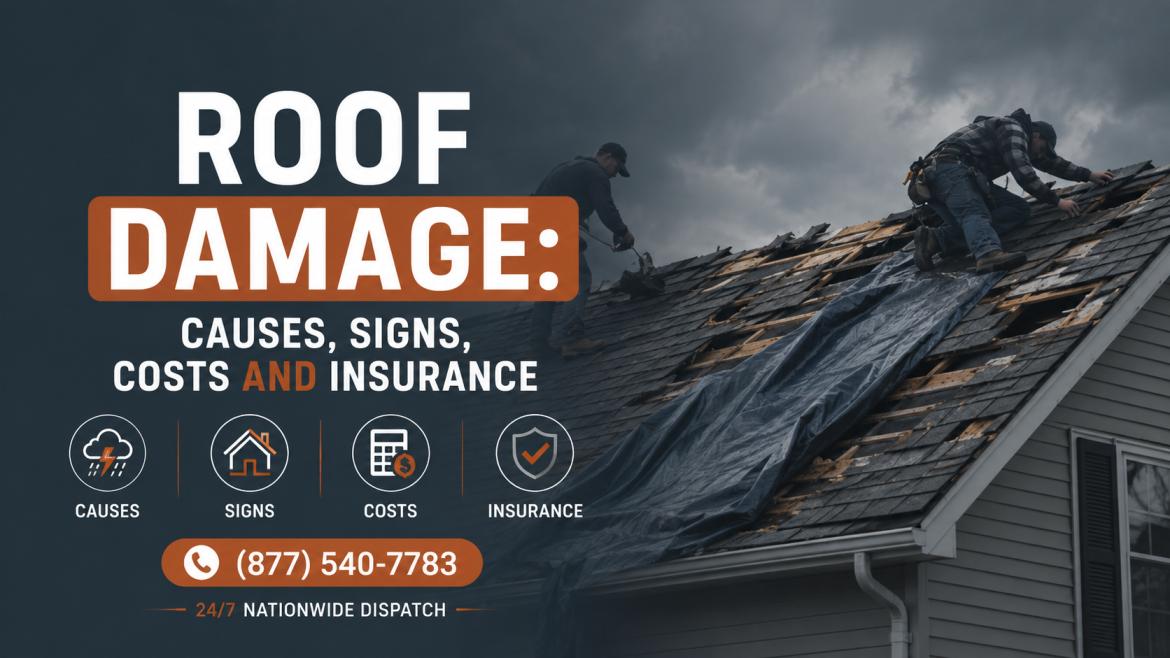
Roof damage is any physical condition that reduces a roof system's ability to keep water out. It covers sudden storm losses and slow material breakdown. Both are damage, but contractors and insurers treat them very differently.
A roof is a layered assembly, not a single surface. Shingles, underlayment, flashing, decking, gutters and ventilation each fail in their own way. Damage to one layer often shows up as a symptom somewhere else entirely.
Wind and hail account for more homeowners claims than any other peril. The Insurance Information Institute reports that about one in 35 insured homes files a wind or hail property damage claim in a given year.
This guide covers what counts as roof damage, the causes behind it, and the signs that appear first. It also covers roof components, materials, inspection, immediate response, insurance treatment, cost drivers, roof repair services, prevention, seasonal patterns and contractor selection.
What Counts as Roof Damage?
Roof damage is any condition that compromises the roof's ability to shed water, resist wind uplift, or carry load. That definition is broader than most homeowners expect. A shingle that has lost its seal is damaged even though it is still physically present on the roof.
The distinction that matters is not how bad the damage looks. It is which category the damage falls into, because that decides who pays and how urgently the roof needs attention.
Functional Damage vs. Cosmetic Damage
Functional damage affects performance. Cosmetic damage affects appearance only. A hailstone that fractures the fiberglass mat inside an asphalt shingle has caused functional damage even if the shingle looks intact from the driveway.
The line between the two carries real money. Many policies now attach a cosmetic damage exclusion to the roof surface, which removes coverage for dents that do not compromise water shedding. Three questions decide which side of the line a defect falls on:
Barrier Integrity: Has the waterproof layer been breached, or only marked?
Fastening and Seal: Does the sealing system still hold under wind uplift?
Underlayment Continuity: Does the secondary barrier beneath the covering remain intact?
Metal roofs sit at the center of this dispute more than any other material. A dented standing seam panel often sheds water perfectly well, which is why carriers write cosmetic exclusions most aggressively for metal.
Sudden Damage vs. Progressive Damage
Sudden damage happens on a date. Progressive damage happens over a decade. Homeowners insurance is built around that distinction, since standard policies respond to sudden and accidental loss rather than gradual deterioration.
The ISO HO-3 form, the most widely used homeowners policy form in the United States, covers the dwelling on an open-perils basis. It then excludes wear, tear, marring and deterioration under Section I, A.2.c.(6)(a). Age itself is not a listed exclusion, but aging evidence is what adjusters cite.
In practice: two roofs can show identical missing shingles. The one with creased tabs and torn seal strips reads as wind damage. The one with brittle, curled edges across every slope reads as roof wear and aging.
Structural Damage
Structural damage reaches past the covering into the framing and sheathing that carry load. It is rarer than surface damage and far more urgent, since it threatens the building rather than just the interior finishes.
The warning signs are visible from inside and from the attic:
A ridge line that dips or waves along what should be a straight run
A rafter that has rotated, split or pulled away from its bearing point
Decking that flexes underfoot instead of feeling solid
Top-floor doors and windows that have stopped closing squarely
New cracks in ceiling drywall running parallel to the framing
Snow load, long-term saturation and large tree impacts are the three usual causes. A roof with sagging or deflection needs assessment before anyone walks on it, because the covering is no longer the primary concern.
What Causes a Roof to Fail?
Roofs fail from a recurring set of causes, split between weather perils and non-weather factors. Each one leaves a different physical signature, which is why identifying what causes roof damage comes before any repair decision.
Severe convective storm activity is rising, and the reporting reflects it:
NOAA's Storm Prediction Center logged 5,432 hail events in 2025, up from 5,373 in 2024
The National Weather Service receives roughly 12,000 wind and hail reports in a typical year
An Insurify analysis of NOAA data found Illinois recorded 216 severe hailstorms in 2024, up 108% over 2022
That last figure explains why demand for hail damage roof repair in Illinois has climbed faster than in the traditional hail belt states.
Cause identification decides the settlement. Insurers pay for sudden perils and decline gradual deterioration, which makes the diagnosis the highest-stakes step in the process.
Weather-Driven Causes of Roof Damage
Weather perils produce the majority of insured roof losses. They share one useful trait for homeowners: each leaves a distinctive pattern that separates it from ordinary aging.
Hail Damage
Hail damages a roof by fracturing the shingle mat and knocking granules loose from the surface. The bruise is often invisible from the ground because the granule layer closes back over the fracture.
Hail at or above one inch in diameter is the general threshold for functional damage to asphalt shingles. Wind changes that threshold, since a stone driven sideways at 60 mph carries far more energy than one falling straight down.
Establishing that hail was the cause is the step that supports hail damage roof repair under a claim. The signature is randomness:
Random Distribution: Strikes land on every slope, including the north face
Irregular Spacing: No alignment or pattern, unlike a manufacturing defect
Soft Bruises: The impact point gives slightly under thumb pressure
Circular Granule Loss: Exposed asphalt in round spots rather than even wear
Collateral Evidence: Dents on gutters, vent caps, downspouts and window screens
Wind Damage
Wind damages a roof through uplift rather than impact. Pressure differential across the roof plane lifts the shingle edge, breaks the factory seal strip, and folds the tab backward until the mat creases.
Wind damage rarely appears uniformly across all four elevations. That asymmetry is the clearest way to separate it from ordinary aging, and it is what a wind damage roof repair scope is built around.
The signature of wind damage on a roof is direction:
Edge Concentration: Damage clusters at the rake, ridge, eave and windward face
Creasing: A horizontal fold line across the tab, permanent even after it lays flat
Torn Nail Holes: Fastener holes elongated where the shingle pulled against them
Broken Seals: Tabs that lift by hand where the adhesive strip has released
A creased shingle has failed even after it lays back down. The crease is a fracture through the mat, and the broken seal will not reset in the next warm spell.
Ice Dams
An ice dam forms in three stages. Heat escaping into the attic melts snow on the upper roof, the meltwater runs down to the cold eave, and it refreezes there. The resulting ridge of ice traps standing water behind it.
That trapped water backs up under the shingle course and reaches the decking. Ice dam roof damage is a ventilation and insulation problem expressing itself as a roofing problem.
Ice dams are a northern problem above all. They drive a large share of the winter demand for emergency roof leak repair in New York and across the Northeast. The visible evidence appears at the perimeter:
Heavy icicle formation along the gutter line
Ice filling the gutter trough rather than water draining through it
Interior staining along exterior walls rather than mid-ceiling
Damp insulation concentrated in the eave bays
Snow Load
Snow load damages a roof when accumulated weight exceeds what the framing was designed to carry. Wet snow and ice weigh several times more per inch than dry powder, which is why depth alone is a poor gauge.
Depth is a poor gauge on its own. A foot of wet snow can weigh more than three feet of dry powder. Weight rather than height is the measure that matters.
Roof snow load damage shows up as deflection before it shows up as failure:
Doors on the top floor that stop closing squarely
New cracks in top-floor drywall, especially at corners
A ridge line that has developed a visible dip
Interior walls showing fresh separation at the ceiling joint
Drifting matters as much as total accumulation. Snow piles unevenly against dormers and roof-to-wall junctions, which concentrates load where reserve capacity is lowest.
Water Intrusion and Ponding
Water damages a roof when it stops moving. Standing water on low-slope sections works through seams, fasteners and any imperfection in the membrane, given enough time.
Roof water damage differs from a storm leak in one respect. It is usually a consequence of another failure, such as a clogged drain, a sagging deck or a flashing gap that changed the drainage path.
Ponding leaves evidence that outlasts the water itself:
Rings of sediment marking where standing water evaporated
Blistered or wrinkled membrane within the ponded area
Decking that feels soft underfoot beneath the low spot
Persistent damp in the same location after several dry days
Sun and UV Exposure
Ultraviolet radiation damages a roof by breaking down the volatile oils that keep asphalt flexible. The material dries, shrinks and loses the ability to move with thermal cycling.
Sun damage on a roof is cumulative and unavoidable. It is the mechanism behind most end-of-life failure on asphalt shingles, and it works fastest on south and west elevations.
The evidence of ultraviolet breakdown is consistent across roofs:
A chalky, faded surface where the granule color has washed out
Brittle edges that snap rather than bend when lifted
Thermal cracking running across the tab rather than along it
Exposed sealant at penetrations that has hardened and split
Poor attic ventilation accelerates every part of this process by heating the covering from beneath.
Wildfire Embers
Embers damage a roof by landing in the debris that collects on it rather than by igniting the covering directly. Valleys, gutters and the area behind chimneys are where that debris accumulates.
Wildfire ember damage to a roof is the leading ignition pathway for homes lost in wildland fires. It operates well ahead of the flame front, since embers travel over a mile on wind.
Ember exposure now shapes roofing material restrictions across the West. It is also why wildfire roof damage repair in California so often involves a full covering replacement. Embers reach a home through three pathways:
Roof Debris: Leaf litter in valleys, gutters and behind chimneys ignites first
Vent Openings: Unscreened or damaged attic vents admit embers directly
Gaps in the Assembly: Openings at ridge, eave and soffit where the covering has lifted
Non-Weather Causes of Roof Damage
Non-weather causes account for a large share of roof failures and almost none of the paid claims. Standard policies exclude most of them, which makes early detection the only meaningful defense.
Tree and Debris Impact
Trees damage a roof in two distinct ways. A falling limb causes sudden impact damage, while an overhanging branch causes slow abrasion every time wind moves it across the surface.
Tree damage on a roof also arrives indirectly, through everything the canopy delivers to the surface below it.
Tree damage arrives through several routes at once:
Falling Limbs: Sudden impact that punctures the covering and can reach the decking
Branch Abrasion: Repeated contact that scrapes granules off in visible tracks
Debris Loading: Leaf litter that dams valleys and gutters and holds moisture
Shade Retention: Reduced sun exposure that lets moss and algae establish
Impact damage is usually covered as a sudden peril. Abrasion from a branch that has been rubbing for years reads as maintenance and typically is not.
Animal and Pest Entry
Animals damage a roof by creating or widening openings to reach the attic. Squirrels, raccoons, birds and bats all target the same weak points: vents, soffit gaps, ridge openings and decayed fascia.
Animal damage on a roof is almost universally excluded from homeowners policies, alongside insect and vermin damage. The exclusion holds even when the resulting opening later admits water during a storm.
The usual indicators are easy to check without roof access:
Chewed or torn vent screens at gable and roof vents
Insulation scattered or matted in the attic
Staining and gaps around soffit joints and fascia ends
Audible movement overhead, typically at dawn or dusk
Droppings or nesting material in the attic space
Wear and Aging
Every roof covering has a service life, and reaching the end of it is not damage in the insurance sense. Roof aging and wear produces failure that looks like storm damage but distributes very differently.
Age-related failure distributes very differently from storm damage. Storms leave concentrated, directional or random evidence, while aging spreads evenly.
The pattern is uniformity, and it shows up in several ways at once:
Granule loss spread evenly rather than concentrated in spots
Curling at every tab edge across all slopes at a similar rate
Cracking that follows the same lines throughout the field
Sealant hardened and split at every penetration, not just one
This is the single most common basis for a denied roof claim. An adjuster who sees uniform deterioration attributes the whole loss to wear and tear.
Installation Defects
Installation defects damage a roof by causing premature failure of a covering that would otherwise perform. The defect is present from day one but the symptom appears years later.
Roof installation defects cluster around a short list of errors:
Nailing Outside the Zone: Fasteners placed above or below the manufacturer's designated nailing strip
Overdriven or Underdriven Nails: Heads cutting through the mat, or heads standing proud and lifting the course above
Missing Starter Course: No sealed edge at the eave, leaving the first course vulnerable to uplift
Improper Flashing Lap: Flashing sealed with caulk instead of layered into the water path
Reused Flashing: Old flashing retained during a re-roof to save cost
Manufacturer warranties usually exclude installation error, and homeowners policies exclude faulty workmanship. That leaves the installing contractor as the only recourse, which is why licensing and warranty terms matter at hire.
Foot Traffic
Foot traffic damages a roof through concentrated point loading on a surface designed for distributed load. The damage is caused by the people inspecting or servicing the roof rather than by weather.
A roof covering is designed to carry distributed load such as snow, not the point load of a person's heel. The difference in pressure is substantial.
Foot traffic damage on a roof is worst on brittle materials:
Clay and Concrete Tile: Crack or shatter under concentrated weight
Aged Asphalt: Loses granules in visible scuffed tracks
Metal Panels: Ribs crush where someone stepped between supports
Slate: Fractures along natural cleavage planes
Satellite installers, HVAC technicians and chimney sweeps cause more of this than roofers do. It is also why drone inspection is now preferred on tile and slate.
How Do You Spot Roof Damage Early?
Most roof damage announces itself before a leak appears. The signs of roof damage show up from the ground or inside the attic. The gap between the first sign and the first drip is often measured in months.
The National Roofing Contractors Association recommends checking a roof in spring and fall. The watch list covers cracked or curled shingles, deteriorated flashing, and granules collecting in gutters.
Signs Visible from the Ground
Exterior signs are the earliest available evidence and the safest to gather. Binoculars from the driveway cover most of what matters without anyone leaving the ground.
Granule Loss
Granules are the mineral surface that shields asphalt from ultraviolet radiation. Once they are gone, the exposed asphalt dries and cracks quickly.
Shingle granule loss shows up first in the gutters and at downspout outlets. On the roof itself it appears as darker patches where the black asphalt below has become visible.
The cause determines the meaning:
Uniform Across Slopes: Normal ageing and ultraviolet wear
Circular Concentrated Spots: Hail impact
Directional Streaks Below Vents: Runoff scouring from a drainage problem
Heavy Loss on One Elevation: Sun exposure or a localised impact event
Curling and Buckling Shingles
Curling lifts the shingle edges upward while buckling pushes the center of the shingle into a ridge. Both break the wind seal and create a catch point for uplift.
Curling shingles and buckling shingles are often reported as the same problem. They are not, and the distinction points at different underlying faults.
The two conditions point to different causes:
Curling: Heat, inadequate attic ventilation or simple age
Buckling: Decking movement or underlayment that absorbed moisture at install
Clawing: Edges down and centre up, usually a sign of advanced ageing
Either condition means the roof can no longer resist wind at its rated speed. A curled roof loses shingles in storms a flat roof would survive.
Blistering
Blisters are raised bubbles on the shingle surface, caused by trapped moisture or voids formed during manufacture. They can be small and scattered or large and clustered.
Roof blistering matters once the blister opens. An open blister exposes the asphalt below and creates a starting point for granule loss and cracking.
Blisters are frequently confused with hail bruises during claim inspections. Two features separate them:
Edge Definition: Hail marks have sharp, irregular edges; blisters are smoothly rounded
Distribution: Hail is randomly scattered; blisters cluster in the same areas repeatedly
Feel: A hail bruise is soft under thumb pressure; an intact blister is firm
Moss and Algae
Moss holds moisture against the covering and works its root structure between courses, which lifts shingle edges over time. Algae produces dark streaking without the same physical effect.
Moss on a roof causes damage. Algae is largely cosmetic and does not shorten the covering's service life in most conditions.
Both point to the same underlying condition:
Shade from overhanging canopy or an adjacent structure
Drainage that leaves the covering damp long after rainfall
Debris accumulation that holds moisture against the surface
Treating the growth without addressing the moisture source produces a repeat within a season or two.
Missing or Displaced Shingles
A missing shingle is the most obvious sign and the most urgent of the exterior indicators. Exposed underlayment degrades under ultraviolet exposure within weeks.
Displaced shingles matter as much as missing ones. A shingle that has slipped out of alignment has lost its fastening, and the course above it has lost its support.
Two things are worth checking beyond the visible gap:
Shingles or granule-heavy fragments in the yard, beds and gutters
The courses adjacent to the gap, which have lost their overlap protection
A Sagging Roof Line
A sagging roof line is the one exterior sign that requires professional assessment immediately. It indicates the structure is deflecting rather than the covering failing.
Roof sagging traces to a short list of causes:
Long-term water saturation weakening the decking
Undersized, damaged or improperly modified framing
Accumulated snow load exceeding the design capacity
The added weight of multiple roof covering layers
Removed or cut structural members during a past renovation
Sight along the ridge from the ground at an angle. Any dip, wave or twist along what should be a straight line is a structural finding, not a cosmetic one.
Signs That Appear Inside the Home
Interior evidence usually means water has already passed the covering. That makes attic and ceiling signs more urgent than most exterior signs, even when they look minor.
Ceiling Stains
A ceiling stain confirms water has reached the interior finishes. The stain grows and darkens with each subsequent rainfall until the entry point is closed.
A ceiling stain from a roof leak is rarely directly beneath the breach. Water travels along rafters and truss chords before it drops, so the visible mark often sits several feet away.
In practice: a stain that bulges or feels soft is holding pooled water above the drywall. That is a containment situation before it becomes a repair situation.
Attic Moisture
The attic is where roof damage is visible earliest, before any water reaches finished space. It is also where ventilation problems announce themselves.
Attic moisture from a roof problem shows up in several forms:
Dark staining on the underside of the sheathing
Compressed, matted or visibly damp insulation
Rust forming on exposed nail shanks
Frost on nail tips during cold weather
Mould growth on rafters or truss chords
Condensation and leakage look similar but distribute differently. Leakage concentrates around a penetration or a specific rafter bay, while condensation spreads evenly across the underside of the deck.
Daylight Through the Roof Deck
Visible daylight through the roof deck means there is a physical opening in the assembly. It is the clearest possible confirmation that the roof has been breached.
Daylight through the roof in the attic appears in predictable places:
Fastener holes where nails have backed out or missed the framing
Split or cracked sheathing panels
Gaps at the ridge where the cap or vent has lifted
Around penetrations where flashing has separated from the deck
Turn off every attic light and let your eyes adjust for a full minute. Small openings that admit water stay invisible until the space is completely dark.
Which Parts of a Roof Fail First?
A roof fails at its transitions and penetrations before it fails in the open field. The individual roof components at those junctions carry more water and more movement than flat runs of covering.
The International Residential Code requires at least one square foot of net free ventilating area per 150 square feet of attic floor area. That ratio drops to 1:300 when at least half the ventilation sits high with balanced intake below.
The Water-Shedding Layers
Three layers work together to keep water out. Each has a defined job, and each fails in a way that reveals which layer is involved.
Shingles
Shingles are the primary weather surface. They shed water by overlap rather than by seal. That is why the fastening pattern and the sealed course edges matter as much as the material.
Roof shingles are rated for a specific wind speed, but that rating assumes correct fastening. Installation quality determines whether the rating means anything.
Roof shingles fail in three ways, and all three reduce wind resistance before they produce a leak. Each points toward shingle repair rather than a full system replacement:
Seal Strip Failure: The adhesive bond releases and the tab is free to lift
Mat Fracture: The reinforcing layer cracks, usually from impact
Granule Loss: The protective surface erodes and exposes the asphalt
The nailing zone decides longevity more than the product does. Fasteners placed correctly hold to the rated wind speed, while fasteners an inch high hold almost nothing.
Roof Underlayment
Underlayment is the secondary water barrier installed directly on the deck beneath the covering. It catches anything that gets past the shingles and directs it back to the drainage path.
Roof underlayment failure stays invisible until the covering comes off:
Ultraviolet Degradation: Both felt and synthetic break down when left exposed
Tearing: Wind gets under exposed underlayment and strips it from the deck
Fastener Perforation: Holes that never sealed become entry points
Wrinkling: Moisture absorbed before covering telegraphs through the shingles
Ice barrier membrane is the upgraded version used at eaves and valleys in cold climates. It self-seals around fasteners and blocks the backed-up water an ice dam creates.
Roof Decking
The decking is the structural sheathing that carries the covering and provides the nailing substrate. Everything above it depends on it holding fasteners.
Nothing above the deck can be reattached until the deck itself is sound. That dependency is why decking problems reset a repair schedule.
Roof decking fails in two ways, and neither holds a nail:
Rot: Prolonged saturation softens the wood until fasteners pull straight out
Delamination: Plywood plies separate, leaving no continuous material to grip
Deck damage is usually discovered at tear-off rather than before it. Replacement estimates carry a per-sheet allowance for sheathing that turns out to be unsound.
Transitions and Penetrations
Transitions are where two planes meet and where the roof is interrupted. They carry the highest leak frequency on a residential roof by a wide margin.
Roof Flashing
Flashing seals the joints where the roof plane meets a wall, a chimney, a vent or another roof section. It is the single most common leak source on a residential roof.
The most frequent error is sealing a joint with caulk instead of layering metal into the water path. Caulk is a finish detail, not a waterproofing method.
Roof flashing fails through a short and predictable list of faults:
Corrosion: Galvanised metal rusting through, or dissimilar metals reacting
Sealant Breakdown: Caulk hardening and cracking away from the joint
Improper Lap Sequence: Metal layered against the water flow rather than with it
Reuse During Re-Roofing: Old flashing retained to save cost on a new covering
Correctly detailed flashing works by gravity and overlap alone. Any flashing depending on sealant to stay watertight has a service life measured in a few years.
Roof Valleys
A valley is the channel formed where two roof slopes meet. It carries the combined runoff from both planes, which makes it the highest-volume drainage path on the roof.
Valleys carry the combined runoff of two planes, which makes them the hardest-working drainage path on the roof.
Roof valley leaks come from three sources:
Debris Damming: Leaf litter blocking flow and forcing water sideways
Metal Corrosion: Valley flashing rusting through at the lowest point
Ice Buildup: Frozen water pushing runoff under the adjoining courses
Open valleys expose the metal and shed debris readily. Closed valleys are woven with shingles and look cleaner, but they trap debris and resist inspection.
Chimney Junctions
A chimney interrupts the roof plane with a masonry mass that moves independently of the framing. That differential movement is what opens the joint over time.
Masonry and framing move at different rates through seasonal cycles. That differential is what opens the joint over time.
Chimney flashing is the detail behind most of these leaks, and chimney flashing repair is a distinct scope from field shingle work. Leaks originate at four points:
Counterflashing: Metal let into the mortar joint that has loosened or corroded
Step Flashing: Individual pieces woven into each shingle course along the sides
The Cricket: A saddle on the upslope face that splits water around the stack
The Mortar Crown: The sloped cap at the top, which cracks and admits water
A chimney wider than 30 inches needs a cricket. Its absence is a frequent finding on older roofs and a common source of persistent leaks.
Skylights
A skylight is a glazed penetration through the roof plane, which makes it a permanent flashing detail rather than a fixture. Every skylight is a managed leak risk.
Every skylight is a managed leak risk rather than a fixture. It interrupts the water path permanently.
A skylight leak repair starts with identifying which of four causes applies:
Perimeter Seal Degradation: The gasket between glazing and frame hardening
Curb Flashing Failure: Metal at the raised base separating from the covering
Condensation: Interior moisture mistaken for a leak, common on single glazing
Missing Flashing Kit: A unit installed without the manufacturer's components
Skylight service life is shorter than the roof's in most cases. Replacing the unit during a re-roof costs far less than returning to it two years later.
Ridge Caps
Ridge caps cover the peak where two slopes meet and, on a vented ridge, house the exhaust opening. They sit at the highest wind exposure on the roof.
Ridge caps sit at the highest wind exposure on the roof. They are also the last component installed, which makes them the first to reveal poor workmanship.
Ridge cap failure appears in three forms, and each admits wind-driven rain directly into the attic:
Lifted or cracked caps along the peak
Exposed fasteners where the covering has receded
A ridge vent that has separated from the deck
Caps cut from three-tab shingles crack far sooner than purpose-made hip and ridge products. That substitution is a common cost-saving shortcut.
Drainage and Edge Components
Drainage components move water off the roof and away from the structure. They fail quietly, and the damage shows up on the fascia, the walls and the foundation rather than on the roof.
Gutters and Downspouts
Gutters collect roof runoff and downspouts carry it away from the foundation. Neither is part of the waterproofing system, but both protect the components that are.
Gutters are not part of the waterproofing system, but they protect the components that are. Fascia, soffit and foundation all depend on them working.
Because the sequence is predictable, gutter repair is usually cheaper than the fascia work that follows if it is deferred. The sequence runs:
Debris accumulates and restricts flow toward the downspout
Water backs up and spills over the rear edge behind the gutter
The fascia board behind the gutter absorbs that water and begins to rot
Fasteners lose their grip in the softened wood
The gutter pulls away under its own weight plus the trapped water
Pitch matters more than capacity. A gutter with insufficient fall holds standing water regardless of size, which accelerates every step above.
Soffit and Fascia
The fascia is the board that closes the rafter ends at the eave. The soffit is the underside panel that spans from the fascia back to the wall and provides intake ventilation.
The soffit does two jobs at once. It closes the eave against weather and pests, and it supplies the intake air the attic ventilation system depends on.
Soffit and fascia damage comes from four sources:
Gutter Overflow: Water spilling behind the gutter and saturating the fascia
Pest Entry: Animals widening gaps at soffit joints and board ends
Paint Failure: Coating breakdown that lets moisture into the wood
Blocked Soffit Vents: Insulation or paint sealing the intake openings
Blocked intake is the quiet version of this failure. Insulation pushed into the eave stops airflow at the source, which makes every exhaust vent less effective.
Roof Vents
Roof vents exhaust the heat and moisture that accumulate in the attic. Balanced ventilation requires intake at the soffit and exhaust at or near the ridge.
Balanced ventilation requires intake low at the soffit and exhaust high at or near the ridge. Both halves have to be present for either to work.
Roof ventilation failure takes several forms:
Damaged or missing screens at vent openings
Wind-driven rain entry through vents not rated to resist it
Mixed exhaust types that short-circuit airflow between themselves
Exhaust capacity installed without matching intake at the soffit
Inadequate ventilation shortens shingle life from below by baking the covering. It also drives the attic moisture and ice dam problems described earlier.
How Does Roofing Material Change the Way a Roof Fails?
Every roofing material has its own failure mode and its own service life. Hail that cracks a clay tile will only dent a steel panel. Seeing roofing materials compared side by side is a useful exercise before any replacement.
Service life guidance published by the National Roofing Contractors Association and the Asphalt Roofing Manufacturers Association gives useful planning ranges by material class.
Asphalt Shingles
Asphalt shingles cover the majority of American homes and fail more predictably than any other material. Three-tab and architectural products behave differently despite sharing the same base composition.
Asphalt shingle roof lifespan runs 15 to 20 years for three-tab and 25 to 30 years for architectural products. Ventilation, climate and installation quality move any individual roof within that range.
The failure sequence is consistent across nearly every asphalt roof:
Granules erode and expose the asphalt beneath
Ultraviolet exposure dries the asphalt and it loses flexibility
Tabs curl at the edges and the seal strip releases
The roof sheds shingles in wind events it previously survived
Metal Roofing
Metal roofing resists impact and fire well and carries the longest practical service life short of slate. Its failure modes are mechanical rather than material.
Metal outlasts every common covering except slate. Its problems are about fastening and finish rather than the substrate wearing out.
Metal roof damage is mechanical rather than material:
Panel Denting: Hail impact marking the surface without breaching it
Fastener Backout: Exposed-fastener systems loosening through thermal cycling
Coating Breakdown: Finish failure leading to corrosion at the exposed steel
Seam Separation: Standing seam joints opening under uplift or movement
Denting is where metal roofs meet the cosmetic exclusion problem. A dented panel usually sheds water perfectly, which gives carriers grounds to decline.
Clay and Concrete Tile
Tile roofs last decades and carry substantial weight, which makes framing capacity a design constraint rather than an afterthought. The two materials behave similarly but not identically.
Weight is the design constraint on both. Framing capacity has to be verified before any tile roof is installed or replaced with a heavier profile.
The two tile materials fail differently despite looking similar:
Clay Tile: Fired clay is brittle and cracks under impact and foot traffic
Concrete Tile: Heavier, and adds surface weathering and greater structural stress
The detail most tile owners miss is the underlayment. The covering routinely outlasts the membrane beneath it, which needs renewal at 20 to 25 years.
Slate
Slate is quarried stone and outlasts every other residential covering by a wide margin. Hard slate reaches 75 to 150 years, while softer varieties fall well short of that.
Hard slate reaches 75 to 150 years and softer varieties fall well short of that. Quarry source matters more than any other variable.
Slate roof damage comes from three sources:
Fracture: Impact or foot traffic breaking individual slates
Fastener Corrosion: Nails rusting through while the stone stays sound
Delamination: The stone splitting along its natural cleavage planes
Fastener failure ends more slate roofs than the slate itself does. A roof where slates are slipping while the stone is intact needs re-fastening, not replacement.
Wood Shake
Wood shake weathers attractively and insulates well, and it demands more maintenance than any other common covering. Its failure modes are biological as well as mechanical.
Wood shake demands more maintenance than any other common covering. Neglect shortens its life faster than it shortens the life of asphalt or metal.
Wood shake roof damage is biological as well as mechanical:
Rot: Retained moisture breaking down the wood fibre
Splitting: Cracks opening along the grain through wet and dry cycling
Cupping: Shakes curling as they absorb and release moisture
Fire Vulnerability: Untreated shakes igniting from airborne embers
Many jurisdictions in wildfire-exposed areas now restrict untreated wood shake. Insurance availability follows those restrictions as closely as code does.
Membrane Roofing
Membrane systems cover low-slope sections such as porches, dormers and additions, and they appear on many homes that are otherwise shingled. Three types dominate.
TPO: A single-ply thermoplastic membrane. TPO roof damage centers on seam separation and ultraviolet surface breakdown over time.
EPDM: A synthetic rubber membrane. EPDM roof damage centers on shrinkage that pulls the sheet away from edges, punctures, and adhesive failure at seams.
Modified Bitumen: A multi-ply asphalt-based system. Modified bitumen roof damage centers on blistering between plies, ply separation and loss of the surfacing layer.
All three depend on drainage. A membrane holding standing water fails at the seams long before its rated service life. That is why flat roof repair addresses slope and drainage alongside the membrane.
How Service Life Compares Across Materials
Material choice sets the planning horizon for every future roofing decision. The comparison below uses published NRCA and ARMA guidance ranges under normal installation and maintenance.
Material | Typical Service Life | Dominant Failure Mode |
|---|---|---|
Asphalt shingles, 3-tab | 15 to 20 years | Seal failure, mat cracking, granule loss |
Asphalt shingles, architectural | 25 to 30 years | UV embrittlement, wind uplift at edges |
Metal roofing | 40 to 70 years | Denting, fastener backout, coating corrosion |
Clay tile | 50 years or more | Cracking under impact and foot traffic |
Concrete tile | 50 years or more | Weathering, weight stress, underlayment failure |
Slate | 75 to 150 years for hard slate | Fracture, fastener corrosion, delamination |
Wood shake | 20 to 30 years | Rot, splitting, fire vulnerability |
TPO membrane | 20 to 30 years | Seam separation, UV surface breakdown |
EPDM membrane | 20 to 30 years | Shrinkage, puncture, adhesive failure |
Modified bitumen | 15 to 25 years | Blistering, ply separation, surface loss |
A full roofing material lifespan comparison is worth running before a replacement decision. The cheapest covering per square rarely produces the lowest cost per year of service.
What Does a Roof Inspection Cover?
A roof inspection is a documented assessment of the covering, the flashings, the penetrations, the drainage and the attic side of the deck. A visual look at the shingles from the driveway is not an inspection.
The scope matters because insurers weigh documentation heavily. Photographs with dates, slope-by-slope notes and measured damage counts carry far more weight than a verbal description. That record is the standard output of an emergency roof inspection.
What the Inspection Includes
Covering Condition by Slope. Granule loss, fractures, seal integrity and impact counts recorded separately for each elevation rather than averaged.
Flashings and Penetrations. Chimney, skylight, vent boot, valley and wall flashing checked for lap sequence, corrosion and sealant condition.
Drainage Path. Gutters, downspouts, valleys and low-slope transitions checked for flow, pitch and standing water.
Attic and Deck Side. Sheathing moisture, daylight gaps, insulation condition, and the balance between intake and exhaust ventilation.
Structural Check. Ridge line, rafter condition and any deflection or soft spots underfoot.
Documentation Set. Dated photographs, a written summary and a repair scope in a format a carrier can review.
A homeowner version of this exists. A roof inspection checklist covers most of the visible evidence using binoculars, an attic light and a phone camera, without anyone leaving the ground.
How Often Should a Roof Be Inspected?
Twice a year is the standard interval, timed to bracket the two highest-stress seasons. That schedule catches most developing problems before they admit water.
A 20-year-old asphalt roof under heavy canopy warrants closer attention than a 5-year-old roof in the open. Exposure matters as much as the calendar does.
Roof inspection frequency should increase with certain conditions:
Roof age past the midpoint of its expected service life
Heavy tree cover or overhanging canopy
A local history of hail or high wind events
Previous ice dam formation at the eaves
A prior claim or repair on the same roof
Event-driven inspection sits on top of the calendar. Any hail event, high wind event or tree impact warrants a look regardless of the last inspection date.
Inspecting After a Storm
A post-storm inspection is a different exercise from a routine one. It is looking for event evidence within a claim window rather than tracking gradual aging.
Checking a roof after a storm should happen within days, not weeks. Carriers weigh the interval between the storm date and the report date when evaluating whether damage is storm-related.
Ground-level and interior evidence come first, and none of it requires roof access:
Shingle fragments or granule-heavy debris in the yard and beds
Granule accumulation at downspout outlets and splash blocks
Fresh staining on attic sheathing or ceiling surfaces
Dents on gutters, vent caps, window screens and outdoor units
Documenting Damage for a Claim
Documentation is what converts observed damage into a paid claim. Carriers reconstruct the loss from the file, not from the roof.
Documenting roof damage for insurance requires more than general photographs. The record needs to establish what was damaged, when, by what, and to what extent.
Dated Wide Shots: Each elevation photographed in full to establish context
Dated Close Shots: Individual strikes, creases and breaches with a size reference in frame
Test Square Counts: Impact counts within a marked 100 square foot area, since carriers apply density thresholds
Interior Evidence: Attic and ceiling conditions photographed with the same date stamps
Pre-Storm Baseline: Prior inspection reports or listing photographs that establish condition before the event
That last item closes the pre-existing damage argument before an adjuster raises it. It is the most valuable and most frequently missing piece of a roof claim file.
Drone Inspections
Drone imagery captures slope-by-slope detail without anyone walking the covering. That matters most on the materials where foot traffic itself causes damage.
Drone roof inspection is now standard practice in several situations:
Tile and slate roofs where foot traffic causes damage
Steep pitches beyond safe walking slope
Large or complex roofs where measurement accuracy matters
Post-storm surveys where speed across many properties is the constraint
The limitation is tactile. A drone cannot lift a tab to test seal strength, press a bruise for a soft mat, or feel for spongy decking. It supplements hands-on inspection rather than replacing it.
What Should You Do First After Roof Damage?
The first response after roof damage is containment, not repair. Knowing what to do after roof damage matters because standard policies place a duty on the policyholder to make reasonable emergency repairs.
That duty appears in the Duties After Loss section of the ISO HO-3 form. Failing to act on it gives a carrier grounds to decline the portion of damage that spread after the event.
The Correct Order of Actions
Confirm It Is Safe. Stay off the roof entirely if it is wet, steep, storm-damaged or structurally suspect.
Contain Water Inside First. Move belongings, catch active drips, and relieve pooling in a bulging ceiling from below.
Photograph Everything Before Touching It. Wide shots, close shots, timestamps, and any debris in the yard.
Apply a Temporary Cover. Tarp or peel-and-stick membrane over the breach, secured well beyond the damaged area.
Notify the Carrier. Report the loss and record the claim number, adjuster name and date of first contact.
Keep Every Receipt. Emergency mitigation costs are usually reimbursable under the policy.
Stopping Water Intrusion Indoors
Interior containment protects the finishes, the contents and the structure while the roof waits for a crew. It is the step that most reduces total loss value.
Stopping a roof leak from spreading inside starts at the ceiling. A bulge holds pooled water, and a controlled puncture with a bucket beneath beats a collapse.
Interior containment follows a short sequence:
Move furniture, electronics and textiles clear of the affected area
Place containers under active drips and change them before they overflow
Relieve a bulging ceiling deliberately from below rather than letting it collapse
Lift or remove saturated carpet and padding where possible
Run fans and dehumidifiers once the water stops arriving
Most policies exclude mould that develops from a delayed response. Air movement in the first 48 hours is what prevents that exclusion from applying.
Applying a Temporary Roof Cover
A temporary cover buys time until a permanent repair is scheduled. Done poorly it does nothing, and done on a wet roof it causes injuries. Emergency roof tarping is normally a same-day professional job for that reason.
An effective temporary roof cover extends well past the damaged area on all sides. It runs over the ridge where possible and is fastened rather than weighted. Tarps held down with bricks fail in the next wind event.
Extend Beyond the Damage: Cover at least four feet past the breach in every direction
Run Over the Ridge: Anchoring on the opposite slope stops wind from getting underneath
Fasten Mechanically: Battens screwed through the tarp hold where weights do not
Avoid New Penetrations: Every fastener through sound covering is a hole that needs sealing later
Treat It as Temporary: Tarps degrade in weeks, and peel-and-stick membrane is the better short-term option
When Not to Go on the Roof
Roof access after damage is the highest-risk action a homeowner can take. The conditions that caused the damage are usually still present on the surface.
Knowing when to stay off is the step homeowners most often skip. Falls from residential roofs cause more injuries after storms than the storms themselves do.
Roof safety rules out access under any of these conditions:
The surface is wet, iced or covered in loose debris
The pitch exceeds a comfortable walking slope
The decking may be compromised by rot, impact or saturation
Power lines are down or in contact with the structure
There is no second person present and no fall protection
Structural uncertainty is the clearest stop signal. A roof that has taken snow load or a large tree impact may not hold weight even where it looks intact.
How Does Homeowners Insurance Treat Roof Damage?
Roof damage insurance covers losses caused by sudden, accidental perils and excludes damage caused by wear, neglect or deferred maintenance. That single sentence explains most claim outcomes.
Insurance Information Institute data shows wind and hail accounted for roughly 42.5% of homeowners claims filed between 2019 and 2023. The average claim amount sat near $14,747.
What Is Covered and What Is Excluded
The HO-3 form covers the dwelling on an open-perils basis, which means everything is covered unless the policy names it as an exclusion. That structure favors the policyholder on cause.
That open-perils structure favours the policyholder on the question of cause. The burden sits with the carrier to name the exclusion it is relying on.
Roof damage coverage divides along a clear line:
Generally Covered: Wind, hail, falling objects, fire, lightning, weight of ice and snow, vandalism
Generally Excluded: Wear and tear, neglect, pest damage, earth movement, flood, faulty workmanship
Anti-concurrent causation language complicates that picture. Where an excluded cause and a covered cause combine, many forms deny the entire claim.
How Deductibles Work on Roof Claims
Most roof claims run through a separate wind and hail deductible rather than the flat all-perils deductible on the declarations page. That separate figure is often percentage-based.
A roof insurance deductible calculated as a percentage applies to the dwelling coverage amount, not to the claim amount:
A home insured for $400,000 with a 2% wind deductible carries an $8,000 threshold
The same home with a flat $1,000 all-perils deductible pays that only for non-wind losses
Named-storm and hurricane deductibles often sit higher again, at 3% to 5%
Insurify data places the average wind and hail deductible in Texas at $7,761. That is the highest in the country as a share of dwelling coverage, at 2.2%.
Deductibles that size change the calculation. Many homeowners arranging storm damage roof repair in Texas find the loss falls entirely below their threshold.
Actual Cash Value vs Replacement Cost Value
Two settlement bases exist, and the difference between them is often larger than the deductible. This is the most consequential line item on a roof policy.
Settlement Basis | What the Carrier Pays | Effect on an Older Roof |
|---|---|---|
Replacement Cost Value (RCV) | Full cost to replace with like kind and quality, minus deductible | Payout unaffected by roof age |
Actual Cash Value (ACV) | Replacement cost minus depreciation for age and condition | Payout drops sharply as the roof ages |
Roof Payment Schedule | A sliding percentage of replacement cost tied to roof age | Payout declines on a fixed schedule each year |
The ACV versus RCV distinction decides whether a 15-year-old roof is a manageable out-of-pocket expense or a large one. Roof payment schedules are the newest of the three and the least understood.
Check the declarations page for a roof surfacing endorsement. Carriers frequently convert roof coverage to ACV at renewal without the change being obvious in the premium.
Depreciation and Recoverable Holdback
Under an RCV policy the carrier issues the actual cash value first and holds back the depreciation. That holdback is released once the work is completed and invoiced.
Roof depreciation and recoverable holdback is the part homeowners most often forfeit. Taking the first cheque and never completing the repair leaves the second payment unclaimed.
Depreciation is calculated from the roof's age against its expected service life, adjusted for condition:
A 12-year-old asphalt roof with a 25-year expectation carries roughly half its value in depreciation
An RCV policy releases that withheld half once the work is completed and invoiced
An ACV policy never releases it, whether or not the work is ever done
How Roof Age Changes Coverage
Roof age is now the most common trigger for underwriting restriction on an otherwise acceptable home. Carriers apply thresholds rather than hard cutoffs, and those thresholds vary by material and region.
Roof Age | Common Carrier Response |
|---|---|
Under 15 years | Standard replacement cost coverage on the roof surface |
15 to 19 years | Inspection or roof certification requested at renewal |
20 years and over | Conversion to ACV settlement on the roof surface |
25 years and over | Non-renewal or mandatory replacement as a renewal condition |
Roof age and insurance underwriting rules explain how a home can be insured while its roof covering is not covered at replacement cost. Metal, tile and slate receive longer grace periods given their service life.
Cutoffs tighten further in coastal counties with named-storm exposure. Public filings with the New Jersey Department of Banking and Insurance show 18 to 20 year cutoffs as typical. That pressure is why roof replacement in New Jersey is often driven by a renewal notice rather than by visible damage.
In practice: a non-renewal notice usually carries 30 to 60 days before coverage lapses. That window is short for scheduling a replacement, which is why roof age is worth tracking ahead of renewal.
Why Roof Claims Get Denied
Denials cluster around a short list of causes, and each one has a different response path. Reading the denial letter for the specific stated reason is the first step.
Wear and Tear: The insurer attributes the damage to aging rather than to a covered peril
Pre-Existing Damage: The insurer argues the damage predates the claimed storm date
Below Deductible: The assessed loss does not exceed the wind and hail deductible
Insufficient Density: Hail strike counts per test square fall short of the carrier's threshold
Cosmetic Exclusion: The damage is judged appearance-only under a cosmetic damage clause
Late Notice: The claim was reported after the policy's reporting deadline
Documentation Gaps: The file does not establish the date, cause or extent of loss
A denial for insufficient documentation is a different situation from a denial under a valid exclusion. The first can be addressed with a re-inspection or insurance claim help, while the second reflects the policy's actual terms.
Deadlines for Filing a Roof Claim
Filing deadlines have tightened across several states in recent years. Missing the notice deadline bars an otherwise valid claim entirely.
Florida Statute 627.70132, as amended in 2022, requires notice of a hurricane or windstorm claim within one year of the date of loss. That replaced a previous three-year window.
Three separate clocks run on a roof claim:
Notice Deadline: When the loss must be reported, commonly within one year
Proof of Loss Deadline: When the sworn statement is due, commonly 60 days from request
Statute of Limitations: When suit must be filed, typically several years by state law
Policy language sets the operative deadline in most states. It is almost always shorter than the statute of limitations for suing a carrier.
The Appraisal Clause
Carriers and homeowners sometimes agree that damage is covered but disagree on the amount. The appraisal clause exists for exactly that situation.
The insurance appraisal clause on a roof claim is a contractual dispute resolution process rather than a lawsuit. It runs in three steps:
Each side appoints its own appraiser
The two appraisers select a neutral umpire
Any two of the three can agree on an amount that binds both parties
Appraisal resolves value disputes only. It cannot decide whether a peril is covered, so a coverage denial has to be addressed through a different route.
Supplemental Claims
A supplemental claim covers damage or scope discovered after the initial settlement. It is routine on roof claims because tear-off reveals conditions no inspection could see.
Tear-off reveals conditions no exterior inspection could have found. That is why supplements are routine on roof claims rather than exceptional.
A supplemental roof claim is most often filed for:
Rotted or delaminated decking found under the covering at tear-off
Code upgrades triggered once the work was underway
Damage to gutters, vents or flashing the original scope missed
Material price increases between the estimate and the work
Supplements carry their own deadlines, often shorter than the original claim window. Dated photographs taken before the work is covered back up are what make one payable.
Ordinance or Law Coverage
Building codes change, and a roof replaced today has to meet current requirements rather than the ones in force at original construction. Standard dwelling coverage does not always pay that difference.
A roof replaced today has to meet current code, not the code in force at original construction. Standard dwelling coverage does not always pay that difference.
Ordinance or law coverage for a roof pays for code-required upgrades the repair triggers:
Ice barrier membrane at eaves and valleys in cold climates
Upgraded deck fastening patterns for wind resistance
Ventilation corrections to meet current intake and exhaust ratios
Full tear-off where the code prohibits layering over existing covering
The coverage is frequently a sublimit expressed as a percentage of dwelling coverage. Homes built under older codes carry the most exposure.
Cosmetic Damage Exclusions
A cosmetic damage exclusion removes coverage for damage that affects appearance without affecting function. It appears most often on metal roofs and in hail-prone states.
A cosmetic damage exclusion on a roof policy typically removes coverage for:
Dents and dings that do not breach the covering
Marring, scratching and surface scuffing
Discolouration and finish inconsistency after impact
The tradeoff is premium. Carriers often present the exclusion as the condition for an impact-resistant roofing discount, which trades future hail coverage for present savings.
The Role of the Adjuster
The adjuster's inspection produces the scope the carrier pays from. That single document shapes the outcome more than any other factor in the claim.
Understanding who the adjuster works for changes how a homeowner prepares for the inspection. Documentation carries more weight than argument does.
Insurance adjusters on roof claims fall into three groups:
Staff Adjuster: Employed directly by the carrier
Independent Adjuster: Contracted by the carrier, common after catastrophes
Public Adjuster: Retained and paid by the policyholder, usually a percentage of settlement
The first two represent the carrier's interest. A public adjuster is worth weighing on large or contested losses, where the fee is offset by scope recovery.
FORTIFIED Roofs and Insurance Discounts
FORTIFIED is a voluntary construction standard from the Insurance Institute for Business and Home Safety. It certifies the whole roof assembly rather than a single product.
A FORTIFIED roof and its insurance discount are available in a growing number of states, with several Gulf Coast states offering statutory premium credits. The designation travels with the property at sale.
The standard specifies the whole assembly rather than a single product:
A sealed roof deck that keeps water out even if the covering is lost
Enhanced edge metal at eaves and rakes
Ridge venting locked down against uplift
Attic vents rated to resist wind-driven rain
Installation by a certified FORTIFIED contractor, required since 2025
State FAIR Plans
FAIR plans are state-established insurers of last resort for property owners who cannot obtain coverage in the standard market. Roof condition is a frequent reason for that situation.
State FAIR plan roof coverage is typically narrower and more expensive than standard market coverage:
Many plans write on a named-peril rather than an open-perils basis
Roof losses are frequently settled at actual cash value regardless of age
Coverage limits are often capped below full replacement value
Liability and contents coverage may need separate placement
FAIR plan availability and terms vary substantially between states. It is a fallback rather than a destination, and most policyholders return to the standard market once the roof is replaced. Replacing the roof is usually the specific step that makes that return possible.
What Drives the Cost of Fixing Roof Damage?
Roof damage cost factors come down to measured area, access difficulty, material class and the extent of hidden damage found at tear-off. Two roofs of identical square footage can differ substantially once pitch and layer count enter the calculation.
The Insurance Information Institute reports that the United States has incurred more than $50 billion annually in severe convective storm losses in recent years. Roofs absorb a large share of that total.
Roof Area and Pitch
Roofing is measured in squares, where one square equals 100 square feet of roof surface. Every material and labor line scales directly with that count.
Two roofs with the same footprint can differ by several squares once pitch is measured. The footprint is a starting point, not the quantity.
Roof pitch changes the number twice:
Surface Area: A steeper roof has more area than its footprint suggests
Access Method: Above a walkable slope, crews need staging and fall protection
Production Rate: Work slows measurably once footing is no longer secure
The transition point is around a 7:12 pitch on most crews. Above that, labour rates rise well before any material cost changes.
Layers, Penetrations and Access
Three site conditions move a quote as much as area does, and none of them appear in a square footage estimate.
Existing Layer Count: Each layer adds tear-off labor and disposal weight, and many jurisdictions cap total layers at two
Penetration Count: Chimneys, skylights, vents and pipe boots each need individual flashing detail
Site Access: Driveway width, landscaping, dumpster placement and distance from the loading point all affect crew hours
Roof Complexity: Hips, valleys, dormers and multiple planes generate cut waste and slow production
In practice: two houses with identical 25-square roofs can differ substantially in price when one is a simple gable and the other has six valleys, two dormers and a skylight.
Hidden Decking Damage and Code Upgrades
Estimates carry allowances for conditions that cannot be seen until the covering comes off. Those allowances are where a quote and a final invoice diverge.
Roof replacement cost factors include per-sheet pricing for unsound decking, discovered at tear-off rather than at estimate. The International Residential Code requires sheathing to be checked before re-roofing and replaced where rotted or unsound.
In practice: code-triggered upgrades follow the same pattern as hidden decking. Ice barrier, fastening patterns and ventilation corrections surface once work begins on a roof that predates the current code cycle.
Repair vs Replacement
The decision usually turns on the ratio of damaged area to total area, combined with the covering's remaining service life. Neither factor decides it alone.
The roof repair versus replacement calculation turns on two variables together. Neither the damaged proportion nor the remaining service life decides it alone.
The calculation runs in two directions:
Repair Favoured: Damage is isolated, service life remains, matching material is available
Replacement Favoured: Damage is widespread, the covering is near end of life, or matching is impossible
Repairing 30% of a covering with five years remaining rarely produces the lower cost per year of service. Where the arithmetic points toward full roof replacement, running it before the decision beats running it afterward.
Paying for Work Insurance Does Not Cover
Insurance rarely covers the full cost on an aged roof. The gap between an ACV payout and the contract price has to come from somewhere.
The gap between an ACV payout and the contract price has to come from somewhere. Planning for it before the work starts avoids a stalled project.
Roof repair financing options include several routes:
Contractor payment plans arranged through a third-party lender
Home equity loans or lines of credit secured against the property
Unsecured personal loans at higher rates and shorter terms
Manufacturer-backed financing programmes tied to specific products
PACE assessments tied to the property tax bill, available in some states
Be wary of any contractor offering to absorb the deductible. That practice is illegal in many states and constitutes insurance fraud regardless of how it is framed.
How Does Roof Damage Get Repaired?
Roof damage repair matches a method to the damage type, the material and the affected area. The right method for three wind-lifted tabs is not the right method for a saturated valley.
Repair Methods
Five methods cover almost all residential roof repair work. Selecting between them is the first technical decision on any repair.
Individual Unit Replacement
This is the smallest intervention: lifting the courses above, removing the damaged shingle or tile, and setting a replacement in its place.
It suits a narrow set of conditions:
Best For: A small number of damaged units scattered across an otherwise sound field
Main Constraint: A new unit rarely matches its weathered neighbours
Material Risk: Brittle tile and slate are easily broken during the work
On brittle materials the surrounding units are at risk during the work. Tile and slate repairs frequently damage adjacent pieces, which is why crew experience with the specific material matters more than the price quoted.
Section Replacement
Section replacement removes and rebuilds a contiguous area rather than individual pieces. It applies where damage covers a defined portion of one slope.
The trade-off is straightforward:
Advantage: A clean, continuous result with correct course alignment and sealed edges
Disadvantage: The new section reads clearly against the weathered field around it
Sections are usually squared off at natural boundaries such as a valley, a ridge or a wall line. That placement hides the transition far better than an irregular patch does.
Flashing Rework
Flashing rework addresses the leak source directly rather than the covering around it. It applies wherever the roof plane is interrupted:
Roof-to-wall junctions and step flashing along dormer sides
Chimney counterflashing and cricket details
Skylight curb and perimeter flashing
Valley metal where two planes converge
The work requires removing the surrounding covering to reach the flashing and rebuild the lap sequence. That makes it more invasive than its small visible footprint suggests.
A flashing repair consisting only of applied sealant has not fixed anything. It has postponed the same leak by a season or two at most.
Deck Repair
Deck repair replaces sheathing that has rotted, delaminated or been damaged by impact. It is discovered work rather than planned work in most cases.
The sequence is fixed:
Affected sheets are cut out at the framing members
New sheathing is set and fastened to the same members
Underlayment is reinstalled across the repaired area
The covering goes back on over the restored substrate
Deck repair adds cost and schedule after tear-off has already begun. It is the single most common reason a repair invoice exceeds its estimate.
Full Slope or Full Replacement
Full replacement applies once the damage crosses a threshold:
Damage covering more than roughly a third of the total roof area
A covering already near the end of its expected service life
Matching material that is no longer obtainable in any form
Decking or structural damage spanning multiple slopes
Insurance scopes often fund full slope replacement where matching is impossible. A partial repair on a visible elevation cannot be made uniform, which is an argument worth raising during scope negotiation.
Replacement resets the code baseline as well as the covering. Ventilation, ice barrier and deck fastening all come up to current requirements as part of the work.
How Repair Scope Gets Decided
Scope is where most claim disputes begin. A carrier scope written for four squares and a contractor scope written for a full slope describe the same roof very differently.
Roof repair scope is decided by four inputs together: the adjuster's assessment, the contractor's inspection, the policy language, and any code requirements.
Three factors expand a scope legitimately:
Matching Impossibility: No available material blends with the existing covering
Code-Triggered Upgrades: Current requirements that did not apply at original build
Tear-Off Discovery: Decking or flashing damage invisible from the exterior
Each of these supports a larger scope than an initial exterior inspection produced. Each also needs documenting at the moment it is found.
Which Damage Needs Immediate Repair
Triage matters after a storm because crews are scarce and prices rise. Knowing which damage genuinely cannot wait protects both the house and the budget.
Not all roof damage is urgent, and treating everything as an emergency wastes money. Pricing routine work as emergency work is a common upsell after storms.
Active water above finished space is the clearest case for emergency leak repair rather than a scheduled visit. Urgent work applies to a short list:
Active water intrusion above living space
Exposed decking with no covering over it
Structural deflection, sagging or visible framing damage
Compromised chimney or wall flashing with wet weather forecast
Any breach large enough to admit wind under the covering
Everything else can wait for a scheduled crew and a proper estimate. A missing shingle on a detached garage in dry weather is not an emergency.
How Long a Repair Takes
Timelines run from a few hours to several days depending on scope, crew size and material. Setting the expectation early prevents most scheduling friction.
Setting the expectation early prevents most scheduling friction. Crew size and material availability move these numbers more than roof size does.
Roof repair timelines run roughly as follows:
Isolated Unit Replacement: Half a day
Section or Flashing Rework: One day
Full Replacement, Average Home: Two to five days
Tile, Slate or Complex Roof: A week or longer
Weather, material lead times and permit inspections extend all of these. Slate and tile carry the longest procurement delays by a wide margin.
Matching Existing Materials
Matching is the constraint that turns small repairs into large ones. It is also poorly understood by homeowners until they see the result.
Matching roof shingles for a repair is often impossible rather than merely difficult. Even a current-production match reads differently against a weathered field.
Matching fails for several reasons at once:
Manufacturers discontinue colour runs and revise product lines every few years
Weathering changes the existing covering's colour beyond any factory match
Granule blends shift between production batches of the same product
Profile and thickness change when a product line is updated
Many policies contain matching language, and several states require reasonably uniform appearance. That language is the basis for expanding a scope to a full slope.
Do Roof Repairs Need a Permit?
Permit requirements vary by jurisdiction and by scope. The common threshold is between minor repair and substantial replacement.
The common threshold sits between minor repair and substantial replacement. Local building departments publish that line, and it varies more than most homeowners expect.
Whether a roof repair needs a permit typically depends on three things:
The area involved, often measured against a square-foot or percentage threshold
Whether structural members are being repaired or altered
Whether the covering is being replaced rather than patched
Skipping a required permit creates problems beyond the fine. Unpermitted work complicates a future sale and can give a carrier grounds to contest a later claim.
Repairing in Rain or Cold
Weather limits what can be done safely and what will actually bond. Both constraints are real and neither is a scheduling excuse.
Roof repair in rain or cold runs into two physical limits:
Seal Strip Activation: Asphalt shingle adhesive bonds through solar heat, so a shingle installed in the cold stays unsealed until spring
Adhesive Temperature Minimums: Most sealants and membranes carry a stated minimum application temperature below which they will not bond
Hand-sealing with roofing cement is the standard cold-weather workaround. Emergency work proceeds in any weather, but permanent repair during a cold snap is worth rescheduling.
How to Tell a Roof Repair Was Done Right
Judging the work afterward is more useful than watching the crew during it. Five checks cover most of what matters.
Nail Placement: Fasteners in the manufacturer's designated nailing zone, driven flush rather than over or under
Flashing Sequence: Metal layered into the water path rather than sealed with caulk alone
Course Alignment: Exposure consistent with the surrounding field, with no visible stagger break
Debris Clearance: Valleys, gutters and penetrations clear of construction debris
Site Cleanup: Magnetic sweep completed, disposal handled off the property, old material removed
Ask for photographs of the underlayment and deck before the covering went on. A contractor who documents the concealed work is one who expects it to be checked.
Work Homeowners Should Not Do
Some roof work is genuinely a homeowner task and some is not. The line falls at roof access and at anything affecting the water path.
The line falls at roof access and at anything affecting the water path. Gutter clearing from a ladder is a homeowner task; flashing is not.
DIY roof repair is unsafe or inadvisable for several categories of work:
Anything requiring roof access on a wet, steep or damaged surface
Structural assessment of framing, decking or deflection
Flashing rework at walls, chimneys, skylights and valleys
Any work on a roof covered by an active manufacturer warranty
Warranty voidance is the consequence homeowners overlook. Most manufacturer warranties require certified installation, and self-performed repair usually ends the coverage.
How Can Roof Damage Be Prevented?
Working out how to prevent roof damage comes down to three levers. Keep water moving off the roof, keep the attic dry and ventilated, and choose coverings rated for the local hazard.
Most of what shortens a roof's life is not a single storm. It is the accumulation of small conditions that go uncorrected between storms.
Seasonal Maintenance
Maintenance is the lever most often deferred, largely because its benefit is invisible. Nothing happening is the return on the investment.
Maintenance costs a few hours twice a year and removes most of the conditions that lead to premature failure. It is the cheapest lever available.
A roof maintenance schedule covers a consistent set of tasks:
Clear the drainage path through gutters, downspouts and valleys
Check flashing seals at every wall, chimney, skylight and vent
Remove debris from behind chimneys and in low-slope transitions
Trim back growth that overhangs or contacts the roof plane
Photograph the covering's condition for the running record
Two seasons matter most. Fall maintenance prepares the roof for winter load, and spring maintenance addresses whatever winter left behind.
Attic Ventilation
Ventilation protects the roof from below by moving heat and moisture out of the attic. Its absence shortens shingle life measurably and drives ice dam formation in cold climates.
Attic ventilation for roof protection requires balance between intake at the soffit and exhaust at or near the ridge. Exhaust without matching intake pulls conditioned air from the house instead of outside air from the eave.
Two errors account for most ventilation failures:
Unbalanced System: Exhaust capacity installed without matching soffit intake
Mixed Exhaust Types: Ridge vents combined with gable vents or powered fans
Both produce the same result. Air short-circuits between the exhaust openings rather than drawing from the intake, and the attic stays hot and damp.
Attic Insulation
Insulation and ventilation solve different halves of the same problem. Insulation keeps heat inside the living space, and ventilation removes whatever heat escapes anyway.
Attic insulation prevents roof ice dams by keeping the roof deck near outside temperature. A warm deck melts snow that refreezes at the cold eave, which is the mechanism behind every dam.
Coverage at the eaves is where most attics fall short, and it fails in two opposite ways:
Too Much: Insulation compressed into the eave blocks intake ventilation
Too Little: Insulation stopping short of the wall leaves a warm strip at the eave
Both produce ice dams. Baffles at the eave solve the first, and extending coverage to the wall plate solves the second.
Roof Drainage
Drainage keeps water moving off the roof and away from the structure. Every component in the path has to work for any of them to matter.
Every component in the drainage path has to work for any of them to matter. One blocked downspout undoes correctly sized gutters.
A roof drainage system has five parts, and each one has to work:
The slope of the covering itself, moving water toward the edge
Valley capacity where two planes converge
Gutter sizing and pitch toward the outlet
Downspout placement and count relative to roof area
Ground discharge carrying water clear of the foundation
Discharge location is the overlooked part. A downspout emptying against the wall moves the problem from the roof to the foundation rather than solving it.
Landscaping and Tree Clearance
Landscaping decisions affect a roof for decades. A tree planted too close becomes an impact and abrasion source as it matures.
Landscaping decisions affect a roof for decades. A sapling planted eight feet from the house becomes an impact source within twenty years.
Managing trees near a roof comes down to three decisions:
Clearance: Keep branches six to ten feet clear of the roof plane
Removal: Take out limbs that overhang the structure entirely
Species Selection: Choose sound wood with predictable growth near the house
That clearance distance removes abrasion contact, reduces debris loading into gutters and valleys, and admits enough sunlight to discourage moss.
Impact-Resistant Roofing and Class 4 Ratings
Impact resistance is measured under UL 2218, a steel ball drop test that assigns a rating from Class 1 to Class 4. It is the standard carriers reference for hail credits.
UL 2218 assigns four classes based on the size of steel ball the material survives:
Class 1: 1.25-inch ball
Class 2: 1.50-inch ball
Class 3: 1.75-inch ball, dropped from 17 feet
Class 4: 2-inch ball, dropped from 20 feet, the highest available rating
The Insurance Institute for Business and Home Safety raised the bar in its 2025 FORTIFIED Home Standard. Asphalt shingles must now rate Good or Excellent on the IBHS Impact-Resistant Shingle Performance Ratings to qualify for the hail supplement.
In practice: insurance credits for Class 4 impact-resistant shingles are real but conditional. Some carriers require a cosmetic damage waiver in exchange, which trades future hail coverage for present premium savings.
Wind Mitigation Features
Wind mitigation addresses the assembly rather than the covering. It is what separates a roof that loses shingles from one that loses its deck.
Wind mitigation is what separates a roof that loses shingles from one that loses its deck. The covering is the least important part of that equation.
Wind mitigation roof features address the assembly beneath the covering:
A sealed roof deck that resists water entry if the covering is lost
Enhanced edge metal at the eaves and rakes
Ring-shank fasteners in the deck at a tightened schedule
Locked-down ridge venting rated against uplift
Attic vents rated to resist wind-driven rain
Shingle wind ratings sit on top of those features. FORTIFIED requires asphalt shingles rated to ASTM D3161 Class F or ASTM D7158 Class H.
How Does Roof Damage Change by Season?
Seasonal roof damage follows a repeating pattern, and that pattern tells homeowners what to check and when. The failure that appears in February often started with a ventilation problem in August.
IBHS research has found that even sub-severe hail under one inch accelerates the aging of asphalt shingles and loosens granules. Damage accumulates across seasons rather than arriving in a single event.
Winter
Winter stresses a roof through weight, ice and repeated freeze-thaw cycling. It produces the most structural roof failures of any season.
Winter roof damage centres on three mechanisms: ice dams at the eaves, snow load on the framing, and freeze-thaw cycling that widens existing cracks.
The winter checks are mostly interior ones:
Attic frost on nail tips or sheathing
Ice filling the gutter trough rather than water draining
New or expanding ceiling stains after a thaw
Any top-floor door that has stopped closing squarely
Spring
Most homeowners discover spring damage in summer, which is exactly the delay that weakens a claim. The inspection matters more than the calendar date.
Spring is the peak season for insured roof losses in most of the country. It concentrates the year's hail activity into a few months.
Spring roof damage comes from three directions at once:
Hail impact from convective storms
Wind uplift from straight-line and frontal systems
Drainage overwhelmed by combined snowmelt and rainfall
This is the season for a full post-storm inspection cycle. Damage unreported through spring becomes much harder to attribute to a specific event later, which weakens any subsequent storm damage roof repair claim.
Summer
Heat is the variable most homeowners underestimate. A roof surface in direct summer sun runs far hotter than the air temperature suggests.
Summer damages a roof through sustained exposure rather than through events. The mechanism is slow, continuous and easy to ignore.
Summer roof damage accumulates rather than arriving:
Thermal cycling that loosens fasteners through daily expansion and contraction
Ultraviolet breakdown of exposed sealant at penetrations
Shingle curling driven by sustained attic heat
Afternoon thunderstorm wind and hail in convective regions
Attic temperature is the variable to check. A poorly ventilated attic runs far above ambient, which cooks the covering from beneath.
Fall
Fall is preparation season. The work done between the last warm week and the first freeze determines how the roof performs through winter.
Fall roof damage arrives through debris loading and wind events that lift already-weakened shingles. The first freeze then reaches a roof that was not prepared.
The fall priority list is short:
Clear the drainage path through gutters, downspouts and valleys
Verify flashing seals at every penetration before freeze-thaw begins
Confirm attic insulation coverage reaches the eaves without blocking intake
Address anything that will worsen under snow load
How Do You Choose a Roofing Contractor After Damage?
Choosing a roofing contractor after a storm carries more risk than at any other time, because storm events attract transient operators alongside established local firms. The evaluation criteria are the same either way.
What to Verify Before Signing
Verification takes a few phone calls and prevents most of the problems homeowners report after storm work. The same checks apply whether the work is a small patch or one of the larger emergency roof repair services a storm typically generates.
Physical Business Address: A verifiable location in the service area, not a post office box or an out-of-state address
Active License: Current where the state or municipality requires one, checked against the issuing authority's records
Certificate of Insurance: Sent directly by the carrier rather than handed over as a photocopy
Written Scope: Materials, quantities, exclusions and payment schedule stated in the contract
Manufacturer Certification: Required where the material warranty depends on certified installation
Aged References: Work completed at least two years ago, since recent work has not been tested by weather
How to choose a roofer comes down to verifiable local presence more than anything else. A company that will still be reachable in five years is what a workmanship warranty actually depends on.
Licensing and Insurance Requirements
Roofing licensure varies widely. Some states license roofing contractors directly, some regulate it under a general contractor category, and some leave it to municipalities.
Roofing contractor license requirements should be checked against the issuing authority rather than taken from the contractor's paperwork. Most states publish a searchable license lookup.
Two insurance policies matter, and both need verifying:
General Liability: Covers damage the contractor causes to the property
Workers Compensation: Covers injury to the crew while on site
Without the second, an injured worker's claim can reach the homeowner directly. Certificates should arrive from the carrier rather than from the contractor.
Recognizing Post-Storm Fraud
Post-storm roofing fraud follows recognizable patterns. Recognizing them early is far easier than unwinding a signed contract later.
Unsolicited Door Knocking: Arrival within days of a storm, often from out of state
Deductible Absorption Offers: Illegal in many states and insurance fraud regardless of framing
Pressure to Sign Immediately: Assignment of benefits or contingency agreements presented at the door
Large Upfront Deposits: Requests for substantial payment before materials are delivered
Free Inspection with Damage Guaranteed: A finding promised before the inspection has happened
No Local Verifiable Presence: Magnetic door signs, temporary phone numbers, no permanent address
Falsely claiming an impact resistance rating a product has not earned is a material misrepresentation under the FTC Act. Federal Trade Commission civil penalties for such conduct can exceed $50,000 per violation.
Understanding Roofing Warranties
Roof warranties split into two separate instruments that cover different failures and run for different terms. Homeowners routinely conflate them.
Roofing warranties consist of a manufacturer warranty covering material defects and a workmanship warranty covering installation error from the contractor. Most leaks trace to installation, which is the shorter of the two.
Manufacturer warranties carry conditions that are easy to miss:
Installation by a contractor certified for that manufacturer's system
Registration within a set window after completion, often 30 to 60 days
Complete system components from the same manufacturer
Documented ventilation meeting the manufacturer's specification
Missing any one of these reduces the coverage substantially, and the reduction is usually discovered only when a claim is made.
Questions to Ask Before Hiring
The right questions separate contractors who have thought about the work from those improvising a quote at the door.
Questions to ask a roofer should cover licensing, insurance, crew composition, warranty terms and the handling of discovered damage. The answers reveal preparation as clearly as the price does.
Who Performs the Work: Employees or subcontractors, and whether the subcontractors carry their own coverage
Discovered Damage Handling: How rotted decking is priced and authorized once tear-off begins
Warranty Terms in Writing: Duration and exclusions for both workmanship and material coverage
Permit Responsibility: Who pulls the permit and schedules the inspection
Ventilation Plan: Whether the existing intake and exhaust are being corrected as part of the work
Payment Schedule: Deposit amount, progress payments and the final payment trigger
Inspection reports and claim documents use trade vocabulary that rarely appears in policy summaries. A plain-language roofing terms glossary covers the terms that show up across scopes, estimates and adjuster reports.
Frequently Asked Questions About Roof Damage
How Long After a Storm Can You File a Roof Damage Claim?
Most policies require notice within one year of the date of loss, and several states have codified that limit. Florida Statute 627.70132 requires notice of hurricane or windstorm claims within one year, reduced from three years in 2022.
Policy language sets the operative deadline. It is almost always shorter than the state's statute of limitations for suing a carrier. Filing within the first 30 to 60 days produces stronger claims, since the link to the storm date is easier to establish.
What Size Hail Damages a Roof?
Hail at or above one inch in diameter is the general threshold for functional damage to asphalt shingles. Smaller stones still cause damage when wind drives them sideways, since impact energy depends on size and horizontal velocity.
Roof age changes the threshold considerably. A 15-year-old shingle has lost flexibility and granule bond. A 0.75-inch stone that leaves a new roof untouched can bruise an aged one.
Does Homeowners Insurance Cover a Leaking Roof?
It depends entirely on what caused the leak. A leak from a covered peril such as wind, hail or a falling tree is generally covered, subject to the deductible and settlement basis.
A leak from aged flashing, failed sealant or deferred maintenance falls under the wear and tear exclusion. Continuous or repeated seepage over weeks or months is separately excluded on most forms.
Can You Repair Part of a Roof Instead of Replacing All of It?
Yes, and partial repair is the correct answer for isolated damage on a roof with service life remaining. The practical constraints are color matching and blending, since weathered shingles never match new stock exactly.
Repair becomes uneconomical once damaged area approaches roughly a third of the roof. The same applies once the covering nears the end of its service life.
How Often Should a Roof Be Inspected?
The National Roofing Contractors Association recommends inspection in spring and fall, which brackets the two highest-stress seasons. That interval catches most developing problems before they admit water.
Additional inspection after any hail event, high wind event or tree impact is warranted regardless of the calendar. Older coverings, heavy tree cover and a history of ice dams all justify a shorter interval.
Will Filing a Roof Claim Raise Your Premium?
A single weather-related claim affects premiums differently than a liability or theft claim. The exact effect varies by carrier and by state.
The larger risk on roof claims is not the rate increase. It is the underwriting review a claim triggers. That review can surface roof age issues and lead to an ACV endorsement or a non-renewal at the next cycle.
What Does a Roof Inspection Report Need to Include for a Claim?
It needs dated photographs, slope-by-slope damage documentation, a stated cause of loss, measured quantities and a written repair scope. Test squares showing impact counts per 100 square feet carry particular weight on hail claims.
Pre-storm documentation matters just as much. Prior inspection reports or real estate listing photographs close the pre-existing damage argument before it starts.
Is Roof Damage Always Visible from the Ground?
No, and the most consequential damage frequently is not. Seal strip failure, mat fracture beneath an intact surface, and flashing separation behind counterflashing all remain invisible from the driveway.
Attic inspection catches a second category that exterior views miss entirely. Sheathing moisture, daylight gaps and nail-line condensation only appear from inside.
Can a Roof Be Damaged Without Leaking?
Yes, and that is the most common state for a damaged roof. Wind can break every seal on a slope without dislodging a single shingle, and hail can fracture the mat beneath an intact granule surface.
The underlayment is why. It buys months or years between the covering failing and water reaching the interior. That window is exactly when a claim is easiest to substantiate.
Does a New Roof Lower Insurance Premiums?
In most markets a new roof reduces premium and, more importantly, restores replacement cost coverage on the roof surface. Several states mandate credits for verified wind mitigation features.
The larger effect is availability rather than price. A recent roof keeps a home in the standard market. An aged roof is the most common reason for non-renewal on an otherwise acceptable risk.