
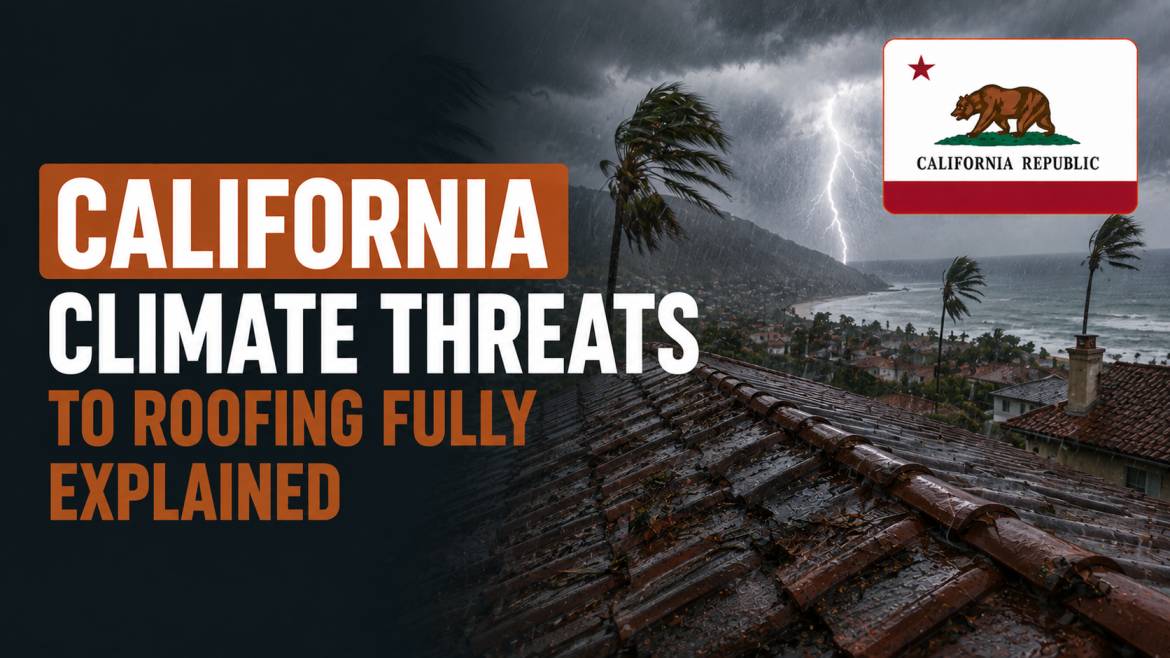
Most states have one dominant roofing threat. California has seven, each operating on its own calendar and concentrating in its own part of the state.
The homeowner in Chico manages ember exposure through fall fire season. The homeowner in San Francisco manages marine layer moisture through the same dry summer months. The homeowner in Stockton faces tule fog from December through February. None of these threats are the same problem with a California label on them.
This hub covers all seven climate drivers, when each peaks, where it concentrates geographically, and what it does to roofing components specifically. Storm and wildfire roof repair across California is available for any weather-related damage covered in this guide.
What Are California's Seven Roofing Climate Threats?
The seven threats split into three distinct timing patterns that help a homeowner plan maintenance and inspection around what their specific location actually faces. The California roof damage guide covers how climate intersects with code and insurance context, and the full services directory covers every repair and replacement option.
Threat | Peak Season | Primary Mechanism | Where It Hits Hardest |
|---|---|---|---|
Wildfire | Late spring through fall | Direct flame, radiant heat, ember exposure | Sierra foothills, Southern California WUI corridors |
Santa Ana winds | September through December | Extreme gusts driving rapid fire spread | Los Angeles and San Diego inland corridors |
Atmospheric rivers | November through March | Sustained heavy rainfall exceeding drainage capacity | Statewide, concentrated in Northern California |
Valley heat | June through September | Thermal cycling and UV degradation | Central Valley and inland desert |
Salt air | Year-round | Electrochemical corrosion of fasteners and metal | Within one mile of the coast, statewide |
Marine layer | May through September | Sustained moisture during the dry season | Coastal strip from San Diego to the Bay Area |
Tule fog | December through February | Persistent low-lying moisture retention | Sacramento Valley and San Joaquin Valley |
In practice: many California properties face more than one threat simultaneously. A home in the Chico foothills faces wildfire exposure in summer plus atmospheric river rainfall in winter. A home in the Long Beach harbor area faces salt air year-round plus marine layer moisture through summer. Climate threat assessment is address-specific, not statewide.
How Does Wildfire Damage California Roofs?
Wildfire roof damage in California operates through three distinct mechanisms, and a roof can suffer damage from any one of them without the fire ever directly reaching the property.
The Three Mechanisms of Wildfire Roof Damage
Ember exposure is the most geographically broad mechanism. Wind-driven embers can travel a mile or more from an active fire front and land on roofs, in gutters filled with debris, and in unscreened attic vents. A single ember landing in a debris-filled gutter can ignite a structure independently of the main fire.
Radiant heat can ignite roof materials even without direct flame contact, particularly when an adjacent structure is burning. The closer a property sits to neighboring structures or to wildland vegetation, the higher the radiant heat exposure.
Direct flame contact occurs when the fire front itself reaches the structure. At this stage, roofing material quality is still a factor, but most unprotected structures cannot survive extended direct contact regardless of material.
The Class A fire rating requirement under the California WUI Code addresses primarily the first two mechanisms. A Class A roof resists ignition from ember exposure and radiant heat, which is why it is required in designated fire hazard zones even when direct fire contact may seem unlikely.
How wildfire damages California roofs covers the full exposure mechanism and California-specific response in detail
CAL FIRE hazard zones and your roof covers how zone designation determines which roofs face the highest wildfire exposure
What Do Santa Ana Winds Do to California Roofs?
Santa Ana winds are a distinct meteorological phenomenon, not simply strong wind. They are dry, hot, fast-moving winds driven by high-pressure systems over the Great Basin, channeled through mountain passes and canyon corridors as they accelerate toward the coast.
What Makes Santa Ana Winds Uniquely Damaging?
Wind speeds regularly reach 60 to 80 mph, with gusts recorded above 100 mph in canyon corridors
Extremely low relative humidity, sometimes below 10%, dries vegetation to highly combustible conditions
Heat reduces the effective viscosity of asphalt shingle seal strips, making shingles more vulnerable to lift
The same conditions that make wildfires more likely also make wind-damaged roofs more exposed to subsequent ember threats
Peak season runs September through December, with the most dangerous conditions typically arriving in October and November. The strongest events concentrate through the Cajon Pass, Santa Ana Canyon, and the major Los Angeles canyon corridors, affecting communities from Pasadena east through the Inland Empire and south through Orange County.
Santa Ana winds and Southern California roofs covers the seasonal pattern, corridor geography, and specific roofing vulnerabilities in detail
Wind damage roof repair in Anaheim sits directly inside the Santa Ana Canyon corridor that gives the wind pattern its name. Emergency roof repair in San Diego serves a region where Santa Ana events are seasonally reliable from October through December.
What Do Atmospheric Rivers Do to California Roofs?
Atmospheric rivers are narrow corridors of moisture-laden air that carry large quantities of water vapor from tropical regions into California. When these systems make landfall, they produce sustained, heavy rainfall over days rather than isolated storm events.
Why Atmospheric Rivers Reveal Existing Roof Problems?
The rainfall intensity and duration of an atmospheric river event exposes vulnerabilities that occasional short rainstorms do not. Minor flashing gaps that drain before damage occurs during a typical rain event can allow sustained water intrusion during a multi-day atmospheric river. Slightly inadequate valley drainage that functions adequately in light rain can be overwhelmed when an atmospheric river delivers several inches over 48 hours.
The November through March window is when the overwhelming majority of California's annual leak-related emergency repair calls occur, concentrated during atmospheric river events rather than distributed across the rainy season.
Emergency leak repair in Sacramento sees peak call volume during atmospheric river events given the city's position in the path of these systems as they move inland from the coast.
Atmospheric rivers and California roof leaks covers how these systems damage roofs and what to inspect after an event
How Does Central Valley Heat Age California Roofs?
The Central Valley operates under a heat profile that standard manufacturer warranty figures, built around national averages, do not adequately capture. Fresno, Bakersfield, Modesto, and Stockton regularly record summer temperatures well above 100 degrees Fahrenheit for extended periods.
The Thermal Cycling Problem
Asphalt shingles expand during heat exposure and contract during cooling. Repeated thermal cycling causes the shingle to fatigue at a rate directly related to temperature range, and California's Central Valley produces some of the most extreme temperature ranges in the country, with summer highs above 105 degrees Fahrenheit followed by overnight lows in the 70s.
That cycling degrades the granule adhesion, causes the asphalt mat to become brittle over time, and accelerates the seal strip breakdown that normally holds courses together. Roofs in the Central Valley regularly show meaningful aging five to seven years sooner than identical products installed in moderate coastal climates.
Heat-related roof repair in Fresno operates within this accelerated aging context, where material condition at year 15 can resemble what a coastal roof shows at year 22.
How Central Valley heat ages California roofs covers the specific degradation mechanism and what to look for on a heat-exposed roof
What Does Salt Air Do to Coastal California Roofs?
Salt air corrosion concentrates within approximately one mile of the coastline, where airborne salt particles deposited by ocean spray accelerate electrochemical corrosion of any exposed metal component. The mechanism is not gradual background weathering; it is accelerated electrochemical degradation that can reduce a standard fastener's service life by decades.
What Salt Air Corrodes Specifically?
Roofing nails and screws, particularly standard galvanized fasteners not rated for coastal exposure
Flashing at all penetrations, valleys, and wall transitions
Gutter hangers, screws, and any other exposed metal connection
Metal roofing panels and their fasteners
Marine-grade fasteners, typically stainless steel or hot-dipped galvanized, are the practical response to coastal exposure. Standard electro-galvanized hardware is insufficient within a mile of the ocean and degrades at rates that make periodic replacement unavoidable without the marine-grade specification.
Coastal roof repair in Long Beach serves one of the state's highest-density coastal markets, where the harbor environment intensifies the standard salt air exposure.
Salt air corrosion on California coastal roofs covers the corrosion mechanism and material specifications for coastal properties
What Do Marine Layer and Tule Fog Do to Roofs?
These two moisture sources damage roofs through sustained low-level dampness rather than through rain or storm events, and they operate on opposite ends of the state's calendar.
Marine Layer: Summer Moisture on a Dry Coast
The marine layer is a low-lying mass of cool, moist ocean air that moves onshore daily from May through September along much of the California coast. It burns off by late morning in most locations but deposits condensation on surfaces throughout the night and early morning hours.
A coastal roof that appears to sit in a dry climate is actually experiencing sustained moisture exposure for a significant portion of the calendar year through marine layer condensation rather than rainfall. This moisture accelerates mold growth in wood components, promotes algae and moss colonization on shingle surfaces, and maintains dampness in debris-filled gutters through the period when those gutters would naturally dry out inland.
Marine layer moisture and coastal roof wear covers the specific damage mechanism and inspection priorities for coastal roofs
Tule Fog: A California-Specific Winter Threat
Tule fog is a radiation fog phenomenon specific to the Central Valley, forming from December through February when overnight temperatures drop significantly following a warm day. Unlike coastal fog, tule fog can be extremely dense, persist through much of the day, and maintain near-saturation humidity at roof level for extended periods.
The saturation humidity keeps roofing surfaces continuously damp, promotes moss and algae growth, and maintains moisture in any wood components that might otherwise dry between episodes. Tule fog is genuinely California-specific, and existing roofing content about it is almost nonexistent despite its consistent seasonal impact.
Winter roof repair in Stockton operates inside the tule fog corridor, where December and January bring some of the densest and most persistent fog events in the state.
Tule fog and Central Valley roof moisture covers the full fog mechanism and its specific roofing consequences
How Do These Threats Stack by Region?
No single California property faces all seven threats at equal intensity. The threats stack differently by location, and knowing which combination applies to a specific address changes the maintenance priority list.
Region | Primary Threats | Secondary Threats |
|---|---|---|
Sierra foothills | Wildfire, Santa Ana proximity, atmospheric rivers | Valley heat at lower elevations |
Coastal Southern California | Salt air, marine layer, Santa Ana winds | Atmospheric rivers |
Central Valley | Valley heat, tule fog, atmospheric rivers | Wildfire at edges near foothills |
Bay Area | Salt air, marine layer, seismic activity | Atmospheric rivers |
Desert inland | Valley heat, UV degradation | Occasional atmospheric rivers |
Wildfire area roof repair in Chico sits in the Sierra foothill threat stack, managing ember exposure through fire season and atmospheric river flooding through winter. Bay Area roof repair in Oakland manages salt air and marine layer as the persistent baseline, with seismic movement adding a structural layer the coastal stack alone does not cover.
Frequently Asked Questions About California Climate and Roofing
What Is the Biggest Climate Threat to California Roofs?
It depends on location. Wildfire and ember exposure are the most severe threat in the Sierra foothills and Southern California WUI corridors. Coastal salt air and marine layer moisture are the persistent baseline threats along the coast. Valley heat is the dominant long-term aging driver in the Central Valley.
Do Atmospheric Rivers Damage California Roofs?
Yes, primarily by revealing existing vulnerabilities rather than causing acute structural damage. Minor flashing gaps, inadequate drainage, and debris-filled gutters that function adequately in ordinary rain can fail under the sustained multi-day rainfall an atmospheric river delivers.
Why Do Coastal California Roofs Degrade During Summer?
Because marine layer moisture deposits condensation on roof surfaces nightly from May through September, even during the dry season. Coastal roofs experience sustained moisture exposure year-round rather than only during the rainy season, which accelerates mold, algae, and moss growth even during months with no measurable rainfall.
What Does Salt Air Do to Roofing Fasteners?
It accelerates electrochemical corrosion that can reduce a standard galvanized fastener's service life by decades. Marine-grade stainless steel or hot-dipped galvanized fasteners are the appropriate specification within approximately one mile of the California coastline.
Does Valley Heat Void Roofing Warranties?
Not automatically, but manufacturer warranty figures are typically built around national average temperature conditions. Central Valley thermal cycling can cause asphalt shingles to age meaningfully faster than the same product installed in a moderate coastal climate, and homeowners should factor in that accelerated timeline when evaluating warranty periods.
What Is Tule Fog and Why Does It Matter for Roofing?
Tule fog is a dense radiation fog specific to California's Central Valley that forms from December through February. It maintains near-saturation humidity at roof level for extended periods, promoting moss and algae growth and keeping wood components damp between episodes.