
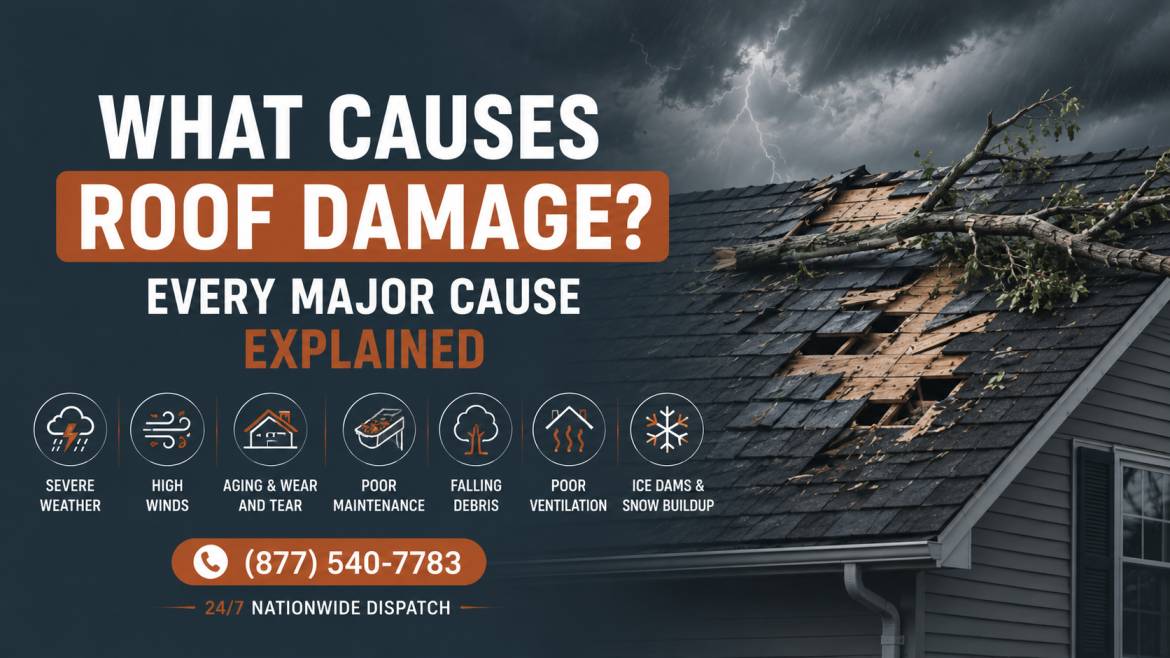
Roof damage traces back to a specific cause, and that cause decides almost everything that happens next. It decides what the damage looks like, how fast it spreads, and whether insurance pays for the repair.
Twelve causes account for nearly all residential roof damage. Seven are weather perils that strike from outside. Five are non-weather factors that develop from within the roof system itself.
Some causes strike in seconds. Others take years to become visible. A hailstorm fractures a shingle mat in an instant, while installation defects can take a decade to surface as a leak.
This guide covers all twelve causes, which ones are weather related, which ones are preventable, and how each one affects an insurance claim. The roof damage guide covers the broader picture this article sits inside.
What Are the Most Common Causes of Roof Damage?
Roof damage has one of twelve recurring causes, and each leaves a different physical signature. Recognizing that signature is covered in the signs of roof damage guide, while this article focuses on the mechanism behind it.
The Insurance Information Institute reports that wind and hail together accounted for roughly 42.5% of homeowners claims filed between 2019 and 2023. NOAA's Storm Prediction Center logged 5,432 hail events nationwide in 2025.
The Twelve Causes at a Glance
Each cause below has its own mechanism, and that mechanism determines what evidence it leaves behind. The table separates weather perils from non-weather factors.
Cause | Category | Primary Mechanism |
|---|---|---|
Hail damage | Weather | Impact fractures the shingle mat and knocks off granules |
Wind damage | Weather | Uplift breaks the seal strip and creases the tab |
Ice dams | Weather | Trapped attic heat melts snow that refreezes at the eave |
Roof snow load | Weather | Accumulated weight exceeds the framing's design capacity |
Water intrusion | Weather | Standing or wind-driven water works past the covering |
Sun and UV exposure | Weather | Ultraviolet radiation dries out asphalt and sealants |
Wildfire embers | Weather | Airborne embers ignite debris trapped on the roof |
Tree and debris damage | Non-weather | Impact and abrasion from limbs and falling branches |
Animal and pest damage | Non-weather | Entry and nesting through vents, soffits and gaps |
Roof wear and aging | Non-weather | Materials lose flexibility as service life expires |
Installation defects | Non-weather | Incorrect fastening or flashing causes early failure |
Foot traffic damage | Non-weather | Concentrated point load fractures brittle coverings |
This table is the reference point for the rest of the article. Each cause gets its own section below, with the mechanism explained in more depth.
That volume of weather activity is also why non-weather factors deserve equal attention. They account for a disproportionate share of denied claims.
In practice: two roofs can show identical missing shingles and still have different causes. The evidence pattern, not the damage itself, is what identifies the true cause.
Roof cost varies significantly by which cause produced the damage, since some causes are isolated and others affect an entire slope. The roof damage cost guide breaks down how cause and cost interact.
Which Causes Are Weather Related?
Seven of the twelve causes originate outside the roof system, triggered by weather events rather than material or workmanship failure. Each one leaves a distinguishing signature that separates it from the others.
The National Weather Service receives roughly 12,000 wind and hail storm reports nationwide in a typical year. That volume is why weather causes dominate both roof repair calls and insurance claims.
How Does Hail Damage a Roof?
Hail damage fractures the shingle mat on impact and knocks loose the protective granule layer. The bruise is frequently invisible from the ground because granules settle back over the fracture point.
Hail at or above one inch in diameter is the general threshold for functional damage to asphalt shingles. Wind changes that threshold, since a hailstone pushed sideways carries more impact energy than one falling straight down.
The signature of hail damage is randomness, which separates it from every other weather peril:
Random impact spacing across every slope, including the north face
Circular dark spots where granules have separated from the mat
Soft spots that give slightly under thumb pressure
Matching dents on gutters, vents and downspouts nearby
According to the Insurance Information Institute, Texas led the nation with 902 major hail events causing significant damage in 2025. That marks the eleventh consecutive year Texas has held the top spot nationally.
Homeowners in high-frequency hail regions increasingly turn to hail damage roof repair for post-storm assessment. That annual volume keeps roof repair crews across Texas busy every spring.
How Does Wind Damage a Roof?
Wind damage works through uplift rather than impact. Pressure differential across the roof plane lifts the shingle edge, breaks the factory seal strip, and folds the tab backward.
The signature of wind damage is direction, which separates it clearly from hail:
Damage concentrated on the windward edge, the rake and the ridge
Rare uniformity across all four roof elevations
Creased tabs that stay folded even after the wind stops
Torn nail holes where the shingle pulled against its fasteners
The August 2020 Midwest derecho produced wind damage across more than 90,000 square miles, according to the National Weather Service Chicago office. That single event caused an estimated $11.5 billion in damage, the costliest thunderstorm event on record.
Illinois sits inside the derecho corridor that produced that event. Straight-line wind events of that scale are why wind damage roof repair sees a sharp spike in demand after any Midwest derecho passes through. That pattern keeps wind-damaged roofs across Illinois in steady repair queues each storm season.
What Is an Ice Dam and How Does It Damage a Roof?
An ice dam forms when heat escaping into the attic melts snow on the upper roof. That meltwater runs down to the cold eave and refreezes into a ridge of ice.
The frozen ridge traps water behind it, and that trapped water backs up under the shingle course. From there it reaches the underlayment and, eventually, the decking.
Heavy icicle formation along the gutter line
Ice filling the gutter trough instead of water draining through
Interior staining concentrated along exterior walls
Damp insulation in the eave bays of the attic
Ice dam risk concentrates in the Northeast and Upper Midwest, where sustained cold holds a frozen eave for weeks. Ice dam removal using steam-based methods clears the buildup without damaging the shingles beneath it.
In practice: roof repair coverage across New York sees this pattern repeat every winter across the state's snowbelt regions, where sustained cold holds the eave below freezing.
What Is Roof Snow Load and When Does It Become Dangerous?
Roof snow load is the downward force that accumulated snow and ice place on the framing. Most residential roofs can support roughly 20 pounds per square foot before becoming stressed, according to the Insurance Institute for Business and Home Safety.
Snow weight varies enormously by type. Ten to twelve inches of fresh snow weighs about 5 pounds per square foot, while the same depth of packed old snow weighs considerably more.
Snow Condition | Approximate Weight |
|---|---|
Fresh, dry snow | About 5 lbs per sq ft per 10 to 12 inches |
Packed, older snow | About 5 lbs per sq ft per 3 to 5 inches |
Ice, one inch | Equivalent to about one foot of fresh snow |
Drifting concentrates load unevenly against dormers, valleys and roof-to-wall junctions. Those areas carry the least structural reserve, which is exactly where overload failures begin.
How Does Water Cause Roof Damage?
Water intrusion damages a roof when moisture stops moving and begins to sit or seep. Standing water works through seams and fasteners given enough time, even on a roof with no visible defect.
Wind-driven rain adds a second pathway. Sustained horizontal rain during a nor'easter or coastal storm forces water past flashing that would otherwise shed a vertical downpour.
Rings of sediment marking where standing water evaporated
Blistered or wrinkled membrane within the affected area
Decking that feels soft underfoot beneath a low spot
Persistent damp in the same spot after several dry days
The Insurance Institute for Business and Home Safety has found that a sealed roof deck can reduce water intrusion by up to 95%. That figure applies specifically to cases where the covering itself has already blown off.
New Jersey's 130-mile Atlantic coastline, tracked by the state's Department of Environmental Protection, sits directly in the path of nor'easters that deliver sustained wind-driven rain. Roof repair along the New Jersey coast routinely finds water intrusion at flashing points long before any shingle goes missing.
How Does Sun and UV Exposure Damage a Roof?
Sun and UV exposure breaks down the volatile oils that keep asphalt flexible. The material dries, shrinks, and gradually loses its ability to move with normal thermal cycling.
This cause is cumulative and unavoidable, working fastest on south and west-facing slopes. It is the underlying mechanism behind most end-of-life shingle failure.
A chalky, faded surface where granule color has washed out
Brittle edges that snap instead of bending when lifted
Thermal cracking that runs across the tab rather than along it
Hardened, split sealant at penetrations and flashing points
Poor attic ventilation accelerates this process by trapping heat against the underside of the deck. That combination bakes the covering from below at the same time sunlight bakes it from above.
How Do Wildfire Embers Damage a Roof?
Wildfire embers rarely ignite a roof through direct flame contact. They land in debris that has collected in valleys, gutters and behind chimneys, then smolder before igniting.
California's Office of the State Fire Marshal reports that 60% to 90% of wildfire home ignitions come from embers, not direct flame contact. Embers can travel more than a mile ahead of the actual fire front.
Roof debris in valleys and gutters ignites first, well before the flame front arrives
Unscreened or damaged attic vents admit embers directly into the attic
Gaps at the ridge and eave let embers reach insulation and stored material
Ember showers during wind events can expose even well-spaced homes
Wildfire-area roof repair in California deals with this risk every fire season in wildland-urban interface zones. Ember-resistant vents and debris-free roof valleys are the two most effective interventions.
Weather Peril Signatures at a Glance
Each weather cause leaves a distinguishing pattern, and that pattern is often the fastest way to identify what actually happened. The table below summarizes the diagnostic signature for each.
Weather Peril | Distinguishing Signature | Typical Season |
|---|---|---|
Hail | Random circular spots on every slope | Spring and early summer |
Wind | Directional damage on edges and ridges | Year-round, peaks in spring |
Ice dams | Ice ridge at the eave, interior staining | Winter |
Snow load | Deflection, sagging, interior cracking | Winter |
Water intrusion | Ponding, blistering, soft decking | Year-round |
Sun and UV | Uniform fading and brittleness | Summer, cumulative |
Wildfire embers | Scorched debris in valleys and gutters | Fire season, regional |
Which Non-Weather Factors Cause Roof Damage?
Five causes originate from within the roof system or from ordinary use rather than from a storm. These causes account for a large share of roof failures and a much smaller share of paid insurance claims.
Standard homeowners policies exclude damage from wear, neglect and workmanship error. That exclusion is why non-weather causes deserve as much attention as weather perils.
How Do Trees and Falling Debris Damage a Roof?
Tree and debris damage happens two distinct ways. A falling limb causes sudden impact damage, while an overhanging branch causes slow abrasion every time wind moves it across the surface.
Impact damage from a falling limb is usually treated as a sudden, covered event. Abrasion damage from a branch that has rubbed against the covering for years reads as gradual wear instead.
Falling limbs that puncture the covering and can reach the decking
Overhanging branches that scrape granules loose in visible tracks
Leaf litter that dams valleys and gutters, trapping moisture
Shade that encourages moss and algae growth over time
A large limb resting on a roof after a storm needs tree removal from roof before any repair work can safely begin. The removal itself often reveals the full extent of the impact damage underneath.
How Do Animals and Pests Damage a Roof?
Animal and pest damage happens when wildlife creates or widens an opening to reach the attic. Squirrels, raccoons, birds and bats all target the same weak points.
This cause is almost universally excluded from homeowners insurance, alongside insect and vermin damage generally. The exclusion holds even when the resulting opening later admits storm water.
Chewed or torn screens at gable and roof vents
Insulation scattered or matted in the attic
Staining and gaps around soffit joints and fascia ends
Audible movement overhead, typically at dawn or dusk
Any of these signs, alone or combined, usually confirms an active entry point rather than a one-time visitor.
How Does Roof Wear and Aging Cause Damage?
Roof wear and aging is not damage in the insurance sense. It is the normal expiration of a covering's rated service life, and every material has one.
The National Roofing Contractors Association and the Asphalt Roofing Manufacturers Association publish planning ranges for each product:
Three-tab shingles: 15 to 20 years
Architectural shingles: 25 to 30 years
Both ranges assume normal ventilation and maintenance
The distinguishing pattern is uniformity. Aging spreads evenly across every slope, unlike storm damage, which concentrates in specific spots or on specific edges.
In practice: uniform granule loss across all four elevations is the single most common basis for a denied claim. Adjusters read that pattern as age rather than as any single storm event.
What Are Roof Installation Defects and How Do They Cause Damage?
Installation defects cause damage that looks like a storm event but traces back to the original build. The defect exists from day one, and the symptom often appears years later.
A study cited by the National Roofing Contractors Association points to workmanship as the leading cause. Poor workmanship, bad design and construction damage account for over 60% of roof leaks and premature failures.
Defect | What Goes Wrong |
|---|---|
Nailing outside the zone | Fasteners placed above or below the manufacturer's strip |
Missing starter course | No sealed edge at the eave, leaving the first course exposed |
Improper flashing lap | Metal sealed with caulk instead of layered into the water path |
Reused flashing | Old flashing kept during a re-roof to save cost |
Manufacturer warranties typically exclude installation error, and homeowners policies exclude faulty workmanship entirely. That leaves the installing contractor as the only source of recourse.
How Does Foot Traffic Damage a Roof?
Foot traffic damage happens through concentrated point loading on a surface built for distributed load. It is caused by the people servicing the roof rather than by weather.
Tile and slate crack most readily underfoot, since both are brittle materials with little give. Asphalt shingles lose granules in visible scuffed tracks where someone has walked repeatedly.
Satellite installers stepping between rafters on brittle tile
HVAC technicians servicing rooftop units on aging asphalt
Chimney sweeps accessing the flue across multiple slopes
Solar installers walking the field during panel maintenance
That pattern is why drone inspection has become the preferred access method on brittle roof coverings.
Non-Weather Causes at a Glance
Non-weather causes share one trait that separates them from weather perils: most fall outside standard coverage. The table below summarizes the mechanism and the coverage note for each.
Cause | Mechanism | Insurance Note |
|---|---|---|
Trees and debris | Impact or abrasion from limbs and branches | Impact often covered; abrasion usually is not |
Animals and pests | Entry and nesting through gaps and vents | Almost always excluded |
Wear and aging | Materials expire at the end of service life | Excluded as wear and tear |
Installation defects | Fastening or flashing errors from the original build | Excluded as faulty workmanship |
Foot traffic | Point load on a surface built for distributed load | Excluded unless tied to a covered repair visit |
Every row above corresponds to a full breakdown further down this page, each linked to its own dedicated article.
Which Causes Are Preventable?
Prevention potential varies enormously across the twelve causes. Some can be reduced through routine maintenance, while others are entirely outside a homeowner's control.
Weather perils sit at one end of that spectrum. Hail and wind cannot be prevented, though their consequences can be reduced through material choice and reinforced installation.
What Can Actually Be Prevented?
Three of the twelve causes respond directly to homeowner action. The rest respond only to material selection, structural reinforcement, or cannot be meaningfully reduced at all.
Trimming trees near the roofline removes most impact and abrasion risk
Sealing vent openings and soffit gaps blocks most animal entry points
Balanced attic ventilation slows sun and UV degradation measurably
Routine maintenance catches early wear before it becomes a leak
The roof damage prevention guide covers each of these levers in full detail, including attic ventilation ratios and drainage design.
Cause-by-Cause Prevention and Insurance Matrix
This matrix brings both questions together in one place. It shows which causes respond to prevention and how each one is typically treated by a standard homeowners policy.
Cause | Preventable? | Typical Insurance Treatment |
|---|---|---|
Hail damage | No | Covered peril |
Wind damage | No | Covered peril |
Ice dams | Partially, via insulation and ventilation | Often covered if sudden; disputed if recurring |
Snow load | No | Covered peril, structural damage |
Water intrusion | Partially, via sealed deck and drainage | Depends on cause of entry |
Sun and UV exposure | Partially, via ventilation | Excluded as wear and tear |
Wildfire embers | Partially, via vent screens and clearance | Covered peril where fire coverage applies |
Tree and debris | Yes, via trimming and clearance | Impact covered; abrasion excluded |
Animal and pest | Yes, via sealing entry points | Almost always excluded |
Wear and aging | No, only delayed | Excluded as wear and tear |
Installation defects | Yes, via qualified contractor selection | Excluded as faulty workmanship |
Foot traffic | Yes, via limiting roof access | Excluded generally |
In practice: the causes marked partially preventable are where maintenance dollars produce the clearest return. Fully preventable causes reward one-time decisions, while unpreventable causes reward reinforced materials instead.
How Do Causes Affect an Insurance Claim?
Identifying the correct cause is the single factor that decides most insurance claim outcomes. The roof damage insurance guide covers coverage rules and deductibles in full; this section focuses on how cause identification changes the outcome.
The ISO HO-3 form, the most widely used homeowners policy in the United States, covers the dwelling on an open-perils basis. It excludes wear, tear and gradual deterioration under its standard exclusions.
Why Does Cause Identification Matter So Much?
Insurers pay for sudden, accidental perils and decline gradual deterioration. That single distinction, more than any other policy detail, determines whether a claim succeeds.
A roof inspection performed soon after a suspected event produces the documentation an adjuster needs to attribute damage correctly. Waiting weeks makes that attribution harder to establish.
Photographs dated to the suspected event, not weeks later
Slope-by-slope notes that separate storm evidence from aging evidence
A stated cause on the claim form, not just a description of the symptom
Prior inspection records that establish the roof's condition beforehand
Matching the fix to the cause, rather than just to the visible symptom, is covered in the roof damage repair guide.
What Happens When the Cause Is Disputed?
Cause disputes are the most common basis for a denied or reduced roof claim. The adjuster and the homeowner frequently disagree on which cause actually produced the damage.
Wear and tear is the exclusion insurers cite most often:
Uniform deterioration across every slope reads as age, not storm impact
A missing storm date on the claim file weakens the sudden-cause argument
No prior inspection record makes the pre-existing condition harder to rule out
Insurance claim help typically centers on building the documentation case for the correct cause. That includes photo evidence, contractor assessment and, where needed, a second inspection.
Do Multiple Causes Ever Combine?
Yes, and combined causes complicate a claim more than any single cause does. A roof already weakened by sun and UV exposure fails faster in a wind event than a newer roof would.
Anti-concurrent causation language in many policies addresses this directly. Where an excluded cause and a covered cause combine to produce a loss, some forms deny the claim entirely rather than dividing it.
Frequently Asked Questions About the Causes of Roof Damage
What Is the Most Common Cause of Roof Damage?
Wind and hail together are the most common causes. The Insurance Information Institute puts their combined share at roughly 42.5% of homeowners claims between 2019 and 2023. Roof wear and aging is the most common non-weather cause, since every roof reaches the end of its service life eventually.
What Causes a Roof to Fail Early?
Installation defects are the leading cause of early roof failure. A study referenced by the National Roofing Contractors Association reached a similar figure. More than 60% of leaks and premature failures traced to poor workmanship, bad design or construction damage.
Can More Than One Cause Damage a Roof at the Same Time?
Yes, and this is common rather than rare. A roof degraded by sun and UV exposure has less reserve capacity. A wind event that a newer roof would survive can strip shingles from an aged one.
Does Every Cause Eventually Show Up as a Leak?
No. Foot traffic damage and installation defects can both exist for years without producing a visible leak, since the underlayment provides a temporary secondary barrier. A leak means that secondary barrier has also failed.
How Do You Know Which Cause Is Responsible for the Damage?
The evidence pattern usually identifies the cause. Random circular marks point to hail. Directional edge damage points to wind, and uniform deterioration across every slope points to age.
Are Some Causes Covered by Insurance and Others Not?
Yes, and the distinction is sudden versus gradual. Hail, wind and snow load are generally covered as sudden perils, while wear, pest damage and installation defects are generally excluded as gradual or workmanship-related.
Which Cause of Roof Damage Is Easiest to Prevent?
Animal and pest entry is the easiest cause to prevent, since sealing vent screens and soffit gaps blocks most entry points directly. Weather perils such as hail and wind cannot be prevented at all, only mitigated.
Does Roof Age Make Every Cause Worse?
Yes, for most causes. An aged roof has less flexibility and weaker seals. Hail, wind and water intrusion all produce more damage on an old roof than on a new one.