
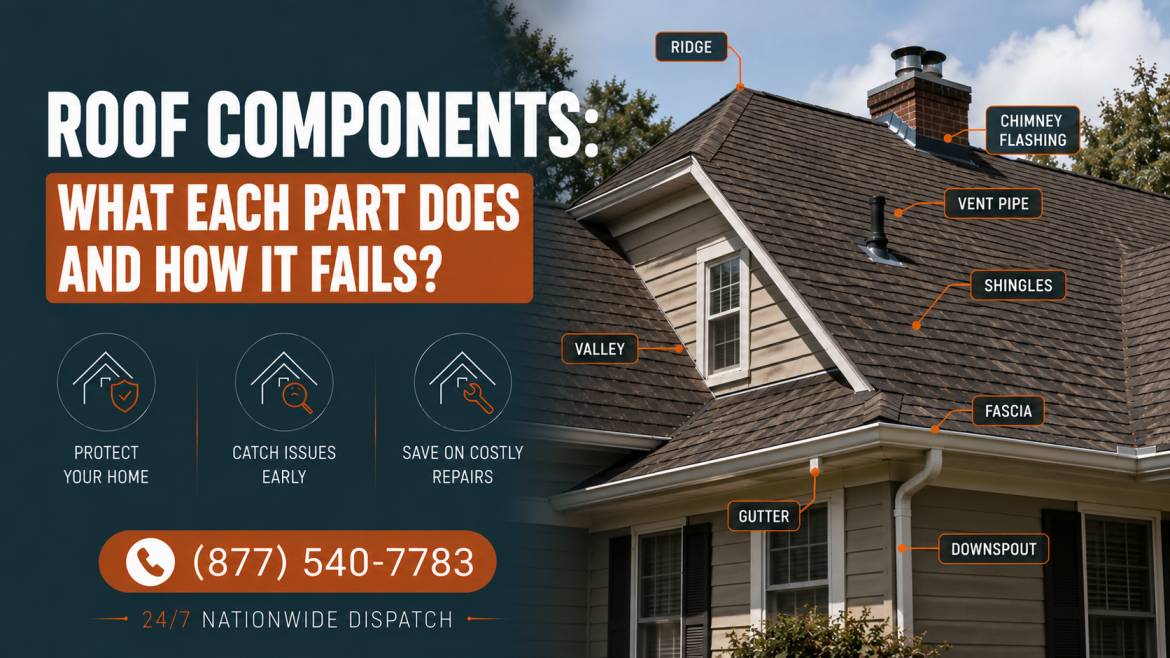
Ask a homeowner what causes a roof leak and most will point straight at the shingles. That instinct is understandable and, in most cases, wrong. Shingles are the part everyone sees, which makes them an easy target for blame, but they are rarely where water actually gets in.
A roof is not a single surface. It is a system of eleven distinct components, each with its own job, its own failure mode, and its own likelihood of being the actual source when something goes wrong. Understanding that system changes how a homeowner reads a leak, judges a repair estimate, and decides what genuinely needs attention.
This guide covers what each component does, ranks them by how often they actually fail, and explains how they depend on each other to keep a home dry. It is one of twelve building blocks that make up the broader roof damage overview, and for repair on any specific component, the services directory covers the available options.
What Are the Parts of a Roof?
A roof's eleven components fall into three functional groups: the water-shedding layers that form the primary weather barrier, the transitions and penetrations where the roof plane is interrupted, and the drainage and edge components that move water safely away once it leaves the covering.
The Full Component Inventory
Each component below gets its own detailed section further down this page, but this table serves as the reference point for the whole system.
Component | Group | Primary Function |
|---|---|---|
Roof shingles | Water-shedding | The primary weather surface, shedding water by overlap |
Roof underlayment | Water-shedding | Secondary water barrier beneath the covering |
Roof decking | Water-shedding | Structural base that carries the covering and fasteners |
Roof flashing | Transitions | Seals joints where the roof meets walls, chimneys, vents |
Chimney junction | Transitions | Multiple flashing components at a masonry penetration |
Skylights | Transitions | Glazed penetration requiring permanent flashing detail |
Ridge caps | Transitions | Covers the peak, the highest wind-exposure point |
Roof valleys | Transitions | Channels combined runoff from two converging planes |
Gutters and downspouts | Drainage | Collects and carries runoff away from the structure |
Roof vents | Drainage and edges | Exhausts attic heat and moisture |
Soffit and fascia | Drainage and edges | Closes the eave and supports the gutter system |
In practice: most homeowners can name shingles, gutters, and maybe flashing without prompting. The other eight components rarely get mentioned until something has already gone wrong, which is exactly why leak diagnosis so often starts in the wrong place.
Which Component Fails Most Often?
This is the single most useful question this guide answers, and the data points in a clear, consistent direction across roofing industry sources. Flashing, not the shingle field, is where most roofs actually fail.
The Flashing Dominance
Figures cited by the National Roofing Contractors Association and echoed across roofing industry sources place flashing as the source of somewhere between roughly 80% and 95% of all residential roof leaks. The exact percentage varies by source, but every credible figure puts flashing well ahead of every other single component.
That dominance has a straightforward explanation. Flashing sits at every point where the roof's continuous, redundant covering gets interrupted, and each interruption is a place the system's built-in overlap and shedding design has to be recreated by hand rather than simply continuing.
Flashing sealant typically fails five to ten years before the surrounding shingles wear out
Metal flashing expands and contracts with every thermal cycle, gradually loosening fasteners and sealant
A joint sealed with caulk instead of properly layered metal fails within a few seasons
Multiple flashing failures on the same roof often point to an original installation-quality problem
A Rough Failure Frequency Ranking
While exact figures vary by study and region, the general pattern of which components fail first is consistent enough across sources to present as a practical ranking.
Rank | Component | Why It Ranks Here |
|---|---|---|
1 | Flashing and transitions | Highest documented leak source by a wide margin |
2 | Roof valleys | Highest water volume of any single location |
3 | Roof vents and penetrations | Rubber seals degrade faster than surrounding materials |
4 | Gutters and drainage | Mechanical and debris-related failure, not weather-sealing |
5 | Shingles in the open field | Lowest failure rate of any component under normal conditions |
Water intrusion covers the broader mechanics of how water defeats a roof once it finds a weak point, and that mechanics section pairs directly with this ranking, since flashing failure is the single most common starting point for the water intrusion cases covered there.
How Do the Water-Shedding Layers Work Together?
Three components form the primary weather barrier, stacked in a specific order where each layer exists to catch what the one above it might miss.
Roof Shingles
Roof shingles are the visible, primary weather surface, shedding water through overlap rather than through a continuous seal. Each course covers the fastener line of the course below it, which is why correct alignment and exposure matter as much as the material itself.
Shingles fail through three distinct mechanisms: seal strip failure, where the factory adhesive bond releases; mat fracture, typically from impact; and granule loss, which exposes the underlying asphalt to accelerated aging. Wind damage is the peril most directly tied to seal strip failure specifically, since wind uplift is what tests that bond most severely. Isolated failures here are typically addressed through targeted shingle repair rather than a full covering replacement.
Roof Underlayment
Roof underlayment is the secondary water barrier installed directly on the deck, existing specifically to catch water that gets past the shingles and redirect it back toward the drainage path rather than letting it reach the deck directly.
In cold climates, code frequently requires an upgraded ice barrier membrane at the eaves and valleys, a self-sealing product that closes around fasteners and specifically resists the backed-up water an ice dam creates. That requirement traces directly back to ice dams, which force water uphill in a way ordinary underlayment was never designed to resist.
Roof Decking
Roof decking is the structural sheathing, typically plywood or OSB, that carries the covering above it and provides the substrate every fastener drives into. Everything above the decking depends on it holding a nail securely.
Decking fails through rot from prolonged saturation and through delamination, where plywood plies separate under sustained moisture exposure. Neither condition is visible from above, which is why decking damage is discovered almost exclusively at tear-off rather than through any earlier inspection.
Which Components Handle Transitions and Penetrations?
Five components exist specifically to manage the points where the roof's continuous surface gets interrupted, and these five collectively account for the overwhelming majority of documented leaks.
Roof Flashing
Roof flashing is the metal or rubber material that seals every joint, penetration, and transition on the roof, working through overlap and gravity in the same way shingles do rather than depending on adhesive alone.
Flashing Type | Where It Is Used |
|---|---|
Step flashing | Along the sides of a chimney or wall intersection |
Counterflashing | Set into a mortar joint, overlapping step flashing |
Kick-out flashing | Diverts water at a roof-to-wall edge above a gutter |
Valley flashing | Lines the channel where two roof planes converge |
Apron and headwall flashing | Seals the uphill side of a wall or chimney intersection |
The International Residential Code specifically requires kick-out flashing, minimum four inches by four inches, at every roof-to-wall intersection above a gutter. Its absence is one of the most common missing details found on older homes, and it is the leading cause of directional leaks during wind-driven rain specifically.
Chimney Junction
The chimney junction requires more flashing components working together than almost any other single point on a roof, since a masonry chimney moves independently of the wood-framed structure around it through seasonal temperature cycling.
A chimney wider than about 30 inches requires a cricket, a small saddle built on the upslope side that splits water around the masonry rather than letting it pool against the uphill face. Its absence is a frequent finding on older roofs and a common source of persistent, hard-to-diagnose leaks, which is why chimney flashing repair ranks among the more frequently requested services tied to this specific junction.
Skylights
Skylights create a permanent glazed penetration through the roof plane, which makes the surrounding flashing detail a managed, ongoing risk rather than a one-time installation concern.
Skylight leak causes split into several categories: perimeter seal degradation, curb flashing separating from the deck, condensation mistaken for an active leak, and units installed without the manufacturer's specific flashing kit. Condensation and genuine leaks are frequently confused, since both produce moisture at the same general location, which makes an accurate diagnosis worthwhile before scheduling skylight leak repair.
Ridge Caps
Ridge caps cover the peak where two roof slopes meet, and on a vented ridge, they also house the exhaust opening. That position places them at the highest sustained wind exposure anywhere on the roof.
Ridge cap failure appears as lifted or cracked caps, exposed fasteners, and a ridge vent that has separated from the deck. Caps cut from ordinary three-tab shingles, rather than purpose-made hip and ridge products, crack considerably sooner, a common cost-cutting substitution with a visible long-term consequence.
Roof Valleys
Roof valleys channel the combined runoff from two converging roof planes into a single concentrated stream, which makes them the highest-volume drainage path on any pitched roof.
Valley Type | Construction |
|---|---|
Open valley | Metal channel left exposed, sheds debris readily |
Closed valley | Woven with shingles, cleaner appearance but traps debris more easily |
That volume is exactly why valleys rank second in the failure frequency table above. Tree and debris damage contributes indirectly here, since leaf litter collecting in a valley dams water in precisely the location least able to tolerate standing water.
Which Components Handle Drainage and Edges?
Three remaining components move water off the roof entirely and manage the roof's edge condition, and their failures tend to show up somewhere other than where the actual problem started.
Gutters and Downspouts
Gutters and downspouts collect roof runoff and carry it away from the foundation, and while they are not technically part of the roof's waterproofing system, their failure directly threatens the components that are.
Gutter failure follows a predictable sequence: debris accumulates, water backs up over the rear edge, the fascia behind the gutter absorbs that water and begins to rot, and the fastening eventually pulls away under the combined weight of trapped water and debris. Animal and pest damage frequently compounds this cycle, since clogged, overflowing gutters create exactly the damp, sheltered conditions wildlife favor for nesting. Catching this sequence early, through gutter repair, is considerably cheaper than the fascia work that follows once it is deferred.
Roof Vents
Roof vents exhaust the heat and moisture that accumulate in the attic, and their correct function depends on a balanced system rather than any single vent working in isolation.
The International Residential Code requires at least one square foot of net free ventilating area per 150 square feet of attic floor area, a ratio that relaxes to 1:300 when at least half the ventilation sits high with balanced intake below. Roof vent failure includes damaged screens, wind-driven rain entering through unrated vents, and mismatched exhaust types that short-circuit airflow between themselves.
Soffit and Fascia
Soffit and fascia close the eave and provide the physical support gutters attach to, with the soffit specifically supplying the low intake air the attic ventilation system depends on.
Rot at the fascia is frequently a drainage symptom rather than an independent problem, tracing back to gutter overflow rather than any defect in the fascia board itself. Roof wear and aging accelerates soffit and fascia deterioration considerably faster wherever gutter drainage has already been compromised for an extended period.
How Do Components Work Together as a System?
No single component failure happens in true isolation. Each one exists inside a chain where a failure upstream changes the load on everything downstream from it.
A Practical Example of the Chain Reaction
A blocked gutter illustrates this dependency clearly. It backs up water against the fascia, which rots and eventually loosens its grip on the gutter fasteners; the compromised fascia and reduced soffit intake then degrade attic ventilation, which accelerates shingle aging from below at the same time UV exposure ages it from above.
That kind of cascading failure is why signs of roof damage so often present at a location well removed from the component that actually started the chain. A ceiling stain near an interior wall frequently traces back to a flashing failure at a chimney several feet away, not to a defect directly overhead.
Why Diagnosis Should Start with Flashing, Not Shingles
Given how heavily flashing dominates the failure statistics covered earlier, an emergency roof inspection that starts by checking every transition and penetration before broadly assessing the shingle field finds the actual problem faster than one that inspects in the reverse order. The roof inspection guide covers this diagnostic sequence in more depth.
Once a specific component's failure is confirmed, the appropriate fix depends on which one is involved, and the roof damage repair guide covers how repair scope gets decided once that diagnosis is complete. Cost follows the same logic, and the roof damage cost guide breaks down how component-specific repairs differ in price from a full covering replacement.
Which States See Component-Specific Roof Failures Most Often?
Certain components fail more consistently in specific regions, driven by climate factors that stress one part of the system more than others.
New Jersey, where flashing failure is consistently cited as the leading cause of residential roof leaks
Illinois, where sustained freeze-thaw cycling accelerates flashing sealant breakdown considerably
Georgia, with intense summer thunderstorm activity that stresses gutter and drainage capacity
Washington, facing the highest sustained rainfall volume of any state in this group
Minnesota, where code-required ice barrier underlayment reflects genuinely elevated cold-climate risk
Texas, with sustained wind exposure that concentrates stress at ridge caps and edge flashing
Florida, where heat and humidity place unusual demand on attic ventilation components specifically
Roof flashing repair across New Jersey addresses what regional roofing professionals consistently identify as the leading cause of leaks statewide, tied to coastal humidity and sustained thermal cycling. Flashing and leak repair covering Illinois deals with a related mechanism, where the Chicago area's roughly 80 to 120 annual freeze-thaw cycles drive moisture into micro-cracks faster than milder climates experience.
Gutter repair services across Georgia sees elevated demand tied directly to the state's intense summer thunderstorm pattern, which regularly overwhelms undersized or clogged drainage systems. Roof drainage services across Washington faces a comparable challenge driven by sustained volume rather than storm intensity, given the state's consistently high annual rainfall.
Underlayment and ice barrier services in Minnesota reflects the state's genuinely elevated cold-climate risk, where code requirements for ice barrier membrane exist specifically because of conditions Minnesota experiences more severely than most of the country. Ridge cap and wind damage repair across Texas addresses the state's sustained wind exposure, concentrated at exactly the high-pressure zones ridge caps and edge flashing occupy. Ventilation and roof services across Florida rounds out the group, where heat and humidity place sustained demand on attic ventilation components beyond what most other climates require.
Frequently Asked Questions About Roof Components
What Are the Parts of a Roof Called?
A roof consists of eleven main components: shingles, underlayment, decking, flashing, the chimney junction, skylights, ridge caps, valleys, gutters and downspouts, vents, and soffit and fascia. Each handles a distinct function within the overall system.
Which Roof Component Fails Most Often?
Flashing fails more often than any other single component, with industry figures placing it as the source of roughly 80% to 95% of all residential roof leaks. This is considerably more common than failures in the shingle field itself.
Why Do Most Roof Leaks Happen at Flashing Rather Than at Shingles?
Flashing sits at every point where the roof's continuous covering is interrupted, and it depends on correctly layered metal and fresh sealant rather than the shingle system's built-in overlap. Flashing sealant also typically fails five to ten years before the surrounding shingles reach the end of their service life.
Can One Component's Failure Cause Damage to a Different Component?
Yes, this is common rather than exceptional. A clogged gutter can rot the fascia behind it, which compromises soffit ventilation, which in turn accelerates shingle aging from below. Components rarely fail in true isolation from the rest of the system.
Which Component Should Be Checked First During a Roof Inspection?
Given how heavily flashing dominates documented leak sources, checking every transition and penetration, including chimneys, skylights, valleys, and wall intersections, before broadly assessing the shingle field tends to identify the actual problem faster.
Do All Roof Components Have the Same Expected Lifespan?
No. Flashing sealant and gutters typically need attention well before the shingles themselves reach the end of their service life, while decking and structural components, when kept dry, can outlast several generations of covering replacement above them.