
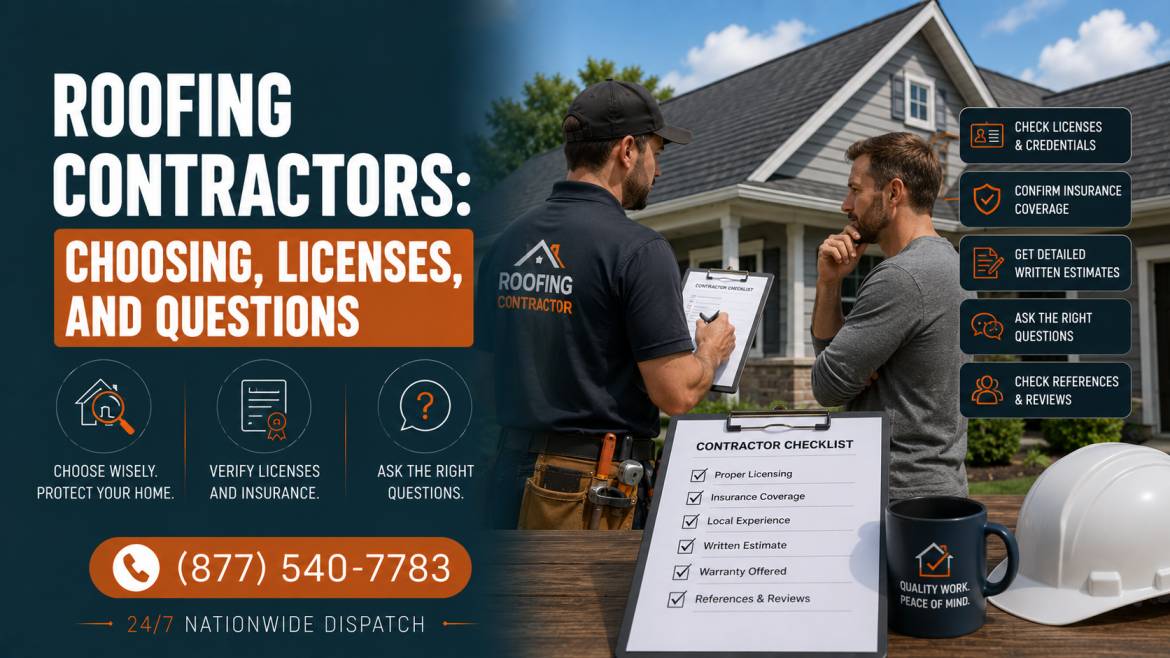
Storm damage brings out two very different kinds of roofing contractor. One is the licensed, insured business that has served the local area for years and will still be reachable if a warranty claim comes up five years from now. The other arrives within days of the storm, offers a deal too good to walk away from, and is gone before the first hard rain tests the work.
Telling the two apart matters more after damage than at almost any other time a homeowner hires a contractor, since storm conditions create exactly the urgency that makes rushed, poorly vetted decisions common. The wrong choice does not just risk a bad roof. In several states, it can expose the homeowner to legal and financial consequences that outlast the storm itself.
This guide covers how to evaluate a contractor, the specific fraud patterns tied to insurance claims, what credentials actually matter, and what a fair contract and warranty should include. The roof damage repair guide and roof damage insurance guide cover the two processes that immediately follow once a contractor is selected.
How Do You Evaluate a Roofing Contractor?
A structured evaluation, rather than a gut reaction to a persuasive sales pitch, is what actually separates a reliable hire from a costly mistake. Five factors cover most of what genuinely predicts whether a contractor will deliver.
The Core Evaluation Framework
Factor | What to Verify |
|---|---|
Licensing | Active status with the issuing state or municipal authority |
Insurance | General liability and workers compensation, confirmed directly with the carrier |
Local presence | A verifiable physical address, not a P.O. box or out-of-state registration |
References | Work completed at least two years ago, tested by at least one full season of weather |
Written scope | Materials, quantities, exclusions and payment terms specified in writing |
In practice: a company that will still be reachable in five years is what a workmanship warranty actually depends on. That single consideration eliminates most of the higher-risk options a homeowner encounters immediately after a storm.
What Should You Verify First?
How to find a good roofer starts with verification before any conversation about price or timeline, since a contractor unwilling to provide basic documentation has already answered the more important question.
The Verification Sequence
Confirm the business has a physical address in the service area, independently verifiable
Request proof of insurance sent directly from the carrier, not a photocopy handed over on-site
Check licensing status against the state or municipal issuing authority's own records
Contact at least two references for work completed a full season or more ago
Compare at least two to three written quotes before making a final decision
Recognizing Red Flags Early
Roofer red flags tend to cluster around pressure and vagueness, two traits that show up early enough in a conversation to save considerable trouble later.
Pressure to sign the same day, often paired with a "storm discount" that expires immediately
Reluctance to provide licensing or insurance documentation when asked directly
Vague verbal estimates with no accompanying written scope
An unsolicited visit claiming the crew was "already in the neighborhood" after a storm
Requests for a large upfront deposit before any material has been ordered
Roof sagging and other structural findings are sometimes exaggerated by less scrupulous contractors specifically to justify a larger scope than the roof actually needs, which is one more reason a second opinion is worth the time when a recommendation feels disproportionate to what was actually observed.
What Are the Warning Signs of Roofing Fraud?
Post-storm fraud follows recognizable, well-documented patterns, and several of the most common tactics carry specific legal consequences that most homeowners never learn about until they are already involved.
What Is a Storm Chaser?
A storm chaser is a roofing crew that travels specifically to follow severe weather events, often arriving within days of a storm and operating with no genuine local presence or long-term accountability. Storm chaser roofers frequently disappear once payment clears, leaving substandard work with no practical recourse for the homeowner.
The Deductible Waiver Trap
Offering to waive, absorb, or rebate a homeowner's insurance deductible is one of the most common tactics used to close a deal quickly, and it is illegal in a minimum of 28 states, independent of general insurance fraud statutes that may also apply.
State | Legal Status |
|---|---|
Texas | Illegal since September 2019, penalties up to 180 days jail and a $2,000 fine |
Colorado | Illegal under Senate Bill 38, the Consumer Protection/Residential Roofing Bill |
Oklahoma | Illegal under state insurance fraud statutes |
Kentucky | Illegal under state insurance fraud statutes |
Is deductible waiving legal is a question with a consistent answer across every state that has addressed it directly: no. A contractor offering to cover the deductible typically recovers that cost by inflating the invoice sent to the insurance carrier, which constitutes insurance fraud that can expose the homeowner to liability alongside the contractor.
Assignment of Benefits Risks
An Assignment of Benefits agreement transfers a homeowner's insurance claim rights to the contractor, allowing that contractor to file the claim, negotiate directly with the carrier, and collect payment without the homeowner's involvement.
In practice: signing an AOB removes the homeowner from their own claims process entirely. The contractor can pursue a higher payout than the insurer offers and sue the carrier in the homeowner's name, while the homeowner loses standing to mediate the dispute directly. Florida addressed this specifically through Senate Bill 2-A, which banned AOB agreements for property insurance policies issued after January 1, 2023, following years of documented abuse in that market. Storm damage repair arranged through a reputable, locally accountable contractor never requires an AOB as a condition of service.
What Legal Protections Exist
Beyond deductible and AOB-specific statutes, most states provide a rescission window allowing a homeowner to cancel a signed contract within a set period, commonly 72 hours, without penalty. Insurance claim help becomes particularly relevant once a fraudulent arrangement is already in motion, since untangling an AOB or a deductible fraud scheme after the fact is considerably harder than avoiding it in the first place.
What Credentials Matter?
Licensing and insurance requirements vary considerably by state, and understanding that variance prevents homeowners from either over-trusting an unlicensed contractor or unnecessarily distrusting one operating correctly under a lighter local regime.
Do Roofers Need a License?
Roofing contractor license requirements differ meaningfully across the country. Some states license roofing contractors directly and specifically, some regulate the trade under a broader general contractor license, and some leave licensing entirely to municipal authorities rather than the state.
Licensing Model | Example Approach |
|---|---|
Dedicated state roofing license | State-specific exam and registration required |
General contractor license covering roofing | Roofing falls under a broader construction license |
Municipal-level licensing only | No state requirement; city or county sets the rules |
How Do You Verify Credentials?
Checking a license against the issuing authority's own public database, rather than accepting a contractor's paperwork at face value, is the only reliable verification method. Most state licensing boards maintain a searchable public lookup specifically for this purpose.
Two insurance policies matter beyond licensing itself. General liability covers damage the contractor causes to the property during the work, and workers compensation covers injury to the crew while on site. Without the second, an injured worker's claim can reach the homeowner directly, which is why confirming both, not just one, matters during verification. This diligence matters most on a larger scope, such as full roof replacement, where the total labor exposure and project duration are considerably greater than a single targeted repair.
What Should a Contract and Warranty Include?
Roofing warranties split into two genuinely separate instruments, and confusing them is one of the most common and costly misunderstandings homeowners have about what protection they actually hold.
Workmanship Versus Manufacturer Warranties
Warranty Type | Covers | Typical Duration | Who Provides It |
|---|---|---|---|
Manufacturer warranty | Material defects in the shingle or product itself | 25 to 50 years, often prorated | The product manufacturer |
Workmanship warranty | Installation errors, such as nailing or flashing mistakes | 2 to 10 years | The installing contractor |
Enhanced manufacturer warranty | Broader coverage, sometimes including labor | Varies, requires certified installer | The manufacturer, contingent on certification |
What does a roof warranty cover depends entirely on which of these applies to a given issue. A material defect straight from the factory falls under the manufacturer warranty. A leak traced to incorrect nailing or a poorly sealed flashing joint falls under workmanship instead, and it is only as good as the contractor's continued existence to honor it.
What Voids Each Warranty
Manufacturer warranties typically require installation by a certified contractor and registration within a defined window after completion, often 30 to 60 days. Workmanship warranties are voided by unrelated repairs performed by a different contractor, or by damage the original contractor can reasonably attribute to a cause outside their original scope.
What a Fair Contract Includes
What does a fair contract include is worth confirming in writing before any deposit changes hands, since verbal assurances rarely survive a later dispute.
An itemized scope specifying materials, quantities, and brand where relevant
A clear payment schedule tied to project milestones, not full payment upfront
Start and completion timeframes, with a process for weather-related delays
Cleanup and disposal responsibilities clearly assigned
Both warranty terms, workmanship and manufacturer, stated explicitly rather than implied
What Questions Should You Ask Before Hiring?
The right questions, asked before signing anything, reveal considerably more about a contractor's reliability than their sales pitch does.
Questions About Credentials and Scope
Questions to ask a roofer should cover licensing, insurance, crew composition, and how discovered damage gets handled once work is underway.
Who performs the actual work, employees or subcontractors, and are they separately insured
How is decking damage discovered at tear-off priced and authorized
What is the payment schedule, and what triggers the final payment
Who pulls the required permit, and who schedules the final inspection
Is the existing attic ventilation being corrected as part of this scope, or left as-is
What Answers Are Warning Signs
An answer that dodges specifics, shifts blame preemptively for future problems, or pressures toward an immediate decision without time to consider the response are each, on their own, sufficient reason to keep looking. Hail damage claims specifically attract contractors eager to lock in a signature before a homeowner gets a second opinion, which is exactly the scenario these questions are designed to slow down. A reputable provider of hail damage roof repair will welcome the extra scrutiny rather than resist it.
Which States See the Most Distinctive Contractor Risk Patterns?
Contractor-related risk concentrates differently by state, shaped by each state's specific legal framework and storm exposure pattern.
Texas, with a specific 2019 law criminalizing deductible waiver alongside high hail-driven storm chaser activity
Colorado, where Senate Bill 38 governs residential roofing contracts directly following major hailstorms
Florida, the site of the 2023 statutory ban on Assignment of Benefits abuse after years of documented misuse
Oklahoma, sharing Texas's high storm-driven contractor volume and deductible fraud exposure
Louisiana, where hurricane recovery periods draw significant out-of-state contractor activity
Illinois, operating under a distinct state roofing licensing framework separate from general contracting
California, regulated through a dedicated statewide contractors licensing board covering the trade directly
Roof replacement services across Texas operate under some of the clearest statutory fraud protections in the country, given the state's specific 2019 deductible waiver law. Storm damage repair covering Colorado follows Senate Bill 38's contract requirements directly, including the mandatory 72-hour rescission window.
Insurance claim help across Florida increasingly involves navigating the aftermath of the state's 2023 AOB reform, which reshaped how contractors and homeowners interact during a claim. Hail damage roof repair in Oklahoma shares Texas's elevated storm chaser exposure tied to comparable hail frequency.
Storm recovery roofing across Louisiana sees particularly high seasonal contractor volume during hurricane recovery, when demand draws crews from well outside the state. Roof inspection and licensing verification in Illinois reflects the state's distinct roofing-specific licensing framework. Roof replacement across California rounds out the group, operating under one of the country's more established statewide contractor licensing systems.
Frequently Asked Questions About Choosing a Roofing Contractor
How Do I Choose a Roofing Contractor?
Verify licensing and insurance directly with the issuing authority and carrier, confirm a genuine local physical presence, check references from work completed at least a season ago, and compare multiple written quotes before deciding. A contractor unwilling to provide any of this documentation should be eliminated early rather than reconsidered later.
What Should I Look for in a Roofer?
Beyond basic credentials, look for a detailed written scope, a payment schedule tied to project milestones rather than full upfront payment, and clear communication about both workmanship and manufacturer warranty terms. A rushed sales process without time to review these details is itself a warning sign.
How Do I Avoid Roofing Scams?
Be cautious of unsolicited door-to-door offers immediately after a storm, any suggestion of waiving your insurance deductible, and pressure to sign an Assignment of Benefits agreement. Verify credentials independently rather than trusting paperwork handed over on-site, and get a second opinion if a recommendation feels disproportionate to the visible damage.
Do Roofers Need a License?
It depends on the state. Some states license roofing contractors specifically, some cover roofing under a broader general contractor license, and some leave licensing entirely to municipal authorities. Checking directly with the relevant licensing board is the only reliable way to confirm current status.
What Is the Difference Between a Manufacturer and a Workmanship Warranty?
A manufacturer warranty covers material defects in the product itself and typically lasts decades, though often on a prorated basis. A workmanship warranty covers installation errors and is provided by the contractor directly, typically lasting two to ten years and only as reliable as the contractor's continued existence to honor it.
Is It Illegal for a Contractor to Waive My Insurance Deductible?
Yes, in at least 28 states, and the practice constitutes insurance fraud regardless of state-specific statutes. A contractor offering to absorb your deductible is typically planning to recover that cost by inflating the amount billed to your insurance carrier, which can expose you to liability alongside the contractor.