
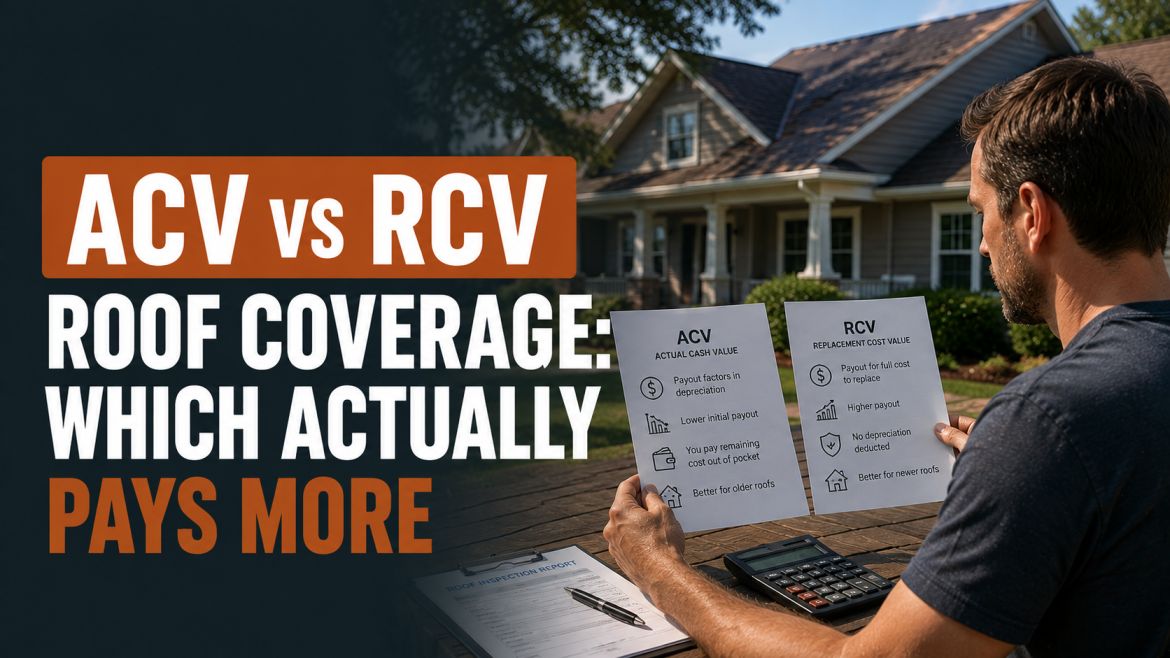
Actual cash value and replacement cost value are two distinct settlement methods, not two prices for the same payout. ACV pays the roof's depreciated value, reduced for age and condition. RCV pays the full current cost to replace it with materials of like kind and quality, without that reduction.
The gap widens every year a roof ages. A roof settled under ACV at year ten can depreciate 40% or more, leaving the homeowner with roughly 60% of what identical damage would generate under RCV. RCV also typically pays in two separate checks rather than one lump sum, a structure many homeowners do not expect.
For a repair estimate clarifying the real replacement cost behind either calculation, roof replacement services provide current pricing, and insurance claim help supports the settlement review.
What Is the Difference Between ACV and RCV?
These two settlement methods produce genuinely different payout amounts for the identical damage, and understanding both is essential before a claim is ever filed.
Where This Fits Within the Broader Claims Process
This settlement calculation is the final stage covered in the roof damage insurance guide, following coverage determination, deductible application, and claim filing as the piece that actually determines the dollar amount a homeowner receives.
The Core Definitions
Term | What It Pays |
|---|---|
Actual Cash Value (ACV) | Replacement cost minus depreciation for age and condition |
Replacement Cost Value (RCV) | The full cost to replace with materials of like kind and quality, regardless of age |
The services directory covers every repair and replacement option nationally.
In practice: ACV treats a roof the way a used car is valued, worth less each year regardless of how well it has been maintained. RCV treats the roof as if it needs to be made whole again at today's prices, without that age-based reduction.
How Is Depreciation Actually Calculated?
The underlying math is straightforward, though the specific figures vary meaningfully by carrier and material.
The Basic Depreciation Formula
Depreciation is typically calculated using the roof's expected useful life and its current age, expressed as a percentage of that expected lifespan already consumed.
Roof Age | Expected Life | Approximate Depreciation |
|---|---|---|
5 years | 20 years | Roughly 25% |
10 years | 20 years | Roughly 50% |
15 years | 20 years | Roughly 75% |
20 years | 20 years | Approaching 100% |
In practice: these figures are illustrative rather than universal, since actual depreciation schedules vary by carrier, roofing material, and specific policy language. A metal or tile roof with a longer expected service life depreciates more slowly than an asphalt shingle roof with a shorter expected lifespan, even at the identical calendar age.
A Concrete Settlement Comparison
Consider a roof with a $20,000 full replacement cost, ten years old, with 50% depreciation applied:
Settlement Type | Calculation | Payout |
|---|---|---|
RCV | Full replacement cost | $20,000 (minus deductible) |
ACV | Replacement cost minus 50% depreciation | $10,000 (minus deductible) |
The $10,000 difference in this example is not a rounding error or a minor policy detail. It is the practical, dollar-for-dollar consequence of which settlement method the policy uses, applied to identical damage on an identical roof.
Why Does RCV Coverage Pay in Two Separate Checks?
This is one of the most commonly misunderstood aspects of RCV coverage, and it surprises homeowners who assume RCV means a single, full payment upfront.
How the Two-Payment Structure Works
The carrier initially pays the ACV amount, replacement cost minus depreciation, as the first check
The remaining amount, called recoverable depreciation, is held back
Once the homeowner completes the actual repair or replacement and submits proof, typically a paid invoice
The carrier releases the recoverable depreciation as a second check, bringing the total to the full RCV amount
Roof depreciation and recoverable holdback covers this release mechanism in complete detail, including the documentation required and common reasons homeowners fail to claim the second check they are entitled to. An emergency roof inspection completed promptly after damage occurs helps establish the pre-loss condition baseline that both settlement methods rely on.
In practice: homeowners who accept the first ACV-based check and never complete the repair, or who complete it without properly submitting the required documentation, frequently forfeit the recoverable depreciation entirely. This is one of the most common ways a homeowner with genuine RCV coverage still ends up with an ACV-equivalent outcome.
What Determines Whether a Policy Uses ACV or RCV?
Several distinct factors can push a specific roof toward ACV settlement even on a policy that generally offers RCV coverage.
Common Reasons ACV Applies
The policy was written or elected as ACV-only from the outset, sometimes to reduce premium cost
Roof age and insurance underwriting rules covers how many carriers automatically shift an aging roof to ACV settlement once it passes a specific age threshold, commonly 15 to 20 years, regardless of the original policy's general settlement structure
Some carriers apply ACV settlement specifically to the roof while maintaining RCV for the rest of the dwelling, a distinction worth confirming directly on the declarations page
A homeowner who elected ACV coverage years ago to reduce premium may not realize the same option, at a different premium cost, could now provide meaningfully better protection given how the roof has aged since that original decision
Confirming Which Applies to a Specific Policy
The declarations page and the policy's loss settlement provisions specify which method applies. A homeowner uncertain which structure their policy uses should contact their agent directly and request written confirmation rather than assuming based on the general policy type, since roof-specific settlement provisions can differ from the policy's general default.
Which Coverage Type Should a Homeowner Choose?
The right answer depends heavily on the roof's current age relative to its expected service life.
The General Case for RCV
RCV coverage typically costs somewhat more in premium than ACV-only coverage, but it eliminates the age-based payout reduction that can leave an ACV policyholder covering thousands of dollars out of pocket on an older roof. For most homeowners, particularly those with a roof approaching or past the midpoint of its expected service life, RCV coverage provides meaningfully better protection against the actual cost of restoring the home.
When ACV Might Still Make Sense
A homeowner with a genuinely new roof, well within its expected service life, experiences a smaller practical gap between ACV and RCV settlement, since minimal depreciation has accumulated. In this narrower scenario, the premium savings from ACV-only coverage may represent a more reasonable tradeoff, though this advantage shrinks with every year the roof ages.
How Does ACV vs RCV Affect a Disputed Claim?
Settlement method disagreements form their own distinct category of dispute, separate from whether coverage applies at all.
Why Settlement Method Matters in a Dispute
Why roof insurance claims get denied covers denial patterns broadly, but disputes over the settlement amount specifically, rather than whether coverage applies at all, frequently center on disagreement about depreciation calculation under ACV. A homeowner who believes a carrier applied excessive depreciation, beyond what the roof's actual condition and material warrant, has grounds to challenge that specific calculation.
The insurance appraisal clause explained covers the formal dispute mechanism available when a disagreement is specifically about the amount of loss, including depreciation calculation, rather than a broader coverage denial.
Which States See the Most Distinctive ACV vs RCV Disputes?
Settlement method disputes concentrate in states with older housing stock and high storm claim volume, where the financial stakes of the ACV/RCV distinction are most pronounced.
Roof replacement services across California frequently involves ACV settlement on older roofs given the state's mix of aging housing stock and rising insurance costs. Storm damage repair in Florida sees this distinction matter enormously given the state's hurricane exposure and correspondingly high claim frequency on roofs of varying ages.
Hail damage roof repair across Colorado navigates ACV and RCV disputes frequently given the state's exceptional hail claim volume across roofs of every age. Roof repair services in Texas covers a market where the ACV/RCV distinction significantly affects settlement outcomes given the state's high volume of both hail and wind claims.
Emergency roof repair across Minnesota deals with this distinction on a roofing stock that faces accelerated aging from the state's freeze-thaw cycling, making the depreciation calculation particularly consequential. Roof replacement in Washington covers a market where sustained rainfall exposure affects roof longevity and, correspondingly, the practical impact of ACV depreciation schedules.
Confirming the Roof-Specific Provision Directly
Because this roof-specific treatment can differ from the general policy default, requesting written confirmation of exactly how the roof is settled, separate from a general statement about the policy's overall coverage type, is worth doing at every renewal rather than assuming last year's terms carried forward unchanged. A short email to the agent asking specifically whether the roof carries RCV or ACV settlement, and at what age that could change, creates a paper trail that proves useful if a dispute arises later, particularly for a roof already approaching whatever age threshold the specific carrier applies.
Does the Age of the Rest of the Home Affect Roof Settlement?
The roof's settlement calculation is generally independent of the rest of the home's age or condition, since most policies apply the ACV or RCV determination specifically to the damaged component rather than the property as a whole.
Why Roof-Specific Provisions Exist Separately
Many carriers include roof-specific settlement language precisely because roofs age and depreciate on a different, often faster, timeline than the rest of a structure's components, such as foundation, framing, or electrical systems. This is why a policy can maintain full RCV coverage for most of the dwelling while applying a roof-specific ACV provision once the roof itself crosses an age threshold, treating the roof as a distinct component with its own depreciation schedule rather than tying its settlement method to the home's overall age.
Does the Age of the Rest of the Home Affect Roof Settlement?
Not every roofing material depreciates at the same rate, and this variation affects the practical size of the gap between ACV and RCV settlement on a given property.
Why Some Materials Hold Value Longer Under ACV
A metal or tile roof, carrying a considerably longer expected service life than standard asphalt shingles, depreciates more slowly at any given calendar age. A ten-year-old metal roof with a fifty-year expected lifespan has consumed a much smaller share of its useful life than a ten-year-old asphalt shingle roof with a twenty-year expected lifespan, meaning the ACV settlement gap is proportionally smaller for the metal roof at the identical age. This is a genuine factor worth discussing with an agent when selecting both a roofing material and the corresponding insurance settlement structure together, rather than treating the two decisions as unrelated.
How Do Adjusters Determine a Roof's Expected Useful Life?
The expected useful life figure used in a depreciation calculation is not arbitrary, and it varies meaningfully by roofing material and, in some cases, regional climate conditions.
What Sources Adjusters Reference
Adjusters typically reference manufacturer specifications, industry-standard lifespan tables, and sometimes state-specific regulatory guidance to establish the expected useful life for a specific material. A homeowner who believes an adjuster applied an unreasonably short expected lifespan, compared to the specific product's documented rating, has grounds to request the source of that figure directly.
Frequently Asked Questions About ACV vs RCV Roof Insurance
The questions below cover both settlement methods and how the payout structure actually works.
What Is the Difference Between ACV and RCV on a Roof?
ACV pays the replacement cost minus depreciation for the roof's age and condition. RCV pays the full cost to replace the roof with materials of like kind and quality, without that age-based reduction, though it is typically paid in two installments.
Should I Get Replacement Cost Coverage on My Roof?
For most homeowners, particularly those with a roof past the early years of its expected service life, RCV coverage provides meaningfully better financial protection than ACV, since it eliminates the growing depreciation gap that widens every year the roof ages.
Why Did I Only Get Part of My Roof Claim Payment Upfront?
If the policy uses RCV, the first check typically reflects the ACV amount, with the remaining recoverable depreciation held back until the repair or replacement is completed and documented. This two-payment structure is standard for RCV coverage, not an error or a sign of a problem.
How Much Does a Roof Depreciate Under ACV?
Depreciation varies by carrier, material, and specific policy language, but a common illustrative pattern shows roughly 50% depreciation by the midpoint of a roof's expected service life, meaning a ten-year-old roof with a twenty-year expected lifespan might see about half its replacement value depreciated away.
Can My Insurance Switch My Roof From RCV to ACV?
Some carriers automatically apply ACV settlement to an aging roof once it passes a specific age threshold, even on a policy that provides RCV coverage for the rest of the dwelling. Confirming this roof-specific provision directly with the carrier, rather than assuming the general policy type applies uniformly, avoids a surprise at claim time.
What Happens if I Never Complete the Repair After an ACV Payment?
If the policy is RCV-based but the homeowner never completes the repair, the recoverable depreciation, the second check, is typically never released, meaning the homeowner effectively receives an ACV-equivalent settlement despite carrying RCV coverage.