
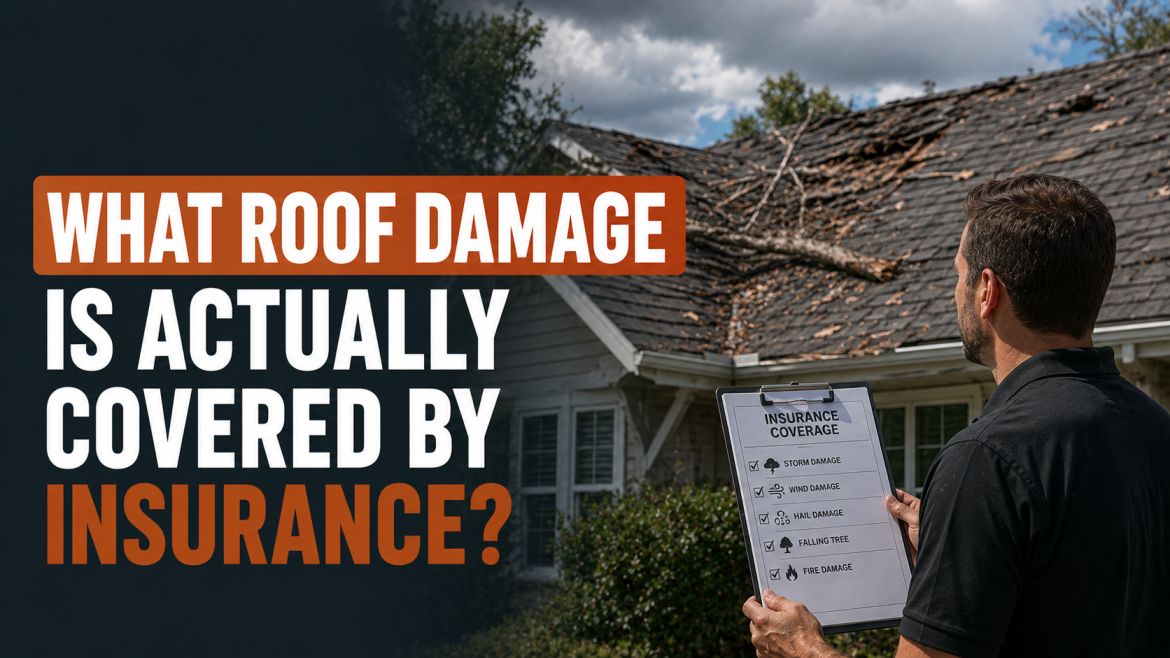
A standard homeowners policy covers the dwelling and personal property under two different rules. The dwelling, including the roof, is typically covered on an open-perils basis: everything is covered unless specifically excluded. Personal property is covered on a named-perils basis: only causes of loss explicitly listed in the policy trigger a payout.
That asymmetry explains outcomes that otherwise look inconsistent. Wind tearing off shingles is covered because wind is not on the dwelling's exclusion list. Rain from the same storm ruining furniture is evaluated separately against the personal property peril list, where a gap would leave an otherwise similar loss uncovered.
For an inspection confirming whether specific damage falls under a covered cause, emergency roof inspection services provide that assessment, and insurance claim help supports the coverage determination.
How Does Roof Damage Coverage Actually Work?
Understanding roof coverage starts with understanding which policy section applies and which rule, open perils or named perils, governs that section.
The Roof's Place Within the Broader Insurance Picture
This coverage question connects directly to the roof damage insurance guide, which covers how coverage determination feeds into claims filing, deductible application, and final settlement calculation as one continuous process.
The Two Coverage Systems Compared
Coverage Part | System | What It Means |
|---|---|---|
Coverage A (Dwelling, includes the roof) | Open perils | Covered unless specifically excluded |
Coverage B (Other structures) | Open perils | Same open-perils logic as the dwelling |
Coverage C (Personal property) | Named perils | Only covered if the specific cause is listed |
The services directory covers every repair and inspection option nationally.
In practice: this is why a roof claim and a personal property claim from the identical storm can produce different outcomes. The roof, under open perils, needs only to avoid an exclusion. The ruined furniture inside, under named perils, needs the specific peril, wind, in this case, to appear on the personal property list.
What Causes of Roof Damage Are Typically Covered?
A short list of perils accounts for the large majority of successful roof claims nationally.
Commonly Covered Perils
Peril | Typical Coverage Status |
|---|---|
Windstorm | Covered under open perils, subject to any separate wind deductible |
Hail | Covered under open perils, subject to any separate wind/hail deductible |
Fire | Covered |
Falling objects (trees, debris) | Covered |
Weight of ice or snow | Covered in most standard policies |
Lightning | Covered |
Hail damage and wind damage together account for the large majority of covered roof claims nationally, and both are treated as sudden, dateable events that fit cleanly within open-perils coverage, provided the damage is documented promptly and tied to an identifiable storm date. Hail damage roof repair and wind damage roof repair address these two causes specifically once coverage is confirmed.
What Roof Damage Is Typically Excluded?
Four exclusion categories account for the overwhelming majority of coverage denials, and each one is worth understanding before a claim is filed.
The Standard Exclusions
Four categories account for the overwhelming majority of roof coverage denials, and understanding each one prevents a homeowner from filing a claim that was unlikely to succeed from the outset.
Wear and tear and gradual deterioration is the most significant exclusion category. A roof that fails because shingles have curled, cracked, or lost granules from age is a maintenance issue, not a sudden covered event, and standard policies exclude this category categorically regardless of how severe the resulting leak becomes.
Flood damage is excluded from standard homeowners policies entirely, requiring a separate flood insurance policy, typically through the National Flood Insurance Program or a private flood carrier. Water entering from a roof leak during a rainstorm is generally distinct from flood, which specifically refers to water entering from the ground up or from overflowing bodies of water.
Earthquake damage is similarly excluded from standard policies and requires a separate earthquake endorsement or policy, relevant specifically for roof damage caused by seismic events affecting structural connections or causing tile or shingle displacement.
Neglect and lack of maintenance is a related but distinct exclusion from ordinary wear and tear, covering situations where a homeowner failed to address a known, developing problem that then worsened into a larger loss.
Exclusion | Why It Applies |
|---|---|
Wear and tear | Gradual deterioration is a maintenance responsibility, not an insurable sudden event |
Flood | Requires separate flood insurance regardless of homeowners policy type |
Earthquake | Requires separate earthquake endorsement or policy |
Neglect | Damage that worsened due to known, unaddressed conditions |
What Is the Cosmetic Damage Exclusion?
Cosmetic damage exclusions on roof policies covers this narrower but increasingly common exclusion in full, but the core concept is that some policies specifically exclude damage that is purely aesthetic and does not compromise the roof's ability to function. A metal roof dented by hail but still fully weathertight is the classic example, where an insurer may decline to pay for cosmetic repair since the roof continues performing its actual job.
How Does the Age of the Roof Affect Coverage?
Roof age increasingly affects both whether a policy is issued at all and what settlement method applies once a covered claim occurs.
Why Older Roofs Face More Restrictions
Roof age and insurance underwriting rules covers how many carriers now apply actual cash value settlement, rather than full replacement cost, once a roof passes a certain age threshold, commonly 15 to 20 years depending on the carrier and material. Some carriers decline to write new policies at all on roofs beyond a certain age, or require an inspection confirming remaining serviceable life before coverage is issued.
How Does the HO-3 Policy Structure Affect Roof Claims Specifically?
The HO-3's specific structure shapes several roof-relevant provisions beyond the basic open-perils rule already covered.
What the Standard HO-3 Actually Covers
The HO-3 is the most common homeowners policy form in the United States, and its structure directly shapes how a roof claim gets evaluated.
Coverage A (dwelling) operates on open perils, covering the roof structure itself against any cause not specifically excluded
Coverage D (loss of use) pays additional living expenses if storm damage makes the home temporarily uninhabitable
Ordinance or law coverage, often a limited add-on, addresses code-required upgrades triggered by a covered repair
Ordinance or law coverage for roofs covers this often-overlooked provision, relevant when a covered roof repair triggers a building code upgrade the base policy would not otherwise pay for.
Why Reading the Declarations Page Matters
The declarations page lists the specific coverage limits, deductibles, and any endorsements or exclusions unique to an individual policy. Two homeowners with the same carrier and the same general HO-3 form can have meaningfully different actual coverage based on state-specific endorsements, wind/hail deductible elections, and roof-specific settlement provisions listed on this page specifically.
How Do Adjusters Determine Whether Damage Is Covered?
The adjuster's inspection follows a fairly consistent evaluation process regardless of which carrier is involved.
The Adjuster's Evaluation Process
Insurance adjusters: types and what they do covers who performs this evaluation and how their role and incentives can differ. In general, the adjuster's inspection focuses on:
Confirming the cause of damage matches a covered peril rather than an excluded one
Establishing a plausible date of loss tied to a verifiable weather event
Distinguishing genuine storm damage from pre-existing wear the storm merely revealed
Documenting the extent of covered damage to establish the claim's scope
A homeowner disagreeing with an adjuster's coverage determination has options beyond simply accepting the decision, including requesting a re-inspection, providing an independent contractor's assessment, or invoking the insurance appraisal clause for disputes specifically about the amount of loss rather than whether coverage applies at all.
Which States Handle Roof Coverage Determinations Differently?
State-specific regulations and typical claim patterns shape how coverage disputes play out differently by location.
Hail damage roof repair across Colorado deals with coverage determinations shaped heavily by the state's exceptionally high hail claim volume, where cosmetic damage disputes on metal roofing are particularly common. Roof replacement services in Kentucky operates within a market where wind and hail coverage is standard but wear-and-tear denials remain a frequent point of dispute on older roofs.
Storm damage repair across Florida navigates some of the most detailed statutory coverage requirements in the country, particularly around hurricane-specific provisions. Roof repair services in Texas covers a market with significant hail and wind claim volume, where the open-perils dwelling standard applies alongside frequently elected separate wind/hail deductibles.
Emergency roof repair across California operates under a distinct coverage environment shaped heavily by wildfire risk, where fire remains a covered peril but carrier availability itself has become a separate challenge. Roof replacement in Illinois covers a market with significant hail exposure and correspondingly detailed cosmetic damage coverage disputes on metal and architectural shingle roofing.
Why Reviewing Sample Claim Scenarios Helps
Some carriers and independent insurance resources publish sample claim scenarios showing how a specific policy would respond to common roof damage situations. Reviewing these examples before a loss occurs, rather than discovering the actual policy response only after damage happens, gives a homeowner a much clearer sense of what genuine protection a specific policy provides beyond the premium and coverage limit figures alone.
Does It Matter Which Insurance Company I Choose for Roof Coverage?
Coverage structure, exclusion language, and roof-specific settlement provisions vary meaningfully between carriers even within the same general HO-3 policy category, making direct comparison worthwhile before assuming any two policies offer equivalent protection.
What to Compare Directly
Reviewing the specific roof settlement provisions, any age-based ACV triggers, and the exact wind/hail deductible structure across multiple quotes reveals differences that a simple premium comparison alone would miss entirely.
Does Coverage Differ for a Detached Structure With Its Own Roof?
A detached garage, shed, or guest house typically falls under Coverage B (other structures) rather than Coverage A (dwelling), and understanding this distinction matters when a storm damages both the main house and a separate structure on the same property.
How Coverage B Compares to Coverage A
Coverage B generally operates on the same open-perils basis as the dwelling, though it is typically capped at a percentage of the dwelling limit, commonly around 10%. A single storm damaging both the main roof and a detached structure's roof may involve two separate coverage calculations under the same policy, each subject to its own limit, though usually sharing the same deductible unless the policy specifies otherwise.
Does Coverage Differ for a Detached Structure With Its Own Roof?
A repair that leaves a visibly different section of roofing, because an exact material match is unavailable, raises a coverage question separate from whether the original damage itself was covered.
Why Matching Disputes Arise
Many state regulations and some policy language address a homeowner's right to reasonably uniform appearance following a covered repair. Where an exact match is genuinely unavailable, this can support expanding the covered scope to a full slope or section rather than leaving a mismatched patch, though the specific standard and how aggressively it is applied varies by state and carrier. This consideration frequently arises on older roofs where the original product has been discontinued, making an isolated repair visually inconsistent with the surrounding, weathered material.
Does Coverage Change if the Roof Was Already Damaged Before the Storm?
Pre-existing damage complicates a claim considerably, since a carrier can attribute post-storm findings to that earlier condition rather than the triggering event being claimed.
Why Prior Condition Matters at Inspection
An adjuster comparing storm damage against a roof already showing significant wear may distinguish between damage clearly attributable to the storm and deterioration that predates it, paying only for the former. Documenting a roof's condition before any storm season, through photos or a professional inspection, provides the baseline that makes this distinction defensible later rather than contested.
Frequently Asked Questions About Roof Damage Insurance Coverage
The questions below cover the specific exclusions and edge cases homeowners ask about most.
What Roof Damage Is Not Covered by Insurance?
Wear and tear, gradual deterioration, flood, earthquake, and neglect are the standard exclusions across nearly all homeowners policies. A roof that fails from age-related curling, cracking, or granule loss without a specific triggering storm event generally falls outside coverage.
Is a Roof Leak Covered by Homeowners Insurance?
It depends on the cause. A leak resulting from sudden storm damage, such as wind-lifted shingles or a fallen tree limb, is typically covered. A leak resulting from gradual deterioration or long-term neglect of a known issue is typically excluded.
What Is the Difference Between Open Perils and Named Perils?
Open perils coverage, typically applied to the dwelling itself, covers any cause of loss not specifically excluded. Named perils coverage, typically applied to personal property, covers only the specific causes explicitly listed in the policy.
Does Homeowners Insurance Cover Hail Damage to a Roof?
Yes, in the large majority of standard policies, hail is a covered peril for the dwelling. Some policies apply a separate, higher wind/hail deductible, and some exclude purely cosmetic hail damage that does not affect the roof's function.
Does a New Roof Affect What Coverage I Can Get?
Yes. A newer roof is more likely to qualify for full replacement cost coverage and may support lower premiums, while an older roof commonly faces actual cash value settlement terms and, in some cases, more restrictive underwriting or coverage limitations.
Is Wind and Hail Always Covered the Same Way Everywhere?
No. Coastal and hail-prone states frequently apply a separate wind/hail deductible distinct from the standard deductible, and some carriers in high-risk coastal areas exclude wind or hail from the base policy entirely, requiring a separate windstorm policy.