
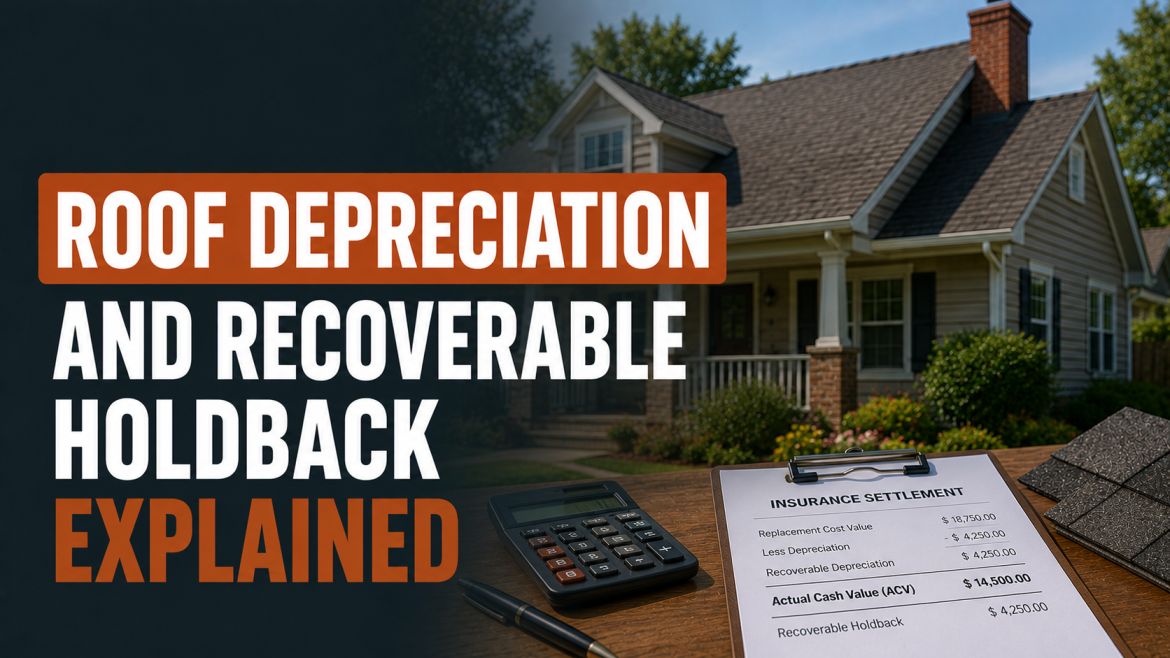
Recoverable depreciation is money already owed under a replacement cost policy. It is withheld temporarily and released once a homeowner completes the repair and submits proof. It is not a negotiated bonus. A homeowner who accepts the first check and assumes the claim is finished leaves this money unclaimed.
This is the most commonly forfeited benefit in residential roof claims. Nothing about the initial payment looks incomplete, and carriers have no obligation to remind policyholders a second check remains available. Understanding how the holdback works, and what triggers its release, prevents that forfeiture.
Storm damage repair services and roof replacement services generate the documentation this release process requires. The services directory covers every option nationally.
How Does Roof Depreciation Actually Work?
Depreciation reduces a roof's value to reflect its age and condition. Understanding this calculation is the foundation for understanding why a portion of it later becomes recoverable.
Where This Fits in the Broader Claims Process
This depreciation mechanism is the final calculation stage within the roof damage insurance guide. It follows coverage determination and deductible application as the step that actually produces a specific settlement figure.
The Two-Payment Structure
Payment | When It Is Issued | What It Represents |
|---|---|---|
First payment (ACV) | Shortly after claim approval | Replacement cost minus depreciation and deductible |
Second payment (recoverable depreciation) | After repair completion and documentation | The depreciation amount held back from the first check |
ACV vs RCV roof coverage compared covers the underlying settlement methods in full. Recoverable depreciation is the bridge between the two. It is the gap a replacement cost policy promises to close once the repair is verified as complete.
What Is Recoverable Versus Non-Recoverable Depreciation?
This distinction determines whether a homeowner has money still coming, or whether the initial payment represents the full and final settlement.
The Critical Difference
Type | What Happens to It |
|---|---|
Recoverable depreciation | Released once the repair is completed and documented, under an RCV policy |
Non-recoverable depreciation | Permanently withheld, under an ACV-only policy or specific policy exclusion |
In practice: whether depreciation is recoverable depends entirely on the specific policy language, not on how the claim is handled or negotiated. A homeowner with an ACV-only policy has no recoverable depreciation to claim, regardless of how promptly repairs are completed. A homeowner with genuine RCV coverage has a real, collectible second payment waiting on the other side of a completed repair.
How to Confirm Which Type Applies
The settlement letter accompanying the first payment typically states explicitly whether recoverable depreciation exists. If it does, the letter also lists the specific dollar amount being held back. Reading this letter carefully, rather than filing it away unread, is the first step toward eventually collecting the second payment.
How Is the Depreciation Amount Actually Calculated?
The underlying math is straightforward, though the specific figures vary by carrier and roofing material.
The General Calculation Method
Depreciation is generally calculated using the roof's age relative to its expected useful life. That percentage is then applied against the full replacement cost to determine how much value the roof has lost through normal aging.
Roof Age | Expected Life | Approximate Depreciation |
|---|---|---|
5 years | 20 years | Roughly 25% |
10 years | 20 years | Roughly 50% |
15 years | 20 years | Roughly 75% |
A roof with $18,000 in full replacement cost at 50% depreciation illustrates the math. The initial ACV payment, minus deductible, reflects roughly $9,000 of that value. The remaining $9,000 becomes the recoverable depreciation available once the repair is completed and documented.
Why Depreciation Schedules Vary by Material and Carrier
Metal and tile roofing carry considerably longer expected service lives than standard asphalt shingles. They generally depreciate more slowly at any given calendar age. Carriers also apply somewhat different depreciation tables and methodologies. This is why two carriers settling identical damage on identical roofs can arrive at meaningfully different initial ACV figures.
What Documentation Releases Recoverable Depreciation?
A specific set of documents triggers the release. Missing any one of them is the most common reason this payment goes uncollected.
The Required Documentation
A completed repair or replacement, performed by a licensed contractor
A final, paid invoice showing the actual cost of the completed work
A written request to the carrier specifically invoking the recoverable depreciation release
In some cases, photographs confirming the completed repair matches the scope originally approved
Documenting roof damage for insurance covers documentation standards that apply throughout a claim. That same rigor matters at the release stage, not only at the initial filing stage most guidance focuses on.
Why Homeowners Commonly Forfeit This Payment
The most common reason recoverable depreciation goes unclaimed is straightforward. The homeowner accepts the first check, assumes the claim process is complete, and never submits the documentation that triggers the second payment. This is not a rare oversight. It happens often enough that some public adjusters specifically market services around recovering depreciation homeowners never realized remained available.
A second, less common but genuinely damaging pattern involves a homeowner who pays a contractor partially or fully in cash. Without a paid invoice, the carrier has no documentation to review. This effectively makes the completed work invisible to the release process, regardless of how thoroughly the repair was actually performed.
Does Recoverable Depreciation Expire?
Yes, and the deadline is separate from any earlier claim filing deadline already tracked.
Why Timing Matters
Most policies specify a window, commonly 180 days to one year from the initial payment, within which the repair must be completed and documented. Missing this window can result in permanently forfeiting the amount. What should have been a temporary holdback becomes, in effect, a non-recoverable loss.
How to file a roof insurance claim covers the broader claims timeline this deadline sits within. Homeowners tracking the original notice deadline should track this separate, later deadline with equal attention. Insurance claim help can assist with tracking both deadlines simultaneously.
What to Do if the Deadline Has Nearly Passed
Contacting the carrier directly to request an extension is a reasonable step. This applies particularly where a documented delay, such as a contractor scheduling backlog after a regional storm, prevented timely completion. Some carriers grant reasonable extensions when the delay is clearly outside the homeowner's control, though this is discretionary rather than guaranteed.
How Does a Public Adjuster Factor Into Depreciation Recovery?
Professional help is not always necessary, but certain scenarios genuinely benefit from it.
When Professional Help Makes Sense
Insurance adjusters: types and what they do covers the distinction between a carrier's own adjuster and a public adjuster retained by the homeowner. For a straightforward depreciation release with clear documentation, professional help is often unnecessary. In a case where the carrier disputes the repair scope, or the depreciation figure seems unreasonably aggressive, a public adjuster's involvement can be worth the fee.
What Happens if a Depreciation Calculation Seems Excessive?
A homeowner is not required to simply accept a depreciation figure that looks disproportionate to the roof's actual documented condition.
Disputing an Unreasonable Depreciation Figure
A homeowner may believe a carrier applied an unreasonably short expected useful life, or an inflated depreciation percentage inconsistent with the roof's documented condition. In that case, there are grounds to challenge the specific calculation. The insurance appraisal clause explained covers the formal dispute mechanism for amount-of-loss disagreements. This includes depreciation disputes, distinct from broader coverage denials.
Does Labor Depreciate the Same Way as Materials?
Some carriers apply depreciation only to material costs, treating labor as a non-depreciable expense. Others depreciate both components together as a single combined figure.
Why This Distinction Affects the Final Number
A policy that depreciates only materials, leaving labor undepreciated, generally produces a higher initial ACV payment than a policy depreciating both equally. This holds true even on identical roofs with identical damage. This is worth clarifying with a specific carrier, since state regulations vary. Some states have moved to restrict or prohibit labor depreciation, given the complaints it has historically generated among policyholders who did not anticipate it.
Which States See the Most Distinctive Depreciation Practices?
Depreciation calculation methodology and typical dispute patterns vary meaningfully by state, given differing regulatory oversight and claim volume.
Storm damage repair across Texas deals with depreciation disputes frequently, given the state's high hail and wind claim volume across roofs of every age. Hail damage roof repair in Colorado navigates this issue often, given the state's exceptional hail frequency and detailed regulatory environment.
Roof replacement services in Florida sees depreciation calculation matter significantly, given the state's hurricane exposure and large share of aging roofing stock. Emergency roof repair across Louisiana navigates a similar dynamic tied to the state's hurricane and severe storm frequency.
Roof repair services in Illinois handles depreciation disputes on a roofing stock shaped by significant hail exposure across a wide range of ages. Storm damage repair in Georgia covers a market where the recoverable depreciation deadline frequently becomes relevant, given contractor scheduling backlogs after major regional storms.
How Does Depreciation Interact With a Partial Repair?
A claim covering only a section of the roof still generates a depreciation calculation. The mechanics work slightly differently than a full-roof claim.
Why Partial Repairs Complicate the Calculation
When only a portion of the roof is repaired, the depreciation figure applies specifically to that repaired section, not the entire structure. This matters because a partial repair's recoverable depreciation is not simply a smaller version of a full-roof number. It is a different scope calculation entirely. Confirming exactly which portion the depreciation covers, directly with the carrier, avoids confusion when the second payment arrives smaller than expected.
What Happens if the Partial Repair Later Expands
Supplemental roof insurance claims covers what happens when tear-off reveals damage beyond the originally approved scope. If a partial repair expands once work begins, the newly added scope typically follows the same recoverable structure as the original claim. It requires its own documentation and submission once that additional work is completed.
Should Homeowners Track Depreciation Deadlines Separately From Claim Deadlines?
Yes. Treating them as a single combined timeline is a common source of missed recoverable depreciation payments.
A Practical Tracking Approach
Set a calendar reminder tied specifically to the recoverable depreciation deadline. Keep it separate from any reminder tracking the original claim filing deadline. This ensures the later obligation does not fall through simply because the earlier, more urgent deadline has already been met.
What Records Should a Homeowner Keep After the First Payment?
Keeping organized records after the initial ACV payment matters as much as the documentation gathered during the original filing. This later stage is where many homeowners let their attention lapse.
A Simple Record-Keeping Checklist
Save the settlement letter stating the exact recoverable depreciation figure. Keep the contractor's final paid invoice. Retain copies of any written request submitted to the carrier. Together, these create a complete file. It resolves most disputes quickly if the second payment is delayed or questioned by the carrier.
Frequently Asked Questions About Roof Depreciation and Recoverable Holdback
The questions below cover how the holdback works and what actually releases it.
What Is Recoverable Depreciation on a Roof Claim?
Recoverable depreciation is the difference between a roof's actual cash value settlement and its full replacement cost value. The carrier holds it back and releases it once the homeowner completes the repair and submits documentation. It applies specifically to policies with replacement cost coverage.
How Is Roof Depreciation Calculated?
Depreciation is generally calculated based on the roof's age relative to its expected useful life. That figure is applied as a percentage reduction against the full replacement cost. The exact methodology and schedule can vary by carrier and roofing material.
Do I Automatically Get My Recoverable Depreciation?
No. The homeowner must complete the repair, submit specific documentation such as a paid invoice, and file a formal request before the recoverable depreciation is released.
What Happens if I Never Complete the Repair?
If the repair is never completed and documented, the recoverable depreciation is typically never released. The homeowner receives only the initial ACV-equivalent payment despite the policy providing for full replacement cost.
Is There a Deadline to Claim Recoverable Depreciation?
Yes, commonly 180 days to one year from the initial payment date, depending on the policy. Missing this window can result in permanently forfeiting the held-back amount.
Can I Dispute the Amount of Depreciation My Insurer Applied?
Yes. If the depreciation percentage seems inconsistent with the roof's documented condition, both the appraisal process and direct negotiation are available to challenge it.