
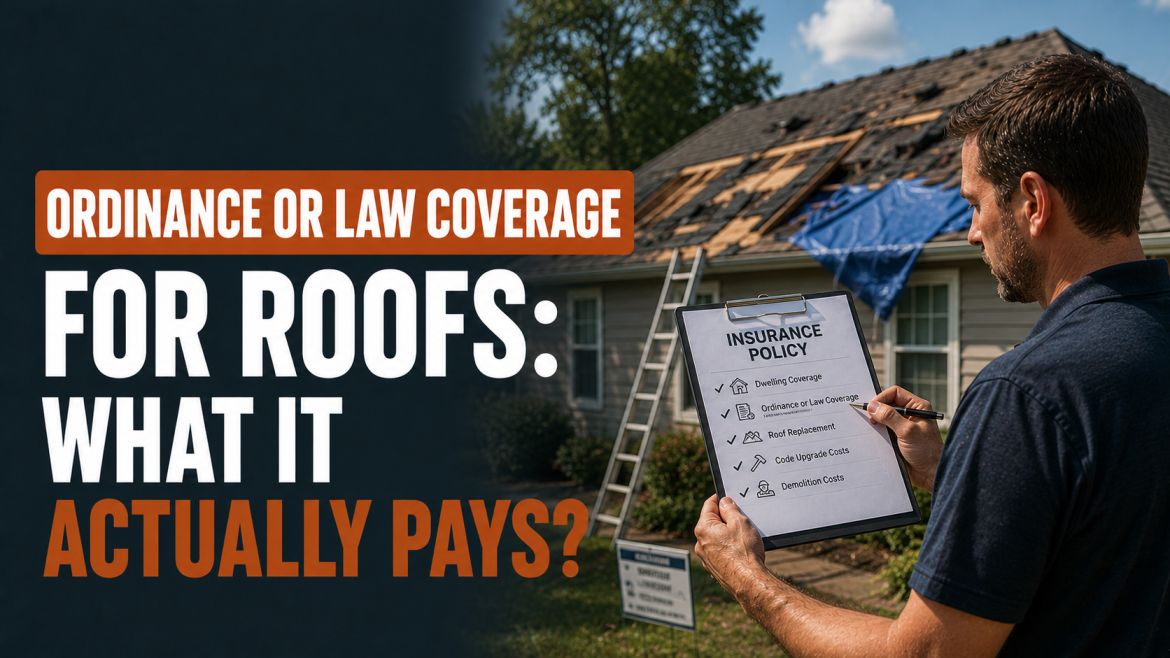
A standard homeowners policy has one job. It restores a roof to what it was before the damage. It does not pay to bring that roof up to whatever building code applies today. That gap is where ordinance or law coverage steps in, and the gap is not small.
Building codes update roughly every three years. A roof installed fifteen years ago was built to older standards. It may no longer meet current requirements for ventilation or fastening. Once a covered loss triggers a permitted repair, the local building department can require these upgrades regardless of what caused the damage.
Roof replacement services and insurance claim help build code compliance into the repair from the start. The services directory covers every option nationally.
What Is Ordinance or Law Coverage?
This coverage pays the added cost of meeting current building code once a covered loss triggers a permitted repair. It does not cover elective upgrades chosen for their own sake.
Where This Fits in the Broader Coverage Picture
Ordinance or law coverage connects directly to the broader roof damage insurance guide. It applies only after a covered peril has already triggered a valid claim.
What This Coverage Typically Pays For
Category | What It Covers |
|---|---|
Demolition cost | Removing undamaged portions the code requires to be replaced |
Code compliance cost | The added expense of meeting current code on the repaired section |
Diminished value | Loss in value caused by the code enforcement itself |
In practice: most homeowners never think about this coverage until a permit office requires an upgrade the standard settlement never anticipated. That upgrade cost can run into several thousand dollars on a single roof project. A homeowner who never confirmed their specific limit often discovers it only once the bill arrives.
Why Does a Covered Roof Repair Trigger Code Upgrades?
A repair or replacement almost always requires a permit. That permit process is exactly where current code requirements get enforced, even on a roof that previously met an older standard.
Common Roof-Specific Code Triggers
Ice and water shield requirements in cold-climate jurisdictions that did not exist decades ago
Updated attic ventilation ratios required under current energy code
Wind-rated fastening patterns in coastal or high-wind zones
Impact-resistant material requirements in mapped hail zones
Roof age and insurance underwriting rules covers how a roof's age separately affects what a carrier will insure. Code compliance and underwriting are related but distinct concerns.
What Are Typical Ordinance or Law Coverage Limits?
Coverage amount varies considerably by policy, state, and insurer. A declarations page confirms the specific figure better than any general assumption.
Common Limit Structures
Limit Type | Typical Range |
|---|---|
Standard included amount | Often 10% of dwelling coverage |
Enhanced optional amount | 25%, 50%, or in some policies 100% |
Dollar-based limit alternative | A specific figure, such as $10,000 or $25,000 |
A ten percent limit on a $300,000 dwelling policy provides $30,000 in ordinance or law coverage. Code upgrades often run $2,000 to $8,000 on a single roof project, so this default limit is usually adequate. Older homes with outdated systems may need more.
What Changed for California in 2026?
California requires a specific statutory floor for this coverage, and few homeowners outside the insurance industry know it exists.
The California Requirement
Assembly Bill 2756, codified under California Insurance Code Section 10103(c), sets the requirement. Every open replacement-cost residential policy must include at least 10% of the dwelling limit. This has applied since July 1, 2021, and continues under policies renewed from July 1, 2026 forward.
In practice: a California homeowner cannot legally be sold an open replacement-cost policy below this floor. The actual amount on a specific policy is still worth confirming, since some carriers offer more than the required minimum.
How Florida Handles This Coverage
Florida law requires carriers to offer ordinance or law coverage on every homeowners policy, up to 25% of the dwelling limit. The amount can be increased, decreased, or declined by the policyholder, but the offer itself is mandatory under state statute.
Storm damage repair across Florida frequently involves this coverage given the state's hurricane-driven repair volume and correspondingly frequent code enforcement during rebuilds.
What Does Ordinance or Law Coverage Not Pay For?
This coverage has real limits. A clear sense of these limits prevents a homeowner from assuming broader protection than the policy actually provides.
Common Exclusions From This Coverage
Elective upgrades chosen simply because a project is already underway do not qualify. Neither does a code upgrade triggered by damage the base policy never covered, such as ordinary wear and tear. What roof damage is actually covered covers this underlying question, since ordinance or law coverage only activates once a genuinely covered loss is already established.
Why roof insurance claims get denied matters here directly. A denied base claim generally means no ordinance or law payment either, regardless of how significant the code upgrade turns out to be.
How Do You Actually Use This Coverage in a Claim?
The Practical Sequence
Confirm the base roof damage claim is accepted as covered
Obtain the specific code requirement from the local building department in writing
Submit that documentation alongside the contractor's itemized estimate
Reference the ordinance or law provision specifically when requesting payment
Confirm the payment against the policy's stated percentage or dollar limit
How to file a roof insurance claim covers the broader filing process this step fits within. Ordinance or law payment typically arrives as an addition to the base settlement, not a separate claim. Storm damage repair documentation often supports this part of the request directly.
Why Written Code Documentation Matters So Much
A carrier will not simply accept a contractor's word that a code upgrade is required. Written confirmation from the permitting authority, naming the specific code section, supports the payment request. Verbal explanations alone rarely satisfy a claims reviewer working from a written file. Insurance adjusters: types and what they do covers how this documentation typically gets reviewed alongside the rest of a claim file.
Should Homeowners Increase Their Ordinance or Law Limit?
For many homes, the standard included amount is enough. For older homes, the calculation looks different. A home built decades ago carries a genuinely higher chance of triggering code upgrades a newer home simply would not face.
When a Higher Limit Makes Sense
A home with original wiring, plumbing, or roofing systems that predate multiple code cycles faces a genuinely higher risk of significant upgrade costs. Age-based underwriting rules covered elsewhere in this cluster often apply to the same older properties.
This limit can often be raised from 10% to 25% inexpensively. Given the potential upgrade cost on an older home, this modest increase is often worth requesting directly from an agent.
Does This Coverage Apply to Both Repairs and Full Replacements?
Yes, though the practical impact differs. A full replacement almost always triggers current code across the entire roof. A partial repair may only trigger code compliance on the repaired section.
Why Partial Repairs Sometimes See Smaller Upgrade Costs
California roof layer limits and the 25 percent rule covers a related threshold. It determines when a partial repair legally must expand into a full section replacement. That threshold, once crossed, often triggers the same code compliance requirement a full replacement would face. Ordinance or law coverage then applies even to a project that started smaller.
A homeowner assuming a small repair avoids code exposure entirely may be surprised once the actual scope is confirmed. A quick check of both figures early avoids that surprise later in the project.
Can Ordinance or Law Coverage Be Denied Even if the Roof Damage Is Covered?
Yes, in specific circumstances. Coverage of the base damage does not automatically guarantee payment for every requested code upgrade.
When a Carrier Might Deny This Portion Specifically
A carrier can dispute whether a specific requested upgrade is genuinely code-mandated rather than elective. Some contractors bundle upgrade items into an estimate without clear proof the local authority actually requires them. A carrier reviewing that kind of estimate may deny the unsupported portions while still paying the underlying covered repair.
In practice: the strongest protection against this kind of denial is written documentation from the permitting authority itself. A contractor's general statement is not enough on its own.
Which States Handle Ordinance or Law Coverage Differently?
Requirements and typical limits vary meaningfully by state, shaped by building code adoption cycles and regulatory mandates.
Roof replacement services across California operates under the state's statutory 10% minimum floor, a requirement few other states impose directly. Florida follows a mandatory-offer structure up to 25%, distinct from California's flat minimum.
Hail damage roof repair across Texas sees this coverage matter significantly given the state's high hail claim volume and frequent code-triggered upgrades. Emergency roof repair across Colorado follows a similar pattern tied to the state's hail corridor.
Roof repair services in Illinois handles ordinance or law claims shaped by older housing stock and evolving local codes. Storm damage repair across Louisiana navigates this coverage frequently given the state's hurricane exposure and rebuild volume.
Do Other States Have a Statutory Minimum Like California?
Some do, though California's flat 10% floor is among the more direct statutory mandates in the country. Other states take different regulatory approaches to the same underlying concern.
How State Approaches Differ
A handful of states require carriers to offer this coverage without mandating a specific minimum amount, leaving the actual limit to policyholder choice. Others leave it entirely to standard industry practice, where a 10% default has simply become common without any specific state law behind it.
A homeowner relocating between states should not assume identical protection carries over automatically. A review of the new state's specific requirements, and the new policy's declarations page, is the reliable way to confirm what applies.
What Should a Homeowner Ask an Agent About This Coverage?
A short set of direct questions clarifies exactly what protection exists before any damage occurs, when the answer actually matters least.
Questions Worth Asking Directly
An agent can confirm the exact percentage or dollar limit currently on a policy. They can also explain whether that limit applies per occurrence or has any aggregate cap across multiple claims in a policy period. A specific question about roof-related code triggers produces a more useful answer than a general question, especially given how often roofing codes update.
In practice: many homeowners only learn their actual limit once a claim is already underway. A question asked before that point, ideally at each renewal, avoids an unwelcome surprise during an already stressful repair process.
Frequently Asked Questions About Ordinance or Law Coverage
What Is Ordinance or Law Coverage?
It is a homeowners insurance provision that pays the added cost of meeting current building code, once a covered loss triggers a permitted repair. It does not cover elective upgrades.
Does Insurance Pay for Code Upgrades on a Roof?
Only if the policy includes ordinance or law coverage and the underlying roof damage is itself covered. Without this provision, a carrier typically pays only to restore the roof to its prior condition.
How Much Ordinance or Law Coverage Do I Have?
Check the declarations page directly. Many policies include 10% of the dwelling limit by default, with options to increase to 25%, 50%, or more depending on the carrier.
Does California Require This Coverage?
Yes. Assembly Bill 2756 requires every open replacement-cost residential policy in California to include at least 10% of the dwelling limit, effective since July 1, 2021.
Can Ordinance or Law Coverage Pay for a Full Roof Replacement?
Only the code-required portion of that cost, not the underlying repair itself. The base policy restores the roof, and ordinance or law coverage pays the additional amount current code enforcement requires.
Do I Need Written Proof of a Code Requirement to Get This Coverage?
Yes, in nearly every case. A written statement from the local building department, specifying the exact code requirement, is what carriers rely on to evaluate this portion of a claim.