
Search for the best roofing material and every result answers the same question: which one should you buy. Cost per square foot, return on investment, lifespan in years. That is a useful question for someone planning a replacement, and it is the wrong question for someone standing under a roof that already exists, trying to understand what just happened to it.
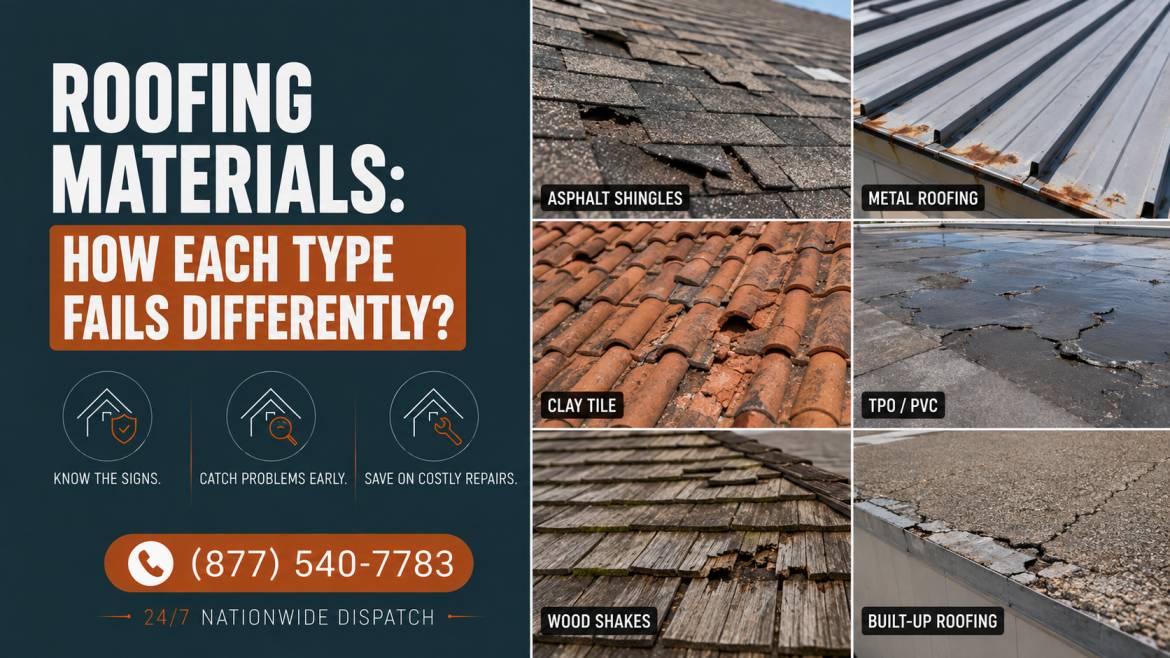
This guide asks a different question. Given a specific material, already installed, how does it actually fail? A hailstone that shatters a clay tile will only dent a steel panel and barely mark a slate slab. A material's failure mode, not its price tag, is what determines whether that failure looks cosmetic or catastrophic, and whether an insurer will pay for it.
This guide covers all ten major residential roofing materials, how each one fails under the same conditions, and which materials share a failure mode versus which stand alone. It connects directly to the roof damage overview, and for anyone ready to explore full roof replacement, the services directory covers every other option as well.
What Roofing Materials Are Available?
Ten materials account for nearly every residential roof in the country, and they group naturally into three families based on how they are manufactured and installed, which turns out to predict how they fail almost as reliably as the material itself does.
The Full Material Inventory
Material | Family | Typical Service Life |
|---|---|---|
Asphalt shingles | Composition | 15 to 30 years |
Metal roofing | Metal panel or seam | 40 to 70 years |
Clay tile | Fired masonry | 50 to 100 years |
Concrete tile | Cast masonry | 50 years or more |
Slate | Quarried stone | 75 to 150 years |
Wood shake | Natural wood | 20 to 30 years |
TPO membrane | Single-ply membrane | 20 to 30 years |
EPDM membrane | Single-ply membrane | 20 to 30 years |
Modified bitumen | Multi-ply membrane | 15 to 25 years |
In practice: service life ranges published by manufacturers and industry bodies describe laboratory conditions and average installation quality. A material's real-world lifespan on a specific roof depends heavily on local climate, ventilation, and the causes covered in the roof damage causes guide, which is why any single number should be read as a planning range rather than a guarantee.
Why Family Grouping Matters More Than It Looks?
Composition materials fail through granule loss and mat fracture. Metal panels fail through denting and fastener movement. Masonry materials fail through cracking under point load. Membrane materials fail through seam separation and puncture. Once a material's family is identified, its likely failure mode becomes predictable even before inspecting the specific roof.
How Does Failure Differ by Material?
This is the question every generic buying guide skips, and it is the one that actually matters once damage has already occurred. The same storm event produces entirely different evidence depending on what the roof is made of.
Impact Resistance and the UL 2218 Standard
Underwriters Laboratories tests impact resistance under UL 2218, dropping a steel ball from a specified height and rating the result from Class 1 through Class 4. That rating reveals something more useful than a pass or fail score: it reveals how a material fails, not just whether it does.
Material | Typical Failure Mode Under Impact |
|---|---|
Asphalt shingles | Mat fracture and granule displacement, often invisible from above |
Metal panels | Visible denting, cosmetic in most cases but sometimes disputed |
Clay tile | Cracking or shattering, brittle failure with little warning |
Concrete tile | Similar cracking pattern to clay, slightly more impact tolerance |
Slate | Fracture along natural cleavage planes |
Class 4 composite or rated asphalt | Surface marking only, structural integrity generally preserved |
That distinction between surface marking and structural failure is the one every material comparison guide glosses over. A material that only marks under impact keeps functioning as a weather barrier. A material that cracks or shatters stops functioning immediately at the point of failure, even if the rest of the roof looks fine.
Wind Resistance and ASTM Ratings
Wind resistance is tested separately from impact resistance, most commonly under ASTM D3161 or D7158, and a genuinely storm-resistant material needs strong performance in both categories, since a single severe storm frequently combines wind and hail.
Wind damage works through uplift, which tests a material's fastening and seal system rather than its surface hardness. Metal panels with concealed fasteners and interlocking seams resist uplift differently than shingles relying on an adhesive seal strip, which is why wind rating and impact rating do not always favor the same material.
Which Material Lasts Longest?
Longevity varies more by an order of magnitude across roofing materials than almost any other home building product, spanning from 15 years to well over a century depending purely on material choice.
The Longevity Spectrum
Tier | Materials | Range |
|---|---|---|
Shortest | Modified bitumen, membrane roofing | 15 to 30 years |
Moderate | Asphalt shingles, wood shake | 15 to 30 years |
Long | Metal roofing | 40 to 70 years |
Very long | Clay tile, concrete tile | 50 to 100 years |
Longest | Slate | 75 to 150 years |
Roof wear and aging progresses at fundamentally different rates depending on which family a material belongs to. Composition and membrane materials degrade chemically, as UV exposure breaks down oils and plasticizers over years. Masonry and metal degrade mechanically or not at all under normal conditions, which is the underlying reason their service life ranges run so much longer.
The Underlayment Ceiling on Tile and Slate
A detail every longevity comparison misses: on tile and slate roofs, the covering routinely outlasts the underlayment beneath it. That underlayment typically needs renewal at 20 to 25 years even when the tiles or slate themselves remain structurally sound, which means the covering's advertised 100-year lifespan assumes at least one underlayment replacement partway through.
How Does Climate Affect Material Choice?
Climate does not just influence which material performs best. It actively determines which failure mode a given material is most likely to experience on a specific roof.
Heat and UV-Dominant Climates
Sun and UV exposure accelerates composition material aging considerably faster in sustained high-heat regions, while having comparatively little effect on masonry, metal, or slate, which do not depend on organic oils for flexibility the way asphalt does.
Cold and Snow-Load Climates
Roof snow load interacts differently with every material's surface texture and slope-shedding behavior. Metal sheds accumulated snow far more readily than asphalt or tile, which reduces peak structural load but introduces a secondary risk of sudden snow slides landing near entrances below.
Coastal and Salt-Air Climates
Salt air accelerates corrosion on metal roofing specifically, attacking fasteners and, on lower-grade panels, the coating itself. Coastal installations generally require marine-grade fastening and coating specifications that inland metal roofs can reasonably skip.
Wildfire-Prone Climates
Wildfire ember damage makes Class A fire rating the dominant selection criterion in wildland-urban interface zones, favoring metal, tile, and slate over untreated wood shake, which carries meaningfully higher ignition risk under ember exposure specifically.
Detailed Breakdown by Material
Each material below gets its own dedicated look at construction, typical failure signature, and the specific conditions that shorten or extend its real-world service life.
Asphalt Shingles
Asphalt shingle roofs cover the majority of American homes, and their failure sequence is more thoroughly documented than any other material simply because of that volume. Three-tab products run 15 to 20 years; architectural products run 25 to 30.
The typical failure sequence runs from granule erosion to asphalt embrittlement to seal strip failure to eventual shingle loss during wind events the roof previously survived without issue. Isolated cases usually respond well to targeted shingle repair rather than requiring a full tear-off.
Metal Roofing
Metal roof damage presents almost entirely as denting and fastener movement rather than the cracking or granule loss composition materials show. That distinct failure mode creates a genuine insurance complication, since a dented panel frequently still sheds water perfectly, which gives carriers grounds to treat the damage as cosmetic rather than functional. Metal roofing specialists typically assess whether denting has actually compromised the seam or fastening system before recommending panel replacement.
Clay Tile
Clay tile roof damage is dominated by cracking under impact and foot traffic, since fired clay is inherently brittle despite its long service life. Individual tile replacement is possible but requires careful handling, since adjacent tiles crack easily during the repair itself.
Concrete Tile
Concrete tile roof damage follows a similar cracking pattern to clay but adds meaningfully more weight to the structure, which makes verifying the home's framing capacity a genuine prerequisite before installation or replacement rather than an afterthought.
Slate
Slate roof damage most often traces back to fastener failure rather than the stone itself. A slate roof shedding individual slates while the stone remains sound needs re-fastening, not replacement, which is a distinction many general contractors miss.
Wood Shake
Wood shake roof damage is biological as well as mechanical, including rot from retained moisture and splitting along the grain, on top of the fire vulnerability that has led many wildfire-prone jurisdictions to restrict or prohibit untreated wood shake outright.
TPO Membrane
TPO roof damage concentrates at the seams, where heat-welded joints can separate under sustained UV exposure and thermal cycling, particularly on membranes installed with inadequate seam overlap or on a substrate that was not properly prepared. Seam-specific issues across all three membrane types below are typically addressed through flat roof repair rather than a full membrane replacement.
EPDM Membrane
EPDM roof damage centers on shrinkage, where the rubber membrane pulls away from edges and penetrations over years of exposure, alongside puncture risk from foot traffic or fallen debris on an otherwise durable, flexible surface.
Modified Bitumen
Modified bitumen roof damage shows up as blistering between the material's multiple plies and surfacing granule loss, following a failure pattern closer to asphalt shingles than to the single-ply membranes it otherwise shares flat-roof applications with.
Comparing Lifespan Across Every Material
Bringing every material into one direct comparison is worth doing on its own, since the tradeoffs between upfront cost, service life, and climate suitability rarely resolve to an obvious universal answer. A full roofing material lifespan comparison covers that decision in more depth, including how local climate shifts the calculation materially away from the national averages most comparison charts publish.
Which States See the Most Material-Specific Roof Damage?
Certain materials fail more consistently in specific regions, driven by the same climate factors covered above interacting with local material popularity.
Texas, where high hail frequency drives strong demand for Class 4 impact-rated materials
Florida, combining hurricane wind exposure with coastal salt air affecting metal roofing specifically
Arizona, with sustained heat and UV exposure accelerating asphalt and tile aging alike
California, spanning wildfire-driven Class A material selection across wildland-urban interface zones
Colorado, where Front Range hailstorms concentrate demand for impact-resistant materials
Minnesota, with heavy snow load favoring metal roofing's superior shedding behavior
South Carolina, facing coastal salt air corrosion risk distinct from Florida's wind-driven exposure
Roof replacement services across Texas see strong demand for Class 4 rated materials specifically, driven by the state's leading national hail frequency. Metal roofing and wind-rated materials in Florida address a dual challenge few other states share, combining hurricane wind exposure with the corrosion risk sustained coastal salt air creates for metal panels specifically.
Roof replacement across Arizona deals with accelerated asphalt aging as a routine finding, given the state's combination of elevation and near-constant intense sun exposure. Wildfire-resistant roofing services in California covers Class A material selection across the state's extensive wildland-urban interface zones. Hail-resistant roofing across Colorado reflects the Front Range's history of severe, damaging hailstorms.
Metal roofing services across Minnesota benefits from metal's superior snow-shedding behavior compared to asphalt or tile in the state's sustained heavy winter accumulation. Coastal roofing and metal repair in South Carolina rounds out the group, addressing salt air corrosion risk that runs independently of the wind-driven concerns Florida's coastline shares.
How Does Material Choice Affect Repair and Insurance?
Material choice shapes far more than the initial installation cost. It determines what a subsequent repair actually looks like and how an insurance claim gets evaluated once damage occurs.
The Repair Complexity Question
Composition and membrane materials generally allow section-by-section repair, replacing only the affected area. Masonry and slate repair carries a higher risk of collateral damage during the repair itself, since adjacent tiles or slates crack easily under the foot traffic a repair crew inevitably introduces. Foot traffic damage is worth reviewing specifically before scheduling any repair on a brittle material roof.
The Cosmetic Exclusion Question
Metal roofing's dent-based failure mode creates a documented insurance complication that composition materials rarely face. A cosmetic damage exclusion, common on metal roofing policies specifically, removes coverage for dents that do not compromise water shedding, which places the burden on the homeowner to document functional rather than purely cosmetic damage.
In practice: the same hailstorm that produces a straightforward, well-covered claim on an asphalt roof can produce a contested, partially denied claim on an adjacent metal roof, purely because of how each material's damage reads to an adjuster. Understanding a material's typical failure signature before a storm hits is worth more than most homeowners realize until the claim is already in dispute.
When Full Replacement Makes More Sense Than Repair
Once a cause has been identified and documented, the roof damage repair guide covers how the decision between targeted repair and full replacement actually gets made, and material plays a direct role in that calculation, since brittle materials with limited matching availability push the math toward replacement faster than composition materials do. The roof damage cost guide breaks down how material choice changes that cost comparison specifically.
Frequently Asked Questions About Roofing Materials
What Is the Best Roofing Material?
There is no single best material, since the right choice depends on climate, budget, and how long the roof needs to last. Metal and slate offer the longest service life, asphalt offers the lowest upfront cost, and Class 4 rated materials offer the best impact resistance regardless of family.
What Are the Different Types of Roofing Materials?
Ten materials account for nearly all residential roofing: asphalt shingles, metal panels, clay tile, concrete tile, slate, wood shake, and three membrane types for flat or low-slope roofs, TPO, EPDM, and modified bitumen.
Does Every Roofing Material Fail the Same Way Under Hail?
No. Asphalt bruises and loses granules, metal dents, tile and slate crack or shatter, and Class 4 rated materials across several families are engineered to mark the surface without compromising structural integrity, which is the key distinction most comparisons overlook.
Which Roofing Material Lasts the Longest?
Slate leads with a typical service life of 75 to 150 years, followed by clay and concrete tile at 50 to 100 years and metal roofing at 40 to 70 years. Asphalt shingles and wood shake fall considerably shorter, typically 15 to 30 years.
Does Roofing Material Affect Insurance Premiums?
Yes, in several ways. Impact-resistant materials often qualify for premium discounts, while materials with documented cosmetic exclusion issues, such as metal roofing in hail-prone areas, can complicate claim settlements even when premiums themselves are unaffected.
Can I Mix Roofing Materials on the Same Home?
Yes, and this is common on homes with both steep-slope and low-slope sections, such as a main roof in asphalt or tile paired with a flat porch or addition roof in TPO, EPDM, or modified bitumen. Each section should be evaluated and maintained according to its own material's specific failure patterns.