
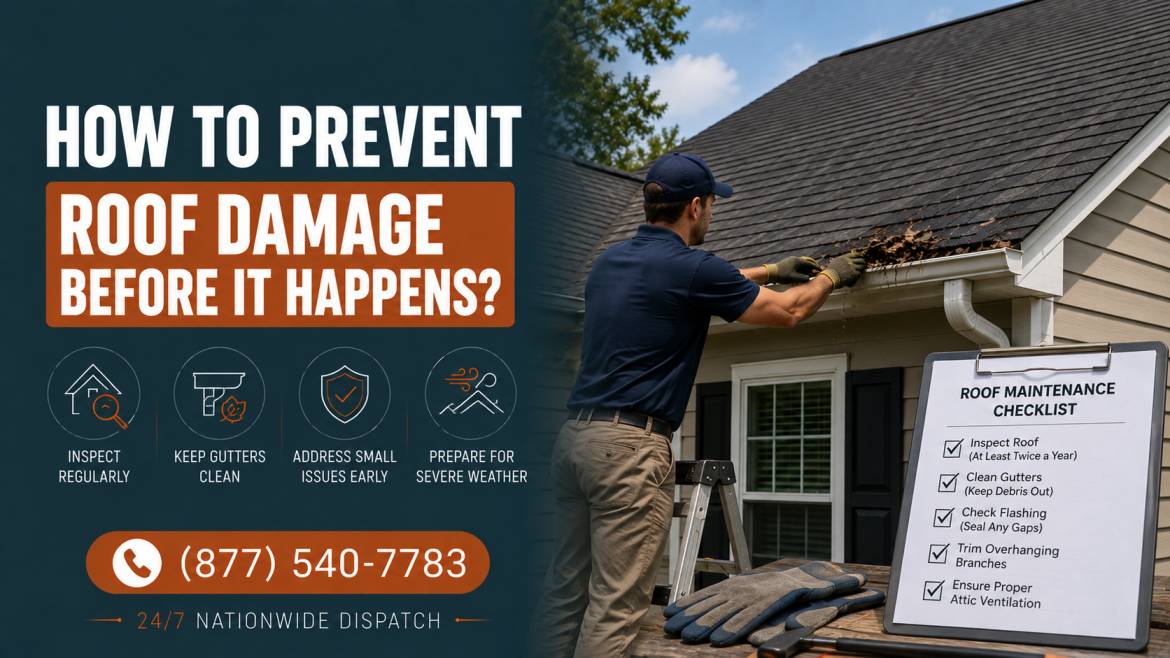
Nine tips. Clean your gutters, trim your trees, check your attic, schedule an inspection. Nearly every roof maintenance article on the internet contains some version of the same list, presented with equal weight and no real sense of which item actually moves the needle.
That equal-weight presentation is the problem. Clearing a gutter and installing a sealed roof deck are both "prevention," but they are not remotely comparable in impact, cost, or the kind of damage each one actually stops. A homeowner deciding where to spend the next weekend, or the next thousand dollars, deserves a clearer sense of priority than a flat checklist provides.
This guide ranks prevention measures by verified effectiveness rather than treating every tip as equally important, using real insurance discount data as one concrete way to separate the measures that genuinely change risk from the ones that mostly just feel productive. It connects to the roof damage overview, and for any inspection needed to confirm where a specific roof stands, the services directory covers the available options.
What Prevents Roof Damage Most Effectively?
Insurance carriers have already done the hard work of ranking prevention measures, whether homeowners realize it or not. The discount a carrier offers for a given feature is effectively a market-tested measure of how much that feature actually reduces risk, since insurers have no incentive to discount something that does not measurably lower claims.
A Verified Effectiveness Ranking
Florida's wind mitigation inspection program, documented on the state-standardized OIR-B1-1802 form, publishes discount ranges by feature category. These figures come from a single, well-documented regulatory program, but the relative ranking they reveal, which features matter most, holds up as a useful guide well beyond Florida's borders.
Prevention Feature | Documented Discount Range | What It Addresses |
|---|---|---|
Opening protection (shutters, impact windows) | Up to 44% | Wind-borne debris entry, not roof-specific but caps overall savings |
Roof-to-wall connections (hurricane clips or straps) | Up to 35% | Whole-roof uplift failure during high wind |
Code-compliant roof covering | Up to 14% | Material and installation quality overall |
Secondary water resistance (sealed roof deck) | Up to 8% | Water intrusion if the covering is lost |
Roof deck attachment (nailing pattern) | Up to 5% | Deck-level wind resistance |
In practice: the roof-specific features on this list, roof-to-wall connections, covering quality, sealed decking, and nailing pattern, can combine for a substantial discount even without impact-rated windows. That combination is also, not coincidentally, close to what the FORTIFIED roof standard requires as a complete package rather than as separate, optional upgrades.
Why This Ranking Matters Beyond Insurance
The dollar figures are specific to wind risk and specific to Florida's program, but the underlying lesson generalizes cleanly. Structural, whole-assembly measures, sealed decking and secure fastening, consistently outrank surface-level or occasional maintenance tasks in terms of actual risk reduction. That does not mean routine maintenance is worthless. It means the biggest gains come from a smaller number of higher-impact decisions than the typical nine-item list suggests.
What Maintenance Actually Matters?
Roof maintenance covers the recurring tasks that catch small problems before they compound, and its value comes specifically from timing rather than from any single dramatic intervention.
A Seasonal Structure That Actually Works
Season | Priority Tasks |
|---|---|
Spring | Post-winter inspection, clear debris, check for ice dam damage |
Summer | Attic temperature check, address any storm damage promptly |
Fall | Clear gutters and valleys before leaf drop compounds, pre-winter inspection |
Winter | Monitor for ice dams, avoid unnecessary roof access |
The National Roofing Contractors Association recommends inspection twice yearly, timed to bracket the two seasons that place the most stress on a roof. That baseline schedule catches the majority of developing problems before they progress into an active leak.
What Homeowners Can Reasonably Do Themselves
Visual ground-level inspection with binoculars after any storm
Clearing accessible gutters and downspouts from a stable ladder position
Trimming reachable branches before they contact the roofline
Checking the attic for daylight, moisture, or pest activity with a flashlight
What Consistently Requires a Professional
Anything involving roof access on a wet, steep, or aging surface belongs with a professional, along with flashing work, structural assessment, and any diagnosis requiring a trained eye for subtle wear patterns. Roof wear and aging accelerates measurably faster on a roof where maintenance has been deferred, which is the core argument for staying on schedule even when nothing looks obviously wrong.
How Does Attic Ventilation Protect a Roof?
Attic ventilation works by keeping the roof deck close to outside air temperature, removing the heat differential that drives several distinct damage mechanisms at once.
The Mechanics of Balanced Ventilation
The International Residential Code requires at least one square foot of net free ventilating area per 150 square feet of attic floor area, a ratio that relaxes to 1:300 once at least half the ventilation sits high with balanced intake below.
Intake at the soffit and exhaust near the ridge have to work together, not independently
Blocked soffit intake, often from insulation pushed too far into the eave, undermines the whole system
Mixed exhaust types, such as a ridge vent combined with gable vents, can short-circuit airflow between themselves
A correctly balanced system prevents both summer heat buildup and winter condensation
What Poor Ventilation Actually Causes
Attic moisture is the most direct sign of a ventilation imbalance, appearing as condensation or frost well before any actual roof breach exists. Left uncorrected, that same imbalance accelerates shingle aging from below at the same rate UV exposure ages it from above, and it is a primary contributing factor behind ice dams in cold climates specifically.
How Does Attic Insulation Affect Roof Performance?
Attic insulation and ventilation solve two different halves of the same underlying problem, and confusing the two is one of the most common mistakes in roof prevention planning.
Insulation's Specific Role
Insulation keeps conditioned indoor air separated from the attic, reducing the heat that escapes upward and warms the roof deck from below. Ventilation then removes whatever heat does escape. Both need to function correctly for either one to meaningfully protect the roof.
Component | Job | Failure Mode If Inadequate |
|---|---|---|
Insulation | Keeps heat inside the living space | Warm deck melts snow unevenly, driving ice dams |
Ventilation | Removes heat that does escape | Trapped heat bakes shingles from below |
Does attic insulation prevent ice dams is one of the more searched questions in this space, and the honest answer is that insulation alone is only half the fix. A warm roof deck, caused by inadequate insulation, melts snow unevenly regardless of how good the ventilation is, which is exactly the mechanism behind most ice dam formation.
Coverage at the Eaves Is Where Most Attics Fall Short
Baffles that maintain an air channel at the eave, combined with insulation depth that extends fully to the exterior wall plate rather than stopping short, address the two most common installation gaps found during attic inspections.
How Does Roof Drainage Prevent Damage?
Roof drainage keeps water moving off the roof and away from the structure, and every component in that path has to function for any single one of them to matter.
The Full Drainage Path
The covering's slope carries water toward the edge by design
Valleys channel combined runoff from converging roof planes
Gutters collect that runoff and direct it toward downspouts
Downspouts discharge water well clear of the foundation
What Causes Drainage to Fail
Clogged gutters are the most common failure point, and their consequences extend well beyond the gutter itself. Overflow saturates the fascia behind the gutter, which can eventually compromise the fastening holding the whole system in place. Animal and pest damage frequently compounds this cycle, since overflowing, debris-filled gutters create exactly the damp, sheltered conditions wildlife favor.
Gutter clearing frequency should scale with overhanging tree cover, with heavily shaded roofs needing attention considerably more often than an open, sun-exposed roof of the same size. Gutter repair addresses the mechanical side of drainage failure once debris alone is no longer the issue.
Which Landscaping Choices Protect a Roof?
Landscaping decisions made when a tree is planted continue affecting a roof for decades, which makes this one of the longest-horizon prevention decisions a homeowner ever makes.
Clearance Guidelines That Balance Risk and Practicality
Six to ten feet of clearance between the canopy and the roof plane is the general working guideline most arborists and roofing professionals recommend, removing abrasion contact, reducing debris load, and admitting enough sunlight to discourage moss establishment.
Tree and debris damage covers both mechanisms clearance addresses: the sudden impact risk from a falling limb and the slow abrasion risk from a branch that repeatedly contacts the roof in wind. Trimming for clearance protects against both simultaneously, which is not true of every prevention measure in this guide.
Species and Growth Habits Matter as Much as Distance
Brittle, fast-growing species with a documented history of unexpected limb failure warrant more conservative clearance than slower-growing, structurally sound species positioned at an identical distance. Shade from any species, regardless of limb strength, still creates the sustained moisture conditions moss depends on to establish itself.
Are Impact-Resistant Shingles Worth It?
Impact resistant shingles address hail risk specifically, and the UL 2218 rating system gives homeowners a concrete, testable way to compare products before deciding whether the upgrade justifies its cost.
Understanding the Class 4 Rating
UL 2218 tests impact resistance by dropping a steel ball onto the material and rating the result from Class 1 through Class 4. A Class 4 rating requires the material to survive a 2-inch steel ball dropped from 20 feet, the highest tier the standard defines.
Class | Test Condition | Practical Meaning |
|---|---|---|
Class 1 | 1.25-inch steel ball | Baseline impact resistance |
Class 2 | 1.50-inch steel ball | Moderate resistance |
Class 3 | 1.75-inch steel ball, dropped from 17 feet | Strong resistance |
Class 4 | 2-inch steel ball, dropped from 20 feet | Highest available rating |
Is the Upgrade Worth the Cost?
Are class 4 shingles worth it depends heavily on regional hail frequency. In consistently high-hail states, the combination of reduced claim frequency, potential insurance discounts, and fewer disruptive repairs tends to justify the upfront premium over the roof's service life. In low-hail regions, a standard architectural shingle may offer comparable practical value at a lower cost.
Hail damage covers the mechanism Class 4 materials are specifically engineered to resist, including why the failure mode differs meaningfully between a rated and an unrated product under the identical impact. Isolated damage on an existing unrated roof is still typically addressed through targeted shingle repair rather than a wholesale material upgrade.
What Is Wind Mitigation and How Does It Reduce Risk?
Wind mitigation roof features address the structural assembly beneath the covering rather than the covering's surface alone, which is why they carry the largest documented insurance discounts of any category in this guide.
The Core Wind Mitigation Features
A sealed roof deck, using self-adhering membrane rather than standard felt underlayment
Enhanced roof-to-wall connections, using clips or straps rather than simple toenailing
Ring-shank or enhanced nailing patterns securing the deck itself
A roof shape and covering rated to the applicable wind speed standard
What is a sealed roof deck is one of the more common questions homeowners have once they encounter the term during a wind mitigation inspection, and the answer is straightforward: it is a fully adhered waterproof membrane applied directly to the deck before the covering goes on, so that even if wind strips the shingles away entirely, the membrane still keeps water out.
How the Inspection Process Works
A wind mitigation inspection is a standardized evaluation, distinct from a general roof inspection, that documents these specific features for insurance purposes. It typically takes under an hour, focuses on the attic for deck attachment and connector type, and results in a form submitted directly to the insurance carrier.
Roof damage insurance covers how these documented features translate into an actual premium adjustment, since the discount itself is applied by the carrier once the inspection report is received rather than being automatic upon installation. Insurance claim help can also clarify whether existing mitigation features were properly documented on a prior policy if a discount seems to be missing.
What Can Homeowners Do Themselves Versus What Requires a Professional?
Bringing every measure in this guide together, a clear pattern emerges: the highest-effort, highest-cost interventions also tend to be the ones carrying the largest verified impact, while the lowest-cost, homeowner-manageable tasks matter most as a way of catching problems the bigger investments have not yet addressed.
A Practical Priority Order
Confirm the roof deck's condition and attachment quality during any inspection or repair
Address ventilation and insulation together, since neither works fully without the other
Maintain drainage and landscaping clearance as ongoing, lower-cost recurring tasks
Consider impact-resistant materials specifically in high-hail regions at the next replacement cycle
Pursue a formal wind mitigation inspection where the documented discount justifies the cost
An emergency roof inspection is the practical starting point for most of this list, since it is the only way to confirm which of these measures a specific roof already has versus which represent a genuine gap. Where the gap is significant enough, that inspection sometimes points toward full roof replacement as the more efficient path to closing several of these gaps simultaneously.
Which States See the Most Distinctive Prevention Priorities?
Prevention priorities shift considerably by region, driven by which specific risks dominate the local climate.
Florida, where the state-standardized wind mitigation program provides the clearest documented discount data available anywhere
Alabama, home to one of the most established FORTIFIED certification programs nationally
Washington, where sustained rainfall and shade make drainage and moss prevention the dominant concern
Minnesota, where insulation and ventilation together directly determine ice dam risk each winter
Texas, with hail frequency driving strong demand for impact-resistant material upgrades
Colorado, sharing that same hail-driven demand along a different seasonal pattern
California, where ember-resistant ventilation screening is a distinct wildfire-specific prevention priority
Wind mitigation inspection services across Florida benefit from the clearest, most standardized discount documentation of any state in the country. FORTIFIED roof services in Alabama reflect the state's leading position in certified construction adoption.
Roof drainage and moss prevention across Washington addresses the Pacific Northwest's defining combination of sustained shade and rainfall. Insulation and ventilation services in Minnesota directly targets the state's severe ice dam risk each winter season.
Impact-resistant roofing across Texas and hail-resistant material upgrades in Colorado both reflect elevated hail frequency, though on different seasonal timelines tied to each state's specific storm patterns. Ember-resistant ventilation services across California rounds out the group, addressing a wildfire-specific prevention priority most other states never need to consider.
Frequently Asked Questions About Preventing Roof Damage
How Can I Make My Roof Last Longer?
Balanced attic ventilation and adequate insulation together address the single largest controllable factor in roof lifespan, since they reduce the thermal stress that ages materials from below. Combined with routine seasonal maintenance and prompt repair of any storm damage, these measures meaningfully extend a roof's real-world service life beyond its rated minimum.
How Do I Protect My Roof from Storms?
Wind mitigation features, particularly a sealed roof deck and secure roof-to-wall connections, address storm risk more directly than any single maintenance task, since they target the structural failure points a severe storm actually tests. Landscaping clearance and gutter maintenance provide additional, lower-cost protection against secondary storm-related damage.
What Maintenance Does a Roof Actually Need?
A twice-yearly inspection covering the exterior, gutters, and attic catches most developing problems before they progress. Beyond that baseline, prompt attention to any storm damage and periodic gutter clearing address the majority of maintenance needs for a typical residential roof.
Are Impact-Resistant Shingles Worth the Extra Cost?
It depends heavily on regional hail frequency. In consistently high-hail states, the combination of fewer disruptive repairs and potential insurance discounts often justifies the upfront cost. In lower-hail regions, the practical value is less clear-cut.
What Is a Wind Mitigation Inspection and Do I Need One?
It is a standardized inspection documenting specific storm-resistant features for insurance purposes, distinct from a general roof inspection. It is worth pursuing in any region where carriers offer meaningful discounts for the documented features, particularly coastal and high-wind states.
Does Attic Insulation Really Prevent Ice Dams?
Insulation addresses half the mechanism, keeping the roof deck cold by preventing heat loss from the living space below. Ventilation addresses the other half, removing whatever heat does escape. Both need to function together, since insulation alone without adequate ventilation still leaves the deck vulnerable to uneven warming.