
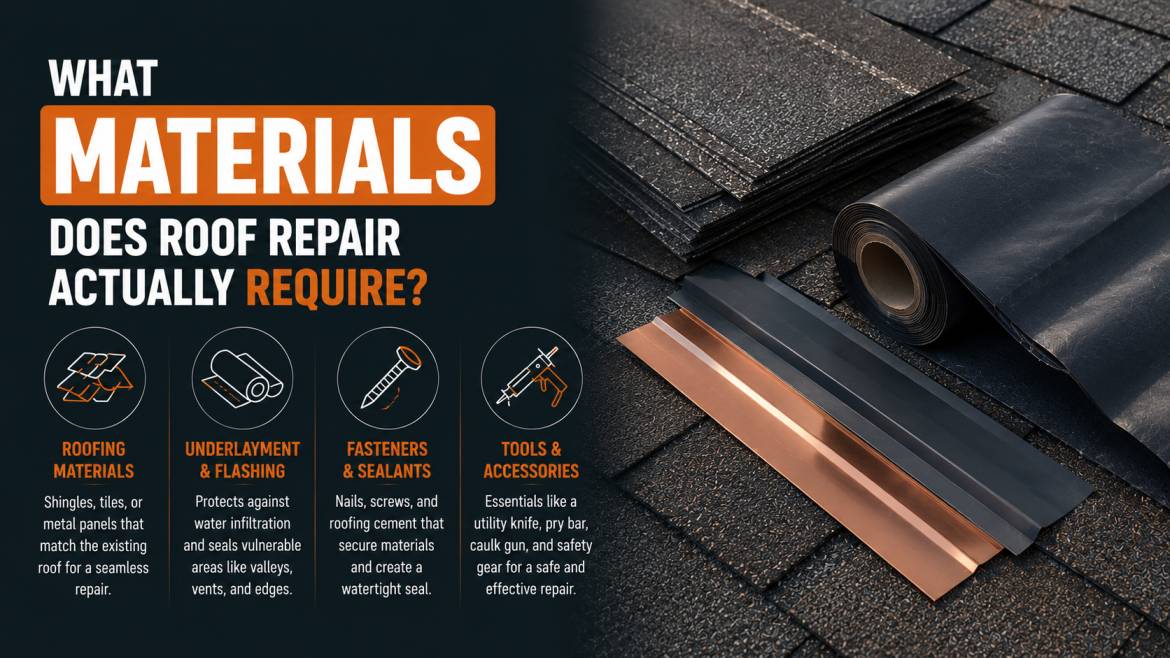
Search for a roof repair materials list and every result reads the same way: shingles, underlayment, flashing, nails, sealant, presented as a flat inventory with a one-line description each. That list is not wrong. It is just incomplete in the way that matters most, since it treats every material as equally relevant to every repair, when in practice a flashing reseal and a full section replacement draw from almost entirely different parts of that list.
Materials also split cleanly into a quality tier most lists never mention. A ring-shank roofing nail and a standard smooth-shank nail from a general hardware aisle can look nearly identical while performing very differently once a roof is tested by real wind. Understanding that distinction, not just the name of each material, is what separates a repair built to last from one that looks finished on day one.
This guide organizes roof repair materials by the function they serve, covers how much of each a typical job actually requires, and explains the grade difference between contractor-sourced and general retail materials. It connects to the broader roof repair process, and the roofing damage repair services directory covers professional sourcing and installation for every material category below.
What Materials Does a Roof Repair Actually Need?
Every roof repair material falls into one of four functional categories, and knowing which category a specific repair draws from is more useful than memorizing a flat list.
The Four Material Categories
Category | Function | Examples |
|---|---|---|
Water-shedding | Primary weather barrier | Shingles, membrane roofing |
Waterproofing layers | Secondary and targeted protection | Underlayment, ice and water shield |
Sealing and transitions | Closes joints and penetrations | Flashing, roofing cement, sealant tape |
Fastening and structure | Holds everything in place | Nails, screws, decking, adhesive |
In practice: a homeowner comparing a repair quote against a generic materials list often assumes every category applies to their specific job. A flashing reseal draws almost entirely from the third category, while a full section replacement draws from all four, which is one reason two repairs described in a single sentence, "fix the leak," can require completely different shopping lists. An emergency roof inspection confirms which categories a specific repair genuinely needs before any material gets ordered.
Why Function Matters More Than Material Name?
Roof repair methods determines which material categories a given job actually touches, since spot patching, section replacement, and reflashing each pull from a different combination of the four categories above. Confirming the method first, before assembling a materials list, prevents both under-ordering and paying for material a specific repair was never going to use.
Which Materials Handle Water Shedding?
The primary weather surface is what most homeowners picture when they think about roof repair materials, and it carries more internal variation than the single word "shingles" suggests.
Asphalt Shingle Categories
Shingle Type | Layers | Typical Use |
|---|---|---|
Three-tab | Single layer, flat profile | Economical repairs and full roofs |
Architectural | Multi-layer, dimensional | Most common current installation |
Starter strip | Specialized edge product | First course at the eave, not a field shingle |
Starter strip deserves specific attention, since it is frequently overlooked on a materials list despite being structurally different from field shingles. It provides the sealed, wind-resistant edge the first course depends on, and substituting a cut-down field shingle in its place produces a weaker eave than the product designed for that specific location.
Membrane Materials for Low-Slope Sections
Roofing materials covers the full comparison across every material family, but flat and low-slope sections specifically draw from a separate set of products: TPO, EPDM, and modified bitumen, each requiring its own compatible adhesive, seam tape, and primer rather than asphalt shingle materials.
Which Materials Provide Waterproofing Beneath the Surface?
A second, less visible material layer exists specifically to catch what the primary covering does not, and its condition matters as much as the visible shingles above it.
Underlayment and Ice Barrier Compared
Material | Function | Where It Is Used |
|---|---|---|
Asphalt-saturated felt | Traditional secondary barrier | General field coverage |
Synthetic underlayment | Lighter, more durable alternative | Increasingly standard field coverage |
Ice and water shield | Self-adhering, puncture-resistant membrane | Eaves, valleys, and penetrations |
Ice dams are the specific reason ice and water shield exists as a distinct product from standard underlayment. Its self-sealing adhesive backing closes around fastener penetrations and resists the backed-up water an ice dam forces uphill, a condition ordinary felt underlayment was never designed to withstand. Ice dam removal covers clearing the ice itself before any repair material can be properly installed underneath it.
Why Underlayment Choice Affects Repair Longevity?
Synthetic underlayment has become the more common choice in new work specifically because it resists tearing during installation and holds up better to brief weather exposure before the covering goes on top of it. A repair using felt underlayment is not inherently inferior, but it demands more careful handling during a repair performed in marginal weather.
Which Materials Seal Joints and Penetrations?
This category accounts for a disproportionate share of repair failures relative to how small the individual components are, since it depends entirely on correct installation sequence rather than raw material durability.
Flashing and Sealant Materials
Step flashing, individual pieces woven into each shingle course along a wall or chimney
Counterflashing, set into a mortar joint and overlapping step flashing below it
Valley flashing, lining the channel where two roof planes converge
Roofing cement or sealant, used at penetrations and as a secondary seal, never as a substitute for properly layered metal
Flashing tape, a self-adhesive alternative increasingly used for smaller penetration repairs
In practice: roofing cement and sealant are frequently misapplied as the primary fix for a flashing failure rather than as the finishing detail on top of correctly layered metal. A joint sealed with cement alone, without the metal flashing beneath it doing the structural work, typically fails again within a season regardless of how much sealant was applied. Chimney flashing repair addresses this exact failure pattern at one of the highest-frequency leak locations on a roof.
Why Flashing Material Choice Depends on Location?
Roof flashing covers the full mechanics of how each flashing type functions, but the material choice itself, aluminum, galvanized steel, or copper, depends heavily on what the flashing contacts. Copper flashing against untreated aluminum gutters, for instance, can accelerate corrosion through a galvanic reaction, which is why matching flashing material to adjacent components matters as much as matching it to the roof covering.
What Fasteners and Structural Materials Are Used?
Fasteners and decking rarely get the attention shingles receive, despite holding the entire visible system in place.
Fastener Types and Their Purpose
Fastener | Best Suited For | Why |
|---|---|---|
Smooth-shank roofing nail | General field installation | Standard holding power for typical conditions |
Ring-shank roofing nail | High-wind areas and re-securing loose shingles | Rings resist pull-out considerably better than smooth shanks |
Galvanized or stainless fasteners | Coastal and high-corrosion environments | Resists rust that a standard fastener would not |
The difference between a ring-shank and smooth-shank nail is not cosmetic. Ring-shank nails resist being pulled straight out of the decking under wind uplift considerably more effectively, which is why they are the specified fastener for re-securing shingles that have already lifted once and for any repair in a documented high-wind region.
Decking Materials
Roof decking replacement, where needed, draws from plywood or oriented strand board, sized to match the existing deck's thickness. A repair that discovers rotted decking during tear-off needs this material on hand or quickly sourced, which is why a reputable estimate specifies a per-sheet allowance rather than assuming sound decking throughout. Shingle repair covers the isolated, material-driven cases where decking and fastening are the main concern rather than a full tear-off.
How Much Material Does a Repair Actually Require?
Material quantity follows a set of standard coverage ratios that make estimating a repair's material needs considerably more precise than guessing.
Standard Coverage Ratios
Material | Coverage Rate |
|---|---|
Asphalt shingles | Roughly 3 bundles per square (100 square feet) |
Standard felt underlayment (#15) | One roll typically covers about 4 squares |
Ice and water shield | Coverage varies by roll width, typically 2 to 3 squares per roll |
A 10% waste allowance on top of the measured area is standard industry practice, accounting for cutting waste at hips, valleys, and edges. A repair covering roughly two squares of visible damage should reasonably budget for closer to 2.2 squares of actual material once that allowance is included.
Why Quantity Estimation Matters for a Homeowner?
Roof repair pricing is directly tied to these quantities, and a homeowner who understands the standard coverage ratios can sanity-check a materials line item on an estimate rather than accepting the total figure without any independent reference point.
Contractor-Grade Versus Retail-Grade Materials: What Is the Real Difference?
This is the distinction most materials lists skip entirely, and it explains why two repairs using products with similar names can perform very differently over time.
Where the Grade Difference Actually Shows Up?
Factor | Contractor-Sourced | General Retail |
|---|---|---|
Fastener quality | Ring-shank, code-compliant length | Often smooth-shank, generic length |
Underlayment weight | Heavier, more tear-resistant synthetic | Lighter-weight consumer-grade product |
Flashing gauge | Heavier gauge metal, longer service life | Thinner gauge, shorter effective life |
Manufacturer certification | Access to enhanced, labor-backed warranties | Material-only coverage at best |
In practice: the visible difference between a contractor-grade and retail-grade repair is often minimal on day one. The gap shows up years later, in fastener pull-out during a wind event a properly specified nail would have resisted, or in underlayment that tore during a routine service visit that a heavier product would have survived undamaged.
How This Connects to Repair Quality and DIY Boundaries?
How to tell if a roof repair was done correctly covers verification steps that apply regardless of material grade, but grade sets the ceiling on how durable a correctly executed repair can actually be. What roof repair work homeowners should never attempt covers the access and safety boundary separately from material sourcing, though the two often intersect, since retail suppliers rarely stock the full contractor-grade product range even for a homeowner willing to attempt the physical work themselves.
Which States See the Most Distinctive Material Requirements?
Material specification varies by state, driven primarily by building code requirements tied to regional climate risk.
Minnesota, where code mandates ice and water shield at eaves in a way milder climates do not require
Wisconsin, sharing similar cold-climate ice barrier requirements with its regional neighbor
Florida, where wind-rated fastening and flashing specifications exceed general national standards
Texas, with material demand shaped heavily by the state's leading national hail frequency
Colorado, where Front Range hail exposure drives strong demand for impact-rated shingle products
Ice barrier and underlayment requirements across Minnesota reflect a code mandate rather than an optional upgrade, given the state's genuinely elevated ice dam risk. Cold-climate roofing materials in Wisconsin follows a closely related pattern tied to comparable regional exposure.
Wind-rated material sourcing across Florida operates under fastening and flashing specifications that exceed general national code minimums, tied directly to the state's hurricane exposure. Hail-resistant material sourcing in Texas sees consistently strong demand for Class 4 rated products given the state's leading hail frequency nationally. Impact-rated shingle materials across Colorado rounds out the group, reflecting the Front Range's history of severe, damaging hailstorms.
Frequently Asked Questions About Roof Repair Materials
What Materials Are Needed for a Basic Roof Repair?
A basic isolated repair typically needs matching shingles, roofing nails, and sealant or roofing cement at any disturbed edges. A repair involving a flashing point adds flashing material specifically, while a repair reaching the decking adds plywood or OSB sheathing.
How Many Shingles Do I Need for a Small Repair?
Asphalt shingles cover roughly one square, 100 square feet, per three bundles. A small, isolated repair covering a few square feet typically uses well under a full bundle, though most suppliers sell by the bundle rather than by the individual shingle.
What Is the Difference Between Felt and Synthetic Underlayment?
Felt underlayment is the traditional asphalt-saturated option, while synthetic underlayment is a newer, generally lighter and more tear-resistant alternative that has become increasingly standard. Both provide secondary water protection, with synthetic generally offering better durability during installation and brief weather exposure.
Do I Need Ice and Water Shield for a Repair, or Is Regular Underlayment Enough?
It depends on location and climate. Eaves, valleys, and penetrations in cold-climate regions typically require ice and water shield specifically, often as a code mandate, while other field areas can generally use standard underlayment.
Why Does Nail Type Matter for a Roof Repair?
Ring-shank nails resist pull-out under wind uplift considerably better than smooth-shank nails, which is why they are specified for re-securing shingles that have already lifted once and for installations in documented high-wind regions.
Is There a Real Difference Between Contractor-Grade and Store-Bought Roofing Materials?
Yes. Contractor-sourced materials generally include heavier-gauge flashing, more tear-resistant underlayment, and fastener specifications suited to local wind conditions, along with access to manufacturer-backed warranties that general retail products typically do not qualify for.