
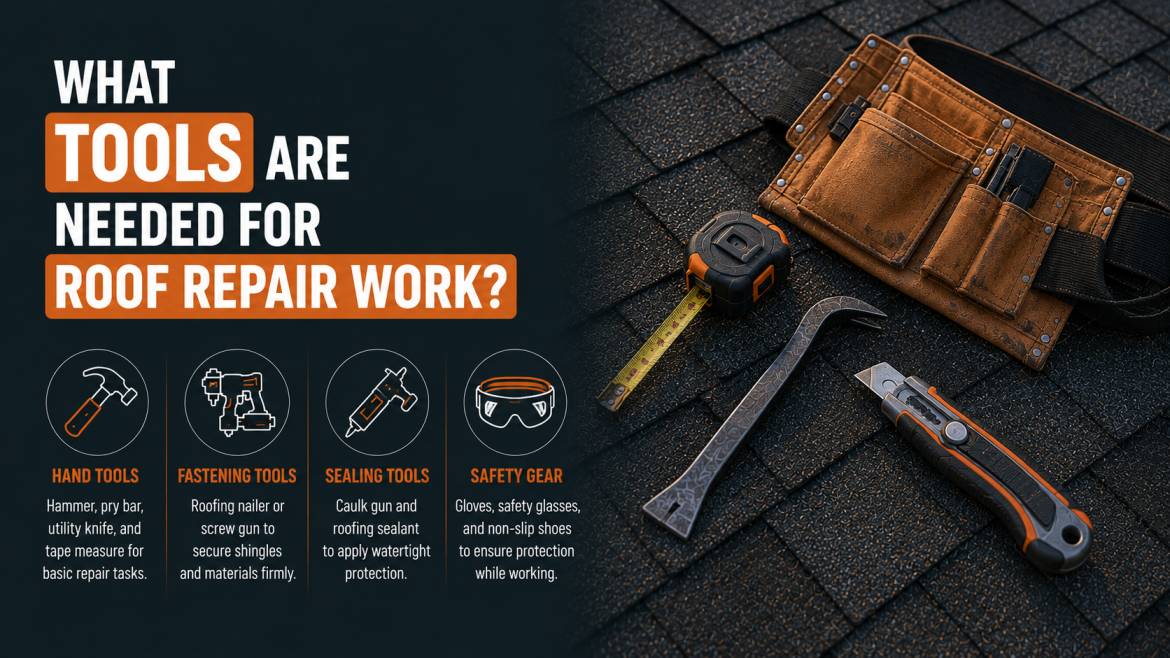
A typical roof repair tools list puts a hammer, a utility knife, and a fall-arrest harness in the same bulleted section, as though owning all three qualifies a person to use any of them safely. A hammer requires no training. A harness rated to a specific OSHA standard, connected to an anchor engineered to hold 5,000 pounds of force, is a different category of equipment entirely, and treating it as just another item on a shopping list undersells exactly what it is protecting against.
That flattening is the main gap in almost every roof repair tools article available. This guide keeps the two categories separate on purpose: the hand tools genuinely comparable to what a homeowner already owns, and the certified safety and specialty equipment that exists specifically because roofing is dangerous enough to warrant a regulatory standard.
This guide covers both categories in full, plus the specialty and diagnostic tools that separate a professional's toolkit from a basic homeowner kit. It connects to the broader roof repair process, and the services directory covers professional work for anything beyond the reasonable DIY boundary.
What Tools Does a Roof Repair Actually Require?
Roof repair tools split into four functional categories, and only one of them, hand tools, genuinely overlaps with equipment most homeowners already own.
The Four Tool Categories
Category | Examples | Typical Owner |
|---|---|---|
Hand tools | Hammer, pry bar, utility knife, chalk line | Often already owned by homeowners |
Fastening tools | Nail gun, caulking gun | Sometimes owned, often rented |
Safety equipment | Harness, anchor, lanyard, roof jacks | Almost always professional-only |
Specialty and diagnostic tools | Flashing brake, moisture meter, thermal camera | Professional equipment |
In practice: the line between "tool a homeowner can reasonably use" and "equipment requiring training and certification" falls almost exactly at the boundary between hand tools and safety equipment. That boundary is the single most useful thing this guide can establish before covering any individual item.
Why Tool Needs Change with Repair Method?
Roof repair methods determines which tools a specific job actually requires, since spot patching draws primarily from hand tools while reflashing and section replacement pull in fastening tools and, on any roof beyond a walkable pitch, the full safety equipment stack.
What Hand Tools Are Used in Roof Repair?
Hand tools cover the physical manipulation of shingles, underlayment, and fasteners, and most of them are general-purpose tools already familiar from other home projects.
The Core Hand Tool List
Hammer or pry bar, for removing damaged shingles and their fasteners
Hook-blade utility knife, which grips shingle material for a cleaner cut than a standard blade
Chalk line, for maintaining straight, even courses across a repair section
Flat or scraper shovel, for removing old shingles across a broader area
Tin snips, for cutting flashing and metal drip edge to size
Why a Hook-Blade Utility Knife Specifically?
A standard utility knife blade tends to drag across a thick shingle rather than cutting cleanly through it, particularly on architectural products with multiple laminated layers. A hook-blade design catches into the material instead, producing a straighter, more controlled cut, which matters directly for matching roofing materials cleanly at a repair boundary rather than leaving a ragged, visible edge.
What Fastening Tools Does a Repair Need?
Fastening tools bridge hand tools and more specialized equipment, and the choice between manual and powered options changes both cost and pace.
Manual Versus Powered Fastening
Tool | Cost Range | Best Suited For |
|---|---|---|
Hammer | Minimal, likely already owned | Small, isolated repairs |
Pneumatic roofing nailer | Roughly $200 to $400 for the tool alone | Larger repairs or full sections |
Caulking gun | Minimal | Sealant application at penetrations and edges |
A pneumatic nailer speeds up any repair involving more than a handful of shingles considerably, but the tool cost alone, before factoring in an air compressor and the nails themselves, often exceeds what a small, isolated repair would cost to simply hire out. This crossover point is worth calculating honestly before purchasing equipment for a single small job.
Why Nail Placement Still Matters with a Powered Tool?
A pneumatic nailer does not correct for incorrect placement automatically. Nails driven above or below the manufacturer's designated nailing zone fail to engage the reinforced strip regardless of whether they were driven by hand or by an air-powered gun, which is why tool choice affects speed but not the underlying installation standard.
What Safety Equipment Is Actually Required?
This is the category every generic tools list undersells, and the specifics matter enough to warrant a dedicated, technical explanation rather than a single bullet point.
The Fall Protection System, Explained Component by Component
OSHA's fall protection standard requires continuous protection on roofs with slopes greater than 4:12, and a complete personal fall arrest system, not any single component alone, is what satisfies that requirement.
Component | Function |
|---|---|
Full-body harness | Distributes fall-arrest force across the body via shoulder, chest, and leg straps |
Dorsal D-ring | The back-mounted attachment point connecting the harness to the rest of the system |
Lanyard or self-retracting lifeline | Connects the harness to the anchor, arresting a fall in progress |
Anchor point | A structurally secured attachment point rated to hold the fall-arrest load |
In practice: OSHA requires a roof anchor point to sustain a minimum tensile load of 5,000 pounds of force per attached worker. That figure is not an arbitrary safety margin, it accounts for the actual force a body generates during a fall before the system arrests it, which is why an anchor has to be installed on a genuine structural member rather than a decorative or non-load-bearing component.
Personal Fall Arrest Versus Fall Restraint?
A personal fall arrest system, the standard for roofing work, is engineered to stop a fall already in progress and limit both the distance fallen and the force experienced. A fall restraint system instead prevents a worker from reaching an edge at all. Roofing typically requires access to edges and valleys, which is why fall arrest rather than restraint is the standard system for this specific work.
Roof Jacks as a Working Platform
Roof jacks, when properly fastened according to the manufacturer's instructions, provide both a stable working platform on sloped roofs and an additional element of fall protection, though they supplement rather than replace a full harness and anchor system on any roof steep enough to require one in the first place. Roof snow load repairs involving structural work at height depend on this same equipment stack, since the access risk exists independent of what specific repair is being performed once someone is on the roof.
What Specialty and Diagnostic Tools Do Professionals Use?
Beyond hand tools and safety equipment, several tools exist specifically to diagnose conditions invisible to the naked eye, and these rarely appear on a general homeowner tools list at all.
Diagnostic Equipment
Moisture meters, which detect trapped dampness in decking or insulation without removing the covering
Infrared or thermal imaging cameras, which reveal temperature differentials indicating hidden moisture or insulation gaps
Test squares, a marked measurement tool used specifically to document hail impact density for insurance purposes
Roof inspection work increasingly relies on this diagnostic category, since these tools confirm conditions a purely visual inspection cannot, particularly attic moisture that has not yet progressed to a visible interior stain. An emergency roof inspection typically brings this exact diagnostic equipment on site as standard practice.
Material-Specific Specialty Tools
A flashing brake, used to bend and form custom metal flashing on site rather than relying only on pre-formed stock pieces
A seam roller, essential for properly bonding membrane roofing seams on TPO, EPDM, or modified bitumen sections
A shingle removal tool, a specialized flat blade designed to lift shingles and cut nails in one motion, speeding up tear-off considerably compared to a standard pry bar
Which Tools Does a Homeowner Genuinely Need?
Bringing the full tool inventory back to a practical boundary, only a narrow subset genuinely belongs in a homeowner's own toolkit.
The Reasonable Homeowner Tool Set
Tool | Reasonable for Homeowner Use |
|---|---|
Hammer, pry bar, utility knife | Yes, for ground-level or ladder-accessible tasks |
Chalk line, tin snips | Yes, for minor accessible repairs |
Pneumatic nailer | Only if the job scope genuinely justifies the equipment cost |
Fall protection harness and anchor system | No, without proper training and certified installation |
Diagnostic and specialty tools | No, these are professional-grade investments |
What roof repair work homeowners should never attempt covers the safety reasoning behind this boundary in depth, and the tool list above simply makes that same boundary concrete in equipment terms rather than task terms. Owning a harness does not substitute for the anchor installation, inspection, and training that make the full system actually protective rather than a false sense of security.
Renting Versus Buying Specialty Equipment
For homeowners who do fall within the reasonable DIY boundary but need a tool beyond their existing kit, renting a pneumatic nailer or a specific specialty tool for a single job frequently makes more financial sense than purchasing equipment that will see infrequent future use. Tool rental counters at most home improvement suppliers carry the common options, including compressors and nail guns, on a daily or weekly basis. For anything beyond that boundary, shingle repair and storm damage repair cover the professional equivalent without requiring any tool investment at all.
How Do Tool Needs Differ by Repair Method?
Connecting tool selection back to the repair method itself clarifies why two homeowners describing "a roof repair" can need entirely different equipment.
Tools by Method
Spot patching typically needs only hand tools: a pry bar, hammer, utility knife, and sealant
Section replacement adds fastening tools and, on any roof beyond a walkable pitch, the full safety equipment stack
Resealing and reflashing adds tin snips, a flashing brake for custom bends, and sealant application tools
Structural repair adds diagnostic tools to confirm the extent of hidden damage before work begins
How roof repair scope gets decided and tool requirements follow the same underlying logic, since both depend on an accurate diagnosis of what the repair actually involves before either the scope or the tool list can be finalized with any confidence.
Which States See the Most Distinctive Tool and Safety Requirements?
Tool and safety equipment requirements vary by state, driven by both climate conditions and regional regulatory enforcement.
Washington, where sustained wet conditions add slip risk that shapes footwear and platform equipment choices
North Dakota, where extreme cold affects both tool performance and required cold-weather safety gear
Missouri, where storm-driven repair volume keeps professional-grade tool demand consistently high
Nebraska, sharing that same central storm corridor's tool and equipment demand
New Jersey, where coastal wind exposure raises the practical stakes on fall protection equipment specifically
Roof repair tool and equipment services across Washington account for the region's sustained wet conditions in both platform equipment and footwear recommendations for safe roof access. Cold-weather roof repair equipment in North Dakota addresses how extreme cold affects tool performance, from adhesive-dependent caulking guns to the flexibility of safety harness webbing itself.
Storm damage repair tool demand across Missouri stays consistently elevated given the state's tornado alley exposure and the resulting repair volume. Emergency repair equipment needs in Nebraska follows a closely related pattern tied to the same central severe weather corridor. Fall protection and safety equipment standards in New Jersey rounds out the group, where coastal wind exposure during nor'easter season raises the practical stakes on properly rated anchor and harness systems specifically.
Frequently Asked Questions About Roof Repair Tools
What Tools Do I Need for a Basic Roof Repair?
A basic, ground-accessible repair typically needs a hammer or pry bar, a hook-blade utility knife, roofing nails, and sealant or roofing cement. Anything requiring roof access on a pitch beyond a comfortable walking slope adds fall protection equipment to that list.
Do I Need a Harness for a Small Roof Repair?
If the repair requires standing on a roof surface beyond a walkable pitch, or for any extended period, yes. OSHA's fall protection standard applies at heights of 6 feet or more, and a small repair does not reduce the physical fall risk simply because the job itself is minor.
How Much Weight Does a Roof Anchor Need to Hold?
OSHA requires a fall-arrest anchor point to sustain a minimum tensile load of 5,000 pounds of force per attached worker, accounting for the actual force generated during a fall before the system arrests it.
Is a Pneumatic Nail Gun Worth Buying for One Repair?
Usually not for a single small job, given the tool cost alone typically runs $200 to $400 before factoring in an air compressor. Renting the equipment for the specific job, or simply using a hammer for a small enough repair, is often more cost-effective than purchasing.
What Is the Difference Between a Fall Arrest System and a Fall Restraint System?
A fall arrest system stops a fall already in progress and limits the distance and force experienced. A fall restraint system instead prevents a worker from reaching an edge at all. Roofing typically requires edge access, which is why fall arrest is the standard system for this work.
What Tools Do Professionals Use That Most Homeowners Do Not Own?
Diagnostic tools like moisture meters and infrared cameras, along with specialty equipment like a flashing brake for custom metal bending and a seam roller for membrane roofing, rarely appear in a general homeowner toolkit and typically remain professional-grade investments.