
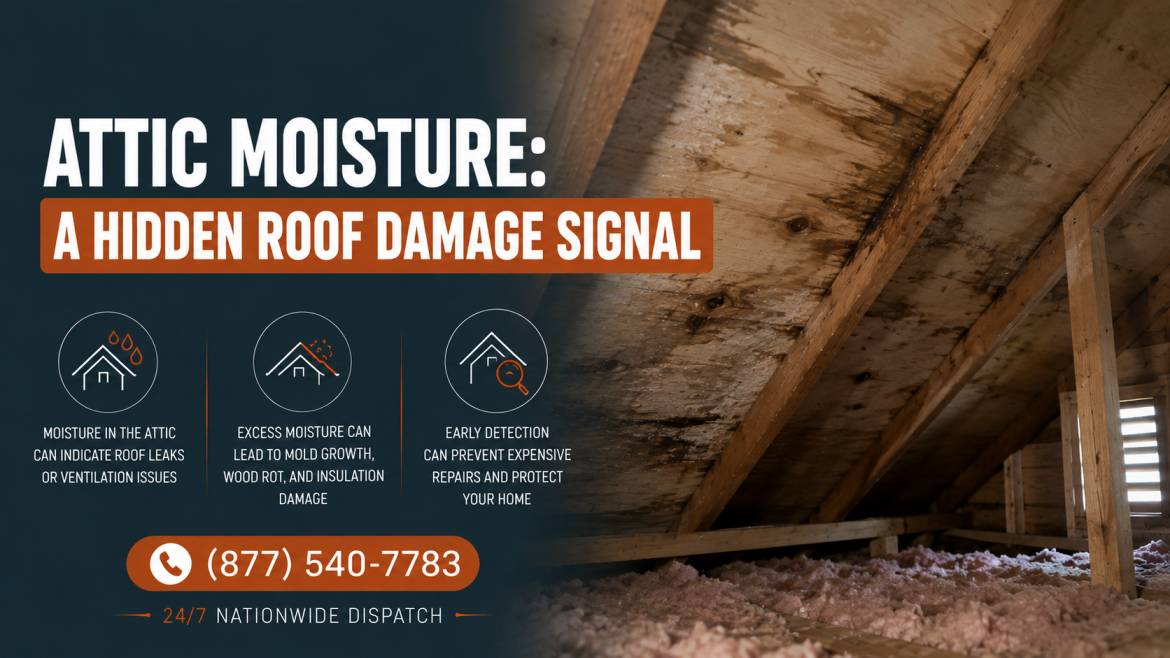
Most homeowners never look in their attic until something forces the issue, usually a stain that has already reached the ceiling below. By the time that happens, the attic has typically been showing evidence of the same problem for weeks or months, unseen simply because nobody looked.
That gap between when evidence appears and when it gets noticed is the central issue this guide addresses. The attic is genuinely the earliest place roof problems become visible, well ahead of any sign that reaches the living space, provided someone actually checks it.
This guide covers what causes attic moisture, how to distinguish an active leak from simple condensation, and what damage trapped moisture causes if it goes unaddressed. It is one entry in the signs of roof damage guide, and for anything found during that check, the services directory covers the available response options.
What Causes Attic Moisture?
Attic moisture traces back to one of two fundamentally different sources, and correctly identifying which one applies changes the entire response, from urgency to the actual fix required.
Active Roof Leaks
A genuine breach in the roof covering admits water directly, and that water shows up in the attic before it ever reaches a finished ceiling. This is the scenario most homeowners picture when they think about attic moisture.
A missing or damaged shingle allowing direct rain entry
Failed flashing at a chimney, skylight, valley, or wall junction
An ice dam forcing meltwater backward under the shingle courses
A cracked or displaced vent boot around a pipe penetration
Condensation From Ventilation Imbalance
The second source has nothing to do with a breach in the covering at all. Warm, moist interior air rises into the attic and contacts the cold underside of the roof deck, condensing into moisture that can look strikingly similar to an active leak.
Attic ventilation exists specifically to prevent this by keeping the roof deck close to outside temperature, removing the temperature differential that condensation depends on. When intake and exhaust vents are blocked, undersized, or imbalanced, that protection breaks down.
Is It a Leak or Condensation?
This is the single most important diagnostic question this guide addresses, since the two sources call for entirely different fixes despite producing visually similar evidence.
The Key Distinguishing Factors
Evidence | Leak Indicator | Condensation Indicator |
|---|---|---|
Location pattern | Concentrated around one penetration or rafter bay | Spread evenly across the underside of the deck |
Timing | Correlates with specific rain events | Appears in cold weather regardless of rain |
Nail condition | Isolated rust near the affected area | Rust or frost on nail tips throughout the attic |
Insulation pattern | Wet in a defined trail or spot | Damp broadly, especially near the eaves |
Seasonal pattern | Can occur any time of year | Most pronounced in winter |
In practice: frost coating every nail tip visible throughout the attic on a cold morning points strongly toward condensation, since a genuine leak would rarely distribute moisture that uniformly across the entire space.
Why Ventilation Imbalance Is So Common
Balanced ventilation requires two components working together: intake low at the soffit and exhaust high at or near the ridge. A surprising number of attics have one half functioning and the other blocked or missing entirely, which undermines the whole system even when it looks adequate from a casual glance.
Insulation pushed too far into the eave blocks the soffit intake
A ridge vent installed without matching soffit intake pulls conditioned air from the house instead
Mixed exhaust types, such as a ridge vent combined with gable vents, can short-circuit airflow between themselves
Bathroom exhaust fans venting into the attic rather than outside add both heat and moisture directly
Any one of these issues alone can be enough to produce visible condensation during a cold winter, even on a roof with an entirely sound covering and no actual breach anywhere.
Following the Evidence to a Conclusion
The most reliable method available to a homeowner is checking the attic during or immediately after a significant rain event, then checking again during a cold, dry stretch of weather.
Enter the attic while it is actively raining, if safely accessible, and look for active dripping
Note whether any wet trail follows a specific path from a high point downward
Return during a cold, dry period and check for frost or condensation on nails and sheathing
Compare the two observations to determine whether moisture correlates with rain or with cold
Moisture appearing only during or after rain confirms an active leak. Moisture appearing during cold, dry weather with no rain involved points toward condensation instead. Some attics genuinely have both problems simultaneously, which complicates the picture but does not change the diagnostic approach.
What Damage Does Trapped Moisture Cause?
Whether the source is a leak or condensation, trapped moisture in an attic causes a predictable cascade of damage if left unaddressed, and the timeline matters more than most homeowners assume.
The Progression of Untreated Moisture
Insulation loses effectiveness once saturated, reducing its ability to regulate temperature
Wood framing and sheathing begin absorbing moisture, weakening over time
Mold growth can establish within 24 to 48 hours in warm, humid conditions
Sustained saturation eventually threatens the structural integrity of the decking itself
Roof wear and aging accelerates measurably faster in an attic with chronic moisture problems, since the combination of dampness and heat compounds the material breakdown that ordinarily happens more slowly under dry conditions.
Mold Specifically
Mold growth in an attic presents a health consideration beyond the structural one, particularly for households with respiratory sensitivities. Musty odor without any visible staining is often the first sign mold has established somewhere in the space, even before visible growth becomes apparent.
Addressing the moisture source is the only durable fix for attic mold. Treating visible growth without correcting the underlying leak or ventilation problem produces a recurrence, typically within the same season.
Insulation and Structural Consequences Compared
The two main categories of damage, insulation loss and structural weakening, progress at noticeably different rates, which affects how urgently each needs to be addressed once identified.
Damage Type | Typical Timeline | Reversibility |
|---|---|---|
Insulation saturation | Weeks to months | Requires full replacement of affected material |
Surface mold growth | 24 to 48 hours in warm, humid conditions | Treatable if caught early |
Framing moisture absorption | Months to years of sustained exposure | Structural assessment needed if advanced |
Decking deterioration | Years of chronic saturation | Often requires replacement at tear-off |
Insulation, once saturated and compressed, rarely returns to its original effectiveness even after drying out completely, which is why replacement rather than simple drying is the standard recommendation for insulation that has been wet for any meaningful length of time.
How Do You Check an Attic Safely?
A basic attic check requires no special equipment beyond a flashlight and sturdy footing, but a few precautions matter for both safety and accuracy.
Preparation and Safety
Use a flashlight bright enough to see into corners and along the full roof plane
Step only on ceiling joists or a stable walkway, never directly on insulation
Wear a mask if mold or heavy dust is suspected before entry
Bring a phone or camera to document any findings with photos
What to Look For
Turning off any attic light and letting eyes adjust to darkness for a full minute reveals evidence that ambient light can otherwise mask, particularly daylight through the roof deck, which confirms a physical breach exists somewhere in the covering.
Beyond visible daylight, check systematically along the roof plane for staining on the underside of the deck, dampness or matting in the insulation, rust on exposed nail tips, and any unusual odor that suggests active mold growth already underway.
When to Call a Professional Instead
Extensive mold coverage, structural damage to framing or decking, or any uncertainty about safe attic access all warrant a professional roof inspection rather than a homeowner attempting to fully diagnose the problem alone.
How Does the Underlying Cause Change the Fix?
Attic moisture is a symptom, and the correct fix depends entirely on which underlying cause produced it, which is why an accurate diagnosis matters more than the visible moisture itself.
When Ice Dams Are the Source
Ice dams produce a distinct pattern of attic moisture, typically concentrated near the eaves and correlating with sustained cold snaps rather than any single rain event. Addressing the visible ice without also correcting the ventilation imbalance driving it results in the same problem recurring the following winter.
When Water Intrusion Is the Source
Water intrusion through wind-driven rain or a compromised flashing joint produces moisture that correlates closely with specific storm events, often with a visible trail leading back toward the actual breach point in the roof covering.
Gutter and Drainage Connections
Gutter repair occasionally resolves what initially looks like a roofing problem entirely. Overflowing or clogged gutters can force water backward under the eave in a way that mimics a genuine roof leak, particularly during heavy, sustained rainfall.
Which States See the Most Attic Moisture Related Roof Concerns?
Attic moisture concerns cluster around states with sustained cold winters, where the temperature differential driving condensation persists for extended periods each year.
Minnesota, with some of the most sustained sub-freezing stretches in the country
Wisconsin, sharing similar lake-effect cold exposure with its regional neighbors
New York, particularly in snowbelt regions with prolonged winter conditions
Michigan, spanning both lake-effect zones and inland sustained cold
Maine, with consistently cold winters across nearly the entire state
Attic moisture inspections across Minnesota frequently trace back to condensation rather than an active breach, given how long the state's sub-freezing stretches hold a significant temperature differential between attic and outside air. Roof and ventilation assessment in Wisconsin follows a closely related pattern tied to comparable lake-effect cold exposure.
Roof repair services across New York deal with this pattern most heavily in snowbelt regions east and south of the Great Lakes. Attic and roof inspection covering Michigan spans both lake-effect zones and inland areas with sustained cold exposure of their own.
Roof services across Maine rounds out the group with consistently cold winters across nearly the entire state, keeping condensation risk elevated for a longer season than milder climates experience.
Frequently Asked Questions About Attic Moisture
What Causes Moisture in an Attic?
Two distinct sources are responsible: an active roof leak admitting water directly, or condensation from warm interior air meeting a cold roof deck due to inadequate ventilation. Both can produce visually similar dampness, which is why correctly distinguishing them matters.
Is Attic Condensation a Roof Problem?
Indirectly, yes, though the roof covering itself is usually not at fault. Condensation typically points toward an attic ventilation imbalance rather than a breach in the shingles, and correcting the ventilation, not repairing the roof surface, is usually the actual fix required.
How Do I Know if Attic Moisture Is From a Leak or Condensation?
Check whether the moisture correlates with rain events or with cold, dry weather. Moisture appearing during or after rain, often following a defined trail, points toward a leak. Moisture appearing broadly during cold snaps, including frost on nail tips throughout the space, points toward condensation.
Can Attic Moisture Cause Mold Even Without an Active Leak?
Yes. Condensation alone provides enough sustained moisture for mold to establish, particularly in a poorly ventilated attic during winter months when the temperature differential between inside and outside is greatest.
How Urgent Is Attic Moisture Compared to Other Roof Signs?
It depends on the source and extent. A small amount of frost during an isolated cold snap is less urgent than active dripping or extensive wet insulation, which both warrant prompt professional assessment regardless of whether the source turns out to be a leak or severe condensation.
Will Fixing Attic Ventilation Resolve Existing Moisture Damage?
Ventilation corrections stop new moisture from accumulating, but they do not repair damage that has already occurred. Saturated insulation, affected framing, or existing mold growth typically require separate remediation alongside the ventilation fix itself.
How Often Should I Check My Attic for Moisture?
Twice yearly, timed around the transitions into and out of the coldest season, catches most developing problems before they progress significantly. An additional check after any major storm or an unusually cold, sustained winter stretch is worth the extra time given how much damage can accumulate unnoticed between routine checks.