
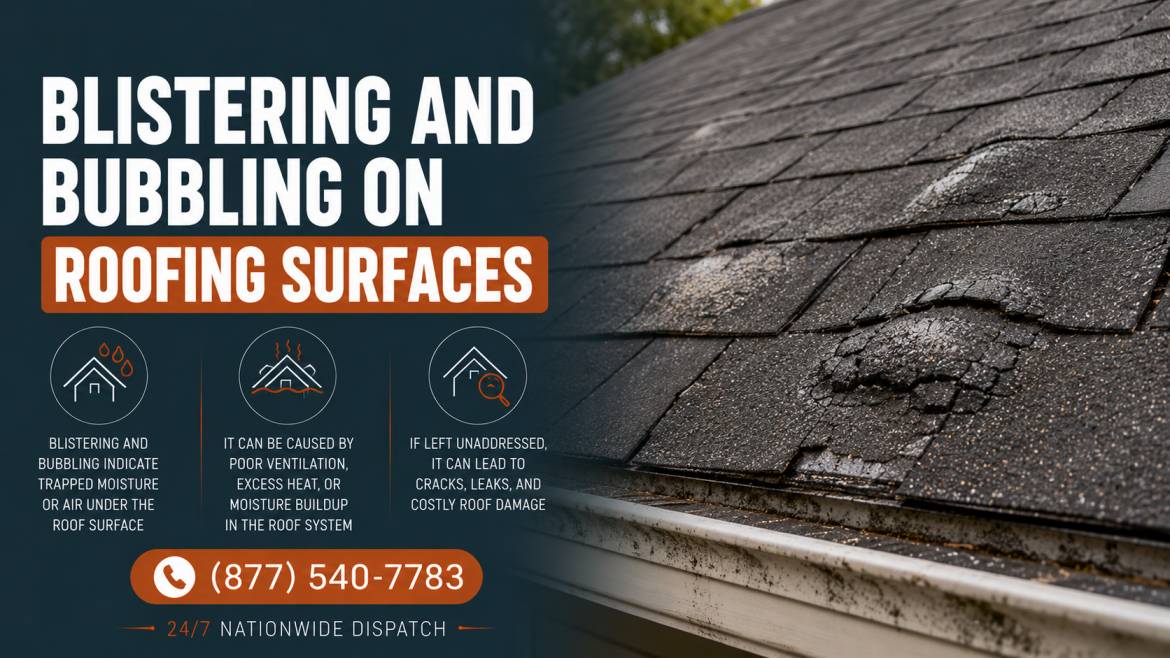
A raised bubble on a shingle surface tends to trigger one of two very different reactions. Some homeowners dismiss it entirely as cosmetic. Others assume it is hail damage and start planning an insurance claim. Both reactions can be wrong, and the actual answer depends on details easy to miss from the ground.
Blistering sits in an unusual position among the signs covered in this series. It is genuinely one of the harder ones to diagnose correctly without close inspection, since its cause can range from a harmless manufacturing artifact to a sign the roof is trapping moisture it should not be.
This guide covers what actually produces blistering, how it differs from hail damage under close inspection, and what happens if a blister is left alone. It is one entry in the signs of roof damage guide, and once a cause is confirmed, the full services directory covers the repair options available.
What Causes Roof Blistering?
Blistering happens when gas or moisture trapped beneath the shingle's surface expands, pushing the material upward into a raised bubble. Several distinct sources can produce that trapped gas or moisture in the first place.
Manufacturing Voids
Some blistering traces back to the shingle manufacturing process itself, where small voids or trapped air pockets form within the asphalt during production. Heat later causes trapped air in these voids to expand, pushing the surface upward into a visible bubble.
This type of blistering can appear even on a relatively new roof
It tends to be scattered somewhat randomly rather than following a clear pattern
Manufacturing-related blisters are typically covered under the material warranty
The shingle's overall quality control during production determines how common this is
Manufacturing-related blistering is worth documenting and reporting to the installer or manufacturer promptly, since warranty claims typically require the issue to be identified within a defined window after installation rather than years later once the connection to a production defect becomes harder to establish.
Trapped Moisture
Moisture trapped beneath the shingle surface during installation, whether from the shingle itself, the underlayment, or ambient humidity during a rushed installation, can produce a similar bubbling effect once heat causes that trapped moisture to expand into vapor.
Sun and UV exposure plays a direct role here, since sustained heat is what drives the expansion process regardless of whether the trapped substance is air or moisture. South and west-facing slopes, receiving the most direct heat, tend to show blistering earlier and more extensively than shaded slopes on the same roof.
Poor Attic Ventilation
A poorly ventilated attic bakes the underside of the roof deck, adding heat from below at the same time the sun adds heat from above. That combined thermal stress accelerates blister formation beyond what either heat source would produce alone.
Is Blistering the Same as Hail Damage?
No, and this is the single most important distinction this guide addresses, since confusing the two can lead either to an unnecessary insurance claim or to a missed legitimate one.
Key Differences Under Close Inspection
Characteristic | Blistering | Hail Damage |
|---|---|---|
Shape | Smoothly rounded, dome-like | Often has a more irregular, dented impact profile |
Distribution | Clustered in the same recurring areas, especially sun-exposed slopes | Random, scattered across every slope including shaded ones |
Timing | Develops gradually over time | Appears suddenly, tied to a specific storm date |
Feel | Firm if intact, since it holds trapped gas or moisture | Soft or slightly depressed at the impact point |
Surrounding evidence | No corresponding damage to gutters, vents, or soft metal | Often accompanied by dents on gutters, vents, and AC housings |
In practice: an inspector checking for corroborating hail evidence, such as dented gutters, downspouts, or vent caps, in the same area as suspected roof damage gains a strong secondary confirmation. Blistering produces no such corroborating evidence, since it is not driven by an external impact.
Checking for Blistering From the Ground
Most blistering is visible without climbing onto the roof, particularly once a homeowner knows which slopes and conditions to check first.
Scan south and west-facing slopes first, since they receive the most direct heat exposure
Look for a slightly different sheen or shadow pattern where a raised bubble catches light differently than the surrounding flat surface
Note whether the pattern clusters in one area or scatters across the whole roof
Check the same general area again after a hot stretch of weather, since blisters can become more visually apparent under sustained heat
Why the Confusion Happens So Often?
Both hail bruises and blisters can appear as a raised or irregular area on casual visual inspection, and the two can genuinely coexist on the same roof if a hailstorm struck a roof that already had some pre-existing blistering. Careful, close inspection, rather than a distant visual glance, is what actually separates them reliably.
Hail damage covers the full diagnostic picture for impact-based damage in more depth, including the test square method inspectors use to establish storm-related damage density.
Does Blistering Lead to Leaks?
Blistering exists on a spectrum from purely cosmetic to a genuine precursor to water intrusion, and where a specific case falls on that spectrum depends largely on whether the blister remains intact or eventually ruptures.
The Progression From Blister to Leak
A blister forms and, if left alone, may remain intact for a considerable time
Foot traffic, hail, or simple aging can eventually rupture the blister's surface
Once ruptured, the underlying asphalt is exposed similarly to granule loss
Exposed asphalt at the rupture site degrades faster and can eventually admit water
An intact, unruptured blister is not actively leaking and generally does not require emergency attention. A ruptured blister, particularly one exposing bare asphalt or the shingle's underlying mat, warrants closer attention since it has effectively become a localized weak point in the covering.
How Widespread Blistering Changes the Calculation?
Isolated blistering, a handful of bubbles scattered across an otherwise sound roof, differs meaningfully from extensive blistering covering a significant portion of one or more slopes. Widespread blistering often signals a systemic issue, most commonly poor ventilation or a broader material quality problem, rather than a few isolated defects.
Extent | Likely Explanation | General Response |
|---|---|---|
A handful of scattered blisters | Isolated manufacturing voids | Monitor, no immediate action needed |
Concentrated on south or west slopes | Heat and UV-driven expansion | Watch for rupture, consider ventilation check |
Widespread across most of one slope | Ventilation imbalance or systemic moisture issue | Investigate ventilation, plan repair |
Extensive across the entire roof | Broad material quality issue or chronic ventilation failure | Full assessment, likely replacement planning |
Roof wear and aging tends to accelerate once widespread blistering has ruptured across a slope, since the exposed asphalt at each rupture point ages considerably faster than the shingle's protected surface would otherwise.
How Is Blistering Repaired?
The appropriate repair approach depends heavily on the blister's extent, whether it has ruptured, and what underlying cause is driving its formation.
Repair Approaches by Situation
Situation | Typical Approach |
|---|---|
A handful of intact blisters | Often monitored rather than repaired immediately |
Ruptured blisters, isolated | Targeted shingle repair of the affected units |
Widespread blistering tied to ventilation | Ventilation correction alongside any needed shingle replacement |
Extensive blistering across most slopes | Often points toward planning for full replacement |
What Happens During a Targeted Repair
For isolated, ruptured blisters, the repair process typically involves removing and replacing the affected shingles rather than attempting to patch the ruptured area in place, since a punctured or torn blister rarely seals reliably on its own.
The affected shingle is lifted and removed along with any adjacent units disturbed in the process
The exposed underlayment beneath is inspected for any secondary damage
A replacement shingle, matched as closely as possible in color and profile, is installed
The surrounding courses are checked for early-stage blistering that might warrant preemptive attention
Color matching deserves the same realistic expectation here as with any other targeted shingle repair. Weathered shingles rarely match new stock exactly, since years of sun exposure change color in ways manufacturing cannot replicate on demand.
Addressing the Underlying Cause
Repairing visible blisters without correcting a ventilation problem driving them tends to produce recurrence within the same general area over subsequent seasons. A roof inspection that includes an attic assessment can confirm whether ventilation is a contributing factor before repair work begins.
How Long Do Blisters Take to Develop?
Blister formation is generally gradual rather than sudden, developing over multiple seasons of heat exposure rather than appearing overnight. A roof that shows no blistering at installation but develops noticeable bubbling within its first few years often points toward a manufacturing or ventilation issue worth investigating, rather than simple ordinary aging.
When Insurance Applies
Insurance claim help is generally not the right path for blistering caused by manufacturing defects, ventilation issues, or ordinary heat exposure, since these are typically treated as either a warranty matter or excluded wear and tear rather than a covered peril. Insurance becomes relevant primarily when blistering is genuinely confused with, or accompanies, documented hail damage from a specific storm.
Which States See the Most Blistering Related Roof Concerns?
Blistering concentrates most heavily in states combining intense heat with sustained humidity, since that combination drives both the manufacturing-void expansion mechanism and moisture-related trapped vapor most aggressively.
Florida, with a combination of heat and humidity that creates ideal blistering conditions
Texas, facing a long, intense summer season across most of the state
Louisiana, sharing similar heat and humidity exposure with the broader Gulf Coast
Georgia, with sustained warm, humid conditions across much of the state
South Carolina, sharing comparable Southeast humidity and heat patterns
Roof blistering assessments across Florida deal with this distinction between blistering and hail constantly, given the state's near-constant heat and humidity independent of any storm activity. Shingle repair covering Texas addresses a similarly elevated blistering rate tied to the state's extended summer heat exposure.
Roof inspection services across Louisiana and roof repair coverage across Georgia both reflect the broader Gulf Coast and Southeast pattern of sustained warm, humid conditions driving blister formation independent of storm frequency. Roof services across South Carolina rounds out the group with a comparable regional climate profile.
Frequently Asked Questions About Blistering
What Causes Shingles to Blister?
Blistering results from trapped gas or moisture beneath the shingle surface expanding under heat. Sources include manufacturing voids from the production process, moisture trapped during installation, and heat compounded by poor attic ventilation.
Are Shingle Blisters Covered by Insurance?
Generally not on their own, since blistering typically traces back to manufacturing defects, ventilation issues, or ordinary heat exposure rather than a sudden, covered peril. Manufacturing-related blistering may be covered under the material warranty instead of an insurance policy.
How Can I Tell Blistering From Hail Damage?
Blisters are smoothly rounded and tend to cluster in sun-exposed areas without any corresponding damage to gutters, vents, or other soft metal nearby. Hail damage is randomly distributed across every slope and is typically accompanied by dents on nearby metal components from the same storm.
Does an Intact Blister Need Immediate Repair?
Not usually. An unruptured blister is not actively admitting water and can often be monitored rather than repaired immediately, though a ruptured blister exposing bare asphalt does warrant more prompt attention.
Can Blistering Happen on a Brand New Roof?
Yes, particularly if it traces back to a manufacturing void or moisture trapped during a rushed installation. This scenario is generally covered under the material warranty and worth reporting to the installer or manufacturer.
Will Improving Attic Ventilation Stop Blistering From Recurring?
In cases where ventilation is a contributing factor, yes, correcting the imbalance typically reduces future blister formation considerably. It will not repair blisters that have already formed or ruptured, which require separate attention.
Does Blistering Affect Every Roofing Material the Same Way?
No. Asphalt shingles are the material most commonly associated with blistering, since the process depends on trapped gas or moisture expanding within the asphalt layer itself. Membrane roofing on flat or low-slope sections can also blister, typically from moisture trapped beneath the membrane during installation, though the mechanism and repair approach differ somewhat from shingle blistering. Metal and tile roofing do not blister in the same sense, since neither material traps gas or moisture the way asphalt does.
Can a Roofing Contractor Confirm the Cause of Blistering During a Regular Inspection?
Yes, typically. An experienced inspector checking blistering alongside general roof condition can usually determine whether the pattern points toward manufacturing defects, ventilation problems, or installation-related moisture without needing specialized equipment, though confirming the exact cause with certainty sometimes requires cutting into a sample blister to examine what is trapped underneath.