
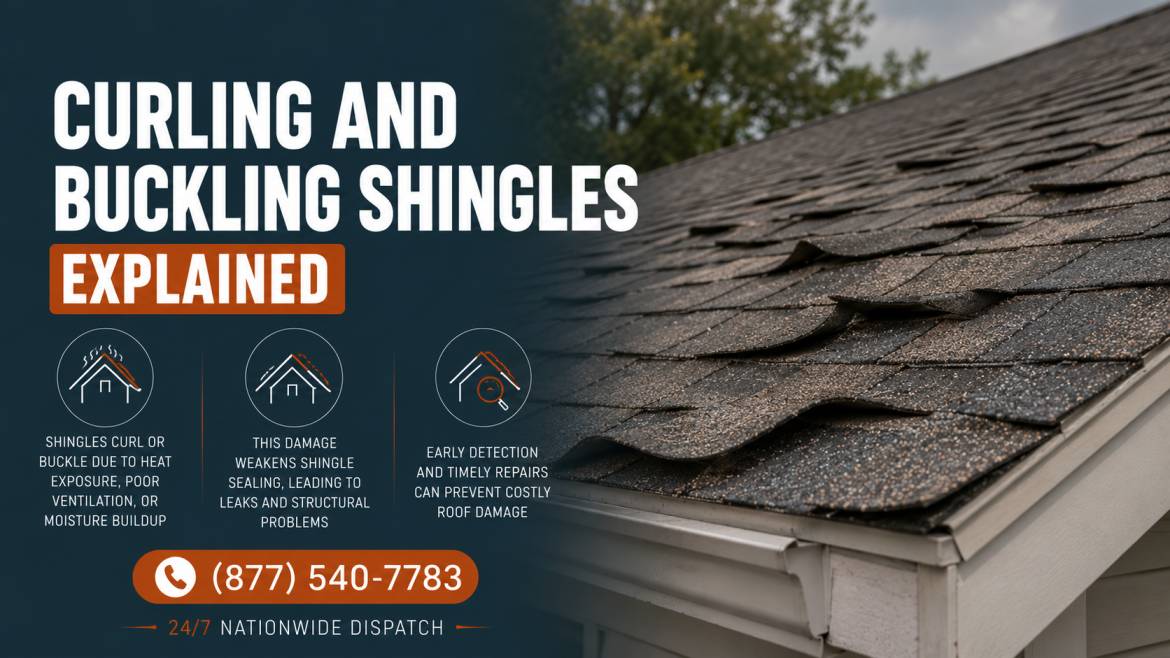
Two roofs can both look "wavy" from the curb and be suffering from entirely different problems. One has shingles lifting at the edges, cupping upward like a shallow bowl. The other has a ridge pushing up across the middle of individual shingles, as if something underneath is forcing them apart.
Homeowners tend to lump both under the same general impression, a roof that just looks off. That is a mistake worth correcting, since curling and buckling point toward different root causes and, in some cases, different urgency levels entirely.
This guide covers both conditions individually, the shared factor of attic ventilation that connects them, and how to judge whether a curled section can be spot-repaired or whether it signals a broader problem. It is one entry in the signs of roof damage guide, and for repair once the cause is identified, the services directory covers the available options.
Why Do Shingles Curl?
Curling describes a shingle whose edges lift upward while the center stays relatively flat, giving the surface a shallow, concave, bowl-like appearance when viewed up close. The underlying mechanism is a loss of flexibility in the asphalt itself.
The Material Science Behind Curling
Asphalt shingles rely on oils within the asphalt coating to stay pliable and to move with normal thermal expansion and contraction. As those oils break down through age, heat, and ultraviolet exposure, the material becomes progressively stiffer, and the edges, which experience the most exposure and the least support, are typically the first area to visibly deform.
Heat accelerates the same oxidation process that ultraviolet exposure drives
A poorly ventilated attic compounds the effect by baking the shingle from below
Lower-quality shingles with less binder can curl prematurely, even on a relatively new roof
The process is generally gradual, developing over years rather than appearing suddenly
Sun and UV exposure is the underlying driver behind most curling that develops on an otherwise normally aging roof, particularly on south and west-facing slopes that receive the most direct, sustained sunlight throughout the day.
What Is the Difference Between Curling and Buckling?
Despite frequently being mentioned in the same breath, curling and buckling describe distinct physical deformations with meaningfully different root causes.
Condition | Visual Appearance | Primary Cause |
|---|---|---|
Curling | Edges lift upward, center stays flat | Age, heat, and UV-driven loss of flexibility |
Buckling | A ridge or wave forms across the shingle's width | Moisture trapped beneath the surface |
Clawing | Edges down, center raised, an advanced curling variant | Late-stage aging, often near end of service life |
Buckling's Distinct Mechanism
Buckling happens when something beneath the shingle surface, most often moisture trapped in the decking or underlayment, expands and pushes the covering upward from below. This is fundamentally a moisture problem rather than a pure aging one, even though the two frequently overlap on an older roof.
Common sources of that trapped moisture include underlayment installed with insufficient time to dry before the shingles went on top, felt underlayment that wrinkles as it absorbs ambient moisture, or a new layer of shingles installed directly over an older layer without addressing decking-level dampness underneath.
Installation Quality as a Contributing Factor
Installation defects play a larger role in premature buckling than many homeowners realize. Shingles installed over damp decking, without adequate time for the substrate to dry, trap that moisture beneath the surface from the very first day.
A roof buckling within its first year or two after installation, well before any reasonable aging timeline, should prompt a warranty conversation with the original installer rather than being treated as a standard maintenance issue.
In practice: curling on a five-year-old roof usually points toward a specific problem, such as poor ventilation or a manufacturing issue, worth investigating directly. Curling on a twenty-year-old roof more often simply reflects the material reaching the natural end of its service life.
How to Spot Curling and Buckling From the Ground
Both conditions are visible without climbing onto the roof in most cases, using nothing more than binoculars and a careful look along each slope.
Sight along a single course of shingles at a low angle, watching for edges that lift away from the plane
Look for a wave or ripple running across the width of individual shingles, distinct from a lifted edge
Check whether the pattern is uniform across the slope or concentrated in one specific area
Note which direction the affected slope faces, since south and west exposures typically show curling first
A pair of binoculars from the driveway catches most cases clearly enough to decide whether closer inspection is warranted, without any need for roof access at this stage.
Curling Versus Other Ground-Visible Signs
Curling is sometimes confused with blistering shingles, particularly from a distance, though the two have distinct causes and appearances up close. Curling affects the shingle's overall shape and edge profile, while blistering produces isolated raised bubbles on an otherwise flat surface.
Telling the two apart matters for repair planning, since blistering often responds to spot treatment of the affected bubbles, while curling typically signals a broader material or ventilation issue affecting the shingle's underlying flexibility across a wider area.
Is Curling Repairable?
The answer depends heavily on how widespread the curling is and how much service life the roof has remaining, which makes this one of the more genuinely case-by-case questions in this guide.
When Individual Repair Makes Sense?
A handful of curled shingles isolated to one area, on a roof that is otherwise sound and reasonably young, can often be addressed through targeted replacement of just the affected shingles.
Confirm the curling is limited to a specific section rather than spread roof-wide
Check whether the roof's remaining shingles show comparable flexibility when gently lifted
Source replacement shingles that reasonably match the existing color and profile
Address any underlying ventilation issue at the same time to prevent recurrence
Color matching is worth setting expectations around honestly. Weathered shingles rarely match new stock from the same product line exactly, since sun exposure changes color over time in ways manufacturing cannot replicate on demand.
When Full Replacement Is the More Sensible Path?
Curling spread evenly across most or all of the roof, particularly combined with granule loss in the same areas, generally signals the covering has reached the end of its useful life rather than experiencing an isolated, fixable problem.
Factor | Favors Repair | Favors Replacement |
|---|---|---|
Extent of curling | Isolated to one section | Spread across most or all slopes |
Roof age | Well within expected service life | At or near end of rated lifespan |
Underlying cause | Identified and correctable | Systemic aging with no single fix |
Material availability | Reasonable match available | Product discontinued or significantly changed |
Shingle repair covers the isolated case well, while roof replacement becomes the more economical choice once curling has spread broadly enough that repeated spot repairs would only chase the underlying problem without resolving it.
Does Ventilation Cause Curling?
Ventilation does not directly cause curling in the way a single defective shingle might, but inadequate attic ventilation is one of the most consistent contributing factors found alongside both curling and buckling.
How Poor Ventilation Compounds the Problem?
A poorly ventilated attic traps heat and, depending on the season, moisture against the underside of the roof deck. That trapped heat accelerates the same oxidation process driving curling from above, effectively attacking the shingle from both directions at once.
Intake ventilation at the soffit is often blocked by insulation pushed too far into the eave
Exhaust ventilation at the ridge can be undersized or entirely missing on older construction
Both halves of the system need to function together for airflow to actually occur
A single blocked or missing component can undermine an otherwise adequate system
Roof wear and aging progresses considerably faster on a roof with compromised ventilation than on an identical roof with a properly balanced system, which is why correcting ventilation is often recommended alongside any repair addressing visible curling.
Diagnosing a Ventilation Problem
A roof inspection that includes an attic assessment can confirm whether ventilation is contributing to observed curling, checking both the physical presence of adequate vents and whether they are actually functioning as intended rather than blocked or restricted.
Signs of a ventilation problem beyond curling itself include noticeably higher attic temperatures than outside air during summer, frost or condensation on the underside of the roof deck during winter, and attic moisture appearing independent of any actual roof leak.
Which States See the Most Curling Shingle Concerns?
Curling concentrates most heavily in states combining high sustained heat with intense ultraviolet exposure, since that combination accelerates the underlying material breakdown faster than milder climates typically produce.
Arizona, with some of the highest sustained heat and UV exposure in the country
California, spanning a wide range of high-UV conditions across different regions
Texas, facing a long, intense summer season across most of the state
Florida, adding humidity on top of heat, which compounds ventilation-related curling specifically
Nevada, sharing desert heat and elevation exposure similar to Arizona
Curling shingle inspections across Arizona see this sign appearing well ahead of manufacturer-rated timelines as a routine finding, given the state's combination of elevation and near-constant intense sun. Roof assessment services across California deal with a wide range of curling severity depending on the specific climate zone, from coastal fog belts to high-heat interior valleys.
Shingle repair covering Texas addresses a similarly accelerated curling timeline tied to the state's extended summer heat season. Roof inspection services across Florida frequently find buckling alongside curling, given how humidity compounds ventilation-related moisture problems on top of the state's heat exposure. Roof repair coverage across Nevada tracks closely with Arizona's desert exposure pattern.
Frequently Asked Questions About Curling and Buckling Shingles
What Causes Shingles to Curl?
Curling results primarily from the loss of flexibility in the asphalt as its oils break down under sustained heat and ultraviolet exposure. Poor attic ventilation compounds the effect by adding trapped heat from below, and lower-quality materials can curl prematurely even on a relatively young roof.
Should Curling Shingles Be Replaced?
It depends on how widespread the curling is. Isolated curling on an otherwise sound, relatively young roof can often be addressed with targeted repair. Curling spread across most or all of the roof, particularly on an aging covering, generally points toward full replacement being the more economical path.
What Is the Difference Between Curling and Buckling Shingles?
Curling lifts the shingle's edges upward while the center stays flat, driven primarily by age and heat. Buckling pushes a ridge across the shingle's width, driven primarily by trapped moisture beneath the surface in the decking or underlayment.
Can New Shingles Curl Shortly After Installation?
Yes, though it is uncommon and usually points toward a specific problem rather than normal aging. Likely causes include a manufacturing or material defect, moisture trapped in the decking before installation, or inadequate ventilation that was present before the new roof went on and was never corrected.
Does Curling Always Mean a Leak Is Coming?
Not immediately, but curled or buckled shingles do lose their ability to resist wind uplift and shed water as effectively as flat ones. Left unaddressed, curling increases the likelihood of eventual granule loss, cracking, and water intrusion, even if no leak is present yet.
How Do I Know if My Attic Ventilation Is Contributing to Curling?
Signs include noticeably higher attic temperatures than outdoor air in summer, condensation or frost on the underside of the roof deck in winter, and curling that appears more severe or earlier than the roof's age alone would suggest. A professional inspection can confirm whether intake and exhaust ventilation are properly balanced.
Is Curling More Common on Certain Shingle Types Than Others?
Yes. Three-tab shingles, generally thinner and less reinforced than architectural products, tend to show curling earlier in their service life. Premium architectural shingles with heavier mat construction and more asphalt content typically resist curling longer under comparable exposure conditions, though no asphalt product is entirely immune to the underlying process.
Can I Prevent Curling on a Brand New Roof?
The most effective prevention is confirming adequate attic ventilation is in place before or during installation, since this single factor has the most influence over how quickly curling develops on an otherwise sound roof. Choosing a quality shingle product suited to the local climate and ensuring correct installation practices also meaningfully extend the timeline before curling becomes visible.