
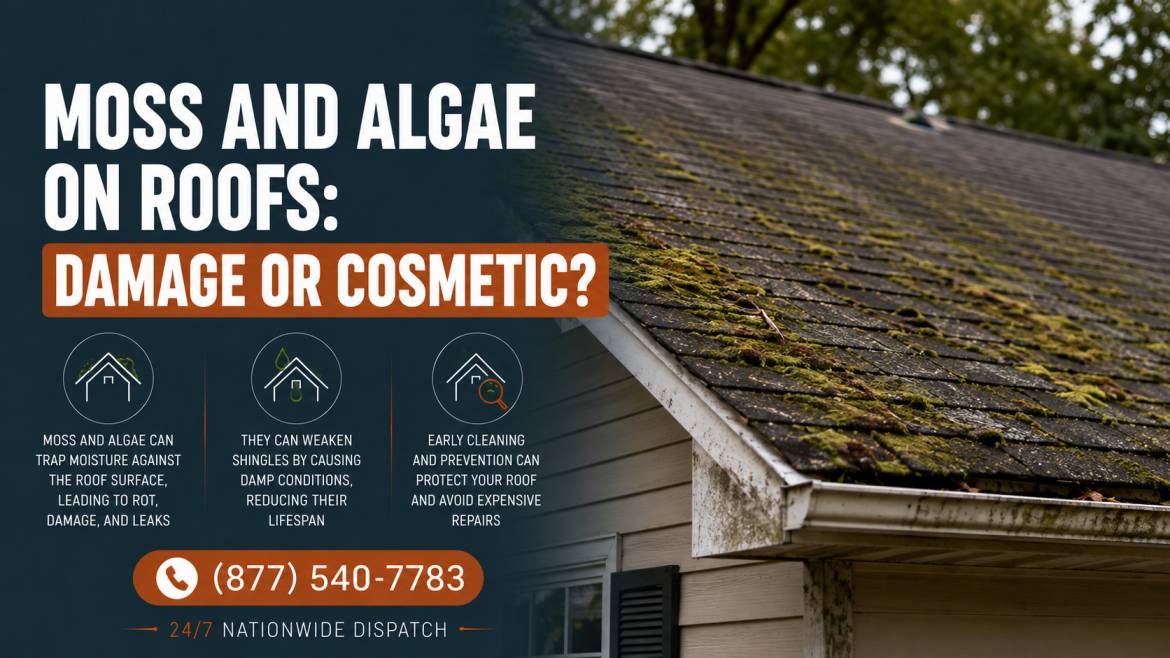
From the street, a dark-streaked roof and a moss-covered one can look almost identical. Both read as roughly the same thing to most homeowners: an aging, neglected-looking roof that probably needs cleaning. Treating them the same way, though, means either overreacting to something largely harmless or underreacting to something that is quietly damaging the covering underneath.
Algae and moss are different organisms with genuinely different relationships to the roof they grow on. One mostly just changes how the roof looks. The other changes how the roof actually performs, which is the distinction this guide exists to make clear.
This guide covers what separates moss from algae, how moss physically damages a roof as it grows, and the removal methods that actually work without causing more harm than the growth itself. It is one entry in the signs of roof damage guide, and the services directory covers repair options for whatever the growth has affected underneath it.
What Is the Difference Between Moss and Algae?
Moss and algae are frequently mentioned in the same breath, but they belong to entirely different biological categories, and that difference translates directly into how each one interacts with a roof.
Algae
Algae, most commonly the species responsible for the dark streaking seen on many older asphalt roofs, is a simple organism that grows on the shingle surface without developing any significant root or attachment structure into the material itself.
Produces dark brown or black streaking, typically most visible on north-facing slopes
Feeds primarily on the limestone filler used in many shingle products
Does not lift or penetrate the shingle surface as it spreads
Considered largely cosmetic, with minimal direct structural impact
Moss
Moss behaves fundamentally differently. It is a small, cushion-like plant that develops a root-like structure called rhizoids, which anchor it to whatever surface it grows on, including directly into and between shingle courses.
Forms visible, raised cushions rather than flat streaking
Thrives in sustained shade and moisture, particularly on north-facing or heavily shaded slopes
Its rhizoid structure works between shingle edges and tabs as it establishes and grows
Retains water against the roof surface far longer than an uncovered shingle would hold it
In practice: algae discoloration alone rarely justifies urgent action beyond routine cleaning for appearance. Moss, by contrast, is doing something to the roof mechanically, not just visually, which changes the calculus considerably.
How to Tell Them Apart From the Ground?
Distinguishing moss from algae rarely requires climbing onto the roof, since the two present differently enough to identify with a careful look from below.
Moss appears as raised, cushion-like growth with visible texture and depth
Algae appears as flat, dark streaking that follows the direction water runs down the slope
Moss concentrates in shaded, slower-drying areas regardless of slope direction
Algae streaking often appears most prominently on north-facing slopes but can occur elsewhere
Ice Dams and the Moisture Connection
Ice dams and moss share a common precondition in cold, shaded climates: sustained moisture retention at the roof surface. A roof prone to ice damming often shows moss establishment in the same general areas, since both problems trace back to a section of roof that stays wetter and colder than the rest of the covering for longer than it should.
Does Moss Damage a Roof?
Yes, and the mechanism is worth understanding in some detail, since it explains why moss removal is treated as maintenance rather than purely cosmetic upkeep.
How Moss Actually Damages Shingles?
Moss's growth pattern creates two distinct problems simultaneously, each compounding the other over time.
Its rhizoid structure works into the gaps between shingle tabs and courses as it spreads
That growth gradually lifts shingle edges away from the flat plane they were installed in
Lifted edges lose their wind resistance, becoming vulnerable to uplift in storms that intact shingles would resist
The moss cushion itself retains moisture against the shingle surface continuously, accelerating granule loss and asphalt breakdown beneath it
Granule loss frequently accompanies established moss growth, since the sustained moisture trapped beneath the moss accelerates the same asphalt degradation process that ordinary aging produces far more slowly on a dry, moss-free surface.
Why Location Matters
Moss growth is rarely uniform across a roof, and its distribution pattern itself carries diagnostic value. Concentrated growth in one specific area, rather than general shading alone, sometimes points toward a localized moisture problem, such as a section that drains poorly or sits in the path of runoff from an upper roof plane.
Why Do Dark Streaks Appear?
Dark streaking, the hallmark of algae rather than moss, follows its own distinct pattern tied to how the organism spreads and what it feeds on.
The Streaking Pattern Explained
Algae spores travel by wind and rain, landing across a roof surface somewhat randomly before establishing and spreading from those initial points. The characteristic streaking pattern develops as spores wash downward with rainfall, creating vertical or diagonal marks that follow the water's path down the slope.
North-facing slopes typically show the heaviest streaking, since they retain moisture longest
Streaking tends to worsen over years as algae colonies mature and expand
Some shingle products include algae-resistant granules specifically to slow this process
Streaking severity varies significantly by regional humidity and rainfall patterns
Does Streaking Affect Shingle Lifespan?
The direct structural impact of algae streaking alone is minimal compared to moss, though heavily algae-covered shingles can run slightly warmer in direct sun due to the darkened surface absorbing more heat, which marginally accelerates the same thermal aging process sun and UV exposure drives more significantly on its own.
How Is Moss Removed Safely?
Removal method matters enormously here, since the wrong approach can cause more damage to the roof than the moss itself ever would.
Methods to Avoid
Certain common removal approaches, while intuitive, cause direct harm to the shingle surface and are worth actively avoiding regardless of how effective they seem at clearing visible growth.
Method | Why to Avoid It |
|---|---|
Pressure washing | Strips protective granules, can force water under shingles |
Metal scrapers or wire brushes | Tears shingle tabs and removes granules mechanically |
Undiluted bleach | Can damage shingles and harm surrounding landscaping |
Walking on wet or aged, brittle roofing during removal | Risks cracking shingles or tiles underfoot |
The Safer Approach
Soft-wash chemistry combined with gentle hand application, followed by a low-pressure rinse, removes moss and algae without the mechanical damage more aggressive methods cause.
Apply a gentle cleaning solution, such as a diluted oxygen bleach or specifically formulated roof-safe product
Allow appropriate contact time per the product's instructions
Rinse with low-pressure water from a garden hose, never a pressure washer
Clear any dislodged moss or algae from gutters afterward to prevent downstream clogging
Preventing Regrowth
Removal alone addresses the visible symptom without changing the conditions that allowed moss to establish in the first place, which is why regrowth within a few years is common without additional prevention steps.
Trimming overhanging tree limbs increases sun exposure and reduces the shade moss depends on
Keeping gutters clear improves drainage and reduces retained surface moisture
Zinc or copper strips installed near the ridge release ions with each rainfall that inhibit new growth
Improving attic ventilation reduces the underside moisture that can contribute to a persistently damp roof
Zinc and copper strips work through a genuinely well-documented mechanism. Rainwater passing over the metal picks up trace ions, carrying them down the slope with each rain event, and those ions create conditions hostile to moss, algae, and lichen regrowth for a meaningful distance below the strip, commonly cited at up to about 15 feet.
In practice: copper strips generally last longer and work somewhat more effectively than zinc, but they carry a documented compatibility issue with aluminum flashing and gutters, since direct contact between the two metals can accelerate corrosion through a galvanic reaction. Isolating copper strips from adjacent aluminum components avoids that problem.
When Moss Has Already Compromised the Covering
Once moss has lifted shingle edges enough to loosen the covering's seal, cleaning alone will not restore the shingle's original wind resistance or watertight seam. Shingle repair becomes necessary for sections where moss growth has visibly displaced or cracked the affected units, rather than relying on removal alone to fully resolve the damage.
Gutter repair frequently accompanies moss remediation as well, since dislodged moss and granules commonly wash into and clog the gutter system during removal, and a gutter already struggling with drainage contributed to the moisture conditions that allowed moss to establish in the first place.
Which States See the Most Moss Related Roof Concerns?
Moss growth concentrates heavily in regions combining sustained rainfall with mild temperatures, since that combination provides the consistent moisture moss needs without the extreme heat that would otherwise dry it out between rain events.
Washington, with a sustained wet season and extensive shaded, forested residential areas
Oregon, sharing nearly identical climate conditions with its northern neighbor
North Carolina, where humid Southeast conditions support moss in shaded areas
Georgia, with comparable warm, humid shade conditions across much of the state
Virginia, spanning a range of humidity and shade conditions favorable to moss establishment
Moss removal services across Washington address one of the most consistent moss patterns in the country, driven by the Pacific Northwest's combination of sustained shade and rainfall through much of the year. Roof cleaning and moss treatment in Oregon follows an almost identical pattern given the shared regional climate.
Roof moss removal across North Carolina reflects a different climate driver, humid Southeast conditions that favor moss in shaded, tree-covered residential neighborhoods rather than the Pacific Northwest's sustained wet season.
Roof cleaning services in Georgia shares that humid Southeast pattern. Moss and algae treatment across Virginia rounds out the group with a comparable mix of humidity and shade conditions favorable to establishment.
Frequently Asked Questions About Moss and Algae
Is Moss on a Roof Bad?
Yes, more so than algae. Moss's root-like structure works into shingle edges as it grows, gradually lifting them and retaining moisture against the surface, which accelerates granule loss and reduces wind resistance in the affected area.
How Do You Get Rid of Roof Moss?
Soft-wash chemistry with a gentle cleaning solution, applied by hand and rinsed with low-pressure water, removes moss without the granule-stripping damage a pressure washer or mechanical scraping would cause. Zinc or copper strips near the ridge help prevent regrowth afterward.
Is Algae on a Roof Something to Worry About?
Not urgently. Algae streaking is largely cosmetic and does not penetrate or lift the shingle surface the way moss does, though heavily algae-covered shingles can run marginally warmer in direct sun, contributing slightly to overall thermal aging.
Why Does Moss Only Grow on Certain Parts of My Roof?
Moss favors shade and sustained moisture, which is why north-facing slopes, areas beneath overhanging tree canopy, and sections that drain poorly typically show the heaviest growth while sun-exposed slopes on the same roof remain largely clear.
Do Zinc Strips Actually Work to Prevent Moss?
Yes, through a well-documented mechanism where rainwater carries trace metal ions down the roof slope, creating conditions hostile to new growth for a meaningful distance below the strip. Effectiveness typically lasts about a year for standard zinc strips before reapplication or replacement is needed.
Can I Remove Roof Moss Myself, or Should I Hire a Professional?
Light growth on an accessible, safe roof can sometimes be addressed with a soft-wash product and careful hand application from ground level or a stable ladder position. Extensive growth, steep pitches, or brittle roofing materials like aged tile are generally safer left to a professional with appropriate access equipment.
How Long Does Professional Moss Treatment Typically Last?
A properly applied professional treatment commonly lasts two to four years before regrowth becomes noticeable again, particularly when paired with zinc or copper strip installation for ongoing prevention. Climate plays a significant role in this timeline, since consistently wet, shaded regions see faster regrowth than drier or sunnier ones even after an identical treatment.
Does Moss Growth Mean My Roof Needs to Be Replaced?
Not on its own. Moss growth alone, even if established for some time, typically indicates a need for removal and possibly localized shingle repair rather than full replacement. Replacement becomes a consideration only if the underlying shingles have sustained extensive granule loss, cracking, or lifted seams across a significant portion of the roof by the time the moss is addressed.