
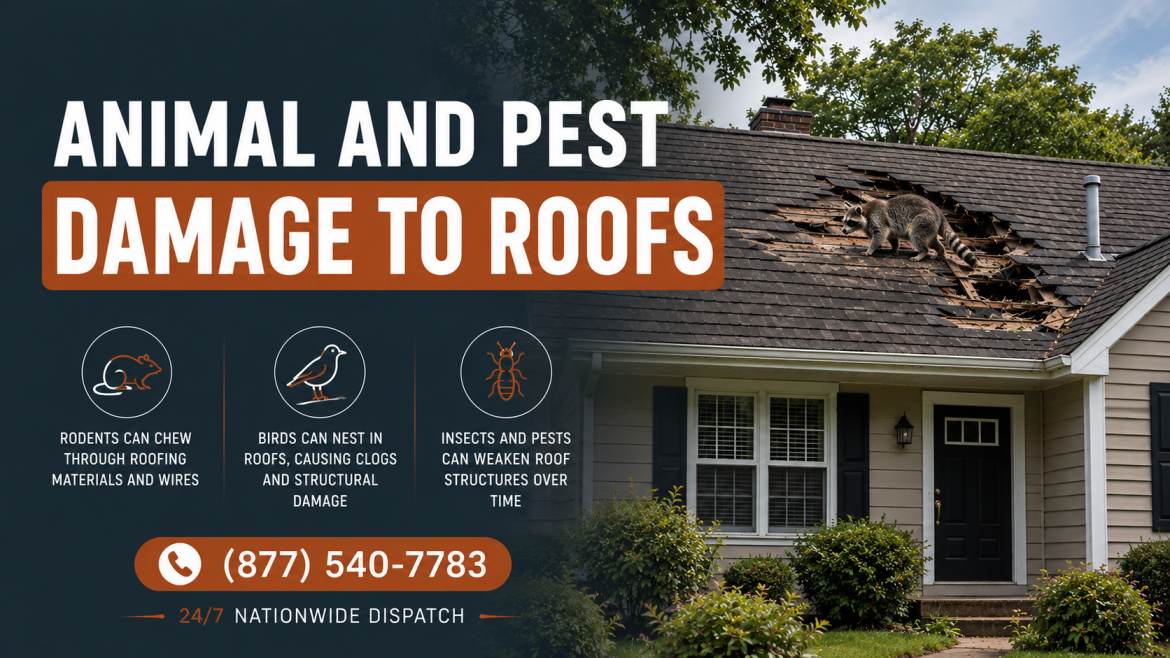
Two homeowners can have identical chewed vent screens, identical torn soffit gaps, and identical damage inside the attic. One gets a paid insurance claim. The other pays out of pocket entirely, and the difference has nothing to do with the severity of what happened.
It comes down to which animal did it. Insurance policy language treats species as a legal category, not just a biological one, and that distinction decides more animal damage claims than any adjuster's judgment call does.
This guide covers how wildlife actually gets into a roof system, why the same opening reads differently depending on the culprit, and what prevention approach genuinely works. It is one of twelve causes catalogued in the roof damage causes guide. The services directory covers repair options for whatever the entry point ends up needing.
How Do Animals Actually Get Into a Roof?
Wildlife rarely creates a new opening from nothing. Most entry happens through an existing weak point that the animal widens rather than through determined excavation of an intact surface.
The Common Entry Points
Animals target the same handful of locations repeatedly, since these represent the roof's structurally weakest points regardless of species involved.
Gable and soffit vents with damaged or missing screens
Gaps where fascia boards have begun to rot or separate
Ridge vent openings where the covering has lifted slightly
Any existing hole from a prior repair that was never properly sealed
Overhanging tree limbs that provide direct access without touching the ground
That last point connects directly to tree and debris damage, since overhanging canopy functions as a bridge for climbing wildlife as much as it does a source of falling branches and abrasion.
Which Animals Cause the Most Damage
Different species cause structurally different damage, which matters for both repair scope and the insurance question covered further down.
Animal | Typical Damage Pattern |
|---|---|
Squirrels | Gnawing through wood, vinyl, and even soft aluminum to widen openings |
Raccoons | Tearing at soffit and roof vents, often creating larger single openings |
Birds | Nest material blocking vents, occasional gutter and flashing displacement |
Bats | Entry through small gaps, minimal structural damage, significant waste accumulation |
Squirrels and rodents generally | Chewing electrical wiring inside the attic, a documented fire risk |
Squirrels cause damage primarily through gnawing, since their teeth grow continuously and require constant wear against hard surfaces. That biological fact is why they target wood, vinyl, and shingle material rather than simply pushing through an existing gap the way a raccoon might.
Why Does the Same Damage Get Treated Differently by Insurers?
This is the detail that separates animal damage from every other cause covered in this series. The physical harm to the roof rarely determines the claim outcome. The species classification does.
The Vermin Exclusion
Standard ISO HO-3 homeowners policies explicitly exclude damage caused by "birds, vermin, rodents, or insects." Squirrels fall under rodents. Woodpeckers and pigeons fall under birds. Both categories are excluded without exception under most standard language.
Raccoons occupy a genuinely different legal position. They are neither rodents, birds, nor insects, and courts in multiple states have specifically ruled that raccoons do not qualify as vermin under standard policy exclusions. A Texas court reached this conclusion in Jones v. American Economy Insurance Co. in 1984, and a Louisiana court followed similar reasoning in Marks v. Trinity Universal in 1988.
In practice: the same torn soffit and the same attic insulation damage can be a covered claim if a raccoon caused it and an automatic denial if a squirrel did, purely based on the exclusion's specific wording. Identifying the actual species matters as much as documenting the damage itself.
Sudden Versus Gradual Damage Still Applies
Even where an animal is not classified as vermin, the same sudden-versus-gradual distinction that governs every other cause on this list still applies. A raccoon that tears through a roof vent in a single incident presents a stronger claim than one that has clearly been nesting in the attic for months before discovery.
Insurance Information Institute data places typical wildlife damage remediation costs between $1,000 and $5,000, though severe cases involving electrical damage or extensive insulation replacement can run considerably higher.
What Are the Clearest Signs of Active Animal Entry?
Wildlife entry produces a recognizable set of evidence, both from outside the home and from inside the attic space. Catching the signs early limits the damage considerably compared to discovering an established, months-old presence.
Location | Sign | What It Suggests |
|---|---|---|
Vents | Chewed or torn screens | Active gnawing entry, likely squirrels |
Soffit | Gaps, staining, or displaced panels | Entry point widening over time |
Attic | Scattered or matted insulation | Nesting activity underway |
Attic | Audible movement, especially dawn or dusk | Confirms an active, not historic, presence |
Roofline | Grease marks or dark smudging near an opening | Repeated animal contact at that specific point |
Audible movement timing is a useful diagnostic on its own. Squirrels are active during the day, while raccoons and many bat species are primarily active at dawn, dusk, or overnight, which helps narrow down the likely species before any professional inspection occurs.
Distinguishing Animal Damage From Wind or Storm Damage
Wind damage and animal entry can produce superficially similar openings, particularly around vents and ridge caps. The distinguishing evidence is usually biological rather than structural: chew marks, droppings, nesting material, or fur caught in the opening's edges.
A homeowner unsure which cause applies benefits from photographing the opening closely before any cleanup, since that evidence disappears quickly once repair work begins.
Which States See the Most Animal-Related Roof Claims?
Wildlife-roof conflict correlates with a combination of suburban tree cover, established housing stock, and regional animal population density, concentrating claims in specific states more than national wildlife populations alone would suggest.
Pennsylvania, with extensive older housing stock bordering wooded suburban areas
Ohio, sharing similar suburban-forest interface conditions across much of the state
New York, spanning both dense urban wildlife pressure and rural entry patterns
Michigan, with significant squirrel and raccoon populations near residential areas
Wisconsin, sharing similar wildlife density patterns with neighboring Michigan
Roof repair services across Pennsylvania frequently addresses entry points on homes decades old, where original vent screens and fascia have degraded well past their intended service life. Wildlife-related roof repair in Ohio follows a similar pattern tied to the state's extensive suburban tree canopy.
Roof repair coverage across New York spans both dense urban raccoon activity and more rural squirrel and bird entry patterns across the state's varied housing stock. Roof services covering Michigan and roof repair across Wisconsin both see comparable seasonal patterns tied to fall nesting behavior, when animals actively seek winter shelter.
What Actually Prevents Animal Entry?
Prevention for this specific cause responds unusually well to targeted homeowner action, more so than most weather-driven causes on this list. Sealing the handful of common entry points addresses the majority of the risk.
Install and maintain metal mesh screens over all vent openings
Repair fascia and soffit gaps promptly rather than deferring the work
Trim tree limbs back from the roofline to remove the climbing bridge
Inspect the attic seasonally, particularly before fall, when animals seek winter shelter
Address any prior repair holes fully rather than leaving temporary patches
Roof wear and aging creates many of the gaps that animals eventually exploit, since deteriorating fascia, worn vent screens, and aging sealant all soften the barrier that would otherwise keep wildlife out. Addressing ordinary maintenance items also functions as animal prevention, even when that is not the primary goal.
When an Opening Needs Immediate Attention
An active entry point left unaddressed rarely stays the same size. Animals widen openings as needed for their body size, and a small gap this season can become a significantly larger structural opening by the next.
If an animal has already created an opening large enough to expose the underlayment or decking, roof tarping provides interim protection against water intrusion while wildlife removal and permanent repair are arranged. Sealing the opening before confirming the animal has actually left can trap it inside, which creates a separate and more urgent problem.
What Should Happen Immediately After Discovering Animal Damage?
Finding an active or recent entry point calls for a specific sequence, since acting in the wrong order can either trap an animal inside or leave the opening exposed to weather longer than necessary.
Documenting Before Repair Begins
Photographing the damage before any repair or cleanup starts matters more for animal damage than for almost any other cause, since the species-specific evidence disappears quickly once the area is disturbed.
Photograph the entry point, including any visible chew marks, droppings, or fur
Note the timing pattern of any audible activity to help identify the species
Contact a wildlife removal professional before sealing anything shut
Arrange gutter repair or fascia repair once the space is confirmed empty
Follow with shingle repair for any surface damage from chewing or scratching
Why Sequencing Matters
Sealing an opening before confirming the animal has left creates a worse problem than the original entry, since a trapped animal will often cause significantly more damage attempting to escape than it did getting in. Professional exclusion methods, typically a one-way door device, solve this by letting the animal leave without letting it back in.
When Water Intrusion Follows Animal Damage
An opening large enough for wildlife entry is also large enough to admit water during the next rain, which connects animal damage directly to water intrusion as a secondary risk. A homeowner who addresses the wildlife problem but delays the roofing repair often discovers a second, water-related problem within the same season.
That sequencing risk is why interim protection matters even for damage that started as a wildlife issue rather than a storm. The underlying vulnerability, an open pathway through the covering, behaves the same regardless of what created it first.
Frequently Asked Questions About Animal and Pest Damage
Does Insurance Cover Animal Damage to a Roof?
It depends almost entirely on the species. Raccoon damage is often covered since courts in several states have ruled raccoons are not legally "vermin," while squirrel, bird, and insect damage is typically excluded outright under standard policy language.
What Animals Most Commonly Damage Roofs?
Squirrels, raccoons, and various birds cause the majority of documented roof entry damage. Squirrels damage through continuous gnawing, raccoons through tearing at existing openings, and birds primarily through nest material blocking vents.
How Do I Know if an Animal Is Still Inside My Attic?
Listen for movement at times matching the suspected species' active hours, typically daytime for squirrels and dawn, dusk, or overnight for raccoons and bats. A wildlife professional can also confirm active presence before any sealing work begins.
Can I Seal an Entry Point Myself Once I Confirm It's Empty?
Yes for straightforward cases, using metal mesh rather than materials animals can simply chew through again. Confirming the space is genuinely empty first, ideally through a one-way exclusion device, prevents trapping an animal inside.
Do Chewed Electrical Wires From Squirrels Pose a Real Fire Risk?
Yes, and this is a documented and serious concern rather than a minor nuisance. Exposed wiring in an attic space filled with insulation and nesting material creates genuine fire ignition risk, which is one reason prompt professional assessment matters even when the visible roof damage seems minor.
Will Trimming Trees Near My Roof Actually Reduce Animal Entry?
Yes, significantly. Overhanging branches function as a direct climbing bridge for squirrels and other wildlife, and removing that access route forces animals to find an alternative path, which many will not attempt once the easy route is gone.
How Much Does Wildlife Removal and Roof Repair Typically Cost?
Insurance Information Institute figures place typical wildlife damage remediation between $1,000 and $5,000, though the total cost depends heavily on how long the animal was present and whether electrical wiring or insulation needed full replacement. Cases discovered early, before extensive nesting has occurred, tend to fall at the lower end of that range.
Can Bats Cause the Same Kind of Structural Damage as Squirrels or Raccoons?
Bats generally cause less structural damage to the roof covering itself, since they typically enter through small existing gaps rather than gnawing new openings. Their primary damage comes from accumulated waste, which can affect insulation and air quality, and colonies are protected under law in many states, requiring specific humane exclusion timing rather than standard removal.