
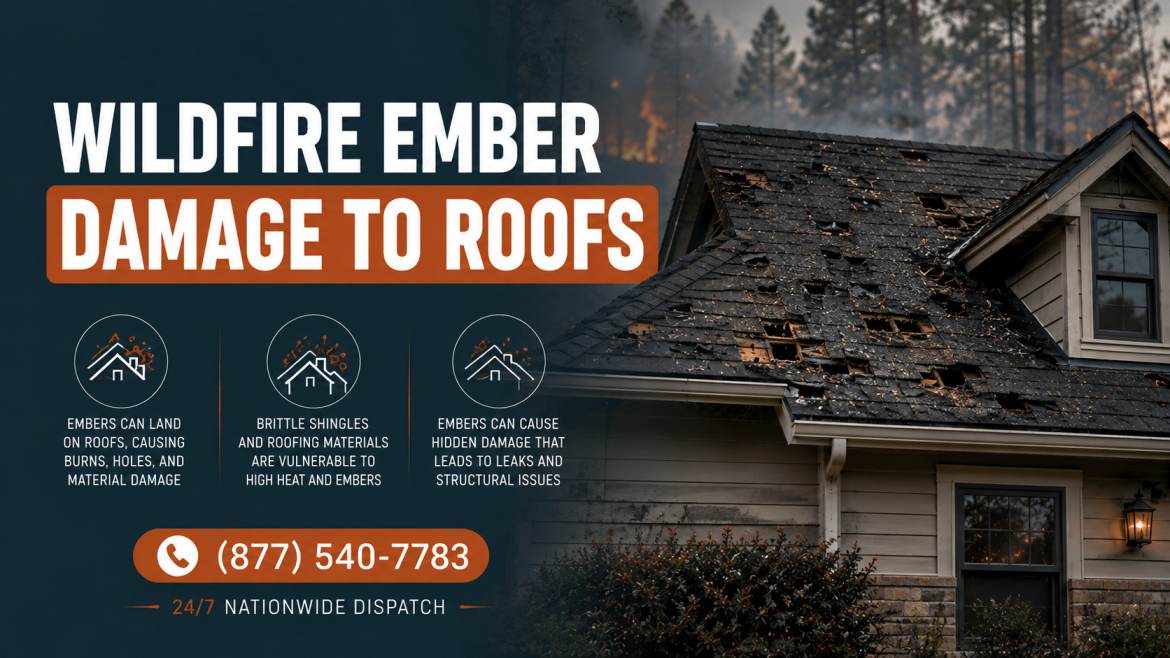
The image most people carry of a home lost to wildfire involves a wall of flame reaching the structure directly. That image is largely wrong, and the correction matters enormously for how homeowners should actually prepare their roofs.
California's Office of the State Fire Marshal reports that 60% to 90% of home ignitions in wildfires occur because of embers, not direct flame contact. Embers routinely travel more than a mile ahead of the fire front itself, landing on structures long before any visible flame arrives nearby.
This guide covers how ember ignition actually works, why roof debris matters as much as roof material, and what a fire rating protects against versus what it does not. It is one of twelve causes covered in the roof damage causes guide. Homeowners in fire-prone areas can also review the complete services directory for material and repair options.
How Do Embers Actually Ignite a Roof?
Embers, sometimes called firebrands, are small burning pieces of vegetation or building material lofted into the air by wildfire heat and carried by wind well ahead of the flame front itself. Ignition happens through a slower, less dramatic process than most people picture.
The Landing and Smoldering Sequence
An ember does not need to strike a roof and immediately combust the way it might in a dramatic scene. More often, it lands, accumulates alongside other debris, and smolders for an extended period before generating enough sustained heat to ignite.
Embers land in valleys, gutters, and any debris already collected on the roof
Accumulated dry material, leaves and needles especially, provides fuel for the smolder
The process can take hours, meaning ignition sometimes occurs well after the fire front has passed nearby
A single ember rarely ignites a home; accumulated ember exposure over an extended "ember shower" period is the more common ignition pathway
In practice: during intense wind events like Santa Ana conditions in California, firefighters describe "ember showers" where dozens or hundreds of embers arrive in rapid succession. Even a home with excellent defensible space around it can face ignition risk purely from this airborne exposure.
Why Do Roof Vents Matter as Much as Roof Material?
This is one of the more counterintuitive findings in wildfire home protection research. A fire-rated roof covering does not fully protect a home if the ventilation system beneath it remains vulnerable.
The Vent Pathway
Attic and roof vents exist specifically to allow air movement, which is exactly the function that also makes them a pathway for embers to bypass the roof covering entirely. An ember small enough to pass through an unscreened or damaged vent lands directly in the attic, surrounded by insulation and stored materials that provide abundant fuel.
Vent Type | Ember Vulnerability | Mitigation |
|---|---|---|
Standard gable vents | High, if unscreened | Fine-mesh ember-resistant screening |
Ridge vents | Moderate to high | Baffled, ember-rated products |
Soffit vents | High, often overlooked | Ember-resistant vent covers |
Foundation and crawlspace vents | Moderate | Similar screening approach |
The Insurance Institute for Business and Home Safety and the National Fire Protection Association both identify ember intrusion through vents as a leading cause of wildfire home ignition, separate from any damage to the roof covering itself.
Gaps at the Ridge and Eave
Beyond dedicated vents, ordinary construction gaps at the ridge, eave, and any place the covering has lifted slightly provide the same kind of access. A roof that looks intact from the ground can still have small gaps sufficient for ember intrusion, particularly on an older or poorly maintained covering.
Which Roofing Materials Resist Ember Ignition Best?
Material choice matters considerably for wildfire resistance, though the comparison is more nuanced than simply "fireproof versus flammable." Class A fire ratings, the highest available, apply to several materials with very different characteristics.
Understanding the Class A Rating
A Class A fire rating, tested under standardized conditions, indicates a roofing material's resistance to fire exposure from outside sources, including flying embers and brands. It does not mean the material is entirely immune to fire under all conditions.
Metal roofing carries Class A ratings and does not provide fuel for combustion itself
Clay and concrete tile similarly carry Class A ratings with minimal combustible content
Slate is naturally fire-resistant and commonly rated Class A
Asphalt shingles can achieve Class A ratings depending on the specific product's construction
Untreated wood shake carries the highest ignition risk of common roofing materials
Roof wear and aging matters for fire resistance in a way that is easy to overlook. An aged, brittle covering with degraded sealant and lifted edges provides more entry points for embers than the same material would when new, regardless of its original fire rating.
Wood Shake and Regulatory Response
Many jurisdictions in wildfire-exposed areas now restrict or prohibit untreated wood shake specifically because of its documented ignition risk. Insurance availability has followed those restrictions in several markets, with some carriers declining to write new policies on homes with untreated wood shake roofing in high fire-risk zones.
What Role Does Roof Debris Play in Ignition Risk?
Debris accumulation is the single most controllable factor in ember ignition risk, since it depends entirely on maintenance rather than on the roof's original construction or material choice.
Where Debris Collects and Why It Matters
Valleys, the areas immediately around chimneys, and gutters all collect organic debris over time, and that same debris provides exactly the fuel an ember needs to transition from a landed spark into a sustained fire.
Clear valleys of accumulated leaves and needles before fire season begins
Clean gutters regularly, particularly under overhanging tree and debris damage exposure
Remove debris from around the base of any roof-mounted equipment
Maintain clearance so falling debris does not continuously replenish cleared areas
A roof that is otherwise well-constructed and correctly vented can still ignite if debris accumulation goes unaddressed through an entire fire season. This maintenance task matters as much as any material or ventilation upgrade in high-risk zones.
Defensible Space Beyond the Roof
Vegetation clearance around a structure, commonly called defensible space, addresses flame contact and radiant heat exposure rather than ember exposure specifically. Fire scientists increasingly note that during extreme wind events, ember exposure becomes the dominant risk factor even for homes with excellent defensible space, since embers arrive regardless of nearby vegetation clearance.
How Do Other Roof Causes Interact With Fire Risk?
Wildfire ember exposure rarely occurs in isolation from a home's broader weather and maintenance history. Several other causes on this list influence how vulnerable a roof actually is once ember exposure begins.
Wind's Role in Ember Distribution
Wind damage and ember exposure share a direct relationship, since the same wind events that drive rapid wildfire spread are also what carries embers such long distances ahead of the flame front. Santa Ana and Diablo wind patterns in California specifically create the "ember shower" conditions fire scientists describe as the most dangerous exposure scenario.
A roof already carrying wind damage, lifted shingles or a compromised ridge cap from an earlier storm, presents additional gaps for ember intrusion beyond its intended vent pathways. Addressing wind damage promptly during fire season is not just a weather question in these regions.
UV-Aged Roofing and Fire Vulnerability
Sun and UV exposure compounds ember risk in a way that is easy to overlook. A shingle that has become brittle and curled from years of UV exposure creates small lifted edges and gaps that would not exist on a newer, more pliable covering, and those gaps function as additional ember entry points beyond the vents themselves.
That interaction is one more reason routine roof maintenance matters in wildfire-prone regions specifically, beyond the general service-life considerations that apply everywhere. A well-maintained roof presents fewer incidental entry points regardless of its material's fire rating.
Which States Face the Highest Wildfire Ember Risk?
Ember risk concentrates heavily in states combining extensive wildland-urban interface development with active fire seasons, though the specific risk profile varies by region within each state.
California, with the largest wildland-urban interface population in the country
Colorado, where Front Range development has expanded significantly into fire-prone terrain
Washington, facing increasingly active fire seasons in recent years
Oregon, sharing similar Pacific Northwest fire exposure with Washington
Texas, particularly in Hill Country and other areas with significant wildland interface
Wildfire-area roof repair in California deals with this risk more consistently than any other state, given the scale of development directly adjacent to fire-prone wildland. Roof repair services across Colorado follows a similarly elevated pattern as Front Range communities continue expanding into historically undeveloped terrain.
Roof repair coverage across Washington and wildfire-related roof services in Oregon both reflect a shift toward more active, longer fire seasons across the Pacific Northwest over the past decade. Roof repair across Texas rounds out the group, where Hill Country and other interface zones face meaningful ember risk distinct from the state's more commonly discussed hail and wind exposure.
What Should Homeowners in High-Risk Zones Actually Do?
Ember-specific preparation differs somewhat from general wildfire preparedness, since it focuses on the specific pathways embers use rather than on flame and radiant heat exposure broadly.
A Practical Priority List
Install ember-resistant vent screens at every attic and soffit opening
Clear roof debris on a seasonal schedule, more frequently just before fire season
Confirm the roofing material carries a Class A fire rating where local codes require it
Address any lifted, cracked, or gapped covering that could admit embers directly
Coordinate roof maintenance with broader defensible space clearing around the structure
None of these steps guarantee immunity from wildfire loss. Together, they address the documented primary ignition pathway rather than focusing exclusively on defensible space, which addresses a different and less common cause of home loss.
When Damage Has Already Occurred
A roof that has sustained ember damage, whether scorched debris, melted vent screens, or actual ignition that was caught and extinguished early, needs professional assessment even if the visible damage seems limited. Smoldering can continue in concealed areas like attic insulation well after the surface fire appears out.
If active damage or a breach exists, roof tarping protects the interior from subsequent weather exposure while a full assessment and repair plan gets arranged. Metal roofing is frequently the material homeowners in high-risk zones choose during replacement, given its combination of Class A rating and long service life.
Frequently Asked Questions About Wildfire Ember Damage
How Do Embers Actually Set a Roof on Fire?
Embers land on roof debris or enter through vents and gaps, then smolder before generating enough sustained heat to ignite surrounding material. This process can take hours, which is why ignition sometimes happens after the visible fire front has already passed.
What Roof Is Best for Wildfire Areas?
Metal, tile, and slate all carry Class A fire ratings with minimal combustible content, making them strong choices for high-risk zones. Correctly installed and vented asphalt shingles can also achieve Class A ratings, though wood shake carries meaningfully higher risk unless specifically treated.
Does a Fire-Rated Roof Guarantee Protection From Wildfire?
No. A fire rating addresses the covering material's resistance to ignition, but vents, gaps, and accumulated debris can still allow ember intrusion regardless of the covering's rating, which is why ventilation and maintenance matter alongside material choice.
How Far Can Wildfire Embers Actually Travel?
Embers can travel more than a mile ahead of a fire front under wind-driven conditions, arriving at structures well before any visible flame is nearby. This is why ember preparation matters even for homes that seem a safe distance from active fire lines.
Does Clearing Vegetation Around My Home Protect Against Ember Damage?
Defensible space primarily addresses flame contact and radiant heat rather than ember exposure specifically. Embers can arrive regardless of nearby vegetation clearance, which is why roof-specific measures like vent screening and debris removal matter as a separate layer of protection.
Is Wildfire Ember Damage to a Roof Covered by Homeowners Insurance?
Generally yes, where the policy includes fire coverage, since ember ignition is treated as a sudden, accidental event similar to other named perils. Coverage availability itself has become more restricted in some high-risk zones independent of any specific claim.
Do Insurance Companies Offer Discounts for Ember-Resistant Roofing?
Some carriers offer premium credits for homes meeting recognized wildfire mitigation standards, which typically include ember-resistant vents, Class A roofing, and documented defensible space alongside the roof-specific measures. Availability and discount size vary considerably by carrier and state, so confirming directly with an insurer is worthwhile before assuming a specific upgrade will affect premiums.
How Often Should Roof Debris Be Cleared in High Fire-Risk Areas?
A seasonal schedule works for most climates, but homes in areas with year-round fire risk or heavy overhanging tree cover benefit from more frequent checks, particularly in the weeks immediately before the local fire season's peak months.