
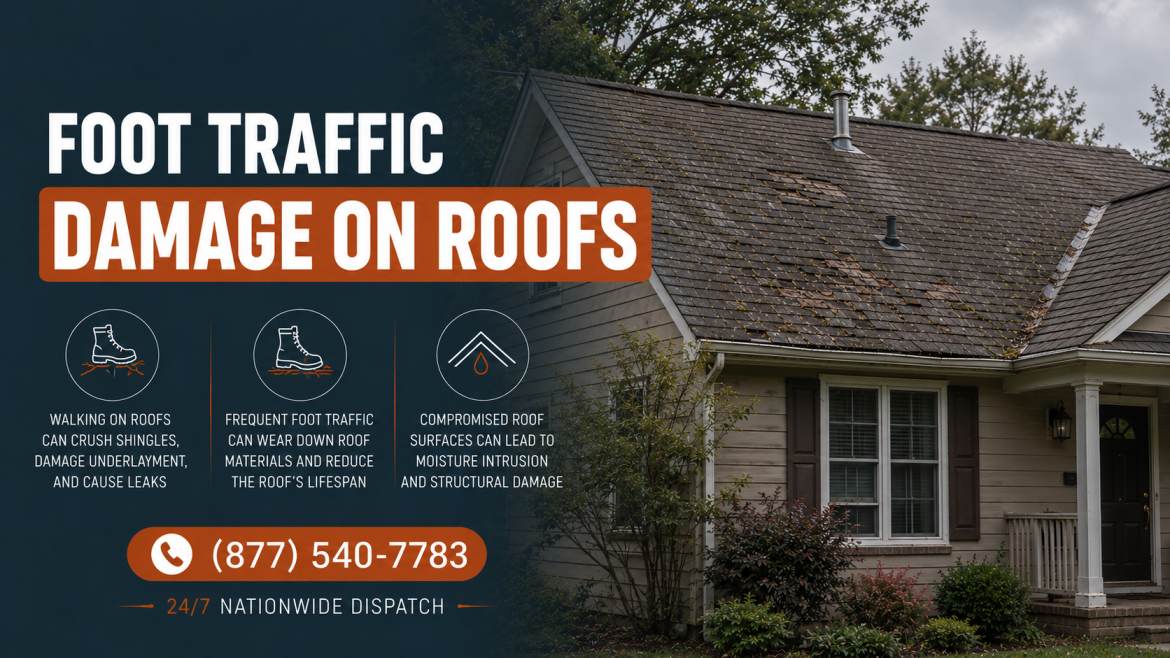
Every other cause covered in the roof damage causes guide comes from outside the home, whether from weather, wildlife, or time itself. Foot traffic damage is the exception. It is caused entirely by people, usually people who are on the roof to help.
That distinction matters for prevention, since it is the one cause a homeowner can genuinely control through scheduling and access decisions rather than through material choice or weather-resistant construction. It is also becoming more relevant than it used to be, driven largely by the growth in residential solar installations.
This guide covers the physics behind why a roof fails under a footstep, which materials and locations carry the most risk, and how the solar boom has reshaped this cause specifically. The services directory covers repair options for whatever the resulting damage requires.
Why Does Walking on a Roof Cause Damage at All?
The physics answer is straightforward once explained, even though it surprises many homeowners who assume a roof built to handle snow and rain should easily handle a person's weight too.
Distributed Load Versus Point Load
Roofing materials are engineered to handle distributed load, weight spread evenly across a wide surface area, the way snow accumulation applies pressure. A human foot creates something entirely different: a concentrated point load applied to a few square inches at a time.
Snow load spreads a given weight across the entire roof surface
A footstep concentrates a comparable or greater weight into a tiny contact area
That concentration can exceed a material's point-load tolerance even when its distributed-load rating is generous
Brittle materials fail at dramatically lower point loads than flexible ones
In practice: a roof rated to hold several tons of evenly distributed snow can still crack under a single person's weight if that weight lands wrong on a brittle tile or an aged, inflexible shingle. The two ratings measure completely different things.
Which Roofing Materials Are Most Vulnerable to Foot Traffic?
Material brittleness is the single biggest factor determining foot traffic risk, more significant than the roof's age or the person's actual weight in most cases.
Material | Foot Traffic Vulnerability | Typical Failure Mode |
|---|---|---|
Clay tile | Very high | Cracking or shattering underfoot |
Concrete tile | High | Cracking, though somewhat more resilient than clay |
Aged asphalt shingles | Moderate to high | Granule scuffing, mat cracking if brittle |
New asphalt shingles | Low to moderate | Granule displacement, rarely structural failure |
Slate | Very high | Fracture along natural cleavage planes |
Metal panels | Moderate | Denting or crushing between structural supports |
Tile roofs deserve particular caution, since even careful, trained foot placement can crack a tile that has weathered for years. Roof wear and aging compounds this risk considerably, since brittleness increases steadily as any material approaches the end of its service life.
Who Actually Causes Most Foot Traffic Damage?
Roofing crews rank surprisingly low on the list of professionals who cause this kind of damage, since they are trained specifically to distribute weight and avoid vulnerable areas. The higher-risk visitors are specialists who access the roof less frequently.
The Usual Culprits
Satellite and antenna installers, often stepping between structural supports on tile
HVAC technicians servicing rooftop units on aging asphalt
Chimney sweeps accessing the flue across multiple roof planes
Solar panel installers and maintenance technicians, an increasingly common visitor
Gutter cleaning crews walking the roof edge rather than working from a ladder
Roofers walk a roof daily and develop an instinct for weight distribution, stepping on the reinforced areas near fasteners and avoiding the center of individual shingles or tiles wherever possible. Occasional visitors rarely have that trained awareness.
How Has Solar Installation Changed Foot Traffic Risk?
The residential solar boom has introduced a new and significant source of foot traffic exposure that simply did not exist at scale a decade ago. Every solar installation requires repeated roof access, sometimes by multiple crews across different phases of the project.
The Installation Phase
Mounting hardware installation, panel placement, and electrical connection work all require crew members on the roof for extended periods, not just a brief inspection visit. Tile roofs present the greatest challenge during this phase specifically, since installers must work carefully around fragile material while carrying and positioning heavy equipment.
A qualified solar installer uses roof brackets and walk boards to distribute weight during installation, and on tile roofs, they typically remove individual tiles to mount hardware directly to the deck rather than working around intact tiles. That approach takes more time and adds cost, but it substantially reduces breakage compared to installers who skip the extra step.
Warranty Implications After Installation
Solar panels themselves present an ongoing foot traffic risk that persists well after installation is complete. Nearly every solar panel manufacturer warranty is voided by physical impact damage, including damage from walking directly on the panel surface.
Microfractures from foot traffic on solar glass are frequently invisible immediately after the incident, only showing up later as gradually declining energy output. That delay makes the connection between the damage and its cause hard to establish after the fact, which is exactly why manufacturers exclude it from warranty coverage rather than relying on after-the-fact inspection.
Does Sun Exposure Change How Much Risk Foot Traffic Carries?
A roof's exposure history changes its foot traffic tolerance considerably, since the same material becomes progressively more brittle over years of sun exposure before any visible sign of that change appears.
The UV and Brittleness Connection
Sun and UV exposure dries out the oils that keep asphalt flexible, and that gradual embrittlement directly determines how much point load a shingle can absorb before cracking. A shingle on a heavily sun-exposed south-facing slope tolerates far less foot traffic than an identical shingle on a shaded north-facing slope of the same roof.
This matters directly for solar installation planning, since panels are typically placed on the most sun-exposed slopes specifically to maximize energy generation. That placement puts installation crews walking on exactly the roof sections most likely to have already lost some of their original flexibility.
When Installation Quality Compounds the Risk
Installation defects from the original roof build can leave a covering more vulnerable to foot traffic than its material rating alone would suggest. A shingle installed with incorrect nailing or without adequate ventilation ages unevenly, developing brittle zones ahead of schedule in specific locations.
A roof already carrying hail damage presents a related complication. Hail-fractured mat beneath the surface weakens a shingle's structural integrity even where the granule layer looks intact, which means foot traffic on a recently hailed roof carries elevated risk of turning invisible storm damage into a visible crack.
Where Does Foot Traffic Damage Typically Concentrate?
Damage rarely spreads evenly across a roof. It concentrates at specific access routes and work zones, which makes those areas worth extra attention during routine inspection.
The path between the access point, typically a ladder location, and any rooftop equipment
The immediate area surrounding HVAC units, satellite dishes, and solar arrays
Valleys and ridges, which crews sometimes use as informal walking paths
Any section directly beneath a skylight or vent, where footing becomes less stable
Foot Traffic and Roof Access Zones
Some roofing systems, particularly commercial membrane roofs, are designed with dedicated walk pads or reinforced pathways specifically to concentrate foot traffic in areas built to withstand it. Residential roofs rarely include this feature, which is why any repeated-access point, like a spot near a chimney a sweep visits annually, deserves periodic inspection for accumulated wear.
Which States See the Most Foot Traffic Related Roof Claims?
Foot traffic risk correlates closely with solar adoption rates and tile roof prevalence, concentrating this specific cause in a smaller set of states than most weather-driven perils on this list.
California, the largest residential solar market in the country by a wide margin
Arizona, combining high solar adoption with extensive tile roof construction
Texas, seeing rapid recent growth in both solar installation and tile roofing
Florida, where tile roofing is common and solar adoption has grown quickly
North Carolina, among the fastest-growing solar markets outside the traditional Southwest
Roof services across California deal with foot traffic considerations on nearly every solar-related service call, given the state's combination of tile roof prevalence and the largest installed solar base nationally. Shingle and tile repair across Arizona follows a closely related pattern, where the same desert climate that favors tile construction also drives strong solar adoption.
Roof repair coverage across Texas has seen this cause grow rapidly alongside the state's expanding solar market. Roof services across Florida combines widespread tile roofing with rising solar demand in a way that keeps foot traffic risk consistently elevated. Roof repair across North Carolina rounds out the group as one of the fastest-growing solar markets where this cause has become increasingly relevant to homeowners.
How Should Foot Traffic Damage Be Handled if It Occurs?
Discovering foot traffic damage, whether from a recent service visit or an older, unknown incident, calls for a specific assessment approach rather than assuming the damage matches whatever visible cracking is present.
Immediate Response
If a technician or installer causes visible damage during a service visit, documentation at that moment protects everyone involved. Photographs of the specific cracked tile or damaged shingle, taken before any cleanup, establish a clear record for any warranty or liability discussion.
Photograph the damage immediately, including the surrounding undamaged area for context
Note which service call or visit preceded the discovery
Check for less obvious damage nearby, since cracking sometimes extends beyond the visible point
Arrange roof tarping if the damage has created an opening exposed to weather
When Full Assessment Makes Sense
A single cracked tile rarely requires a full roof assessment on its own. Repeated foot traffic over a period of years, particularly around a solar array or HVAC unit, sometimes warrants a broader emergency roof inspection to check whether accumulated damage extends beyond the immediately visible area.
Shingle repair for isolated foot traffic damage is typically straightforward, since the affected area is usually well-defined and limited in scope compared to storm damage spread across an entire slope.
Frequently Asked Questions About Foot Traffic Damage
Does Walking on a Roof Always Cause Damage?
Not always, particularly on newer, flexible asphalt shingles where careful foot placement rarely causes visible harm. Brittle materials like aged tile or slate carry much higher risk, where even trained, careful walking can crack the surface.
Can I Walk on a Tile Roof Safely?
Generally not recommended without specific training in where to step, since tiles crack under point loads that would not affect a more flexible material. Professional roofers know to step near the structural support points rather than the center of individual tiles.
Will Solar Panel Warranties Cover Foot Traffic Damage?
Almost never. Nearly every manufacturer warranty explicitly excludes damage from physical impact, including foot traffic, since the microfractures involved are difficult to distinguish from other causes after the fact.
Is Foot Traffic Damage Covered by Homeowners Insurance?
Generally no. This type of damage is caused by human activity rather than a weather event, which places it outside standard coverage in most cases, similar to how installation defects and ordinary wear are typically excluded.
How Do I Know if a Contractor Caused Foot Traffic Damage or if It Was Already There?
This is genuinely difficult to establish after the fact, which is why photographing the roof's condition before any service work begins is worthwhile whenever a major installation or repair is scheduled. A pre-work photo record, even a few phone snapshots from the ground and any accessible vantage point, gives both the homeowner and the contractor a clear baseline if a dispute arises later over when specific damage occurred.
Does Foot Traffic Damage Get Worse Over Time if Left Unaddressed?
Yes, in most cases. A crack from foot traffic can widen under subsequent weather exposure, and it creates a weak point where future foot traffic, hail, or wind is more likely to cause additional failure at the same location.
Should I Ask a Solar Installer About Their Foot Traffic Approach Before Signing?
Yes, particularly for a tile or slate roof. Asking whether the crew removes tiles to mount hardware directly to the deck, or attempts to work around intact tiles, gives a useful signal about installation quality before any work begins. An installer unfamiliar with the specific risks of a brittle roofing material is more likely to cause avoidable breakage during the project.