
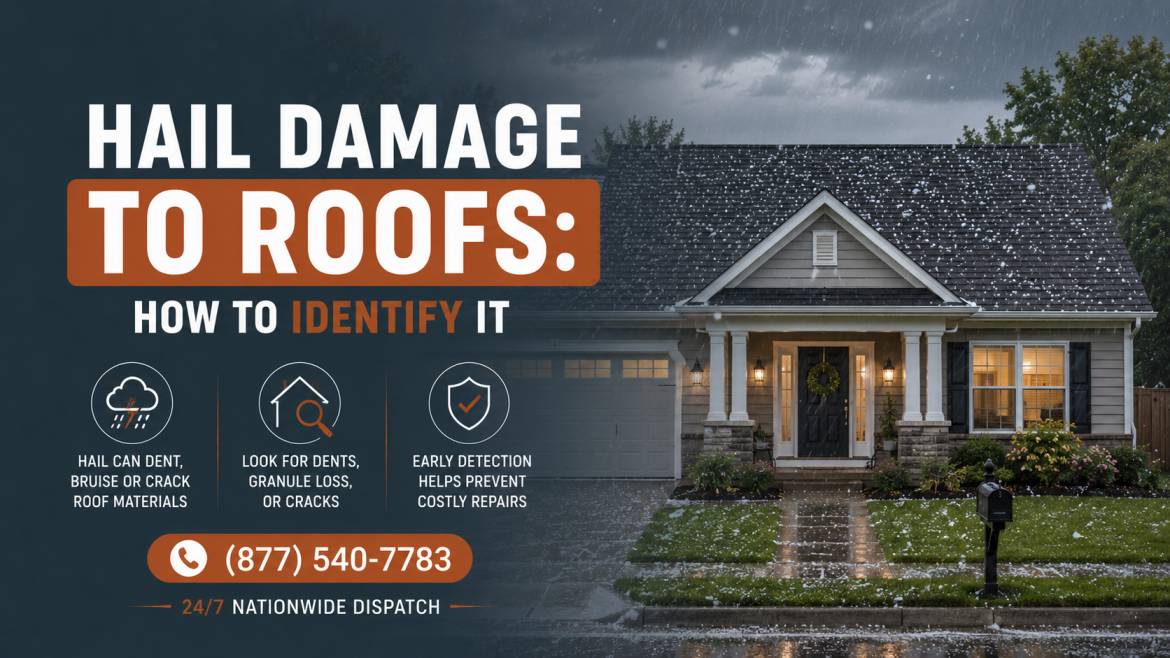
A hailstorm can pass over a home and leave the roof looking untouched from the driveway. That impression is often wrong. Hail is the storm peril most likely to cause damage nobody notices until months later.
The mechanism explains why. Hail does not tear a roof apart the way wind does. It bruises the shingle from the inside, fracturing the mat while leaving the granule surface mostly intact.
This guide covers how hail actually damages a roof, what that damage looks like across different materials, and how to tell a genuine hail strike from an aging shingle or a manufacturing defect. It also covers how insurers evaluate hail claims and what changes the outcome. For the full list of roofing services available nationwide, from tarping to inspection, the services directory covers every option.
How Does Hail Actually Damage a Shingle?
Hail damages a shingle through blunt force impact, not penetration. A hailstone striking the roof compresses the mat inside the shingle, and that compression is what fractures it. This is one of twelve recognized causes covered in the roof damage causes guide, and it behaves differently from every other peril on that list.
The asphalt shingle has three functional layers: the granule surface, the asphalt coating, and the reinforcing mat underneath. Hail impact travels through the first two layers and does its real damage to the third.
The Mat Fracture Mechanism
The fiberglass or organic mat gives a shingle its structural integrity. When hail compresses that mat hard enough, it cracks internally without necessarily breaking the surface above it.
The granule layer often stays in place directly over the impact point
The asphalt beneath softens and loses flexibility at the strike site
The mat itself develops a hairline fracture invisible from above
Water eventually finds that fracture during a later rain event
Alpine Intel, a firm that trains adjusters on hail identification, notes that indentation on the underside of a shingle is the clearest confirmation of a mat fracture. That underside check is something only a hands-on inspection can perform.
Why the Damage Often Stays Hidden
Hail bruises frequently leave the granules undisturbed at the center of the strike, even while the mat underneath has already fractured. That combination is what makes hail the hardest peril to self-diagnose.
A roof can pass a casual visual check and still carry functional damage across dozens of strike points. The bruise becomes visible only once granules eventually loosen and expose the asphalt below.
What Does Hail Damage Look Like by Roofing Material?
Hail interacts differently with every roofing material, and knowing the material-specific signature speeds up identification considerably. A roofer trained on asphalt evidence can miss the signs on metal or tile entirely.
Material | Typical Hail Signature | Detection Difficulty |
|---|---|---|
Asphalt shingles | Circular bruises, granule loss, exposed black mat | Moderate, worse on older roofs |
Metal panels | Visible dents, similar to hail dents on a vehicle hood | Low, dents are usually obvious |
Wood shingles | Cracks and splits, isolated rather than uniform | Moderate |
Clay or concrete tile | Cracked or shattered tiles, chips at the edges | Low once cracked, otherwise hidden |
Slate | Fracture lines, sometimes full breakage | Low |
Metal roofing shows hail impact more honestly than any other material, since a dent is visible regardless of angle or lighting. That visibility carries a separate consequence explained further down.
Reading the Signs on Asphalt Shingles
Asphalt is the most common residential material and also the hardest to read correctly. Indentations, dimples, and depressions in the surface are the first indicators worth checking.
Wood shingles behave differently from asphalt under the same impact. Wood cracks or splits rather than bruising, and the damage tends to concentrate unevenly across one slope rather than spreading uniformly.
Confirming Damage on Soft Metal Components
Gutters, vents, and HVAC housings are softer than most roofing materials, and they dent more readily under the same hailstone. That property makes them a reliable proxy for confirming hail size and force.
Alpine Intel's inspection guidance notes that dents in soft metal collaterals can measure up to twice the size of the hailstone that caused them. That relationship helps an inspector estimate storm severity even without a weather report.
What Size Hail Actually Causes Functional Damage?
Hail size is the first thing most homeowners ask about, and the honest answer depends on more than diameter alone. Wind speed, impact angle, and shingle age all change the threshold significantly.
One inch in diameter is the general threshold cited for functional asphalt shingle damage
Wind-driven hail carries more force than the same stone falling straight down
An older, more brittle roof bruises at smaller hail sizes than a new one
Wind damage and hail frequently strike in the same storm system, compounding the effect
Confusing Hail With Other Damage Types
Hail bruises are commonly mistaken for blistering, mechanical damage, and natural granule loss during a claims dispute. Alpine Intel specifically flags bird damage, moss growth, and heat blistering as frequent hail look-alikes.
The distinguishing trait is distribution. Hail lands randomly across every exposed slope, including the north face, while other causes tend to concentrate in one specific location or pattern.
Which States See the Most Hail Activity?
Hail frequency varies enormously by geography, and that variation shapes both roofing material choices and insurance pricing in the affected states. A handful of states account for a disproportionate share of national hail claims.
According to the Insurance Information Institute, Texas led the nation with 902 major hail events causing significant damage in 2025, the eleventh consecutive year it has held that position. Illinois placed second with 375 major events.
State | Hail Exposure Pattern |
|---|---|
Texas | Highest event frequency and total claims nationally |
Colorado | Front Range corridor with repeated severe storms |
Nebraska | Sits within the core of the historical "Hail Alley" |
Kansas | High seasonal frequency, concentrated in spring |
Illinois | Second-highest 2025 total per the Insurance Information Institute |
That frequency shapes demand for hail damage roof repair unevenly across the country. Spring convective storm season drives the bulk of it, and five states carry most of the load.
Roof repair crews across Texas field the highest volume of hail calls of any state, consistent with the Insurance Information Institute's 2025 ranking. The Dallas-Fort Worth corridor alone generates a large share of that total most years.
Hail-related roof repair in Colorado concentrates heavily along the Front Range, where Denver and Colorado Springs sit inside a corridor that produces some of the costliest single hailstorms on record. Seven of Colorado's ten most expensive storms trace back to that same metro area.
Nebraska sits at the geographic center of what meteorologists still call Hail Alley, and roof repair coverage in Nebraska reflects that positioning. The state records some of the highest average annual hailstorm counts in the country.
Emergency roof repair across Kansas follows a similarly seasonal pattern, concentrated in a narrow spring window when Kansas sees the bulk of its severe convective activity. Illinois closed out 2025 in second place nationally, and hail damage repair serving Illinois homeowners has scaled up as claim volume there has climbed.
How Should Hail Damage Be Documented for a Claim?
Documentation quality decides more hail claims than the damage itself does. Adjusters weigh dated, systematic photo evidence far more heavily than a general description of storm activity in the area.
The Test Square Method
Insurance adjusters commonly use a marked test square, typically 100 square feet, to count impact density on a representative section of roof. That count establishes whether the damage meets a carrier's density threshold for a full slope replacement.
Mark a 100 square foot test area on each affected slope
Count and photograph every confirmed hail strike within it
Repeat on at least one additional slope for comparison
Photograph soft metal components separately as corroborating evidence
What Makes a Hail Claim File Strong
A well-documented hail claim includes more than photographs of the roof itself. The strongest files also establish storm timing and pre-loss condition.
Dated wide shots of every slope, taken the same day if possible
Close-up shots with a coin or ruler for scale at each strike point
Photos of soft metal denting on gutters, vents, and AC housings
Any available pre-storm inspection report or listing photo
A recorded storm date matched against local weather service data
Insurance claim help typically focuses on assembling exactly this kind of file before an adjuster's first visit, since a weak initial file is harder to reverse after a denial.
Does Insurance Always Cover Hail Damage?
Hail is a named peril under nearly every standard homeowners policy, which puts it in a stronger coverage position than causes like roof wear and aging or pest entry. Coverage is common, but not automatic.
The dispute that actually happens is narrower than most homeowners expect. Carriers rarely deny that a storm occurred. They dispute whether the specific damage found is functional or purely cosmetic.
Functional Versus Cosmetic Hail Damage
A cosmetic damage exclusion, common on metal roofing policies specifically, removes coverage for dents that do not compromise water shedding. That distinction becomes the entire argument in many contested claims.
Granule loss alone is sometimes treated by insurers as cosmetic, since the shingle can still technically shed water even with a bruise. Documentation that shows mat fracture, not just surface marking, strengthens the case for functional damage.
When Installation Quality Complicates a Claim
A roof with pre-existing installation defects gives an adjuster grounds to attribute damage to workmanship rather than to the storm. Correct nailing and proper sealing matter as much for claim strength as for weather resistance.
In practice: the strongest hail claims combine a dense, well-photographed test square with soft metal corroboration and a stated storm date. Any one element alone is weaker than the combination.
What Should Happen Immediately After a Hailstorm?
Hail rarely creates the kind of open breach that demands an emergency tarp the way water intrusion or a fallen limb does. The response still needs to move faster than most homeowners expect.
The interior check matters as much as the exterior one. Hail bruises take weeks or months to progress into an active leak, but a roof already carrying hidden mat fractures is more vulnerable to the next rain event than an undamaged one.
A Practical Response Sequence
Walk the exterior and photograph gutters, vents, and any visible shingle disruption
Check the attic for fresh staining, even if none was present before the storm
Schedule a professional inspection within the first week rather than waiting
Hold onto all photos and notes in case a filing deadline applies later
If a section is already missing or torn open, arrange roof tarping the same day to prevent a hidden bruise from becoming an active leak before repairs are scheduled
That last step matters more than it seems. A hail-bruised roof with an unrelated small opening, from a broken vent cap or torn ridge cap, loses its margin for error once water starts tracking into weakened mat fractures nearby.
Why Waiting Rarely Helps
Some homeowners delay inspection on the assumption that hail damage, if present, will announce itself eventually. That assumption holds some truth, but it works against the homeowner rather than for them.
A delayed inspection means a delayed storm date on file, and adjusters weigh timing heavily. Roofs left unchecked through a full season also accumulate ordinary weathering on top of any hail bruising, which makes the two harder to separate later.
Frequently Asked Questions About Hail Damage
How Do I Know if My Roof Has Hail Damage?
Check gutters and downspouts first for accumulated granules, since that is often the earliest visible sign. Soft metal components such as vents and gutters showing dents also strongly suggest the roof surface took comparable impacts.
Is Hail Damage Always Visible Right After a Storm?
No, and this is the defining trait of hail damage specifically. Granules frequently stay in place directly over a fracture point, which means the underlying mat damage can remain invisible for months until the covering fails.
What Size Hail Actually Damages a Roof?
One inch in diameter is the commonly cited threshold for functional damage to asphalt shingles. Smaller hail can still cause damage when wind adds horizontal force, since impact energy depends on speed as much as size.
Do All Roofing Materials Show Hail Damage the Same Way?
No. Metal dents visibly and predictably, asphalt bruises in ways that can hide beneath intact granules, and brittle materials like tile and slate tend to crack or shatter outright rather than showing a soft bruise.
Will My Insurance Company Automatically Deny an Older Roof's Hail Claim?
Not automatically, but age raises the bar for evidence. An adjuster reviewing an older roof looks more closely for uniform wear patterns that would suggest the damage is aging rather than storm related.
How Long After a Hailstorm Should I Get an Inspection?
Inspecting within days rather than weeks produces stronger documentation, since the link between a specific storm date and the observed damage is easier to establish. Many policies also carry filing deadlines that reward early action.