
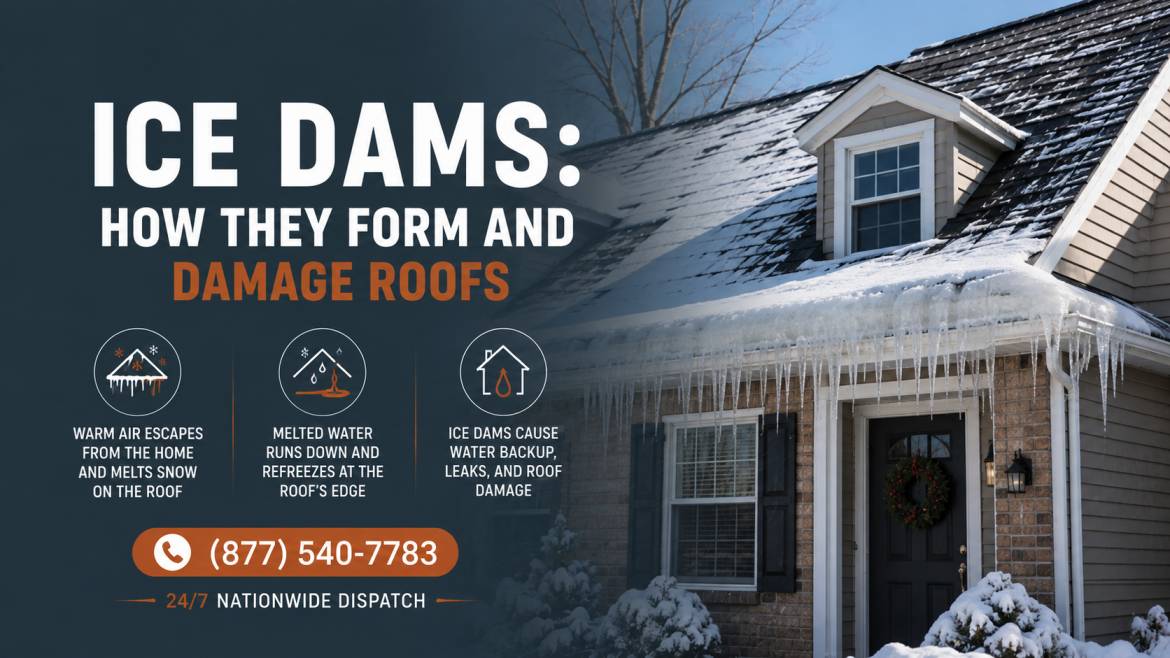
An ice dam looks like a winter weather problem. However, it is really a heat problem, and understanding that distinction is the difference between a homeowner who fixes it once and one who fights the same ice ridge every January.
The roof covering is rarely the cause. Ice dams form because of what is happening in the attic beneath it, which makes them one of the few roof damage causes that a new roof alone cannot solve.
This guide covers exactly how an ice dam forms, why it forces water backward into a home rather than simply melting away, and what stops the cycle permanently. For any roof already showing active leakage from ice buildup, the full range of emergency roofing services covers immediate response options.
How Does an Ice Dam Actually Form?
An ice dam forms through a three-stage process that starts inside the attic, not on the roof surface itself. It is one of twelve causes detailed in the roof damage causes guide, and it is unusual among them for originating below the roof rather than on it.
Stage One: Heat Escapes Into the Attic
Warm air from living space rises into the attic through gaps around light fixtures, plumbing stacks, and inadequate insulation. That escaped heat raises the attic's temperature above outside air, even in freezing weather.
Poorly sealed attic hatches and pull-down stairs leak significant warm air
Recessed lighting without proper covers is a common heat source
Bathroom exhaust fans venting into the attic instead of outside add moisture and heat
Insufficient insulation depth lets heat pass through the ceiling plane freely
Stage Two: Snow Melts Unevenly Across the Roof
The warm attic heats the roof deck from below, melting snow on the upper and middle sections of the roof while the unheated eave, which overhangs beyond the attic space, stays at outside temperature.
That uneven melting is the entire problem in miniature. Meltwater runs down the roof toward the eave and hits a section of shingle that never warmed up in the first place.
Stage Three: Water Refreezes and Backs Up
Once the meltwater reaches the cold eave, it refreezes into a ridge of ice. That ridge grows with each melt cycle, and it eventually dams enough water behind it to force meltwater backward, uphill, under the shingle courses above.
In practice: water does not need gravity to defeat a roof once an ice dam has formed. Trapped, pressurized meltwater finds its way through seams and nail holes that were never designed to resist standing water from below.
Why Do Ice Dams Force Water Uphill?
This is the detail that confuses most homeowners, since shingles are designed entirely around water flowing downhill. An ice dam defeats that design by creating standing water rather than moving water.
Shingles overlap like the scales on a fish, shedding water that flows in one direction across a dry, sloped surface. That system has no defense against water pooling behind an ice ridge and pushing upward against gravity through capillary action and hydrostatic pressure.
The Underlayment's Role
Ice barrier membrane, a self-sealing waterproof layer installed at the eave during construction, exists specifically to stop this backed-up water from reaching the deck. Its presence or absence often determines whether an ice dam produces a leak or just an unsightly icicle.
Older homes built before ice barrier membrane became standard in cold climates carry significantly more risk from the same dam size. A newer roof with proper underlayment can tolerate an ice dam that would flood an older attic.
Which Signs Confirm an Active Ice Dam Problem?
Ice dams announce themselves in specific, recognizable ways both outside and inside the home. Catching the early signs before water reaches the interior saves considerably more than catching it after.
Location | Warning Sign | What It Indicates |
|---|---|---|
Gutter line | Heavy icicle formation | Meltwater refreezing at the roof edge |
Gutter trough | Ice filling the channel | Water no longer draining, only freezing |
Exterior walls | Staining below the roofline | Water has already breached the covering |
Attic | Frost or dampness on rafters | Warm, moist air escaping from below |
Ceiling | Fresh stains near exterior walls | Water has reached the living space |
Interior signs matter more than exterior ones for urgency, since ice on the gutter line is a warning while a ceiling stain means the dam has already succeeded in breaching the roof.
Distinguishing an Ice Dam Leak From Other Winter Causes
Roof snow load and ice dams both concentrate in winter, but they produce different evidence. Snow load causes structural deflection and sagging, while an ice dam produces staining and active water intrusion without any structural movement.
A roof can experience both conditions from the same winter storm cycle, which makes careful diagnosis worthwhile before assuming a single cause explains everything observed.
Which States Face the Highest Ice Dam Risk?
Ice dam formation requires a specific climate pattern: cold enough for sustained snow cover, but with enough sun or attic heat loss to drive repeated melt-refreeze cycles. That combination concentrates in a predictable band of states.
New York, particularly the snowbelt regions east and south of the Great Lakes
Minnesota, where sustained cold holds ice ridges in place for weeks at a time
Wisconsin, sharing similar lake-effect exposure to neighboring Minnesota
Massachusetts, where older housing stock often lacks modern attic ventilation
Michigan, spanning both lake-effect snowbelt zones and inland cold pockets
Ice dam removal serving New York sees its heaviest demand in the state's snowbelt corridor, where lake-effect snow compounds ordinary winter accumulation. Roof repair coverage across Minnesota follows a similarly concentrated seasonal pattern tied to the state's sustained sub-freezing stretches.
Older housing stock plays a larger role than climate alone in several of these states. Ice dam services across Massachusetts frequently involve homes built before modern ventilation codes existed, which raises baseline risk independent of that winter's snowfall total. Winter roof repair across Wisconsin and ice dam response in Michigan both track closely with the same lake-effect exposure pattern.
How Is an Active Ice Dam Removed Safely?
Removing an ice dam without damaging the shingles underneath requires a different approach than simply chipping away visible ice. Mechanical removal methods routinely cause more damage than the dam itself.
Why Steam Is the Preferred Method
Low-pressure steam melts ice on contact without the mechanical force that a hammer, ice pick, or pressure washer applies. Ice dam removal using steam clears the buildup while leaving the shingle mat and granule surface undisturbed.
Steam melts through ice quickly without breaking the shingle beneath it
No mechanical impact means no new fracture points for future water entry
The method works on both the visible dam and the ice trapped in gutters
It can be performed while the roof is still cold, without waiting for a thaw
What Homeowners Should Avoid
Salt and calcium chloride products, commonly marketed for ice dam relief, can accelerate corrosion of metal flashing and gutters when used repeatedly. Physical chipping is worse, since it routinely cracks the shingle mat directly beneath the visible ice.
Climbing onto an icy, sloped roof to address a dam personally carries a separate and more immediate risk than the dam itself. This is one of the clearer cases where professional access outweighs any cost savings from a homeowner attempt.
Does Attic Ventilation Actually Prevent Ice Dams?
Ventilation and insulation together address the root cause rather than the symptom, which is why they matter more than any removal method for preventing recurrence. Removing this winter's dam does nothing to stop next winter's.
The Two-Part Fix
Balanced attic ventilation, combined with sufficient insulation depth, keeps the roof deck close to outside air temperature. That uniform cold temperature prevents the uneven melting that starts the entire ice dam cycle.
Confirm insulation reaches full depth across the attic floor, including at the eaves
Verify baffles keep the intake vents clear at the soffit
Check that bathroom and kitchen exhaust fans vent outside, not into the attic
Address any recessed lighting or plumbing penetrations leaking warm air upward
In practice: a roof that develops the same ice dam in the same location every winter almost always has a specific, findable heat leak directly above that spot. Tracking the dam's location back to its interior source solves the recurring pattern.
Long-Term Costs of Repeated Ice Dam Cycles
A single winter's ice dam is a nuisance. Ten winters of the same recurring dam is a structural problem, since repeated freeze-thaw cycling stresses fasteners, sealant, and decking well beyond what any one event would cause alone.
Homeowners who address only the visible ice each year, without ever fixing the attic heat loss driving it, typically spend more over a decade than a one-time ventilation correction would have cost. The dam is a symptom that keeps returning until its cause is addressed.
Roofing Materials and Their Interaction With Ice Dams
Every material handles ice dam risk differently, and this connects directly to the broader comparison covered in the roofing materials guide. Metal roofing sheds snow more readily than asphalt, which reduces dam formation but shifts the risk toward sudden snow slides instead.
Roof wear and aging compounds ice dam vulnerability over time, since older shingles and aging sealant provide less resistance to water forced backward under a course than newer materials do.
What Should Happen the Moment Water Reaches the Interior?
An active ice dam leak behaves differently than most other roof leaks, since the source is often still frozen even after water has already reached the ceiling. That timing gap changes the right response.
Immediate Steps Indoors
Standard leak response, catching drips and relieving a bulging ceiling, still applies during an ice dam event. The complication is that the dam itself often cannot be cleared until conditions allow safe roof access.
Contain the drip with a bucket and relieve any bulging ceiling section carefully
Move furniture and belongings away from the affected area
Photograph the interior staining with a timestamp for insurance purposes
Schedule steam-based dam removal as soon as it can be done safely
When Temporary Covering Makes Sense
If an ice dam has already forced a shingle course loose or torn underlayment during the freeze-thaw cycle, the roof needs more than dam removal alone. Roof tarping over the compromised section prevents the next thaw cycle from reopening the same pathway before permanent repairs happen.
This differs from water intrusion caused by wind-driven rain, where the source is immediately obvious and accessible. An ice dam leak can require waiting for a safe weather window before the actual dam is addressed, which makes interim protection more important, not less.
A Note on Wind-Driven Winter Storms
Ice dams rarely form in isolation from other winter weather. Wind damage frequently accompanies the same storm systems that produce heavy snow, and a shingle already stressed by an ice dam's backed-up water resists wind uplift less effectively than a dry one.
That combination is why late-winter storms sometimes produce disproportionate damage relative to their wind speed alone. The ice dam has already compromised the shingle's seal before the wind ever arrives to test it.
Frequently Asked Questions About Ice Dams
What Causes Ice Dams on a Roof?
Heat escaping from living space into the attic melts snow on the upper roof while the unheated eave overhang stays frozen. That meltwater refreezes at the cold eave, forming an ice ridge that traps water behind it.
Do Ice Dams Always Cause a Leak?
Not always, but the risk rises significantly the longer a dam persists. A roof with proper ice barrier membrane at the eave can tolerate a dam that would produce an active leak on an older roof without that protection.
Can I Remove an Ice Dam Myself?
Homeowners can safely clear accessible gutters from the ground, but removing an established dam from the roof itself is a task better left to professionals using steam equipment. Chipping or salting can cause more damage than the ice itself.
Will a New Roof Stop Ice Dams From Forming?
Not on its own. Since ice dams originate from attic heat loss rather than the roof covering, a new roof without addressing insulation and ventilation will develop the same dams the old one did.
How Fast Can an Ice Dam Cause Interior Damage?
It varies with dam size and how much backed-up water accumulates, but interior staining can appear within days of a dam forming during a sustained cold snap with intermittent sun exposure driving the melt cycle.
Is Ice Dam Damage Covered by Homeowners Insurance?
Often yes, since the resulting water damage is frequently treated as a sudden, accidental event. Coverage can become contested if an insurer determines the dam resulted from long-term neglected ventilation rather than a single storm cycle.
Why Do Some Homes on the Same Street Get Ice Dams While Others Don't?
Attic construction varies far more between individual homes than most people expect, even on an identical street facing the same weather. Insulation depth, ventilation design, and heat sources like recessed lighting all differ by house, which explains why dams appear selectively rather than uniformly.