
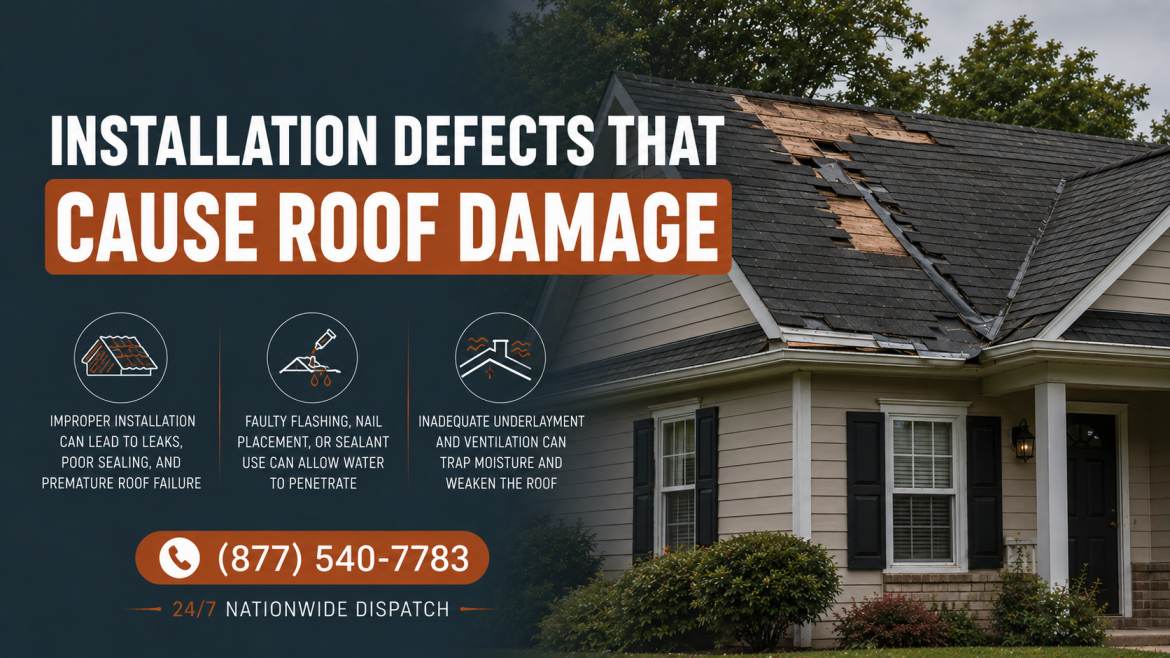
A roof can fail for reasons that trace back to a single afternoon, years before the visible symptom ever appears. Installation defects are unusual among the twelve causes in the roof damage causes guide for exactly this reason: the mistake happens once, at the original build, but the consequence can take a decade to surface.
A study cited by the National Roofing Contractors Association found that poor workmanship, bad design and construction damage were responsible for more than 60% of roof leaks and premature failures. That figure puts installation quality ahead of material quality as the leading driver of early roof failure.
This guide covers the specific errors that cause this outcome, how they mimic storm damage during a claim dispute, and what separates a properly installed roof from a shortcut-laden one. The services directory covers repair and replacement options for whichever defect ends up applying.
What Are the Most Common Installation Defects?
Installation defects cluster around a predictable set of errors, most of which trace back to a crew skipping a manufacturer-specified step in favor of speed. Each one produces a distinct, identifiable failure pattern.
Nailing Errors
The nailing pattern is the single most consequential detail in an asphalt shingle installation, since it determines how well the roof resists wind uplift for its entire service life. Manufacturers specify an exact nailing zone, and deviation from it undermines the shingle's rated performance regardless of material quality.
Nails placed above the designated zone miss the reinforced strip entirely
Underdriven nails leave the shingle head loose and prone to lifting
Overdriven nails cut through the shingle mat, creating an immediate weak point
Too few fasteners per shingle reduces wind resistance below the rated speed
Flashing Shortcuts
Flashing failure accounts for a disproportionate share of roof leaks relative to how small a component it is. The errors that cause this are almost always about sequence, not material quality.
Flashing Error | Consequence |
|---|---|
Sealed with caulk instead of layered metal | Fails within a few seasons as caulk degrades |
Reused during a re-roof | Existing corrosion and wear carried into the new roof |
Improper lap sequence | Water flows against the joint instead of over it |
Missing at a wall-to-roof junction | Direct, unprotected entry point for water |
Missing or Incorrect Underlayment
A missing starter course at the eave leaves the first row of shingles without the sealed edge that resists wind uplift at the roof's most exposed point. Similarly, underlayment installed with insufficient overlap or left exposed too long before covering degrades before the roof ever sees its first storm.
In practice: these underlayment errors stay completely invisible once the finished shingles go on top. They surface only once the covering itself has already failed and the secondary barrier is asked to do a job it was never properly positioned to perform.
Why Does Installation Damage Often Look Like Storm Damage?
This overlap is what makes installation defects genuinely difficult for homeowners and even some inspectors to diagnose correctly. A roof failing from a nailing error produces symptoms that resemble wind damage closely enough to confuse an untrained eye.
The Overlap With Wind Damage
Wind damage and installation defects share a nearly identical visible symptom: missing or lifted shingles. The distinguishing factor is timing and pattern rather than appearance. A properly installed roof loses shingles only in genuinely severe wind, concentrated at edges and corners. A poorly installed roof loses shingles at wind speeds the same product should easily withstand, sometimes across the field rather than just the perimeter.
An adjuster investigating a wind claim on a roof with underlying nailing defects may attribute the loss entirely to poor workmanship, denying coverage even where a genuine storm also occurred. Separating the two causes requires examining the nail placement on shingles that remain, not just the ones that came off.
The Overlap With Hail Damage Claims
Hail damage claims face a related complication. An insurer looking for a reason to deny coverage on an aging or poorly installed roof will sometimes attribute bruised or missing shingles to installation quality rather than to a documented storm, particularly when the roof's nailing pattern shows any irregularity at all.
That dynamic makes correct installation documentation valuable well beyond the initial construction phase. A homeowner who can demonstrate the roof was installed to specification has a stronger position defending a legitimate storm claim years later.
The Overlap With Water Intrusion
Water intrusion frequently traces back to a flashing installation shortcut rather than to any storm event at all. A leak at a chimney base that appears during an ordinary rainstorm, with no wind or hail involved, points toward an installation issue far more often than toward weather.
The Accelerated Aging Connection
A roof with underlying installation defects does not simply fail once and stop there. It also ages faster than a correctly installed roof of the identical age and material, since roof wear and aging compounds on top of whatever weakness the original build already introduced.
That compounding effect is why two roofs installed the same year, using identical shingles, can show dramatically different condition a decade later. The installation quality set a different starting trajectory for each one from day one.
How Do You Spot a Bad Installation Before It Fails?
Some installation defects are visible immediately after the work is completed, well before any failure occurs, which makes post-installation inspection genuinely worthwhile rather than purely reactive.
Visible Signs of Poor Workmanship
Missing or visibly crooked starter course along the eave edge
Inconsistent shingle exposure, where courses do not align cleanly
Nail heads visible on the shingle surface rather than covered by the course above
Flashing that appears caulked rather than mechanically layered
Debris, old nails, or discarded materials left on the property after completion
Why a Post-Installation Inspection Matters
An independent emergency roof inspection shortly after a new roof installation, before any warranty window closes, can catch defects while they are still the installer's clear responsibility to correct. Waiting until a leak actually develops years later makes the same defect far harder to trace back to its origin with confidence.
Photographing the underlayment and deck before the final covering goes on, something a transparent contractor will readily allow, gives a homeowner documentation that most people never think to request until it is too late.
Which States See the Most Installation-Related Roof Disputes?
Installation defect disputes concentrate in states with high storm frequency, since the combination of urgent post-storm demand and transient contractor activity creates conditions where shortcuts happen more often.
Texas, where high hail and wind claim volume drives intense seasonal demand
Florida, with hurricane-driven urgency and a large seasonal contractor population
Colorado, where Front Range hailstorms create similarly compressed repair windows
Oklahoma, sharing high storm-driven demand with limited local crew capacity
Louisiana, where hurricane recovery periods draw significant out-of-state contractor activity
Roof replacement services across Texas deal with installation quality disputes at a higher rate than lower-storm-frequency states, given how much post-storm work floods the market each spring. Storm recovery roof repair across Florida frequently intersects with installation quality questions during hurricane recovery periods when demand for repairs spikes sharply.
Roof repair coverage across Colorado sees similar seasonal compression tied to Front Range hail activity. Storm-related roof repair in Oklahoma and roof replacement across Louisiana both reflect markets where urgent, high-volume repair demand can outpace the availability of experienced local crews, raising the odds that shortcuts occur somewhere in the process.
Does a Manufacturer Warranty Cover Installation Errors?
This is one of the more misunderstood aspects of roofing warranties, and the answer disappoints many homeowners who assumed their new roof carried broader protection than it actually does.
Two Separate Warranties, Two Separate Coverages
A manufacturer warranty covers material defects, meaning a flaw in the shingle itself as it left the factory. It does not cover damage caused by incorrect installation, even when that damage manifests as a failure in the material.
A workmanship warranty, offered by the installing contractor rather than the manufacturer, covers installation errors specifically. This warranty is typically shorter than the material warranty, often two to ten years, and its value depends entirely on the contractor remaining in business and honoring it.
Warranty Type | Covers | Typical Duration | Who Provides It |
|---|---|---|---|
Manufacturer material warranty | Factory defects in the shingle itself | 25 to 50 years, often prorated | The shingle manufacturer |
Workmanship warranty | Installation errors like nailing or flashing | 2 to 10 years | The installing contractor |
Enhanced manufacturer warranty | Broader coverage, sometimes including labor | Varies, requires certified installer | The manufacturer, contingent on certification |
An enhanced manufacturer warranty, available only through contractors certified by that specific manufacturer, occasionally extends coverage to include installation-related failures. That certification requirement is one practical reason to verify a contractor's manufacturer credentials before signing a contract.
Reading a Warranty Document Before Signing
Most homeowners sign a roofing contract without reading the workmanship warranty section closely, focusing instead on price and timeline. That section deserves the same attention, since its exclusions and duration determine what recourse exists if a defect surfaces later.
Confirm the warranty duration in writing, not just verbally promised
Check whether the warranty transfers to a new owner if the home is sold
Look for exclusions specific to flashing, ventilation, or other common defect points
Verify the contractor's business has a track record long enough to honor a multi-year term
What Should Happen if a Recent Roof Is Already Failing?
A roof failing within its first few years, well short of any material's expected lifespan, warrants a different response than damage on an older roof, since installation defects are the leading suspect rather than an afterthought.
Document the failure with dated photographs before any repair work begins
Contact the original installing contractor to invoke the workmanship warranty
If the contractor is unresponsive, request an independent inspection for a second opinion
Consider insurance claim help if the failure occurred during or after a storm and the cause is disputed
If the failure has already created an active leak, roof tarping limits interior damage while the warranty question or repair scope gets sorted out. Interim protection does not affect the underlying dispute over who is ultimately responsible.
Frequently Asked Questions About Installation Defects
What Are the Signs of a Bad Roof Installation?
Look for an uneven or missing starter course, inconsistent shingle alignment, visible nail heads, and flashing that appears sealed with caulk rather than properly layered. Debris left on the property after completion is also a common indicator of rushed work.
Can a Badly Installed Roof Be Fixed Without Full Replacement?
Sometimes, if the defects are isolated to specific areas like flashing points rather than affecting the entire nailing pattern. Widespread nailing errors across the whole roof typically require more extensive correction than a targeted repair can economically address.
Are Installation Defects Covered by Homeowners Insurance?
No. Standard homeowners policies exclude faulty workmanship, treating it as a construction quality issue rather than a covered peril. Recourse for installation defects comes through the contractor's workmanship warranty rather than an insurance claim.
How Long Does a Typical Workmanship Warranty Last?
Workmanship warranties commonly run two to ten years, considerably shorter than the material warranty on the shingles themselves. The exact term varies by contractor and should be specified clearly in writing before work begins.
Can I Tell if My Roof Was Installed Correctly Without Climbing on It?
Some signs are visible from the ground with binoculars, including alignment consistency and starter course condition, but confirming nailing pattern and flashing sequence typically requires a professional inspection.
What Should I Do if I Suspect My New Roof Was Installed Poorly?
Contact the installing contractor first to request a warranty inspection, and document everything with photographs in case the dispute requires an independent second opinion or escalation beyond the original contractor.
Does Hiring a Cheaper Contractor Increase the Risk of Installation Defects?
Not automatically, but price alone is a poor predictor of installation quality either way. A significantly below-market bid sometimes reflects a crew cutting corners on fastener count, underlayment overlap, or flashing detail to compress labor time, which is why checking licensing, insurance, and manufacturer certification matters more than comparing price quotes.
Can Installation Defects Void a Homeowner's Ability to File Future Storm Claims?
Not entirely, but they can weaken a future claim considerably. An adjuster who identifies pre-existing nailing or flashing defects during a storm inspection may attribute part or all of the damage to those defects rather than to the storm itself, reducing or denying the payout even for a genuinely severe weather event.