
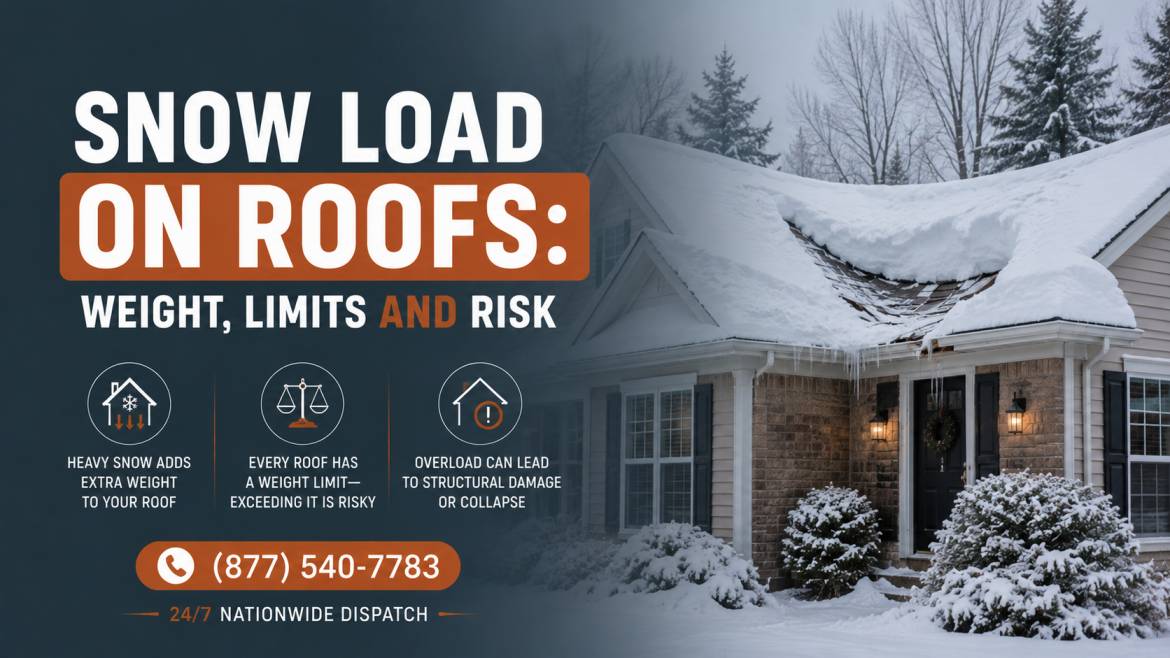
A foot of snow does not weigh the same amount twice. That single fact is the reason snow load causes so much confusion among homeowners trying to judge whether their roof is actually at risk.
Depth is the number everyone measures because it is the easiest one to see from a window. Weight is the number that actually matters, and the two can diverge by a factor of four or more depending on the type of snow involved.
This guide covers how snow load is actually calculated, what design capacity means for a typical residential roof, and the specific warning signs that separate ordinary winter accumulation from a genuine structural risk. Roof snow load is one of twelve causes covered in the roof damage causes guide, and homeowners can also review the complete directory of roofing services for any repair response.
How Is Roof Snow Load Actually Measured?
Snow load is expressed in pounds per square foot, a unit that captures weight rather than the depth most homeowners instinctively track. That distinction is the entire reason two roofs with visually similar snow cover can carry very different actual loads.
Why Depth Alone Is Misleading
Fresh, dry powder and old, saturated snow occupy the same visual depth while carrying dramatically different weight. A roof holding four feet of light fresh snow may carry less total load than one holding two feet of packed, wet snow from an earlier storm.
Snow Condition | Approximate Weight |
|---|---|
Fresh, dry powder | About 5 lbs per sq ft per 10 to 12 inches |
Packed, older snow | About 5 lbs per sq ft per 3 to 5 inches |
Ice, one inch | Equivalent to roughly one foot of fresh snow |
Rain-soaked snow | Can exceed 20 lbs per sq ft in a single layer |
The Insurance Institute for Business and Home Safety states that most residential roofs can support roughly 20 pounds per square foot before becoming structurally stressed. That figure assumes a roof in sound condition, without prior damage or decay.
What Actually Triggers Structural Concern
Rain falling on top of existing snow cover is the scenario that concerns structural engineers most, since it saturates and compacts the snow layer almost immediately. A moderate snow load that a roof was handling comfortably can cross the danger threshold within hours once rain adds to it.
Combined old and new snow layers stack weight faster than either alone
Rain-on-snow events add weight without adding visible depth
Drifting concentrates load unevenly rather than spreading it across the roof
A roof's design capacity was set for its local building code, not for extremes
Why Does Load Concentrate Unevenly Across a Roof?
Wind rarely deposits snow uniformly, and that unevenness is where most snow load failures actually begin. A roof rated for a specific average load can still fail locally where drifting has doubled or tripled that figure.
Where Drifts Form and Why They Matter
Dormers, valleys, and any roof-to-wall junction create wind eddies that drop snow faster than it accumulates on an open slope. Those same locations carry the least structural reserve, since they already interrupt the simple, continuous framing that handles load most efficiently.
Parapet walls on flat and low-slope roofs create a similar effect, trapping drifting snow against the wall rather than letting wind carry it off the edge. Commercial and multi-family buildings with this roof style see a disproportionate share of snow-related structural claims for exactly this reason.
How Roof Pitch Changes the Equation
Steeper roofs shed snow naturally as it accumulates, which reduces peak load compared to a flat or low-slope roof of the same size. That relationship is why the Insurance Institute for Business and Home Safety recommends slopes of at least 3 inches of rise per 12 inches of horizontal run in regions with heavy seasonal snowfall.
A flat roof carries the full calculated snow load with no reduction for slope, which is one reason flat roof repair demand rises sharply in the days following a major snow event in low-slope commercial districts.
What Are the Warning Signs of an Overloaded Roof?
Structural warning signs appear before outright failure in nearly every documented case, which makes early recognition genuinely useful rather than academic. The signs cluster in two locations: the roofline itself and the interior ceiling.
Location | Warning Sign | Urgency |
|---|---|---|
Roof ridge | Visible dip or wave in an otherwise straight line | High |
Interior doors | Doors on the top floor sticking or misaligned | Moderate to high |
Ceiling | New cracks, especially running toward a corner | High |
Walls | Fresh separation where wall meets ceiling | High |
Support beams | Audible creaking or popping under load | Critical |
In practice: a ridge line that has always been perfectly straight and suddenly shows even a slight dip after a heavy snow event should be treated as a structural finding, not a cosmetic one. That dip means the framing is deflecting under load right now.
When to Call for Emergency Assessment
Any combination of interior warning signs alongside heavy roof accumulation warrants same-day professional assessment rather than a wait-and-see approach. Emergency roof inspection services exist specifically for this kind of time-sensitive structural question.
Waiting through a second snow event on top of an already-stressed roof compounds risk in a way that is not linear. A roof already near its capacity has far less reserve for the next storm than an unstressed one would.
Which Roofs Carry the Least Reserve Capacity?
Not every roof faces equal snow load risk, and several identifiable factors combine to determine which structures need the closest winter monitoring. Age and prior condition matter as much as raw design capacity.
Homes built before 1975 in many jurisdictions predate stricter modern load codes
Flat and low-slope roofs carry full calculated load with no shedding benefit
Roofs already carrying multiple layers of old shingles add dead weight before any snow falls
Roof wear and aging reduces framing capacity over decades even without visible damage
A roof compromised by prior water damage carries less true reserve than its original design rating suggests, since rot and fatigue reduce a rafter's actual strength well before it becomes visible from below.
Which States Design for the Heaviest Snow Loads?
Building codes vary enormously by region specifically because snow load risk varies enormously by region. Several states require design loads several times higher than warmer-climate states ever consider.
Colorado, where mountain elevations require some of the highest ground snow load figures in the country
Minnesota, with sustained cold holding heavy accumulation in place through most of winter
New York, particularly in lake-effect snowbelt zones east of the Great Lakes
Montana, where mountain and high-plains snowfall both contribute to elevated design requirements
Wisconsin, sharing lake-effect exposure with neighboring snowbelt states
Roof repair coverage across Colorado reflects the state's position among the highest design-load requirements nationally, particularly in mountain communities. Snow-related roof services in Minnesota and roof repair across New York both see concentrated winter demand tied to sustained sub-freezing accumulation periods.
Emergency roof repair covering Montana deals with a combination few other states share, mountain snowpack alongside high-plains wind-driven drifting. Winter roof services across Wisconsin rounds out the group with lake-effect exposure similar to its snowbelt neighbors.
How Does Snow Load Interact With Other Winter Causes?
Snow rarely arrives on a roof in isolation from other winter conditions, and understanding how these causes compound each other changes both risk assessment and repair sequencing.
The Connection to Ice Dams
Ice dams and snow load often develop from the same storm cycle but represent distinct structural questions. An ice dam is a water intrusion problem at the eave, while snow load is a weight-bearing problem across the entire roof plane.
A roof carrying both conditions simultaneously needs assessment for each separately, since resolving one does not address the other. Clearing an ice dam does nothing to reduce the total weight still sitting on the roof above it.
When Snow Removal Becomes Necessary
Professional snow removal, rather than waiting for natural melt, becomes appropriate once accumulated weight approaches a roof's estimated capacity or once interior warning signs appear. Removal itself carries technique requirements that reduce risk to the roof surface below.
Removal should leave a layer of snow rather than scraping to bare shingles
Roof rakes with rubber or plastic edges reduce granule stripping
Ice buildup at the eave requires separate steam-based treatment, not scraping
Any removal near power lines or on steep pitches needs professional equipment
What Response Does an Overloaded Roof Need Immediately?
Structural risk from snow load calls for a different first response than most other roof causes, since the danger is active weight rather than a breach admitting water. The priority shifts from covering an opening to reducing load.
The Correct Order of Action
Move occupants and belongings out from directly beneath any area showing warning signs
Contact a structural professional before attempting any snow removal personally
Arrange professional snow removal that targets the heaviest drift areas first
Schedule a follow-up assessment once the load has been reduced
If the accumulated weight has already cracked shingles or opened a seam, roof tarping protects the interior from active leaks while the structural question gets resolved separately. The two problems, weight and water entry, need independent attention even when they appear together.
Compounding Risk From Prior Installation Quality
Installation defects rarely cause snow load failure on their own, but they reduce the safety margin a roof has against it. A rafter installed with undersized lumber or improper spacing carries less true capacity than the code assumed at construction.
That gap between assumed and actual capacity usually stays invisible until an unusually heavy winter tests it directly. A home that handled every prior winter without issue can still fail once a rain-on-snow event pushes load past what the original framing, quietly under-built from the start, was ever able to carry.
A Note on Post-Storm Wind Exposure
Heavy snow events frequently transition into windy conditions as a system clears, and wind damage can compound an already-stressed roof's problems. A shingle course already flexed under snow weight resists wind uplift less effectively than it would under normal conditions.
Frequently Asked Questions About Snow Load
How Much Snow Can a Roof Hold?
Most residential roofs can support roughly 20 pounds per square foot before becoming structurally stressed, according to the Insurance Institute for Business and Home Safety. That translates to roughly four feet of fresh powder or considerably less packed or wet snow.
Can Snow Actually Cause a Roof to Collapse?
Yes, though true collapse is relatively rare and usually involves a combination of factors: an already-aged structure, uneven drift loading, or rain falling on top of existing accumulation that saturates and compacts it rapidly.
Does a Steep Roof Eliminate Snow Load Risk?
No, but it reduces it considerably. Steeper slopes shed accumulating snow more readily than flat or low-slope roofs, which is why building codes in heavy snowfall regions often specify minimum pitch requirements.
How Do I Know if My Roof Is Overloaded Right Now?
Watch for a visible dip in the ridge line, doors on the top floor that suddenly stick, or fresh cracks in ceiling drywall. Any of these signs during or after a heavy snow event warrants same-day professional assessment.
Should I Remove Snow From My Roof Myself?
Ground-level removal with a roof rake is reasonable for accessible eave areas. Climbing onto a snow-covered roof is not recommended, since the surface is both unstable and already carrying weight it may be near its limit for.
How Long Does It Take Professionals to Clear an Overloaded Roof?
Timing depends heavily on roof size, pitch, and accumulation depth, but a typical residential roof takes a few hours for a professional crew working systematically from the ridge down. Steeper or more complex rooflines with multiple valleys and dormers take longer, since drift-prone areas need extra care to avoid gouging the shingle surface.
Is Snow Load Damage Covered by Homeowners Insurance?
Generally yes, since the weight of ice and snow is a named peril under most standard homeowners policies. Structural damage from an overload event is typically treated as a sudden, covered loss rather than gradual wear.
Does the Type of Roofing Material Change Snow Load Risk?
Material choice affects how snow sheds but not the total weight the framing must support once accumulation occurs. A metal roof sheds snow faster than asphalt shingles, which can reduce peak load, though it introduces a separate risk of sudden snow slides landing near entrances or walkways below.
Why Do Commercial and Flat-Roof Buildings See More Snow Load Claims?
Flat and low-slope roofs carry the entire calculated snow load without any reduction for shedding, unlike a steep residential roof that continuously sheds accumulation as it falls. Parapet walls common on commercial buildings also trap drifting snow rather than letting wind clear it, which concentrates load exactly where the structure has the least reserve capacity.