
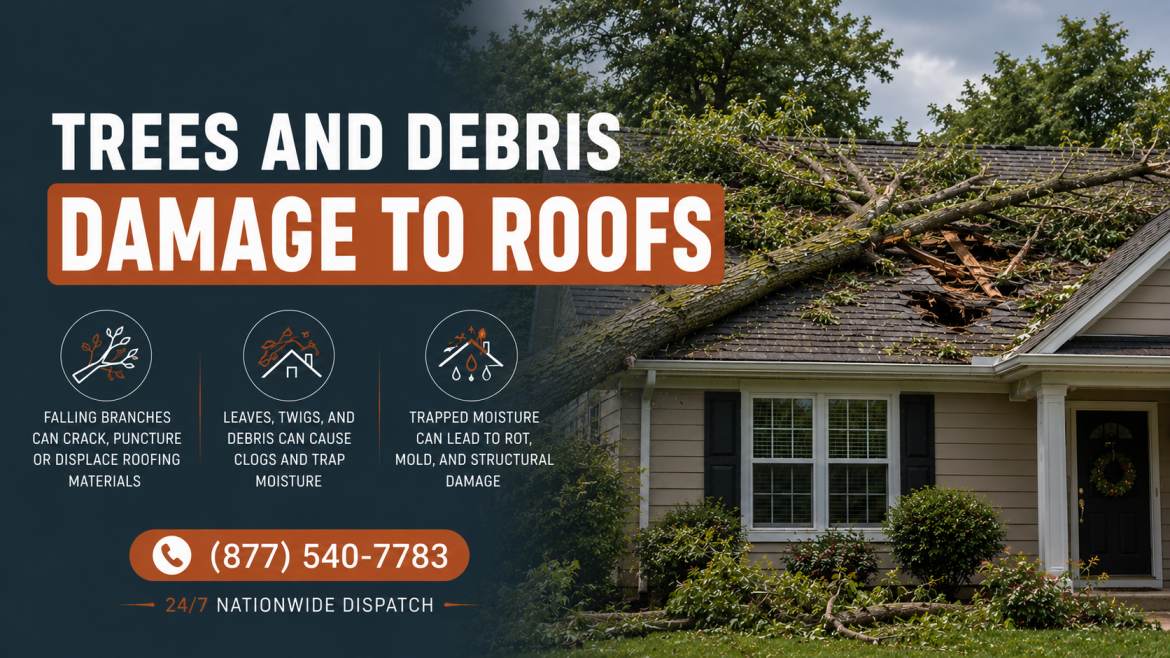
A landscaping decision made a decade ago is often the actual cause of a roof problem discovered today. Trees rarely damage a roof the moment they are planted. The relationship builds slowly until either a storm or simple growth turns a shade tree into a liability.
That delay makes tree damage unusual among the twelve causes covered in the roof damage causes guide. Most other perils arrive and depart within a single storm. Tree-related damage frequently develops across seasons, sometimes years, before it becomes visible.
This guide covers the two distinct ways trees damage a roof, how to judge safe clearance distances, and what changes once a limb is actually resting on the structure. For homeowners dealing with an active situation right now, the complete directory of roofing services covers everything from emergency tarping to full tree removal.
How Do Trees Actually Damage a Roof?
Trees cause roof damage through two mechanisms that share almost nothing in common except the source. One is sudden and violent. The other is slow and easy to overlook entirely.
Sudden Impact Damage
A falling limb or full tree strikes a roof with concentrated force, capable of puncturing the covering, fracturing decking, and in severe cases compromising the framing beneath it. This is the scenario most homeowners picture when they think about tree damage.
Impact force depends on the limb's weight, fall height, and the angle of contact
A large limb can puncture through shingles, underlayment, and decking in one event
Smaller branches typically damage only the surface covering
The impact point often shows debris embedded directly in the fractured area
Slow Abrasion Damage
An overhanging branch that never falls can still cause significant damage over time, simply by moving across the roof surface every time wind blows. This mechanism produces evidence that looks nothing like a sudden impact.
In practice: a branch rubbing the same section of roof for several years wears a visible track through the granule surface, exposing the asphalt beneath well before any single storm event would explain the damage. Insurers read this pattern as gradual wear rather than storm damage, which changes how the claim gets treated.
Why Does Falling Debris Complicate Drainage?
Beyond direct impact, trees contribute to roof problems through the debris they continuously shed, and this pathway causes damage indirectly rather than through any single dramatic event.
How Leaf Litter Creates a Secondary Problem
Leaves and small debris collect in valleys and along gutters, and that accumulation holds moisture against the roofing material far longer than the surface would otherwise stay wet. Prolonged dampness accelerates granule loss and, in colder climates, contributes directly to ice dam formation by blocking normal drainage at exactly the location where meltwater needs to escape.
Valleys clogged with leaves dam water similarly to a clogged gutter
Trapped moisture encourages moss and algae growth in shaded areas
Debris accumulation is worst under canopy that overhangs the roofline directly
Regular clearing, particularly each fall, interrupts this cycle before it compounds
Shade and Its Role in Moss Growth
Overhanging canopy reduces the sun exposure a roof section receives, and less sun exposure means slower drying after every rain. That combination of shade and retained moisture is the primary condition moss needs to establish itself on a roof surface.
Moss does more than look unsightly. Its root structure works between shingle courses as it grows, gradually lifting edges and creating small gaps that would not otherwise exist on a dry, sun-exposed roof.
How Far Should Trees Actually Be From a Roof?
Clearance guidelines balance genuine risk reduction against the practical reality that mature trees cannot always be relocated once established near a home. A working distance exists that addresses most of the risk without requiring wholesale landscape removal.
Clearance Zone | Distance From Roof Plane | Rationale |
|---|---|---|
Direct contact risk | Under 3 feet | Immediate abrasion and moisture retention risk |
High-risk overhang | 3 to 6 feet | Falling debris and branch-sway contact likely |
Moderate risk | 6 to 10 feet | Reduced but not eliminated impact and shade risk |
Low risk | 10 feet or more | Minimal direct interaction under normal conditions |
Six to ten feet of clearance from the roof plane is the general working guideline most arborists and roofing professionals recommend. That distance removes abrasion contact, reduces debris load significantly, and admits enough sunlight to discourage moss establishment.
Species Matter as Much as Distance
Not every tree carries equal risk at the same distance. Brittle species with a history of unexpected limb failure, such as certain fast-growing varieties, warrant more conservative clearance than slower-growing, structurally sound species positioned at the same distance from a home.
Root systems deserve consideration alongside canopy distance. A tree with aggressive roots can eventually affect a foundation or driveway even while its canopy stays a safe distance from the roofline itself, which is a separate concern from the roof damage this guide focuses on.
What Changes Once a Tree Actually Falls on a Roof?
A tree resting on a roof shifts the situation from a landscaping question to an active structural hazard, and the response sequence changes. Safety considerations take priority over any repair planning at this stage.
The Correct Immediate Sequence
Confirm no downed power lines are involved before anyone approaches the structure
Evacuate any room directly beneath the impact if structural compromise seems possible
Photograph the scene from a safe distance before any debris gets moved
Arrange professional tree removal from roof rather than attempting removal personally
Follow removal with roof tarping to seal the exposed area the same day
Removing a fallen tree safely requires more than cutting it into manageable pieces. Weight distribution changes as sections are cut away, and a limb that seemed stable can shift suddenly once the branches supporting it are removed.
Why Professional Removal Matters Beyond Safety
A tree resting across a roof frequently obscures the full extent of damage underneath it. Professional removal crews working alongside roofing contractors can assess structural compromise as the debris comes off, rather than discovering hidden damage only after the tree is already gone and the homeowner has moved on to repair planning.
Which States See the Most Tree-Related Roof Claims?
Tree damage risk correlates closely with tree cover density combined with storm frequency, which concentrates claims in specific regions more than tree cover alone would predict.
Georgia, combining dense forest cover with active severe thunderstorm and hurricane remnant exposure
North Carolina, sharing similar forest density with regular tropical storm impact
Virginia, exposed to both nor'easters and inland severe thunderstorm activity
Pennsylvania, with mature, older-growth trees common in long-established neighborhoods
Ohio, seeing significant derecho and severe wind exposure interacting with heavy tree cover
Tree damage roof repair across Georgia sees some of the highest seasonal demand nationally, driven by the combination of dense canopy and an active storm season that runs long into fall. Storm and tree damage repair in North Carolina follows a closely related pattern tied to the same tropical weather systems.
Roof repair services across Virginia covers a broader annual window than purely coastal states, given exposure to both winter nor'easters and summer thunderstorms. Tree removal and roof repair in Pennsylvania deals disproportionately with mature, decades-old trees positioned closer to older homes than modern clearance guidelines would recommend. Storm damage roof repair across Ohio rounds out the group, where the same derecho corridor responsible for severe Midwest wind events also drives significant tree-related roof damage.
Does Insurance Treat Impact Damage Differently From Abrasion?
Insurance coverage for tree damage depends heavily on which of the two mechanisms actually caused the loss, and that distinction changes the outcome of a claim more than the visible damage itself does.
When Impact Damage Is Covered
A falling limb or tree striking a roof during a storm is generally treated as a sudden, accidental event, which places it squarely within standard homeowners coverage. The claim typically proceeds similarly to wind or hail damage, with documentation of the storm date supporting the timeline.
When Abrasion Damage Faces Denial
Slow abrasion from a branch that has rubbed against the roof for years reads very differently to an adjuster. That pattern resembles roof wear and aging far more than a sudden event, and insurers frequently deny claims on this basis, citing preventable neglect rather than an unavoidable storm.
In practice: the distinction between a fallen limb and a rubbing branch is rarely ambiguous once photographed properly. A homeowner who trims contact branches before they cause slow damage avoids this entire category of coverage dispute.
How Does Tree Damage Interact With Other Causes?
A roof carrying tree damage rarely presents that damage in isolation. Several other causes on this list frequently appear alongside it, either as a shared trigger or as a consequence that develops afterward.
Wind as the Common Trigger
Most falling limbs and trees come down during the same severe weather that produces wind damage elsewhere on the roof. A single storm can leave a homeowner assessing both an isolated impact point and broader wind-related shingle loss across the same roof plane.
Separating the two causes in the claim documentation matters, since an adjuster needs distinct evidence for the impact zone and for the wind-affected areas rather than a single combined description covering both.
Debris as an Open Invitation for Wildlife
A canopy overhanging the roofline does more than shed leaves. It also provides the access route most animal and pest damage cases depend on, since squirrels and other climbing wildlife use overhanging branches as a direct bridge onto the roof surface.
Trimming clearance around a roofline addresses both problems simultaneously, since the same distance that prevents abrasion and impact risk also removes the easiest access path for animals that would otherwise reach the roof without ever touching the ground.
When Debris Blockage Leads to Water Intrusion
Clogged valleys from accumulated leaf litter set up conditions for water intrusion independent of any direct tree contact with the roof. A valley that cannot drain behaves the same way a clogged gutter does, holding water against the covering long after a healthy drainage path would have cleared it.
That indirect pathway is often the least visible of all tree-related risks, since the tree itself may be a safe distance from the roof while its debris still causes measurable damage every season.
Frequently Asked Questions About Tree Damage
What Should I Do if a Tree Falls on My Roof?
Confirm no power lines are involved, stay clear of the area, and photograph the scene before arranging professional removal. Avoid climbing onto the structure or attempting to move debris personally, since weight distribution can shift unpredictably during removal.
Do Overhanging Branches Really Damage a Roof if They Never Fall?
Yes. Repeated wind-driven contact between a branch and the roof surface wears away granules over time, and the resulting exposed asphalt ages faster in that specific location than the rest of the roof.
How Close Can a Tree Safely Be to a Roof?
Six to ten feet of clearance from the roofline is the general recommendation from most roofing and arborist professionals, though species, growth rate, and limb health can justify more conservative spacing in some cases.
Is Tree Damage to a Roof Covered by Homeowners Insurance?
It depends on the mechanism. Sudden impact from a falling limb is typically covered as an accidental event, while slow abrasion from a long-standing overhanging branch is often treated as preventable neglect and denied.
Does Leaf Litter From Nearby Trees Actually Cause Roof Damage?
Yes, indirectly. Trapped leaf litter in valleys and gutters holds moisture against the roof surface, accelerates granule loss, encourages moss growth, and can contribute to ice dam formation in colder climates.
Should I Remove a Healthy Tree Just Because It's Close to My Roof?
Not necessarily. Trimming overhanging limbs and maintaining clearance often addresses the risk without requiring full removal, unless the species is known for brittle limb failure or the tree shows visible signs of disease or structural weakness.
How Do I Know if a Nearby Tree Poses a Genuine Risk?
Look for dead or hanging limbs, visible cracks in the trunk, fungal growth at the base, or a noticeable lean that has developed recently rather than always being present. Any of these signs, combined with proximity to the roofline, warrants a professional arborist assessment before the next major storm rather than after.