
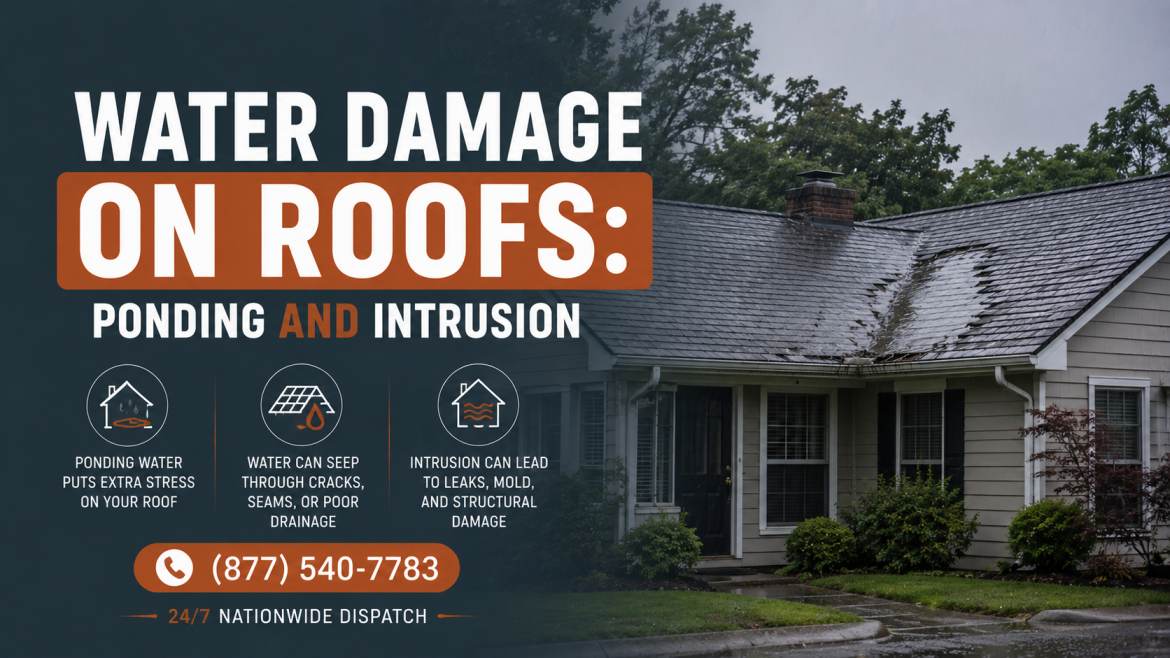
Water is patient in a way that hail and wind are not. A storm peril does its damage in minutes. Water intrusion can take weeks to become visible, working through a gap the size of a nail hole the entire time.
That patience makes water intrusion different from every other entry on the roof damage causes list. It is rarely the original cause of a problem. It is almost always the consequence of one, arriving after wind, hail, or age has already opened a pathway.
This guide covers how water actually moves once it finds an opening, why standing water behaves differently than wind-driven rain, and which parts of a roof see the highest concentration of moisture-related failure. Homeowners facing an active leak right now can review the complete list of emergency roofing services for immediate response options.
How Does Water Actually Get Past a Roof Covering?
Water intrusion happens through two distinct mechanisms, and understanding which one applies to a given leak changes both the diagnosis and the fix. One mechanism involves water that stops moving. The other involves water pushed by wind.
Standing Water and Ponding
Ponding occurs when water remains on a roof surface rather than draining away within a normal timeframe. Industry standards published by the National Roofing Contractors Association define ponding as water still present on a low-slope membrane 48 hours after rainfall.
Flat and low-slope roofs are the most common location for ponding
Clogged or undersized drains slow the water's path off the roof
A sagging deck creates a low point where water naturally collects
Standing water works through seams and fasteners given enough dwell time
Ponding rarely causes damage from a single rain event. The risk accumulates with repetition, since each pooling cycle stresses the same seams and fastener penetrations again.
Wind-Driven Rain
Wind-driven rain defeats a roof's design in a fundamentally different way than ponding does. Shingles and flashing are built to shed water flowing downhill under gravity, not water forced sideways or upward by sustained wind pressure.
The Insurance Institute for Business and Home Safety has found that a properly sealed roof deck can reduce water intrusion by up to 95% in cases where the covering itself has already blown off during a storm. That figure illustrates how much of the water intrusion problem is really about the layers beneath the visible shingle.
Where Does Water Actually Enter a Roof System?
Water rarely enters through the open field of a roof, since that area is where the covering performs exactly as designed. Entry concentrates at transitions, penetrations, and any point where the continuous water-shedding surface gets interrupted.
Entry Point | Why Water Concentrates There |
|---|---|
Valleys | Combined runoff from two roof planes in one narrow channel |
Chimney flashing | Differential movement between masonry and framing opens joints |
Skylight perimeter | A permanent penetration through the covering, dependent on seal integrity |
Vent boots | Rubber seals around pipe penetrations degrade faster than the surrounding roof |
Wall-to-roof junctions | Step flashing installation quality varies widely |
Flashing failure specifically accounts for a large share of documented roof leaks, since it depends on correct installation sequencing rather than material durability alone. A flashing joint sealed with caulk instead of properly layered metal fails within a few seasons regardless of the caulk's quality.
How Installation Quality Changes the Picture
Installation defects are directly responsible for a significant share of water intrusion cases that appear, on the surface, to be simple material failure. Reused flashing during a re-roof and improperly lapped joints both create pathways that look identical to storm damage once water has found them.
That overlap complicates diagnosis considerably. A leak at a chimney base could trace to a recent storm, a decade-old installation shortcut, or ordinary sealant aging, and each explanation carries different implications for both repair scope and insurance coverage.
What Happens Inside a Roof Once Water Gets Past the Covering?
Water that breaches the primary covering does not immediately reach the living space below. Several intermediate layers exist specifically to catch and redirect it, and how those layers perform determines whether a breach becomes a visible leak.
The Underlayment's Buying Time
Underlayment, the secondary water barrier installed directly on the roof deck, catches water that gets past the shingles and channels it back toward the drainage path rather than letting it soak straight through. A sound underlayment can buy months between a covering failure and an actual interior leak.
That delay is both good and bad news for a homeowner. It means damage is not always immediately obvious, but it also means functional damage can exist for a long stretch before any visible sign appears indoors.
When Decking Becomes Involved
Once water reaches the roof decking itself, the damage shifts from a repair question to a structural one. Prolonged saturation softens the wood until it no longer holds a fastener securely, which is discovered almost exclusively at tear-off rather than through any earlier inspection.
In practice: a roof estimate that assumes sound decking underneath can change substantially once tear-off begins. Water-damaged sheathing is one of the most common reasons a repair invoice exceeds its original estimate.
Which States See the Heaviest Water Intrusion Exposure?
Water intrusion risk tracks closely with coastal storm exposure and sustained rainfall patterns, which concentrates it in a specific band of states more than any single weather event would suggest.
New Jersey, where a 130-mile Atlantic coastline sits directly in the path of nor'easters
New York, sharing similar coastal nor'easter exposure across Long Island and the Hudson Valley
North Carolina, exposed to both nor'easters and hurricane-driven rain from the south
Florida, facing sustained tropical rainfall alongside hurricane wind-driven exposure
Massachusetts, where older coastal housing stock compounds nor'easter rain exposure
Roof repair along the New Jersey coast deals with wind-driven rain at flashing points as a near-annual occurrence during nor'easter season, which typically runs from October through April. Emergency roof repair across New York follows a closely related seasonal pattern along its own coastal exposure.
Storm-related roof repair in North Carolina covers a wider window than purely coastal states, since the state sees both winter nor'easters and summer hurricane remnants. Roof repair services across Florida faces the most sustained annual rainfall exposure of the group, with hurricane season adding concentrated risk on top of routine tropical weather. Coastal roof repair covering Massachusetts rounds out the group, where aging housing stock often lacks the sealed-deck protection newer construction includes.
How Do You Tell Ponding From an Active Leak?
Distinguishing the two matters because they call for different fixes. Ponding is a drainage design problem, while an active leak is a breach problem, and treating one as the other wastes both time and repair budget.
Evidence of Ponding
Ponding leaves physical evidence that persists even after the water itself evaporates, which makes it identifiable well after any specific rain event has passed.
Rings of sediment marking where standing water sat and evaporated
Blistered or wrinkled membrane concentrated in the low area
Algae or discoloration in the same recurring spot after every rain
A membrane surface that flexes or feels soft when walked
Evidence of an Active Breach
An active breach, by contrast, shows evidence indoors as much as on the roof surface itself. Ceiling stains that expand after each new rainfall are the clearest indoor confirmation that water is actively finding its way through rather than simply pooling on the surface.
Attic inspection often catches breach evidence before it ever reaches a finished ceiling. Dark staining on the underside of the decking, well before any interior sign appears, gives the earliest possible warning of an active pathway.
What Immediate Steps Limit Water Damage Once It Starts?
The first hours after discovering active water intrusion matter more than almost any later repair decision, since uncontrolled water spreads damage far beyond its original entry point.
Contain interior water with buckets and relieve any bulging ceiling section
Move furniture, electronics, and belongings clear of the affected area
Photograph the interior damage with timestamps before starting any cleanup
Arrange roof tarping over the exterior breach the same day if it is visible and accessible
Run fans and a dehumidifier once active dripping has stopped
Most homeowners policies place a duty on the policyholder to make reasonable emergency repairs that prevent further loss. Skipping that step can give an insurer grounds to decline the portion of damage that spread after the original event.
When the Cause Traces Back to Wind
Wind damage and water intrusion frequently appear together, since a wind-lifted or torn shingle is exactly the kind of opening that lets rain reach the underlayment during the same storm. Addressing the wind damage without also confirming the underlayment's condition leaves the water pathway unresolved.
A roof repaired for wind damage alone, without checking whether water already reached the deck during the same event, risks a slower secondary failure appearing weeks or months later.
How Do Other Causes Set Up Water Intrusion?
Water intrusion is rarely a first cause on its own. It is usually the second act, arriving once another peril has already opened a pathway that the roof's design never anticipated.
Ice Dams as a Water Intrusion Trigger
Ice dams create one of the more counterintuitive water intrusion pathways, since they force water uphill rather than letting gravity carry it down and away. A roof that sheds every ordinary rain flawlessly can still fail against a backed-up ice dam.
That mechanism explains why some water intrusion appears only in winter and never during summer thunderstorms of comparable or greater rainfall intensity. The pathway itself, not the total water volume, is what changes seasonally.
Debris-Blocked Drainage
Tree and debris damage contributes to water intrusion indirectly, through leaf litter and branch debris that dams valleys and clogs drainage paths rather than through direct impact. A blocked valley behaves similarly to a clogged gutter, holding water against the covering far longer than the roof was designed to tolerate.
Regular clearing of valleys and drainage paths, particularly under overhanging canopy, prevents this indirect pathway from ever developing into an active leak. It is one of the lower-cost preventive measures available against water intrusion generally.
Frequently Asked Questions About Water Damage
What Does Water Damage From a Roof Actually Look Like?
It typically starts as a brown or yellow ring on a ceiling, often expanding with each new rainfall. In the attic, it appears earlier as dark staining on the sheathing or rafters, well before any interior sign shows up.
How Long Before a Roof Leak Causes Real Damage?
It varies considerably based on the underlayment's condition and the size of the breach, but visible interior staining can appear within days of a significant leak, while a slow seep can take months to become noticeable.
Is Ponding Water Always a Sign of a Problem?
Not immediately, but persistent ponding beyond 48 hours after rainfall, per National Roofing Contractors Association guidance, indicates a drainage issue that will eventually stress the membrane if left unaddressed.
Does Water Damage Always Mean the Roof Needs Full Replacement?
No. Isolated water damage often responds to targeted flashing repair or localized decking replacement. Full replacement becomes necessary only when saturation has spread across a wide area or when the underlying cause cannot be economically isolated and fixed.
Does the Roofing Material Change How Fast Water Intrusion Progresses?
Yes. Membrane roofing on flat sections responds differently to standing water than asphalt shingles on a pitched slope, and the comparison across materials is covered in more depth in the roofing materials guide. Membrane seams under sustained ponding fail faster than an equivalent shingle roof shedding the same rainfall on a slope.
Is Water Damage From a Roof Covered by Insurance?
It depends entirely on the cause. Water intrusion from a sudden, covered peril such as wind or hail is typically covered, while water damage from long-term neglect, aged flashing, or gradual sealant failure is usually excluded as wear and tear.
Can Water Damage a Roof Without Any Visible Leak Indoors?
Yes, and this is one of the more common ways water damage goes undetected for a long time. Underlayment can intercept water for months, allowing decking and insulation damage to accumulate before any interior stain finally appears.
Why Does the Same Leak Sometimes Stop and Start Again Later?
Intermittent leaking usually points to a marginal pathway that only admits water under specific wind direction or rainfall intensity, rather than a constant open breach. A gap that leaks only during driving rain from one direction, but stays dry in calmer conditions, still represents a genuine failure that needs repair rather than something safe to ignore because it isn't constant.
What Role Does Roof Pitch Play in Water Intrusion Risk?
Steeper roofs shed water faster and give it less time to find a weak seam, while low-slope and flat roofs hold water on the surface longer by design. That difference is why ponding-related intrusion concentrates so heavily on commercial and low-slope residential roofing rather than on steep-pitched homes.