
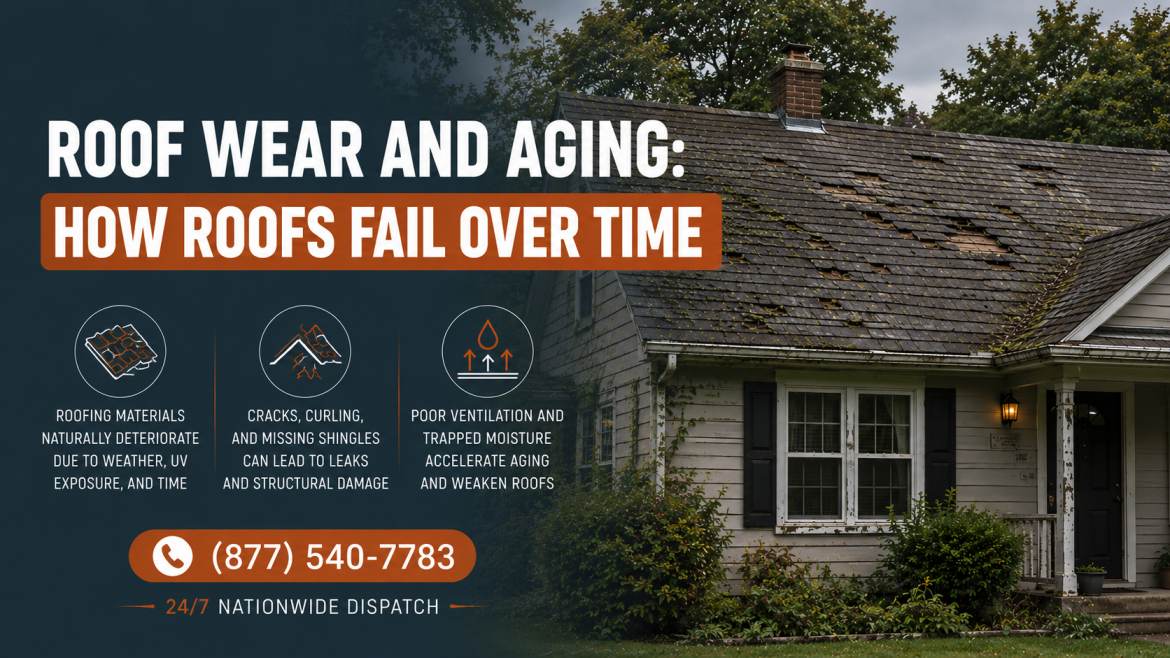
Every insurance adjuster keeps one explanation in reserve for a damage claim that does not quite hold together: age. Wear and tear is the default fallback, the cause an insurer reaches for whenever a storm claim's evidence looks even slightly uniform.
That makes roof aging different from every other entry in the roof damage causes guide. It is not just a cause in its own right. It is also the explanation competing against every other cause, whenever a claim gets disputed.
This guide covers what actually happens to a roof over its service life, why the pattern of aging looks so distinct from storm damage, and where the genuine line sits between an old roof and a damaged one. The services directory covers repair and replacement options once that line has been crossed.
What Actually Happens to a Roof as It Ages?
Roof aging is a material science question more than a roofing question, and understanding the underlying process explains why the damage looks the way it does. Three processes work together, each compounding the others over years.
Thermal Cycling
A roof surface expands under daytime heat and contracts overnight, every single day, for its entire service life. That repeated movement, called thermal cycling, gradually fatigues the asphalt and its reinforcing mat the same way repeated bending eventually fatigues a piece of metal.
Daily temperature swings stress the shingle at a molecular level
Seasonal extremes compound the daily cycling with larger stress ranges
The reinforcing mat loses elasticity gradually, becoming more rigid over time
A rigid shingle cracks under stress that a flexible one would simply absorb
Granule Loss
The granule layer protects the asphalt beneath it from direct ultraviolet exposure, and that layer erodes gradually across a roof's service life through ordinary weathering, foot traffic, and rainfall runoff. Once enough granules are gone, the exposed asphalt ages far faster than the rest of the roof.
In practice: granules collecting in gutters is often the first visible evidence of aging, appearing years before any leak or structural sign follows. Homeowners who notice this early have genuine lead time to plan a replacement rather than react to an emergency.
Sealant and Adhesive Breakdown
The factory seal strip that bonds each shingle course to the one below loses its adhesive strength over time, particularly on slopes with heavy sun exposure. A weakened seal does not fail on its own. It fails once wind tests it, which is why aging and wind damage so often appear together on the same roof.
How Long Should a Roof Actually Last?
Service life expectations vary considerably by material, and the number printed on a shingle package rarely matches real-world performance once climate, ventilation, and installation quality are factored in.
Material | Typical Rated Service Life | Common Real-World Range |
|---|---|---|
Three-tab asphalt shingles | 20 to 25 years | Often 15 to 20 in demanding climates |
Architectural asphalt shingles | 30 years | Often 25 to 30 with adequate ventilation |
Wood shake | 25 to 30 years | Highly dependent on climate and maintenance |
Metal roofing | 40 to 70 years | Consistently reaches or exceeds rating |
Clay or concrete tile | 50 years or more | Frequently exceeds rating significantly |
Slate | 75 to 150 years | Among the most consistent with rated life |
The National Roofing Contractors Association and the Asphalt Roofing Manufacturers Association publish these planning ranges as guidance rather than guarantees, since ventilation, climate, and installation quality all shift the actual outcome for any individual roof.
Why the Printed Number Rarely Matches Reality
A shingle's rated lifespan assumes adequate attic ventilation, moderate climate exposure, and correct installation. Any one of those assumptions failing shortens the real-world outcome, sometimes considerably.
Sun and UV exposure alone can shave years off a rated lifespan on a south-facing slope in a high-UV climate, independent of any other factor. A roof's actual service life is really a range determined by its specific conditions, not a fixed number that applies uniformly everywhere.
How Do Insurers Distinguish Age From Storm Damage?
This is the question that decides more disputed roof claims than any other single factor. The evidence pattern, not the severity of the damage itself, is what an adjuster relies on to make that call.
The Uniformity Signature
Aging spreads evenly across every slope of a roof, affecting all four elevations at a comparable rate regardless of orientation. Storm damage, by contrast, concentrates: randomly for hail, directionally for wind, or locally for a single tree impact.
Pattern | Aging | Storm Damage |
|---|---|---|
Distribution across slopes | Uniform | Concentrated or directional |
Granule loss pattern | Even, gradual | Localized, often sudden |
Sealant condition | Uniformly hardened | Mixed, unless recently exposed |
Shingle flexibility | Consistently brittle | Varies by impact zone |
In practice: an adjuster who documents uniform granule loss and consistent brittleness across all four slopes has strong grounds to deny a storm claim, regardless of what the homeowner believes caused the visible damage. That single finding often ends the discussion before it starts.
When Aging and Storm Damage Overlap
The most contested claims involve a roof that was genuinely aging when a real storm also struck it. An older roof damaged by legitimate hail or wind shows both patterns simultaneously, and separating the two requires more careful documentation than either cause alone.
Hail damage on an aged roof can be harder to distinguish from ordinary granule loss, since both processes expose the same underlying asphalt. A trained inspector looks for the mat fracture specific to impact, distinct from the gradual erosion pattern of age alone.
How Does Aging Interact With Other Roof Causes?
An aged roof rarely fails in isolation. More often, its reduced flexibility and weakened seals turn an otherwise minor event into a genuine failure that a newer roof would have shrugged off entirely.
Installation Quality Sets the Starting Point
Installation defects present at the original build do not wait for age to become visible. A roof installed with incorrect nailing or missing starter strip effectively begins its aging process from a weaker starting position than a correctly installed roof, even before either one has weathered a single season.
That compounding effect explains why two roofs of the identical age and material can show dramatically different wear patterns. The installation quality set the baseline that the aging process has been working against ever since.
Brittleness and Foot Traffic
Foot traffic damage illustrates aging's practical consequences clearly. A newer, flexible shingle can absorb a technician's weight during routine maintenance without visible harm, while the identical point load on an aged, brittle shingle cracks it outright.
This interaction matters directly for any roof scheduled for solar installation, chimney service, or other maintenance requiring foot access. An aging roof often benefits from addressing its wear before adding that access risk, rather than discovering the brittleness only once a technician is already standing on it.
Which States See Roofs Age Fastest?
Roof aging rate varies by climate more than almost any other factor, since heat, humidity, and UV exposure all accelerate the underlying material processes described above. Several states see materially shorter real-world service life than the national average.
Florida, combining intense UV exposure with sustained humidity
Texas, with a long, hot summer season across most of the state
California, spanning high-UV desert and coastal zones alike
Arizona, among the most extreme combinations of heat and UV nationally
Pennsylvania, where an older housing stock means many roofs are already well past midlife
Roof replacement services across Florida deal with accelerated aging as a routine finding, given the state's combination of UV intensity and humidity that stresses both the shingle and its sealant. Shingle repair covering Texas addresses a similarly compressed service-life curve across the state's extended summer heat season.
Roof replacement across California spans a wide range of aging rates depending on the specific climate zone within the state. Roof services across Arizona sees some of the shortest real-world shingle lifespans nationally, driven by sustained desert heat and UV exposure together. Roof repair coverage across Pennsylvania reflects a different driver entirely, an older overall housing stock where original roofs are frequently already approaching or past their rated service life.
Does Roof Age Affect Insurance Coverage Beyond Just Claims?
Aging affects an insurance policy in ways that go beyond whether a specific claim gets approved or denied. Roof age itself has become an underwriting factor independent of any actual damage.
The Underwriting Timeline
Carriers increasingly apply age-based thresholds regardless of a roof's actual condition, converting coverage from replacement cost to actual cash value once a roof crosses a certain age, commonly somewhere between 15 and 20 years depending on the carrier and material.
Under 15 years: standard replacement cost coverage in most markets
15 to 19 years: some carriers request inspection or certification at renewal
20 years and older: conversion to actual cash value coverage becomes common
25 years and older: non-renewal becomes a realistic possibility at some carriers
That underwriting pressure means a roof can remain physically sound while still losing full coverage purely due to its calendar age, which is a separate consideration from the claim-denial dynamics covered above.
What Signals That Aging Has Crossed Into Genuine Damage?
Ordinary aging and functional damage exist on a spectrum rather than as two cleanly separate categories, but several signs indicate a roof has moved from cosmetic wear into something requiring attention regardless of the storm-versus-age question.
Widespread curling or clawing across multiple slopes, not just isolated tabs
Brittle shingles that crack rather than flex when lifted for inspection
Consistent granule loss exposing bare asphalt across large surface areas
Sealant that has visibly hardened and separated at every penetration point
A roof reaching several of these signs simultaneously has typically moved past the point where targeted repair makes economic sense, regardless of whether a specific storm event is involved. Roof replacement becomes the more cost-effective path once repair would need to address the majority of the roof's surface anyway.
If a section has already failed enough to admit water, roof tarping provides interim protection while a full replacement gets scheduled, particularly useful for a roof too far gone for a single targeted shingle repair to meaningfully help.
Frequently Asked Questions About Roof Wear and Aging
What Is Considered Normal Wear and Tear on a Roof?
Gradual granule loss, slight color fading, and minor sealant hardening that develops evenly across the entire roof over many years qualifies as normal wear. It differs from damage in that no single event or date explains it.
How Do I Know if My Roof Is Simply Old or Actually Damaged?
Check whether the wear pattern is uniform across every slope, which suggests age, or concentrated in specific spots or directions, which suggests a storm event. Brittleness and cracking that appear consistently everywhere point toward age rather than a single cause.
Does Aging Affect Insurance Coverage Even Without a Claim?
Yes. Many carriers apply age-based underwriting thresholds, converting a roof's coverage to actual cash value or requiring inspection once it crosses a certain age, independent of whether any specific damage has occurred.
Can a Well-Maintained Roof Exceed Its Rated Service Life?
Yes, considerably in some cases. Adequate ventilation, prompt minor repairs, and a favorable climate can extend a roof's real-world performance well past its printed rating, while the opposite conditions can just as easily shorten it.
Is There Anything That Actually Slows Down Roof Aging?
Balanced attic ventilation is the single most effective intervention, since it reduces the heat that compounds UV-driven material breakdown. Prompt repair of minor issues also prevents small problems from accelerating wear across a larger area.
Will Insurance Ever Cover Damage Caused Purely by Age?
No. Standard homeowners policies exclude wear and tear specifically because it is gradual and expected rather than sudden and accidental, which is the basic distinction nearly every coverage decision in this category comes down to.
Does the Original Installer's Warranty Cover Aging?
Workmanship warranties, offered by the installing contractor, typically cover installation defects for a limited period, often two to ten years, but they do not extend to ordinary material aging beyond that window. Manufacturer material warranties last longer but are usually prorated, paying a shrinking percentage of replacement cost as the roof approaches the end of its rated life.
Is It Ever Worth Replacing a Roof Before It Shows Obvious Damage?
Sometimes, particularly for homeowners in high-UV or high-heat climates where real-world aging consistently outpaces the rated lifespan. Replacing proactively, before a forced emergency replacement during storm season, often allows more control over contractor selection, material choice, and scheduling than waiting for an active failure would.