
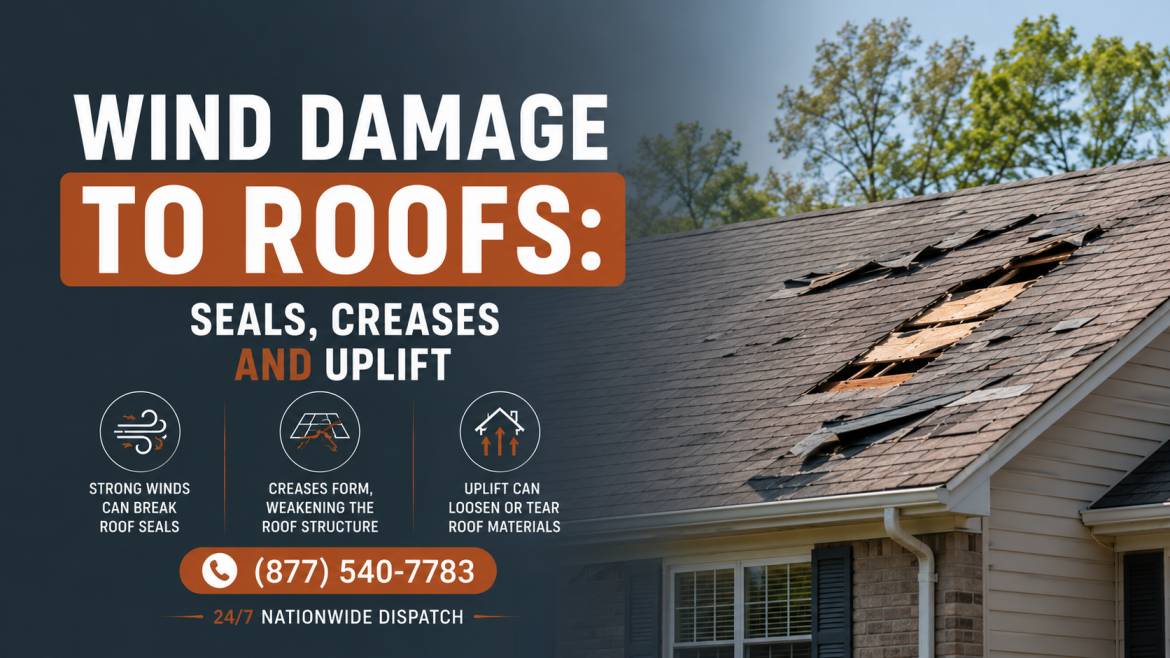
A missing shingle is the obvious sign of wind damage. It is also the least useful one, since by the time a shingle is gone, the wind has already been working on the roof for a while.
Wind damage begins earlier and more quietly than most homeowners assume. It starts with pressure lifting a shingle edge just enough to break the factory seal, long before anything visibly moves.
That distinction between a broken seal and a missing shingle matters for both repair and insurance purposes. A roof that looks intact after a windstorm can still carry extensive functional damage across its most exposed surfaces.
This guide covers how wind actually works against a roof, why damage concentrates on edges and corners, and what wind speeds correspond to real risk. The full directory of roofing services covers every response option, from emergency tarping to full replacement.
How Does Wind Actually Damage a Roof?
Wind damages a roof through aerodynamic uplift, the same physics that lifts an airplane wing. It is one of the twelve causes catalogued in the roof damage causes overview, and its mechanism is distinct from every impact-based peril on that list.
The Uplift Mechanism
Air moving across a roof surface creates a pressure differential. Pressure builds beneath the shingle edge while it drops above, and that difference is what physically pulls the tab upward against its own fastening.
Wind speed increases the pressure differential exponentially, not linearly
Roof pitch and shape change how air accelerates across different sections
A shingle's factory-applied seal strip is the first line of resistance
Once that seal breaks, the same shingle offers far less resistance next time
Why the Seal Strip Is the Real Point of Failure
Every modern asphalt shingle ships with a thin strip of adhesive that bonds it to the course below once warmed by sunlight. That bond, not the nails alone, is what keeps a shingle flat against uplift.
A shingle that has lost its seal can look completely normal while lying flat. It has already failed structurally, and the next moderate gust can lift it with far less force than the original storm required.
Why Do Roof Edges and Corners Fail First?
Wind does not load a roof evenly, and understanding that pattern is the fastest way to identify genuine wind damage. Edges, corners, and ridgelines experience dramatically higher uplift pressure than the open field of a roof.
The Physics Behind Edge Concentration
Air separates and accelerates sharply at any roof edge, similar to how wind speeds up around the corner of a tall building. That acceleration is what concentrates failure at the rake, the eave, and the ridge rather than spreading evenly.
Roof Zone | Relative Uplift Pressure | Typical Failure Pattern |
|---|---|---|
Field (open middle area) | Baseline | Rare failure except in extreme events |
Perimeter edges | 2 to 3 times field pressure | First shingles to crease or lift |
Corners | Highest of any zone | Frequently the origin point of larger failures |
Ridge | Elevated, concentrated | Ridge cap loss, especially with three-tab caps |
This uneven loading is why manufacturers specify tighter nailing patterns near roof edges on many products. A roof installed without that reinforcement fails at the perimeter well before its rated wind speed.
What a Creased Shingle Actually Tells You
A crease is a permanent fold through the shingle mat, and it does not reverse itself once the wind stops. That single fact separates genuine wind damage from a shingle that merely looks slightly disturbed.
In practice: a homeowner walking the yard after a storm and finding no debris often assumes the roof is fine. Creased shingles that folded back into place leave no debris at all, yet they no longer resist wind the way they did before.
What Wind Speed Actually Damages a Roof?
Wind speed thresholds vary by shingle rating, installation quality, and roof age, which makes a single universal number misleading. Manufacturer wind ratings describe laboratory conditions, not a real roof with years of weathering.
Standard three-tab shingles are commonly rated around 60 to 70 mph when new
Architectural shingles carry higher ratings, often 110 to 130 mph
A roof with broken or aged seals can fail well below its rated speed
Roof wear and aging compounds wind vulnerability by degrading the seal strip years before the shingle's full service life ends
How the 2020 Midwest Derecho Illustrates the Scale
The August 2020 Midwest derecho produced wind damage across more than 90,000 square miles, according to the National Weather Service Chicago office. That single event caused an estimated $11.5 billion in damage, the costliest thunderstorm event on record in the United States.
A derecho differs from a tornado in a way that matters for roof damage specifically. Instead of a narrow, intense path, it applies sustained straight-line wind pressure across a massive continuous area, which is why the associated roof damage spreads across so many properties at once rather than concentrating in a single neighborhood.
Which States See the Most Wind-Driven Roof Damage?
Wind risk concentrates differently than hail risk, spanning tornado alley, derecho corridors, and hurricane-exposed coastlines. Five states illustrate the range of that exposure.
State | Primary Wind Risk |
|---|---|
Oklahoma | Sits inside the core of tornado alley |
Illinois | Derecho corridor, site of the costliest 2020 event |
Kansas | Shares tornado alley exposure with severe thunderstorm activity |
Texas | Combines tornado risk with coastal hurricane exposure |
Nebraska | Frequent severe thunderstorm wind events |
Wind damage roof repair across Oklahoma sees some of the highest seasonal demand nationally, driven by the state's position inside the most tornado-active corridor in the country. Spring remains the peak season there by a wide margin.
Storm response for roofs in Illinois scaled sharply after the 2020 derecho, and that demand pattern has repeated with smaller events in the years since. Emergency roof repair in Kansas follows a closely related seasonal curve tied to the same weather systems.
Texas carries a dual exposure that few other states share. Wind and storm roof repair across Texas covers both inland tornado risk and coastal hurricane wind, which keeps demand elevated across a longer season than single-risk states see. Nebraska rounds out the group with roof repair coverage across Nebraska tracking closely with its severe thunderstorm frequency.
Does Installation Quality Change How a Roof Resists Wind?
A correctly installed roof and a poorly installed one can carry the same wind rating on paper and perform very differently in an actual storm. Installation defects are one of the most common reasons a roof fails well below its rated speed.
The Nailing Pattern Problem
Manufacturer wind ratings assume fasteners placed exactly within the designated nailing zone, at the correct count per shingle. A roof nailed too high, too low, or with too few fasteners per shingle loses a significant share of its rated resistance.
Nails placed above the designated zone miss the reinforced strip entirely
Underdriven nails leave the shingle free to flex and eventually tear
Missing starter strip at the eave leaves the first course exposed to direct uplift
Reused or aged fasteners from a prior roof layer rarely hold as well as new ones
An emergency roof inspection after any significant wind event can confirm whether nailing pattern, not just storm severity, played a role in the damage. That distinction matters for both warranty claims and insurance documentation.
When Hail Arrives With the Same Storm
Wind and hail frequently strike together inside the same severe thunderstorm system, and separating the two causes on a single roof takes a trained eye. Hail damage bruises the shingle mat while wind lifts and creases the tab, and a roof can show both patterns from one storm.
That overlap complicates insurance documentation, since an adjuster needs to see evidence supporting each cause independently rather than a single combined description. Photographing wind-pattern damage and hail bruising separately, even within the same visit, produces a stronger file.
A Winter-Specific Wind Vulnerability
Cold-weather wind events carry a complication that summer storms do not. Ice dams at the eave can hold a shingle course rigid and brittle, which makes it more likely to crack rather than flex under the same wind load that a warm, pliable shingle would simply resist.
That combination, sustained cold plus wind, is why late winter storms sometimes produce disproportionate damage relative to their measured wind speed. A shingle that would flex safely in July can fracture outright in February.
How Do You Confirm Wind Damage Versus Ordinary Wear?
Wind damage and ordinary aging can look similar from a distance, and the distinction changes whether an insurance claim succeeds. The evidence pattern is what separates them, not the severity of what is missing.
The Directional Test
Wind damage concentrates on specific elevations depending on the storm's approach direction. A roof missing shingles only on its windward slope points clearly to a single wind event.
Uniform, evenly distributed missing shingles across every slope suggests age, not wind
Damage concentrated on one or two elevations points to a directional storm
Fresh, bright exposed decking beneath a missing shingle suggests recent loss
Weathered, discolored decking beneath a gap suggests the shingle has been missing longer than the storm date claimed
What to Photograph First
Documentation for a wind claim benefits from capturing the directional pattern clearly, not just the individual missing or lifted shingles. An adjuster reviewing a file wants to see the storm's fingerprint across the whole roof.
Wide shots of every elevation, labeled by compass direction
Close-up shots of any creased tabs still in place, not just missing ones
Photos of any debris in the yard matched to the direction it likely traveled
Interior attic photos if any water has reached the sheathing since the storm
When Does a Fallen Tree Complicate a Wind Claim?
Severe wind events frequently bring down limbs and full trees alongside the shingle damage itself, and the two causes can occupy the same roof at the same time. Tree and debris damage often needs its own separate assessment.
A single storm producing both wind uplift and impact damage from a falling branch is common rather than rare. Separating the two causes on the claim file matters, since they are documented and scoped differently even under the same policy.
Left unaddressed, a wind-lifted section next to fallen debris can also let water in faster than either problem would alone. Getting roof tarping over any breach the same day keeps a manageable wind claim from becoming a much larger water damage claim.
Debris removal itself carries its own risk on a roof that has already lost some wind resistance. A limb resting across two or three courses of already-lifted shingles can shift during removal and open a larger gap than the original impact caused, which is one reason this work is rarely a safe do-it-yourself task after a significant storm.
Insurance Sequencing When Both Causes Are Present
When wind and tree impact appear on the same roof, most carriers still process the loss as a single claim rather than two. The scope simply needs to account for both the uplift pattern and the isolated impact zone in the same estimate.
A contractor experienced in storm damage typically separates the two in the written scope even when billing under one claim number. That separation protects the homeowner if a dispute later arises over which portion of the damage traces to which cause.
Frequently Asked Questions About Wind Damage
How Do I Know if Wind Damaged My Roof?
Check for shingles that look creased or folded rather than perfectly flat, since a crease indicates a permanent structural failure even if the shingle never came loose. Directional damage concentrated on one elevation is the clearest confirmation.
What Wind Speed Damages a Roof?
There is no universal number, since it depends on the shingle's rating, its age, and how well it was installed. A well-maintained architectural shingle roof can withstand well over 100 mph, while an aged or poorly sealed roof can fail closer to 50 or 60 mph.
Can Wind Damage a Roof Without Removing Any Shingles?
Yes, and this is the most commonly missed form of wind damage. A broken seal strip with the shingle still lying flat represents a real structural failure that produces no visible debris and no obvious gap.
Does Wind Damage Always Come With Missing Shingles?
No. Creased or lifted-and-resettled shingles frequently show no visible loss at all, yet they no longer resist wind the way an undamaged shingle does, and they remain vulnerable to the next storm.
Is Wind Damage Covered by Homeowners Insurance?
Generally yes, as wind is a named peril under most standard policies. Coverage disputes typically center on whether the specific damage found is attributable to a documented wind event or to gradual aging instead.
How Is Wind Damage Different From Hail Damage?
Wind works through uplift and pressure, concentrating on edges and specific elevations, while hail works through impact and lands randomly across every slope. The two often occur in the same storm but leave distinctly different evidence patterns.