
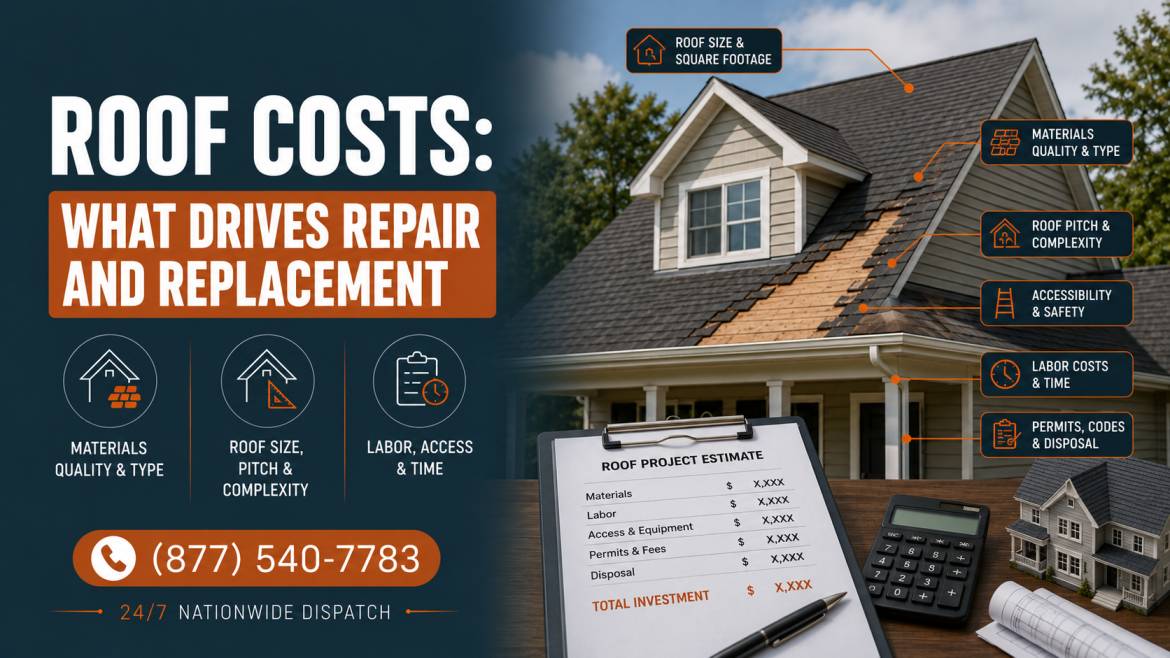
Search for the average cost of roof repair and the answer changes depending on which source you land on. One cites $531. Another cites $1,158. A third cites a range stretching from $150 to $8,000. None of these figures are wrong exactly. They are just measuring different roofs, in different places, with different damage, and presenting the result as if it applies universally.
That inconsistency is actually the most useful thing this guide can point out before offering a single number of its own. A national average tells a homeowner almost nothing about what their specific roof will cost, because the variables that matter, area, pitch, material, access, hidden damage, and local labor rates, swing the final price by a wider margin than any average can capture.
This guide covers what actually drives a roofing quote, why two similar-looking roofs can produce very different estimates, and the building code threshold that quietly decides whether a repair stays a repair or becomes a full replacement. It connects to the roof damage overview, and when the numbers point toward replacement, the full roof replacement services page covers what that process involves.
What Drives a Roofing Quote?
Every roofing estimate, regardless of the contractor writing it, is built from the same handful of variables. Understanding them is what turns a confusing quote into something a homeowner can actually evaluate.
The Core Cost Drivers
Driver | Why It Moves the Price |
|---|---|
Roof area in squares | Every material and labor line scales directly with area |
Pitch and walkability | Steep slopes require staging, harnesses and slower production |
Number of existing layers | Each layer adds tear-off labor and disposal weight |
Penetration count | Chimneys, skylights and vents each need individual flashing detail |
Material class | Covering cost varies enormously across material families |
Hidden decking damage | Rotted sheathing is discovered after tear-off begins |
Code-triggered upgrades | Ice barrier, ventilation and fastening requirements |
Access and staging | Landscaping, driveway width and dumpster placement |
Labor market and season | Regional rates and demand during peak storm season |
A survey cited in industry cost reporting found that roughly 65% of homeowners who recently replaced a roof identified labor, not material, as the largest single line item in the total project cost. That figure runs counter to the common assumption that shingles or metal panels drive most of the price.
Why the Same Roof Can Produce Different Quotes
Two contractors inspecting the identical roof can arrive at meaningfully different numbers, and the gap usually traces back to differing assumptions about the variables above rather than one contractor simply overcharging. A quote that skips a walk-through of the attic, for instance, cannot account for decking condition, which means it is incomplete regardless of how competitive the number looks on paper.
Tree and debris damage illustrates this well. A quote written from a ground-level look at storm damage often misses debris still resting against a slope, which changes both the safety plan and the final scope once a crew actually gets on the roof.
Why Do Estimates Vary So Much?
The wide range of published "average" costs is not a data problem. It reflects a genuine fact about roofing: no two projects share enough variables in common to be usefully averaged together in the first place.
Regional Labor and Material Costs
Labor rates alone can differ by a wide margin between a rural market and a major metropolitan one. A project quoted in a lower-cost inland market can run tens of thousands of dollars less than an equivalent project in a high-demand coastal metro, purely from labor and permit fee differences.
Seasonal and Post-Storm Demand Spikes
Roofing costs rise measurably in any region recently hit by a major hailstorm or hurricane, as available crews become stretched thin across a sudden surge in demand. Industry reporting has documented price increases of 20% to 30% for months following a significant regional storm event, independent of any change in material costs.
In practice: getting a quote during the slower months, outside the late spring through early fall peak season most regions share, can produce a meaningfully better price on comparable work, provided the roof's condition allows for that timing.
What Does Roof Pitch Change?
Pitch is one of the most underestimated cost variables, since two roofs with identical square footage on paper can require completely different labor approaches once the actual slope is factored in.
The Walkability Threshold
Most crews treat a roof as walkable up to roughly a 7:12 pitch. Beyond that point, safety requirements shift meaningfully, and the added labor shows up directly in the quote.
Pitch Range | Typical Impact |
|---|---|
Under 4:12 (low slope) | May require different material systems, minimal walkability concerns |
4:12 to 7:12 (walkable) | Standard labor rates, no special staging typically required |
7:12 to 9:12 (steep) | Harnesses and roof jacks required, labor rates increase |
Over 9:12 (very steep) | Significant staging, slower production, highest labor premium |
Pitch also changes the actual measured area beyond what the building's footprint suggests, since a steeper roof has more surface area covering the same footprint than a low-slope one does. That difference alone can add a meaningful percentage to the material total before labor is even factored in.
What Affects Roof Replacement Cost Specifically?
Replacement carries its own distinct cost structure separate from repair, built around full tear-off, disposal, and bringing the entire assembly up to current standards rather than patching an isolated section.
Tear-Off and Disposal
What affects roof replacement cost starts with what has to come off before anything new goes on. Each existing layer adds both labor time and disposal weight, and many jurisdictions cap the number of layers a roof can carry, which forces full tear-off on older homes that were previously re-roofed over existing material.
Decking Discovery
Rotted or delaminated decking is a cost surprise virtually every homeowner underestimates, since it is invisible until the old covering actually comes off. Curling shingles on the surface are sometimes the first visible clue that decking beneath has also been compromised, though the two do not always correlate directly.
Estimates typically carry a per-sheet allowance for sheathing replacement
Actual decking condition is confirmed only once tear-off begins
A reputable contract specifies the per-sheet rate rather than leaving it open-ended
Widespread decking damage can shift a project's total cost considerably above the original quote
An emergency roof inspection that includes attic access before a quote is finalized catches some, though never all, of this risk in advance, since decking condition is only ever fully confirmed once the old covering is physically removed.
Code-Triggered Upgrades
Replacement resets the code baseline along with the covering itself. Ventilation corrections, upgraded ice barrier membrane, and updated deck fastening patterns can all be required on a roof that predates the current code cycle, adding cost that a same-era repair would never have triggered.
Roof Repair vs Replacement: How Do You Decide?
This is the single most consequential decision covered in this guide, and one specific building code threshold decides it more often than homeowners realize.
The 25 Percent Rule
Most jurisdictions following the International Building or Residential Code include a provision stating that once more than 25% of a roof section is repaired or replaced within any 12-month period, the entire section must be brought up to current code rather than continuing as a patch.
The rule originated in the Florida Building Code, Section 706.1.1, and has since been adopted in some form by many other jurisdictions
Texas applies the threshold per slope or section under its 2018 International Residential Code adoption
Minnesota enforces the same 25% threshold under its state building code
Some municipalities also use 25% as a separate permit exemption threshold, a related but distinct application
Should I repair or replace my roof often comes down to exactly this math. Once damage or planned repair work crosses that 25% line on a given slope, bringing the whole section up to current code, effectively a replacement, is usually both the compliant choice and, once ventilation, fastening, and ice barrier upgrades are factored in, the more economical one compared to a patchwork of partial repairs.
When Repair Is Still the Right Call
When is a roof beyond repair is really the inverse question, and it resolves in the other direction under a specific, narrower set of conditions.
Damage is isolated to a small, well-defined area rather than spread across the slope
The roof has substantial remaining service life beyond the current damage
Matching material is genuinely available rather than discontinued
The affected area sits well under the 25% threshold with room to spare
Foot traffic damage is a good example of damage that typically stays well under that threshold, since it usually affects a small, defined path rather than an entire slope. Shingle repair covers this kind of isolated case well, targeting just the affected units rather than the full slope.
A Decision Framework
Factor | Favors Repair | Favors Replacement |
|---|---|---|
Damaged area per slope | Well under 25% | Approaching or exceeding 25% |
Roof age | Early in its expected service life | Near or past midpoint of expected life |
Material availability | Reasonable match available | Discontinued or significantly changed |
Underlying cause | Isolated, identified event | Systemic aging or widespread wear |
How Does Insurance Affect What You Pay?
Insurance changes the cost equation considerably, though the effect depends entirely on the settlement basis and the specific cause behind the damage.
A claim settled on a replacement cost basis pays the full cost of the work, minus the deductible, regardless of the roof's age. A claim settled on an actual cash value basis pays that same figure minus depreciation, which can leave a substantial gap between the payout and the actual invoice, particularly on an older roof.
Roof damage insurance covers the full mechanics of how that settlement basis gets determined, along with how deductibles, denials, and the claims process itself interact with the cost figures covered in this guide. Insurance claim help becomes particularly relevant once a settlement falls short of the actual repair cost, since a supplemental claim can sometimes recover the difference where genuine additional damage is documented. Roof tarping in the meantime protects the property from further loss while a settlement is worked out, which most policies require as a condition of coverage.
How Do You Pay for Roof Work Without Full Insurance Coverage?
When insurance covers only part of the cost, or none of it, several financing paths exist, each with meaningfully different terms, eligibility, and risk.
The Main Options Compared
Option | Typical Terms | Key Consideration |
|---|---|---|
Contractor payment plan | Varies by contractor, often shorter term | Convenience, but compare against other rates |
Home equity loan or HELOC | 7% to 10% APR, longer approval process | Lowest rates, but home serves as collateral |
Unsecured personal loan | Higher rates, faster approval | No collateral risk, but costs more over time |
PACE financing | Repaid through property tax bill, 10 to 25 years | Only available in California and Florida |
The PACE Financing Detail Most Guides Get Wrong
Property Assessed Clean Energy financing gets mentioned frequently in roofing cost guides as if it were a nationally available option, and that framing is misleading. Residential PACE programs currently operate only in California and Florida, following Missouri's decision to end its residential program in 2024. Every other state offers, at most, commercial PACE for business properties, not homes.
What if insurance does not cover the full roof cost is the question PACE is often pitched as answering, and for homeowners in one of the two states where it is genuinely available, it can be worth evaluating. The tradeoff is real: PACE attaches a lien to the property itself, which can complicate refinancing or a future sale, and some lenders decline to refinance a home carrying an active PACE assessment.
Questions Worth Asking Before Signing Any Financing Agreement
What is the total cost over the full term, not just the monthly payment
Does the financing attach to the homeowner personally or to the property itself
Can the agreement transfer to a new owner if the home sells during the term
Is there a prepayment penalty for paying off the balance early
What happens if a dispute arises with the contractor after financing is in place
In practice: a HELOC or home equity loan generally offers the lowest cost of capital for homeowners who qualify, since the rate reflects the lender's reduced risk from using the home as collateral. That collateral requirement is also its main drawback, which is why comparing more than one option before signing anything matters more than choosing the first one offered.
Which States See the Most Distinctive Roof Cost Dynamics?
Roof cost drivers vary considerably by state, shaped by building code adoption, storm frequency, and regional labor markets.
Texas, where the 25% rule is enforced per slope under the state's IRC adoption and hail-driven demand spikes are common
Minnesota, applying the same 25% threshold under its own state building code
Florida, the origin state for the 25% rule and one of only two states offering residential PACE financing
California, the other state with active residential PACE financing available
Colorado, where Front Range hailstorms have driven documented 20% to 30% price spikes in affected areas
Pennsylvania, where some municipalities apply the 25% threshold specifically as a permit exemption rule
Washington, representing the high-labor-cost Pacific Northwest metro pricing pattern
Roof replacement cost guidance for Texas homeowners increasingly centers on the 25% rule specifically, given how frequently hail damage in the state approaches that threshold on a single slope. Roof cost and code compliance in Minnesota follows a closely related pattern under the state's own building code enforcement.
Roof replacement financing across Florida benefits from residential PACE availability, one of just two states offering it, alongside the state's role as the 25% rule's origin. Roof cost and PACE financing in California shares that same financing advantage, distinct from nearly every other state in this guide.
Hail-driven roof cost assessment across Colorado reflects the Front Range's documented pattern of post-storm price spikes tied to surging regional demand. Roof permit and cost guidance in Pennsylvania addresses the state's municipal-level 25% permit exemption applications specifically. Roof cost estimates across Washington rounds out the group, reflecting the Pacific Northwest's consistently higher labor and permit cost structure relative to national averages.
Frequently Asked Questions About Roof Costs
How Much Does It Cost to Repair a Roof?
Published national averages range enormously, from a few hundred dollars for a minor isolated repair to several thousand for more involved flashing or structural work. The actual number depends far more on the specific roof's area, pitch, material, and local labor rates than on any single published average.
What Affects Roof Repair Cost the Most?
The extent and location of damage, roof pitch and accessibility, material type, and whether the repair uncovers hidden decking damage all move the price considerably. Labor, not material, is frequently the single largest cost component in the total.
Should I Repair or Replace My Roof?
It depends heavily on how much of a single roof slope is affected. Damage well under the commonly applied 25% threshold often favors repair, while damage approaching or exceeding that threshold usually favors replacement, both for code compliance and because bringing an entire section up to current standards is often more economical than repeated partial repairs.
What Is the 25 Percent Rule in Roofing?
It is a building code provision, most commonly traced to the Florida Building Code and since adopted by many other jurisdictions, requiring that once more than 25% of a roof section is repaired or replaced within a 12-month period, the entire section must be brought up to current code rather than continuing as a patch.
Can I Finance a New Roof if Insurance Does Not Cover It?
Yes, through several paths including contractor payment plans, home equity loans or lines of credit, unsecured personal loans, and, for homeowners specifically in California or Florida, PACE financing repaid through the property tax bill.
Is PACE Financing Available for Roofing in My State?
Only if the property is in California or Florida, the two states with active residential PACE programs. Most other states offer commercial PACE for business properties only, so homeowners elsewhere should plan around home equity products or personal loans instead.