
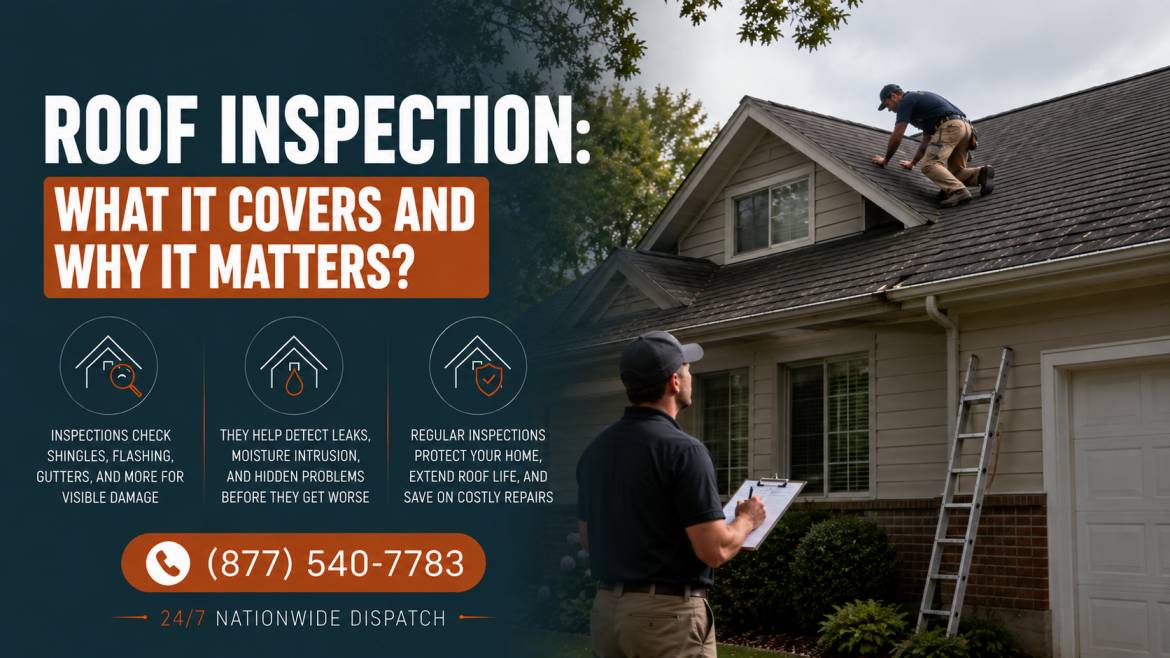
Most homeowners picture a roof inspection as someone glancing up from the driveway or, at best, climbing a ladder to look at the shingles for a minute. That picture is closer to a curbside opinion than an actual inspection, and the gap between the two shows up exactly when it matters most, during an insurance claim or a home sale.
A genuine roof inspection is a structured, documented process covering the exterior covering, the flashing at every penetration, the drainage path, and the attic side of the deck, produced by someone qualified to judge all four. Skipping any one of those layers leaves real damage undiscovered.
This guide covers what a proper inspection actually includes, how often one is genuinely needed, what a complete report should contain, and who is qualified to perform one. To book an emergency roof inspection directly, or to browse the full services directory, both are available whenever a professional check is needed.
What Does a Roof Inspection Include?
A roof inspection covers four distinct layers, and a report that skips any one of them is incomplete regardless of how thorough it looks on paper. Roof condition, after all, is only one part of the broader picture covered in the roof damage overview, which explains what counts as damage in the first place.
The Four-Layer Framework
Every complete inspection works through the same general structure, whether performed by a contractor, a certified inspector, or an insurance adjuster.
Layer | What Gets Checked | Why It Matters |
|---|---|---|
Exterior covering | Shingles, tiles, or membrane condition by slope | Confirms the primary weather barrier is sound |
Flashing and penetrations | Chimneys, skylights, vents, valleys | Identifies the most common leak sources |
Drainage | Gutters, downspouts, valley flow | Confirms water is actually leaving the roof |
Attic and structure | Decking, insulation, ventilation, framing | Catches damage invisible from outside |
In practice: an inspection limited to the exterior alone routinely misses the most consequential findings. A roof inspection checklist built around all four layers, rather than the covering alone, is what actually catches problems before they become expensive.
What a Ground-Level Check Can and Cannot Catch
A homeowner can reasonably assess a meaningful share of exterior condition using binoculars from the ground, without ever touching a ladder. What that check cannot reach is anything requiring attic access, physical contact with the shingle surface, or a trained eye for flashing sequence.
Granule loss, curling, and missing shingles are visible from the ground in most cases
Seal strip condition and mat fracture require physical contact to confirm
Flashing lap sequence is difficult to judge accurately without close inspection
Attic-side evidence is entirely invisible without direct access to the space
What Are the Different Types of Roof Inspections?
Three distinct inspection methods exist, each suited to different roof conditions and different budgets, and understanding the tradeoffs between them helps homeowners choose correctly rather than defaulting to whichever option a contractor offers first.
Visual, Drone and Infrared Compared
Type | Typical Cost | Best Suited For | Key Limitation |
|---|---|---|---|
Physical walk-through | $75 to $400 | Standard, walkable roofs | Requires safe roof access |
Drone inspection | $200 to $400 | Steep pitches, tile, large commercial roofs | Cannot assess seal strength by touch |
Infrared or thermal | $300 to $600 | Detecting hidden moisture beneath the surface | Higher cost, requires trained interpretation |
A drone roof inspection has become the preferred method on steep or brittle roofing specifically because it eliminates the foot traffic risk that comes with walking a tile or slate surface, though it cannot replace the tactile check a physical inspection provides for seal integrity.
Why Method Choice Affects the Result
Choosing the wrong method for a given roof produces gaps in the findings regardless of how carefully the inspection itself is conducted. A drone survey on a low, walkable asphalt roof adds cost without adding much value over a direct physical check. A physical walk-through on a steep, aged tile roof risks foot traffic damage the inspection is supposed to be assessing in the first place.
In practice: many insurers now accept high-resolution drone imagery as supporting evidence for a claim, which has shifted method selection for storm-related inspections specifically toward drone use even on roofs that would otherwise be safely walkable.
How Often Should a Roof Be Inspected?
Inspection frequency depends on a combination of factors, and no single number applies uniformly to every roof. The National Roofing Contractors Association recommends a baseline of twice yearly, but that baseline shifts considerably based on roof age, material, and local storm exposure.
The Baseline Schedule
Spring and fall inspections bracket the two seasons that place the most stress on a roof, catching winter damage before summer heat compounds it and catching summer wear before winter weather arrives.
A spring inspection following winter snow, ice, and freeze-thaw cycling
A fall inspection ahead of winter, checking drainage and ventilation before cold weather sets in
An additional inspection after any hail, high wind, or major storm event
A pre-purchase or pre-listing inspection tied to a real estate transaction
Roof inspection frequency should increase beyond this baseline for older roofs, roofs under heavy tree cover, or roofs in regions with frequent severe weather, where the twice-yearly minimum genuinely is a minimum rather than a sufficient schedule on its own.
Does Roof Age Change the Interval?
Older roofs benefit from more frequent checks than the standard baseline suggests, since aging materials develop new vulnerabilities faster than a young roof does. A roof past the midpoint of its expected service life warrants closer, more frequent attention than a five-year-old roof in comparable condition otherwise would.
Roof wear and aging progresses at different rates depending on climate, ventilation, and material, which is exactly why a fixed universal schedule undersells the actual risk on an aging roof in a demanding climate.
What Should the Inspection Report Contain?
A complete report does more than list problems. It documents condition, establishes a timeline, and provides the specific detail an insurer, a lender, or a future buyer will actually rely on.
The Standard Report Structure
Section | What It Covers |
|---|---|
General description | Roof size, material, pitch, and overall condition summary |
Scope of work | What was and was not covered by the inspection |
Itemized findings | Specific areas inspected with detailed findings for each |
Photographs | Visual evidence supporting every documented finding |
Summary and recommendations | Prioritized list of needed repairs, flagging any urgent items |
Repair estimate | Cost range for recommended work, sometimes provided separately |
Documenting roof damage for insurance depends heavily on this structure being followed completely, since a report missing photographic evidence or a clear itemized breakdown gives an adjuster far less to work with than one built to this standard.
Why Photo Quality Matters as Much as Photo Quantity
A report with fifty unlabeled, poorly lit photos is less useful than one with fifteen dated, clearly labeled images tied to specific findings in the written summary. Quality and organization matter more than sheer volume, particularly when the report needs to hold up under an adjuster's scrutiny.
Who Should Perform the Inspection?
This question matters more than most homeowners realize, since several genuinely different professionals can inspect a roof, and each one carries a different scope of legal authority, a different fee structure, and a different appropriate use case.
A Role-by-Role Comparison
Role | Legal Authority | Typical Fee Structure | Best Suited For |
|---|---|---|---|
Roofing contractor | Assesses condition, provides repair scope and estimate | Often free or a flat inspection fee | Routine checks, repair planning |
Certified roof inspector | Independent assessment, no repair conflict of interest | Flat fee, typically $150 to $500 | Pre-purchase, unbiased condition report |
General home inspector | Broad property assessment, roof is one component | Included in a full home inspection fee | Real estate transactions |
Public adjuster | Licensed to negotiate insurance settlements on the homeowner's behalf | Contingency, a percentage of the settlement | Denied, underpaid, or disputed claims |
Structural engineer | Licensed to assess and certify structural integrity | Project-based fee | Sagging, suspected framing failure |
In practice: a roofing contractor can assess condition and explain what repair work is needed, but in most states cannot legally negotiate an insurance settlement on a homeowner's behalf. That distinction is precisely what separates a contractor's role from a public adjuster's, and confusing the two is a common and costly mistake.
Why the Distinction Matters for a Contested Claim
A homeowner facing a denied or underpaid claim sometimes assumes a more thorough contractor inspection alone will reverse the decision. Insurance claim help more often requires the specific licensed authority a public adjuster carries, since a contractor's opinion, however well documented, is not the same as an entity legally authorized to negotiate the settlement itself.
For routine condition checks and repair planning, a qualified roofing contractor remains the right and sufficient choice. The public adjuster route becomes relevant specifically once a claim has already stalled or been contested.
Is a Free Roof Inspection Trustworthy?
Nearly every roofing contractor advertises a free inspection, and the honest answer is that the offer itself is neither inherently trustworthy nor inherently a scam. What determines which one it is has less to do with the price and more to do with how the inspection and the sales process are kept separate.
The Structural Conflict of Interest
A contractor offering a free inspection profits from finding work, not from finding a roof in good condition. That incentive does not automatically make every free inspection dishonest, but it does mean the same report structure and evidence standard covered earlier in this guide matters more, not less, when the inspector also stands to win the repair contract.
The National Roofing Contractors Association has noted that a substantial share of roof replacements, cited at around 70% in industry analysis, could have been avoided through proper maintenance and timely repair rather than full replacement. That figure is worth keeping in mind whenever an inspection's first and only recommendation is a complete tear-off.
Warning Signs Worth Recognizing
Several patterns recur across documented complaints and consumer protection warnings about biased or fraudulent free inspections, and recognizing them takes only a few minutes of attention during the visit itself.
Pressure to sign a contract the same day, with a discount that expires if you wait
A verbal recommendation with no accompanying written report or photographs
An unsolicited visit claiming the inspector was "already in the neighborhood" after a storm
Vague findings that never specify which shingles, flashing points, or areas are actually affected
Reluctance to provide licensing and insurance documentation when asked directly
In practice: a legitimate free inspection produces the same kind of documented, itemized report a paid inspection would, regardless of whether a repair contract follows. The absence of that documentation, more than the price of the inspection itself, is the real signal worth watching for.
When a Second Opinion Is Worth the Cost
Getting a second, independent assessment makes particular sense when a recommendation feels disproportionate to what was actually found, when the inspector pushes for an immediate decision, or when the recommended scope is full replacement on a roof that seemed to be functioning normally beforehand. A paid, independent inspector, compensated directly for the assessment rather than through a resulting repair contract, removes the underlying incentive question entirely.
What Is the Difference Between a Roof Inspection and a Roof Certification?
These two terms get used almost interchangeably in casual conversation, yet they describe genuinely different documents serving different purposes, and confusing them causes real friction during real estate transactions and insurance renewals specifically.
Two Different Documents, Two Different Purposes
Aspect | Roof Inspection | Roof Certification |
|---|---|---|
What it documents | Current condition, findings, and recommendations | A forward-looking guarantee of remaining condition |
Typical validity | A point-in-time snapshot | Usually valid for 2 to 5 years |
Primary purpose | Identifying problems and planning repairs | Providing proof of condition for a transaction |
Who typically requests it | Homeowner, contractor, adjuster | Lender, buyer, insurer, or seller |
Prerequisite | None | Often requires an inspection first, with any needed repairs completed |
A roof certification is, in effect, built on top of an inspection rather than replacing it. The inspection identifies what condition the roof is in; the certification is the formal document stating that condition meets a defined standard for a stated period going forward.
When a Certification Specifically Matters
Certifications come up most often in three recurring situations, each involving a third party who needs documented assurance rather than just the homeowner's own understanding of the roof's condition.
Selling a home, where a buyer's lender may require proof the roof will not need replacement within the loan's early years
Renewing insurance, particularly in coastal or high-risk states where carriers increasingly request documented condition before renewal
Completing a recent repair, where a certification confirms the finished work meets a defined standard rather than relying on the contractor's own assurance alone
Roof inspection frequency and certification timelines are related but distinct considerations. A roof might reasonably go two years between routine inspections while still needing a fresh certification specifically triggered by a pending home sale or insurance renewal.
How Do You Check a Roof After a Storm?
Post-storm inspection differs from routine inspection in one critical respect: timing directly affects the strength of any resulting insurance claim, which makes speed a genuine priority rather than a convenience.
The First Steps After Severe Weather
Checking a roof after a storm should begin from the ground and interior, gathering evidence before ever considering roof access, particularly if the storm's severity makes roof access unsafe in the immediate aftermath.
Photograph any visible debris in the yard, matched against the likely storm direction
Check gutters and downspouts for granule accumulation or other debris
Look for interior ceiling stains or fresh attic moisture that developed since the storm
Note the exact storm date for the eventual claim file
Arrange roof tarping immediately if the inspection reveals an active breach exposed to weather
How to check a roof after a storm covers the complete sequence in more depth, including when professional assessment should happen and how documentation timing affects claim strength specifically.
Why Speed Matters More Here Than for Routine Checks
Insurers weigh the interval between a storm date and the inspection date when evaluating whether damage is genuinely storm-related. A roof checked within days of a severe weather event produces a far stronger evidentiary link than one checked weeks later, once ordinary weathering has had time to blur the picture.
Which States See the Most Roof Inspection Demand?
Inspection demand concentrates around states with frequent severe weather, aging coastal housing stock, or insurers actively requiring documented condition reports as a condition of coverage. Demand for hail damage roof repair and storm damage repair both typically follow the same inspection findings that confirm a storm is responsible.
South Carolina, where coastal insurers increasingly require inspection reports before renewing policies
Texas, with the nation's highest hail event frequency driving constant post-storm inspection demand
Florida, where hurricane season and insurer requirements both drive inspection volume
Colorado, where Front Range hailstorms generate some of the most inspection-intensive claims nationally
California, spanning both wildfire ember risk and general aging housing stock inspection needs
New York, where winter storm and ice dam season drives a distinct seasonal inspection pattern
Illinois, where the state's derecho corridor exposure keeps post-storm inspection demand elevated
Roof inspection services across South Carolina reflect a genuinely distinct driver from most other states, since coastal insurers there have moved toward requiring documented inspection reports specifically as a renewal condition rather than leaving inspection purely optional. Emergency roof inspection across Texas sees the highest sustained demand nationally, tied directly to the state's leading hail event frequency.
Post-storm roof inspection covering Florida combines hurricane-driven urgency with a similar insurer documentation trend to South Carolina's. Hail-related inspection services in Colorado deals with some of the most inspection-intensive individual storm events on record, concentrated along the Front Range corridor. Roof assessment across California spans both wildfire-adjacent inspection needs in wildland-urban interface zones and general condition checks on the state's varied, often aging housing stock.
Winter roof inspection across New York follows a distinctly seasonal pattern tied to the state's snowbelt ice dam exposure, differing meaningfully from the spring-storm pattern common in hail-driven states. Storm damage inspection across Illinois rounds out the group, where derecho-driven wind events regularly generate concentrated inspection demand across affected communities.
How Does Inspection Connect to Repair and Cost Planning?
An inspection is rarely the end point. It is the diagnostic step that determines what happens next, whether that is a straightforward repair, a full replacement, or an insurance claim.
Once a cause is confirmed, the appropriate fix is covered in the roof damage repair guide, which walks through how scope gets decided once an inspection identifies the specific damage present. Cost naturally follows from that same diagnosis, and the roof damage cost guide breaks down how inspection findings translate into an actual repair or replacement estimate.
For anything the inspection reveals tied to a specific storm or peril, the roof damage causes guide covers all twelve recognized causes in depth, helping connect an inspection's findings back to the mechanism that actually produced them.
Frequently Asked Questions About Roof Inspections
What Does a Roof Inspection Include?
A complete inspection covers four layers: the exterior covering, flashing and penetrations, drainage, and the attic and structural framing. A report limited to a visual glance at the shingles alone falls well short of what a genuine inspection requires.
How Much Does a Roof Inspection Cost?
Costs typically range from $75 to $600 depending on the method and roof complexity. A standard physical walk-through runs $75 to $400, while drone inspections run $200 to $400 and infrared or thermal inspections run $300 to $600.
How Do I Inspect My Roof Myself?
A ground-level check using binoculars can catch many exterior signs, including granule loss, curling, and missing shingles. What a homeowner check cannot reliably catch includes seal strip condition, flashing sequence quality, and anything requiring direct attic access.
Should I Get My Roof Inspected After Every Storm?
Not every storm warrants a full professional inspection, but any hail event, high wind event, or heavy snow load does. A quick ground-level and interior check after milder weather can help decide whether professional assessment is genuinely needed.
Are Drone Roof Inspections Accepted by Insurers?
Many insurers now accept high-resolution drone imagery as supporting evidence for a claim, particularly for steep or otherwise hard-to-access roofs. Acceptance varies by carrier, so confirming with the specific insurer before relying solely on drone documentation is worthwhile.
Do I Need a Roofer Present When My Insurance Adjuster Inspects the Roof?
It is not mandatory, but a knowledgeable contractor present during the adjuster's visit can help identify and document damage the adjuster might otherwise miss. A contractor can explain roofing components and review the resulting estimate, though only a licensed public adjuster or attorney can formally represent the homeowner in the claim itself.