
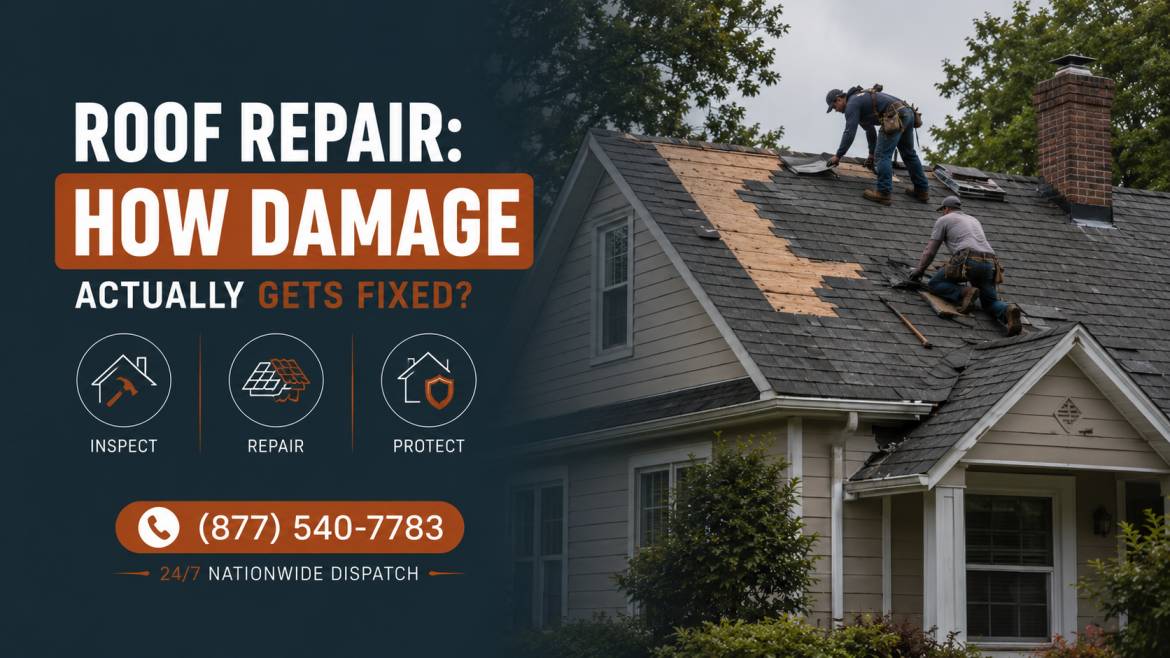
"Roof repair" sounds like a single service, but it covers a range wide enough to include a fifteen-minute shingle swap on one end and a multi-day section rebuild with rotted decking on the other. The word tells you almost nothing about what actually happens until the specific damage, method, and scope are established.
That sequence, not any single step in isolation, is what this guide covers. A repair moves through a predictable order: identifying which method fits the damage, deciding how large the scope actually is, pricing that scope, scheduling it against urgency and weather, and finally confirming the finished work meets a real standard rather than just looking acceptable from the driveway.
This guide walks through that full sequence. It connects to the roof damage overview, and for active damage needing attention right now, storm damage repair covers the immediate response options.
What Does a Roof Repair Involve?
A roof repair is the process of restoring a roof's function at a specific, confirmed point of damage, as distinct from a full replacement that resets the entire covering.
The General Sequence
Stage | What Happens |
|---|---|
Diagnosis | Confirming the cause and extent of the damage, not just the visible symptom |
Method selection | Matching the repair approach to the specific damage type and material |
Scope determination | Defining exactly what work the repair will and will not include |
Pricing | Calculating cost based on scope, access, material, and labor |
Scheduling | Balancing urgency against weather and material availability |
Verification | Confirming the completed work actually meets a real quality standard |
In practice: Skipping the diagnosis stage is the most common reason a repair fails to hold. A crew that patches a visible symptom without confirming the underlying cause, such as animal and pest damage that created the original opening, often finds the same problem recurring within a season.
Which Repair Method Fits Which Damage?
Roof repair methods fall into three general categories, and matching the right one to the actual damage matters more than the specific brand of shingle or crew doing the work.
The Three Core Methods
Method | Applies To | Limitation |
|---|---|---|
Spot patching | Isolated, small-area damage on an otherwise sound roof | Color and profile matching rarely perfect |
Section replacement | Damage spread across a defined but limited portion of one slope | Visible transition against weathered surrounding material |
Resealing and reflashing | Leaks originating at a joint or penetration rather than the field | Requires removing surrounding covering to reach the flashing |
When Spot Patching Is Enough?
Spot patching, replacing individual shingles or a small cluster of them, works well for isolated damage where the surrounding covering remains sound and flexible. Roof wear and aging on the rest of the roof is the key variable here, since patching a young, healthy roof produces a durable fix in a way patching an already-brittle one does not.
When Section Replacement Becomes Necessary?
Once damage spreads across a meaningful share of a single slope, rather than staying isolated to a handful of units, section replacement generally outperforms repeated individual patches, both in appearance and in long-term durability. Wind damage frequently produces this pattern, since uplift concentrates along an entire edge or elevation rather than a single random spot.
What Resealing and Reflashing Actually Fixes?
Flashing-related leaks require a fundamentally different approach than surface damage, since the fix lies beneath the visible covering rather than on top of it. A flashing repair limited to applied sealant, without rebuilding the actual lap sequence, typically fails again within a season or two.
How Is Roof Repair Scope Actually Decided?
Roof repair scope of work is where more disputes originate than any other stage of the process, and understanding the mechanism behind those disputes explains why a homeowner's contractor and their insurance adjuster can look at the identical roof and arrive at meaningfully different numbers.
Why the Insurance Scope Is Often Smaller Than the Contractor Estimate?
The vast majority of insurance carriers, industry estimates place the figure at roughly 85% to 90%, use a standardized estimating platform to generate the adjuster's scope and pricing. That platform builds its figures from a regional median price list rather than current market rates, and that list can lag actual material and labor costs by several months, particularly following a major regional storm event when demand spikes faster than the pricing database updates.
The estimating software prices from a database, not from a physical walk-through of the specific roof
An adjuster working primarily from the ground or a drone survey can miss items a contractor identifies during a hands-on inspection
Common under-counted items include ridge caps, drip edge, pipe boots, and code-triggered upgrades
Documenting roof damage for insurance covers how a contractor's detailed, line-item estimate closes that gap during a claim
Why Scope Is Often Larger Than Expected?
Ceiling stains discovered during the initial walkthrough, alongside hidden decking damage found once tear-off begins, are the two most common reasons an initial scope expands after work actually starts. Neither is fully confirmable from an exterior inspection alone, which is why a reputable contract specifies how discovered damage gets priced and authorized rather than leaving it open-ended.
What Is the 25 Percent Rule?
Most jurisdictions following the International Building or Residential Code include a provision requiring that once more than 25% of a roof section is repaired within any 12-month period, the entire section must be brought up to current code. The rule originated in the Florida Building Code and has since been adopted in some form by many other jurisdictions, including Texas and Minnesota under their own state code frameworks.
In practice: this threshold is frequently what actually converts a repair into a full section replacement, more often than any single judgment call about the damage's severity. Once repair work on a given slope approaches that 25% line, bringing the whole section current is usually both the compliant choice and the more economical one once code-triggered upgrades are factored in.
Who Decides the Final Scope?
The final scope is a negotiation between what the adjuster's estimate covers, what the contractor's inspection finds, and what code requires once work begins. Insurance claim help becomes relevant specifically when that negotiation stalls, since a well-documented supplemental claim can close a scope gap the initial estimate missed.
What Affects Roof Repair Pricing?
Roof repair cost per square foot varies enormously, and the variation traces back to a consistent set of factors rather than random pricing differences between contractors.
The Core Pricing Factors
Factor | Why It Moves the Price |
|---|---|
Access and pitch | Steep or hard-to-reach roofs require more labor and safety staging |
Material type | Covering cost varies significantly across material families |
Damage extent | Isolated damage costs less per square foot than a full section |
Material matching | Discontinued or hard-to-source products add cost and delay |
Minimum charge | Most contractors apply a minimum regardless of job size |
Why Access Changes the Price So Much?
A roof requiring harnesses, roof jacks, or extended staging costs measurably more per square than a simple, walkable slope, independent of the actual damage size. Foot traffic damage is also a genuine risk consideration on steep or brittle roofs, since the access difficulty that raises labor cost is often the same condition that makes careless foot placement more likely to cause additional damage during the repair itself.
When Repairs Cost More Than Quoted?
Hidden decking damage discovered once the covering is removed is the most common reason a final invoice exceeds the original quote. A reputable estimate specifies a per-sheet allowance for this contingency rather than presenting a fixed price that assumes sound decking throughout. Isolated damage that stays within the original estimate is typically resolved through straightforward shingle repair without any of these complications.
How Long Does a Roof Repair Take?
How long does a roof repair take depends heavily on scope, but a few general benchmarks help set realistic expectations before work begins.
Typical Timelines by Scope
Scope | Typical Duration |
|---|---|
Isolated spot patch | A few hours |
Flashing or valley reseal | A single day |
Section replacement | One to two days |
Full replacement, average home | Two to five days |
What Extends a Repair Timeline?
Weather delays, material lead times on less common products, and permit inspection scheduling all push a straightforward repair timeline out considerably. Tree and debris damage repairs specifically can extend further when a fallen limb needs professional removal before the actual roof work can even begin safely.
When a Repair Becomes a Multi-Day Job?
A repair that seemed isolated during the initial estimate can expand into a multi-day project once tear-off reveals decking damage, or once the 25% rule pushes the scope from a section repair into a full slope replacement mid-project.
Which Roof Damage Needs Immediate Repair?
Urgent roof repair applies to a genuinely narrow set of conditions, and treating every finding as an emergency wastes both money and contractor availability that a real emergency might need.
A Practical Urgency Framework
Active water intrusion reaching living space
Exposed decking with no covering over it
Structural deflection or visible sagging
Compromised chimney or wall flashing with wet weather forecast
Any breach large enough to admit wind directly
Ice dams illustrate a case where urgency is less about the visible ice and more about what it is actively doing. An ice dam without any interior staining yet is a developing risk; one accompanied by fresh ceiling staining is already an active emergency.
What Can Safely Wait?
Cosmetic granule loss, isolated curling on an otherwise sound roof, or minor damage on a detached structure in dry weather can typically wait for a scheduled appointment rather than emergency dispatch. Pricing routine work as an emergency is a common upsell worth recognizing.
How Weather Changes Roof Repair Urgency?
A moderate issue ahead of a forecasted storm deserves faster action than the same issue during a stretch of dry weather. Roof tarping bridges that gap, providing interim protection while a permanent repair gets scheduled around weather and material availability.
Do Roof Repairs Need a Permit?
Roof permit requirements vary by jurisdiction and by the scope of the specific repair, which makes a blanket answer misleading.
What Typically Triggers a Permit?
Scope | Typical Permit Requirement |
|---|---|
Minor spot repair, small area | Often exempt in most jurisdictions |
Section replacement | Frequently requires a permit |
Full replacement | Almost universally requires a permit |
Structural repair | Requires a permit in virtually every jurisdiction |
The 25% rule covered earlier connects directly here, since crossing that threshold in many jurisdictions triggers both the code-compliance requirement and the permit requirement simultaneously.
Who Pulls the Roof Repair Permit and What Happens Without One?
A licensed contractor typically pulls the permit as part of the project, not the homeowner directly. Wildfire ember damage repairs in fire-prone jurisdictions often carry additional permit scrutiny specifically tied to material fire rating compliance. Unpermitted work that should have required one creates two lasting problems: it complicates a future home sale, and it can give an insurer grounds to contest a later claim on the same roof.
Why Is Matching Roofing Materials So Hard?
Matching roof shingles for a repair is frequently more difficult than homeowners expect, and the reasons are structural to how roofing products are manufactured rather than a contractor limitation.
The Core Matching Problem
Manufacturers discontinue color runs and revise product lines every few years, and even a current-production match differs visibly from a weathered roof due to years of accumulated UV exposure and granule loss. Sun and UV exposure is the underlying reason existing shingles never quite match new stock, since that exposure changes color in a way manufacturing cannot replicate on demand.
What Dye Lot Variation Means?
Granule color varies slightly between manufacturing batches even within the same product line, a difference known as dye lot variation. A repair using new material from a different lot than the original installation can produce a visible seam even when both are technically the identical product.
What Happens When a Product Is Discontinued?
A fully discontinued product forces a choice: source remaining inventory from a secondary market, accept a visible mismatch with the closest available replacement, or expand the repair to a full slope where uniform appearance no longer depends on matching old material at all.
When Matching Forces a Full Replacement?
Many policies contain matching language, and several states have regulations addressing reasonably uniform appearance following a repair. That language is frequently the basis for expanding a repair scope to a full slope once matching genuinely proves impossible.
How Do You Tell a Roof Repair Was Done Right?
Check roof repair quality using verification that goes beyond a general visual glance, since several specific, checkable details separate a properly executed repair from one that only looks acceptable.
What to Check from the Ground?
Consistent shingle exposure and alignment across the repaired section
A shingle overhang of roughly 1 to 1.5 inches past the drip edge, neither excessive nor insufficient
No visible gaps, lifted edges, or exposed fastener heads
A roofline free of dips or waviness where the repair meets the original covering
What the Roof Repair Contractor Should Show You?
A transparent contractor readily provides photographs of the underlayment and deck condition taken before the new covering went on, since that documentation confirms work that becomes permanently hidden once the job is complete. Roof snow load repairs specifically should include confirmation that any structural reinforcement was actually completed, not just the visible covering above it.
What Roof Repair Documentation You Should Receive?
A completed repair should come with a written summary of the work performed, photographs of any concealed conditions found and addressed, and clear terms for both the manufacturer and workmanship warranty. An emergency roof inspection performed independently after a repair, particularly a larger one, provides a second opinion worth the modest additional cost on higher-scope projects.
What Roof Work Should Homeowners Not Do?
DIY roof repair is reasonable for a narrow set of tasks and genuinely unsafe or counterproductive for most of what this guide has covered.
What a Homeowner Can Safely Handle?
Ground-level visual inspection and photo documentation
Clearing accessible gutters from a stable ladder position
Minor caulking touch-ups on penetrations already in generally sound condition
Interior water containment during an active leak, before professional repair arrives
Why Roof Access Itself Is the Real Risk?
Falls from residential roofs cause more injuries after storms than the storms themselves, and that risk exists independent of skill level once the surface is wet, steep, or structurally uncertain. Roof sagging specifically should never prompt a homeowner to climb onto the roof for a closer look, since a structural concern is precisely the scenario where the surface may not reliably hold weight.
What Voids a Warranty for Roof Repair?
Most manufacturer warranties require certified professional installation, and self-performed repair work on an otherwise warrantied roof frequently voids that coverage entirely, even for damage unrelated to the DIY work itself.
When DIY Roof Damage Repair Work Costs More in the End?
A DIY patch that misses an underlying cause, such as unaddressed moss retaining moisture beneath the repaired area, often costs more to properly correct later than a professional repair would have cost from the start.
Can a Roof Be Repaired in Bad Weather?
Can you roof in the rain has a straightforward answer for most repair work: not effectively, and the reasons are physical rather than a matter of contractor preference.
How Cold Affects Sealing?
Asphalt shingle seal strips activate through solar heat, meaning a shingle installed during cold weather does not achieve its full seal until warmer temperatures return. Most adhesives and sealants specify a minimum application temperature, and work performed below that threshold produces a bond that looks complete but has not actually cured correctly.
What Temperature Is Genuinely Too Cold?
While the exact threshold varies by specific product, most standard roofing adhesives struggle to cure reliably much below 40 degrees Fahrenheit, and manufacturer specifications for any given product should take precedence over a general rule of thumb.
What Can Still Be Done in Bad Weather?
Emergency mitigation, tarping an active breach, containing interior water, and temporary sealing, proceeds regardless of weather, since the cost of continued exposure outweighs any disadvantage of working in suboptimal conditions. Permanent, adhesive-dependent repair is what genuinely waits for a better weather window whenever the situation allows it.
Which States See the Most Distinctive Roof Repair Dynamics?
Repair practices and disputes vary by state, shaped by each region's building codes, claim volume, and climate.
Texas, where high hail claim volume drives frequent scope disputes between adjuster and contractor estimates
Minnesota, applying the 25% rule under its own state building code alongside genuine cold-weather sealing constraints
Florida, the origin state for the 25% rule and a jurisdiction with strict permit enforcement tied to code compliance
Colorado, where Front Range hailstorms drive some of the highest emergency repair demand nationally
Illinois, where sustained freeze-thaw cycling limits the practical repair season considerably
California, with a dedicated statewide contractor licensing structure shaping permit and matching practices
Washington, where sustained rainfall genuinely limits the practical window for adhesive-dependent repair work
Storm damage repair across Texas deals with scope disputes more frequently than most states, tied directly to the volume of hail claims processed each season. Roof repair services across Minnesota navigates both the state's 25% code threshold and a materially shorter practical repair season than warmer climates experience.
Roof replacement and permit guidance in Florida operates under the origin jurisdiction for the 25% rule, with correspondingly strict enforcement. Emergency leak repair across Colorado sees some of the highest urgent repair demand nationally, concentrated along the Front Range hail corridor.
Cold weather roof repair across Illinois contends with a genuinely compressed repair season given the state's severe freeze-thaw pattern. Roof replacement across California operates under one of the more established statewide contractor licensing systems, shaping both permit compliance and material sourcing. Roof tarping and wet weather repair in Washington rounds out the group, where sustained regional rainfall genuinely narrows the annual window for adhesive-dependent work.
Frequently Asked Questions About Roof Repair
How Is a Damaged Roof Repaired?
The process moves through diagnosis, method selection, scope determination, pricing, scheduling, and verification. The specific method, spot patching, section replacement, or reflashing, depends on the damage type, while the overall timeline depends on scope, weather, and material availability.
What Are the Different Roof Repair Methods?
The three core methods are spot patching for isolated damage, section replacement for damage spread across a defined portion of one slope, and resealing or reflashing for leaks originating at a joint or penetration rather than the open field of the roof.
Why Is My Contractor's Estimate Higher Than My Insurance Claim?
Most insurance estimates are generated using standardized software built on regional median pricing that can lag several months behind actual market rates, particularly after a major storm drives up local demand. Contractor estimates also frequently include items, such as code-triggered upgrades or additional penetrations, that a ground-level or software-based adjuster estimate missed.
Do I Need a Permit to Repair My Roof?
It depends on the scope. Minor, isolated repairs are often exempt in many jurisdictions, while section replacement, full replacement, and any structural work generally require a permit. Crossing the 25% repair threshold frequently triggers both a code compliance requirement and a permit requirement simultaneously.
Can I Repair My Own Roof?
Limited tasks, such as ground-level inspection, accessible gutter clearing, and interior water containment during an active leak, are reasonable for most homeowners. Roof-surface work carries genuine fall risk and frequently voids manufacturer warranties, which is why most actual repair work is better left to a licensed professional.
How Do I Know if My Roof Repair Was Done Right?
Check for consistent shingle exposure and alignment, correct overhang past the drip edge, no visible gaps or lifted edges, and a straight roofline at the repair transition. A transparent contractor also provides before-and-after documentation of concealed work, such as decking and underlayment condition, that becomes permanently hidden once the job is complete.