
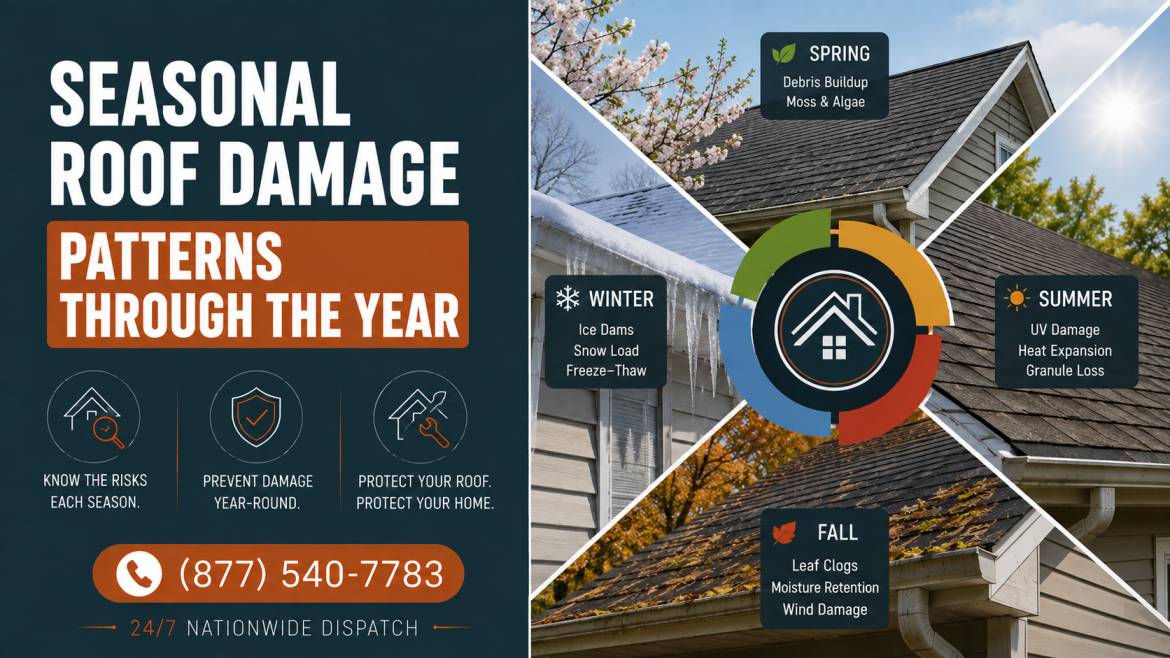
A roof rarely fails because of a single dramatic moment. More often, it fails because of a sequence: a winter that weakened the seal, a spring storm that found the weak point, a summer that baked an already-stressed shingle, and a fall that never got a proper inspection before the cycle started again.
That sequence is easy to miss when each season's damage is treated as its own isolated event. It is far more useful, and far more accurate, to treat a roof's year as one continuous story where each season either compounds or resets the damage the previous one caused.
This guide covers how each season damages a roof differently, which one actually causes the most damage nationally, and when repair work is genuinely easiest to schedule. It connects to the roof damage overview, and for active seasonal damage right now, storm damage repair covers the available response.
How Does Roof Damage Change by Season?
Every season stresses a roof through a different primary mechanism, and recognizing which mechanism is active at a given time of year changes both what to check and how urgently to respond.
The Four-Season Framework
Season | Dominant Mechanism | Primary Risk |
|---|---|---|
Winter | Freeze-thaw cycling, trapped meltwater | Ice dams, snow load |
Spring | Convective storm activity | Hail, wind, heavy runoff |
Summer | Sustained heat and UV exposure | Thermal aging, afternoon thunderstorms |
Fall | Accumulating debris, early cold | Clogged drainage, pre-winter vulnerability |
In practice: damage from one season frequently does not become visible until the next. A roof weakened by summer UV exposure often does not fail outright until the first real wind event of fall tests a seal that has already lost most of its strength.
Wind and Hail Dominate the Annual Total
The Insurance Information Institute and related industry data consistently place wind and hail as the leading cause of homeowners claims nationally, accounting for roughly 41% of all property damage losses in recent reporting years. That single peril category, concentrated heavily in spring, is why one season stands out clearly from the rest.
Which Season Causes the Most Damage?
Spring holds that position by a wide margin, driven almost entirely by the seasonal concentration of severe convective storm activity across the country.
Why Spring Dominates the National Total?
NOAA's Storm Prediction Center consistently logs the highest concentration of hail events during the spring months, when the atmospheric conditions that produce severe thunderstorms, warm, moist air colliding with cooler air masses, occur most frequently across the central and southern United States.
Spring accounts for the largest share of annual hail activity nationally
Wind events frequently accompany the same storm systems producing that hail
Roofs entering spring already weakened by winter freeze-thaw cycling fail more readily
Insurance claim volume tracks this pattern closely, spiking each spring across affected regions
That said, "most damage nationally" does not mean every roof faces its greatest individual risk in spring. A roof in a heavy snowbelt region genuinely faces its highest annual risk in winter, and a roof in a wildfire-prone area faces its highest risk during that region's specific fire season. National aggregate data describes the country as a whole, not any single roof's specific exposure.
Winter Roof Damage
Winter roof damage concentrates around two related mechanisms: sustained freeze-thaw cycling and the specific risk of trapped meltwater forming an ice dam at the eave.
What Damages Roofs in Winter
Repeated freezing and thawing stresses every joint, fastener, and sealed seam on a roof, since materials contract in the cold and expand again once temperatures rise, a cycle that can repeat dozens of times across a single winter in colder climates.
Freeze-thaw cycling gradually widens existing cracks in flashing and mortar
Ice dams form when attic heat loss melts snow unevenly, refreezing at the cold eave
Roof snow load can exceed a structure's design capacity during sustained heavy accumulation
Brittle, cold shingles crack more readily under wind or foot traffic than warm, flexible ones
Ice dams specifically trace back to an attic heat imbalance rather than the roof covering itself, which is why the same visible ice ridge can recur every winter until the underlying ventilation and insulation issue is actually corrected.
Can Roofs Be Repaired in Winter?
Cold-weather repair carries genuine limitations, since asphalt shingle seal strips activate through solar heat and most adhesives specify a minimum application temperature. A shingle installed during a cold snap is not fully sealed until warmer weather arrives, which is why emergency winter work often relies on hand-sealing with roofing cement as an interim measure. Ice dam removal using steam-based methods remains effective regardless of ambient temperature, since it addresses the ice directly rather than depending on adhesive cure conditions.
Spring Roof Damage
Spring roof damage is where the year's most significant losses concentrate, driven by the same severe storm season that makes spring the peak period for insurance claims nationally.
What Damages Roofs in Spring
The combination of hail, wind, and heavy runoff from combined snowmelt and rainfall makes spring the season most likely to produce sudden, dramatic roof failure rather than gradual deterioration.
Hail damage peaks seasonally alongside the broader severe thunderstorm pattern
Wind frequently accompanies the same storm systems, compounding hail impact with uplift stress
Heavy runoff from combined snowmelt and spring rain tests drainage systems at their highest annual volume
A roof already weakened by winter freeze-thaw cycling has less reserve capacity against spring storms
Why Spring Inspection Timing Matters
A full post-storm emergency roof inspection in spring catches damage while its connection to a specific storm date remains easy to establish. Damage that goes undocumented through spring becomes considerably harder to attribute to a specific event later in the year, once ordinary summer weathering has had time to blur the evidence.
Summer Roof Damage
Summer roof damage works through sustained exposure rather than a single dramatic event, accumulating gradually across the season even as afternoon thunderstorms add their own periodic stress.
What Damages Roofs in Summer
Heat is the defining summer mechanism, and it attacks a roof from two directions simultaneously once poor attic ventilation is factored in.
Mechanism | Effect |
|---|---|
Direct UV exposure | Breaks down asphalt oils, accelerating granule loss and brittleness |
Surface heat | Roof surfaces regularly run 40 degrees or more above ambient air temperature |
Trapped attic heat | Bakes the shingle from below simultaneously |
Afternoon thunderstorms | Add periodic wind and hail risk on top of cumulative heat stress |
How Does Heat Affect Shingles?
Sustained summer heat accelerates the same oxidation process that ages a shingle over its entire service life, compressing years of ordinary aging into a single intense season on roofs with inadequate ventilation. Roof blistering appears more frequently during and after summer specifically, since trapped heat and moisture expand more aggressively under sustained high temperatures than during any other season.
What Is Thermal Shock?
Thermal shock describes the stress a roofing material experiences when it cycles rapidly between temperature extremes, such as a sudden summer thunderstorm cooling a roof surface that had been baking in direct sun moments earlier. That rapid contraction, following extended expansion, is a recognized contributor to premature material fatigue independent of UV exposure alone.
Fall Roof Damage
Fall roof damage is preparation season in disguise. The work completed, or skipped, between the last warm week and the first freeze determines how the roof performs through the winter that follows.
What Damages Roofs in Fall
Debris accumulation is the dominant fall-specific risk, since falling leaves and small branches collect in valleys and gutters at a rate no other season produces.
Leaf litter dams valleys and gutters, holding moisture against the covering
Wind events can lift shingles already weakened by a full summer of UV exposure
The first hard freeze reaches roofs that were not adequately prepared beforehand
Granule loss accumulated over summer becomes more visible once leaf debris highlights it in the gutters
Why Debris Matters Most Now
Tree and debris damage peaks seasonally in fall specifically because of the sheer volume of material shedding at once, and clogged valleys or gutters heading into winter set up exactly the drainage failure that contributes to ice dam formation once cold weather arrives. Scheduling gutter repair before the first freeze addresses that risk directly rather than discovering it mid-winter.
The Last Safe Repair Window
Fall represents the final practical window for scheduling non-emergency roof work before winter's temperature constraints limit what adhesive-dependent repairs can reliably achieve. Roof maintenance completed in fall, particularly gutter clearing and a pre-winter inspection, addresses the specific risks winter is about to introduce rather than reacting to them after the fact.
What Should You Check Each Season?
A rotating seasonal checklist, rather than a single annual inspection, catches problems while they are still specific to the season that caused them.
A Practical Seasonal Checklist
Winter: monitor for ice dam formation, check attic frost, avoid unnecessary roof access
Spring: conduct a full post-storm inspection, check drainage after snowmelt, document any hail or wind evidence
Summer: check attic temperature and ventilation function, address any storm damage promptly
Fall: clear gutters and valleys, schedule a pre-winter inspection, confirm insulation coverage at the eaves
A roof inspection timed to this seasonal rhythm, rather than performed only when something already looks wrong, is what actually catches developing problems while they remain inexpensive to address.
When Is Repair Work Easiest?
Timing genuinely affects both the quality and the cost of roof repair work, and understanding the seasonal constraints helps homeowners plan non-emergency work more effectively.
The Case for Moderate-Weather Scheduling
Spring and fall generally offer the most favorable working conditions: temperatures warm enough for proper adhesive cure, without the extreme heat that makes steep-slope work dangerous for crews or the storm-driven demand spikes that stretch contractor availability thin during peak season.
Roof damage cost factors covers how seasonal demand affects pricing specifically, including the documented pattern of costs rising in any region recently hit by a major storm, as available crews become stretched across a sudden surge in work.
When Emergency Work Overrides Seasonal Preference
None of these seasonal preferences apply once active water intrusion is involved. Roof tarping and other emergency mitigation proceed in any season and any weather, since the cost of delay in an active leak situation outweighs any advantage of waiting for better working conditions.
Which States See the Most Distinctive Seasonal Roof Patterns?
Seasonal risk concentrates differently by region, shaped by each state's specific climate and storm exposure pattern.
Minnesota, where sustained winter cold drives the year's most severe ice dam risk
Texas, sitting inside the corridor most exposed to spring's peak hail activity
Colorado, sharing that spring hail exposure along the Front Range specifically
Arizona, where summer heat and UV exposure dominate the annual risk profile
Florida, facing summer thunderstorm activity that transitions into hurricane season
Georgia, where fall debris accumulation compounds with lingering tropical storm exposure
Illinois, where fall wind preparation matters most ahead of the state's severe winter storms
Winter roof repair across Minnesota addresses some of the most severe sustained ice dam risk nationally, tied directly to the state's extended sub-freezing stretches. Spring storm and hail repair in Texas and hail-season roof repair across Colorado both reflect the same national hail peak, concentrated along slightly different regional corridors within it.
Summer heat and UV roof assessment in Arizona deals with the most extreme sustained heat exposure of any state in this group. Storm season roof repair across Florida spans the transition from summer thunderstorms into hurricane season specifically. Fall debris and storm prep across Georgia and pre-winter roof preparation in Illinois round out the group, each addressing a distinct fall-specific risk ahead of very different winter conditions.
Frequently Asked Questions About Seasonal Roof Damage
What Season Causes the Most Roof Damage?
Spring causes the most roof damage nationally, driven by the concentration of severe thunderstorm activity, hail, and wind that peaks during that season across most of the country. Regional exposure varies, with heavy snowbelt areas facing their greatest individual risk in winter instead.
When Should I Check My Roof?
A rotating seasonal check, roughly every three months, catches problems specific to each season's dominant risk. At minimum, inspections timed to spring, after winter stress, and fall, before winter arrives, cover the two highest-value windows in the annual cycle.
What Causes Roof Damage in Winter?
Freeze-thaw cycling, ice dam formation from trapped attic heat, and snow load exceeding a roof's design capacity are the three dominant winter mechanisms, all connected to temperature extremes and moisture management rather than direct storm impact.
Does Summer Heat Really Damage Shingles?
Yes. Sustained UV exposure and elevated surface temperatures accelerate the same oxidation process that ages asphalt shingles over their entire service life, and that aging compresses considerably during an intense summer, particularly on roofs with inadequate attic ventilation.
What Should I Do to My Roof in Fall?
Clear gutters and valleys of accumulated debris, schedule a pre-winter inspection, and confirm attic insulation coverage reaches fully to the eaves. These three steps address the specific vulnerabilities winter is about to introduce.
Can Roof Repairs Happen in Any Season?
Emergency repairs addressing active water intrusion proceed in any season and any weather, since delay carries more cost than working under suboptimal conditions. Non-emergency, adhesive-dependent repairs perform best in moderate spring or fall temperatures, when seal strips activate reliably without the complications of extreme heat or cold.