
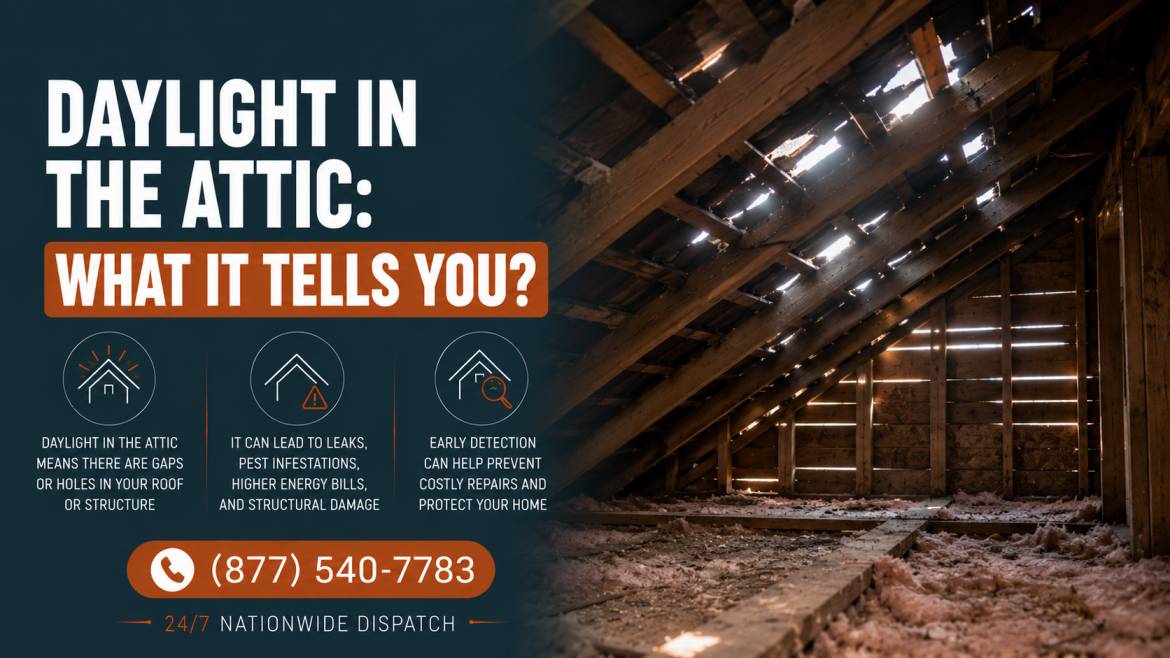
Most signs covered in the signs of roof damage guide require some interpretation. A stain might be old or active. Curling might be normal aging or a warning sign. Daylight visible through the roof deck from inside the attic removes almost all of that ambiguity. There is a physical hole in the roof assembly, and light is passing through it.
That directness is what makes this sign both simple to confirm and easy to miss entirely. Most homeowners never enter their attic during daylight hours with the intention of checking for gaps, which means a confirmed opening can persist unnoticed for a surprisingly long time.
This guide covers where these gaps typically appear, why they can hide even from a careful look, and how to judge urgency once one is confirmed. For any breach found during that check, the services directory covers the available repair options.
What Does Daylight in the Attic Mean?
Visible daylight through the roof deck confirms a continuous physical opening exists somewhere in the assembly, running from the exterior surface all the way through to the attic space itself. This is distinct from most other signs, which indicate a problem developing rather than confirming a completed breach.
Why This Sign Is Different From the Others?
Most signs covered elsewhere in this series describe a process still underway. Granule loss indicates aging that may or may not yet threaten the covering's integrity. Daylight confirms the covering has already been physically breached, with nothing left ambiguous about whether an opening exists.
The opening has to pass through every layer: shingle, underlayment, and decking
Any gap large enough to admit visible light is also large enough to admit wind and rain
The sign requires no interpretation the way a stain's timing or a shingle's texture does
Its presence typically means water intrusion has already begun or is imminent
The Layers a Gap Has to Pass Through
A visible daylight gap did not form in a single moment in most cases. It typically represents the final stage of a process that worked through several layers before becoming visible from inside the attic.
The shingle covering fails first, whether through a crack, a lifted edge, or a missing unit
The underlayment beneath, meant to catch exactly this kind of failure, has also given way at the same point
The decking itself has developed a gap, split, or hole large enough to transmit light through
Only once all three layers have failed at the same location does daylight become visible from below
That layered failure explains why a daylight gap, once found, often indicates a more established problem than its size alone might suggest, since it represents the complete breakdown of a system designed with redundancy specifically to prevent this outcome.
Where Should You Check First?
Daylight gaps rarely appear in the open field of a roof, where the covering performs exactly as designed. They concentrate at specific, predictable locations where the assembly is interrupted.
The Most Common Locations
Location | Why Gaps Form There |
|---|---|
Fastener holes | Nails backing out over time leave a small but real opening |
Ridge line | Cap shingles or ridge vents that have lifted or cracked |
Valleys | Metal corrosion or shifted shingles at the convergence point |
Penetrations | Flashing around vents, pipes, or chimneys separating from the deck |
Eave edges | Deteriorated drip edge or lifted starter course |
Fastener holes deserve particular attention, since they are individually small enough to be easy to overlook yet numerous enough, across an entire roof, to add up to meaningful cumulative risk if several have backed out simultaneously.
A Systematic Search Approach
Checking methodically rather than glancing around randomly catches gaps that a casual look would miss entirely.
Turn off every attic light and allow eyes to adjust to darkness for a full minute
Scan systematically along the ridge line first, since it experiences the highest wind exposure
Work outward toward the eaves, checking valleys and penetrations along the way
Note the exact location of any confirmed gap for the repair crew's reference
In practice: even a small amount of ambient light elsewhere in the attic, from a gable vent or a soffit gap, can mask a genuine pinhole opening in the deck itself. Full darkness is what makes small gaps visible, and skipping that step is the most common reason homeowners miss this sign entirely during a casual check.
Is Daylight Always a Leak?
Not immediately, though the distinction matters less here than it does for most other signs in this guide, since a confirmed physical opening represents risk regardless of whether water has found it yet.
The Difference Between an Active Leak and an Unrealized Risk
A gap can exist for some time without producing a visible leak if no rain has occurred since it formed, or if the gap's location and angle happen not to align with the prevailing direction of wind-driven rain in recent storms. That absence of an active leak does not mean the gap is safe to leave alone.
Attic moisture often develops before an obvious drip does, since moisture can travel along rafters and saturate insulation for a period before enough volume accumulates to produce a visible interior stain. A confirmed daylight gap with no current staining is still an active risk waiting for the right storm.
Why Waiting Is Riskier Than It Seems
Every day a confirmed gap remains unaddressed is a day it could admit water during unpredictable weather. Unlike signs that develop gradually and allow for a reasonable monitoring period, a confirmed physical opening does not improve or resolve itself over time. It only gets fixed through direct repair.
How Urgent Is the Repair?
Daylight gaps generally warrant faster action than most other signs covered in this series, given that the physical breach is already confirmed rather than suspected.
A Practical Urgency Framework
Situation | Recommended Timeline |
|---|---|
Small gap, no rain forecast in the immediate future | Schedule repair within the week |
Any gap with rain forecast in the coming days | Arrange roof tarping immediately as interim protection |
Large or multiple gaps found together | Same-day professional assessment |
Gap accompanied by active dripping or staining | Emergency response, treat as urgent |
Emergency leak repair becomes the appropriate call once a gap has already progressed to active water intrusion rather than remaining a confirmed but currently dry opening.
What a Repair Actually Involves?
Fixing a confirmed daylight gap depends heavily on its cause and location, ranging from a straightforward fastener correction to a more involved flashing rebuild.
Backed-out nails often require removal, sealing, and replacement with a corrected fastener
Ridge cap issues typically need the affected caps removed and replaced properly
Valley and penetration gaps usually require rebuilding the flashing sequence rather than simply sealing the visible opening
Any gap revealing damaged decking underneath needs that structural issue addressed before the covering is restored
A roof inspection that confirms the gap's exact cause, not just its presence, produces a more durable repair than addressing only the visible symptom.
What Other Causes Typically Produce Daylight Gaps?
Understanding which underlying cause produced a specific gap helps set expectations for whether it represents an isolated issue or a sign of broader roof problems worth investigating further.
Wind-Related Gaps
Wind damage is among the most common causes of a fresh daylight gap, particularly following a storm with sustained or gusting winds. Lifted or torn shingles, displaced ridge caps, and separated flashing all trace back to wind uplift overcoming the covering's resistance at a specific point.
Ember and Fire-Related Gaps
In wildfire-prone regions, wildfire ember damage can create small burn-through openings distinct from mechanical wind or age-related gaps. These require particular attention, since a burned opening may indicate smoldering damage extending beyond what is immediately visible from the attic side.
Age-Related Gaps
A roof reaching the end of its service life can develop multiple small gaps simultaneously as fasteners loosen and sealant fails across several locations at once, rather than presenting as a single isolated opening. Multiple gaps found during the same inspection often point toward this broader aging pattern rather than a single storm event.
Installation-Related Gaps
Installation defects occasionally produce daylight gaps well before a roof's expected service life would suggest, particularly around penetrations where flashing was sealed with caulk rather than properly layered into the water path. Caulk-only seals degrade and crack considerably faster than correctly layered metal flashing, sometimes opening a visible gap within just a few years of installation.
A gap traced back to installation quality, rather than storm damage or ordinary aging, is worth raising with the original contractor if the work remains within any applicable workmanship warranty period.
Which States See the Most Daylight Gap Related Roof Concerns?
Daylight gaps concentrate somewhat around states with either older housing stock or severe wind exposure, since both factors increase the likelihood of fastener and flashing failures that produce visible openings.
Pennsylvania, with substantial older housing where original fasteners and flashing have aged considerably
Ohio, sharing comparable older housing stock alongside notable derecho wind exposure
New York, spanning both aging urban housing and significant winter storm exposure
Massachusetts, with older coastal construction facing sustained nor'easter wind exposure
Illinois, combining older Midwest housing with the region's derecho corridor exposure
Roof inspection services across Pennsylvania frequently find multiple small gaps concentrated on homes decades old, where original construction-era fasteners and flashing have simply reached the end of their functional life. Roof repair coverage across Ohio follows a related pattern, compounded by the state's history of severe derecho wind events.
Emergency roof repair across New York deals with this sign heavily during and after winter storm seasons, when sustained wind and ice combine to stress aging flashing and fasteners simultaneously. Roof services across Massachusetts reflects a similar dynamic tied to nor'easter exposure on the region's older coastal housing.
Storm damage repair across Illinois rounds out the group, where derecho-driven wind events regularly produce fresh gaps on top of an already aging housing base.
Frequently Asked Questions About Daylight Gaps
What Does Daylight in the Attic Mean?
It confirms a physical opening exists somewhere in the roof assembly, extending from the exterior surface through to the attic space. Unlike most other signs, this one removes ambiguity entirely, since light passing through means a genuine breach is present.
Is Seeing Light Through the Roof Always Bad?
Yes, in the sense that it always indicates a real opening requiring repair. It does not necessarily mean an active leak is already occurring, but the opening represents an ongoing risk regardless of whether water has found it yet.
How Do I Check for Daylight Gaps in My Attic?
Turn off all attic lighting and allow your eyes to adjust to complete darkness for about a minute before looking, since even modest ambient light elsewhere in the space can mask a small gap. Check systematically along the ridge, valleys, and around any penetrations.
Can a Daylight Gap Exist Without Any Water Damage Yet?
Yes, particularly if the gap's location and angle have not yet aligned with a storm's wind direction, or if limited rain has fallen since the gap formed. The absence of current water damage does not mean the gap is safe to leave unaddressed.
How Quickly Should a Daylight Gap Be Repaired?
Treat any confirmed gap as warranting repair within days rather than weeks, and arrange temporary protection immediately if rain is forecast before a permanent fix can be scheduled. Multiple gaps or any gap accompanied by active dripping should be treated as same-day emergencies.
Can I Seal a Daylight Gap Myself as a Temporary Fix?
Interior sealing from the attic side is generally not a reliable long-term fix, since it does not address the actual opening in the exterior covering. Exterior tarping, properly secured, provides more effective interim protection until a permanent repair addressing the root cause can be completed.
Does the Size of a Daylight Gap Determine How Urgently It Needs Repair?
Size matters, but not as much as location and weather timing. A small pinhole gap ahead of a forecasted storm deserves the same prompt interim protection as a larger one, since wind-driven rain can exploit even a small opening effectively. A larger gap discovered during a dry stretch still needs scheduling promptly, but the immediate emergency response applies more to timing against incoming weather than to the gap's measured size alone.