
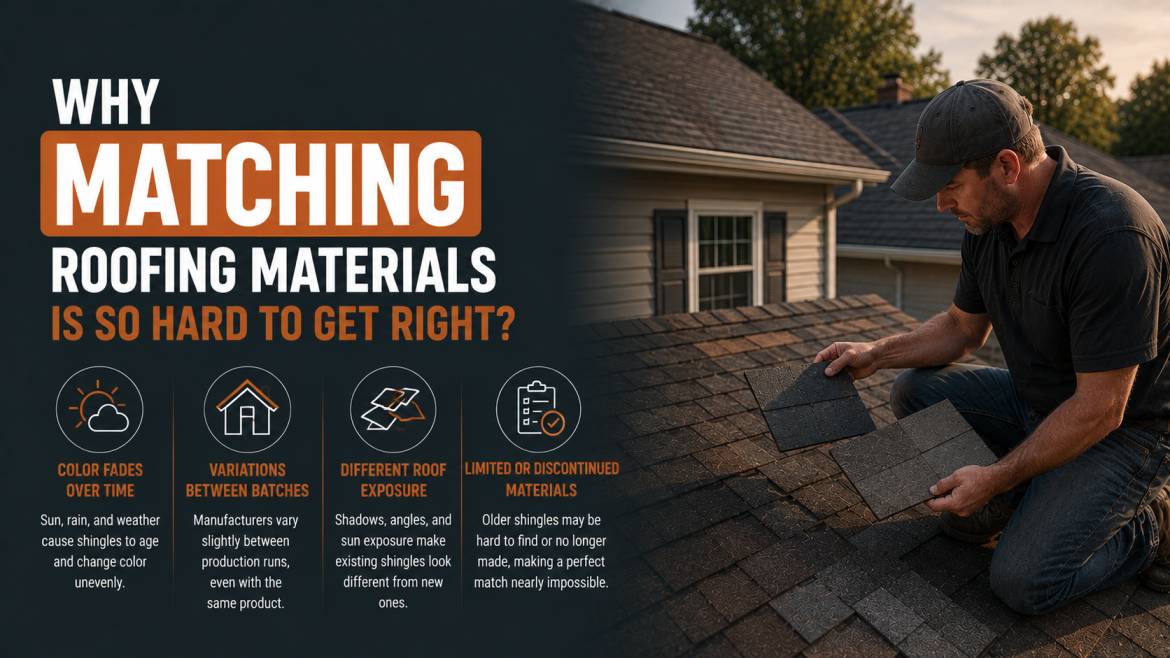
A homeowner requesting "just a few matching shingles" for a repair is asking for something that sounds straightforward and rarely is. The shingle installed a decade ago and the shingle available today share a product name, sometimes even a product line, but they are not the same material by the time weathering and manufacturing changes are both accounted for.
This mismatch surprises homeowners more than almost any other aspect of roof repair, since the underlying assumption, that a repair simply replaces damaged material with identical material, breaks down as soon as the actual sourcing begins. Understanding why matching fails, rather than assuming a contractor is simply not trying hard enough, changes how a homeowner evaluates a repair estimate that flags this issue upfront.
This guide covers why matching is structurally difficult, what dye lot variation actually means, and when the problem becomes significant enough to force a full replacement. It connects to the broader roof repair process, and the services directory covers repair and replacement options across every material type.
Why Is Matching Shingles Difficult?
Two separate forces work against a clean match, and both apply regardless of how careful or experienced the contractor sourcing the roofing repair material happens to be.
The Two Core Obstacles
Obstacle | Why It Prevents a Match |
|---|---|
Manufacturing changes | Products are discontinued and revised every few years |
Weathering | Years of sun exposure change the existing roof's color permanently |
In practice: even a genuinely current-production shingle, purchased from the same manufacturer and product line as the original installation, will look visibly different against a roof that has weathered for five or more years. New material simply has not experienced the same UV exposure and granule settling the surrounding roof has.
How Weathering Changes Color Over Time?
The visible color shift on an aging roof is not random fading. It follows a predictable, measurable pattern tied to how long the material has been exposed and which direction it faces.
Weathering Stage | Approximate Timeframe | Visible Effect |
|---|---|---|
Initial settling | First 1 to 2 years | Slight darkening as loose granules settle |
Early weathering | 3 to 7 years | Gradual, even color shift begins |
Established weathering | 8 to 15 years | Pronounced color difference from new material |
Late-stage weathering | Beyond 15 years | Significant fading, especially on sun-exposed slopes |
South and west-facing slopes weather measurably faster than north-facing ones on the identical roof, which is why a repair on a north slope sometimes matches more successfully than an identical repair attempted on a south-facing section of the same house.
Why Manufacturers Change Products So Often?
Roofing manufacturers revise color offerings, discontinue underperforming lines, and update formulations on a rolling multi-year cycle driven by market trends, roof repair cost inputs, and manufacturing efficiency. Roof wear and aging on the existing roof compounds this timing problem, since the older the original installation, the more product cycles have likely passed since it was purchased.
What Is Dye Lot Variation?
Even within a single, still-current product line, granule color varies subtly between individual manufacturing batches, a difference known as dye lot variation.
How Dye Lots Actually Differ?
Granule color depends on the specific mineral batch and coating process used during a given production run, and manufacturers do not guarantee identical color across different lots even for the same named product. A repair using new material from a different lot than the original installation can produce a visible seam even when both are technically the identical product on paper.
Dye lot variation is most visible under direct sunlight and from a distance
The effect is more pronounced on darker colors, where subtle tone shifts stand out more
Ordering material from the same production run as the original installation is rarely possible years later
Sun and UV exposure accelerates the visible divergence between old and new material even when the dye lots were originally similar
Why This Matters More Than Homeowners Expect?
A contractor sourcing "the same shingle" in good faith can still produce a visibly mismatched result purely from dye lot variation, independent of any error in the sourcing process itself. Setting this expectation honestly before a repair begins prevents a frustrating surprise once the work is complete.
Blending Techniques That Reduce Visible Mismatch
Where a perfect match is not possible, several placement techniques can reduce how noticeable the transition appears without solving the underlying color difference entirely.
Placing new material toward the ridge or a less visible section of the slope where feasible
Distributing replacement shingles across a wider area rather than concentrating them in one visible block
Squaring the repair boundary at a natural line, such as a valley, rather than an irregular patch shape
Allowing new shingles a season of natural weathering before final judgment on how visible the difference remains
What Happens When a Product Is Discontinued?
A fully discontinued product removes the straightforward sourcing option entirely and forces a choice among several imperfect alternatives.
The Available Options
Search secondary suppliers or salvage sources for remaining inventory of the discontinued product
Accept a visible mismatch using the closest currently available replacement
Expand the repair scope to a full slope, where uniform new material eliminates the matching problem
Consider a different but complementary product if an exact aesthetic match is genuinely unavailable
Hail damage claims involving an older, discontinued product frequently end up at option three, expanding to a full slope replacement, specifically because insurance matching provisions treat an impossible match as grounds for expanded coverage.
Why Some Materials Resist Matching More Than Others?
Matching difficulty is not uniform across every roofing material, and understanding which factors make a specific material harder to match helps set realistic expectations before sourcing even begins.
Material Factor | Why It Complicates Matching |
|---|---|
Custom or regional color blends | Fewer suppliers carry the exact formulation |
Textured or dimensional profiles | Subtle profile differences prevent a clean seam even with similar color |
Products tied to a specific manufacturing run | No guarantee of restocking once the run sells through |
Coatings that weather unevenly by exposure | New material weathers differently even from a genuine same-batch match |
A profile mismatch is often more visually disruptive than a color mismatch, since a slight difference in surface texture or dimensional relief catches the eye even under color conditions that would otherwise blend acceptably. This is why a contractor's physical sample comparison, held directly against the existing roof in natural light, remains the most reliable pre-repair check available, more reliable than comparing product names or catalog photos alone.
When Does Matching Force a Full Replacement?
Several policies and regulations address the matching problem directly, and understanding them helps a homeowner recognize when an impossible match legitimately expands the scope of covered work.
Insurance and Regulatory Matching Provisions
Many homeowners insurance policies contain language addressing reasonably uniform appearance following a covered repair, and several states have regulations reinforcing this expectation specifically for roofing claims. Where matching is genuinely impossible, that language frequently supports expanding a repair to a full slope rather than leaving a visibly patched result.
Factor | Supports Full Slope Expansion |
|---|---|
Product fully discontinued | Strong support |
Available but visibly different dye lot | Moderate support, case-dependent |
Minor variation, mostly unnoticeable | Weak support, patch usually stands |
Insurance claim help becomes directly relevant when a homeowner believes matching should expand their covered scope but the adjuster's initial estimate does not reflect that, since documenting the specific unavailability of a match strengthens that argument considerably.
How Roof Age Affects the Matching Decision?
An older roof, already well into its expected service life, presents a different calculation than a newer one facing the identical matching problem. Roof repair scope decisions often weigh remaining service life alongside matching difficulty, since forcing a full slope replacement on a roof with only a few years of life left rarely makes economic sense compared to accepting a moderate, isolated mismatch.
How Do You Minimize Matching Problems Before They Happen?
A few practical steps taken well before any repair is needed can meaningfully reduce future matching difficulty.
Practical Prevention Steps
Keep a record of the original product name, color, and manufacturer at installation
Ask the original installer whether extra material was retained after the job for future repairs
Register the product with the manufacturer where possible, which sometimes provides access to matching support
For a roof nearing its expected service life, weigh whether a targeted repair or planned replacement makes more sense before a matching problem forces the decision
What to Ask a Contractor About Matching Before Work Begins?
An emergency roof inspection visit is a reasonable time to raise the matching question directly, before an active repair is underway and time pressure limits the sourcing options available.
Ask whether the exact original product is still available
Request to see a physical sample compared against the existing roof before committing
Confirm what happens if the closest available match is still visibly different
Ask whether the contract addresses matching disputes explicitly
Which States See the Most Distinctive Matching Challenges?
Matching difficulty varies by state, shaped by typical housing age, regional material popularity, and local supply availability.
Connecticut, where older housing stock frequently involves long-discontinued original products
Massachusetts, sharing similarly aged regional construction across much of the state
West Virginia, where rural supply access can extend sourcing time for less common products
California, spanning a wide range of material types and ages across diverse regional housing stock
Texas, where high hail claim volume frequently surfaces matching disputes during the claims process
Roof repair services across Connecticut frequently navigate matching challenges tied to the state's older housing stock, where original products installed decades ago are long since discontinued. Matching and repair services in Massachusetts follows a closely related pattern given comparably aged regional construction.
Emergency leak repair across West Virginia can face extended sourcing timelines for less common products, given the state's more rural supply chain compared to denser metro markets. Roof replacement and matching across California spans an unusually wide range of material ages and types given the state's diverse housing stock. Hail damage roof repair across Texas rounds out the group, where the state's leading national hail claim volume regularly surfaces matching disputes as part of the broader claims process.
Frequently Asked Questions About Matching Roofing Materials
Can You Match Existing Roof Shingles?
Sometimes, particularly if the product is still in current production and the existing roof has not weathered extensively. A perfect match is rare even then, due to dye lot variation between manufacturing batches, and the closer the match needs to be, the more limited the sourcing options typically become.
What if My Shingles Are Discontinued?
Options include searching secondary suppliers for remaining inventory, accepting a visible mismatch with the closest available replacement, or expanding the repair to a full slope where uniform new material eliminates the matching problem entirely.
What Is Dye Lot Variation?
Dye lot variation refers to subtle color differences between different manufacturing batches of the same named roofing product. Even current-production material from the same product line can show a visible difference against previously installed material from a different batch.
Will Insurance Pay for a Full Slope if Matching Is Impossible?
Often yes, particularly where policy language or state regulation addresses reasonably uniform appearance following a repair. A fully discontinued product provides stronger grounds for this argument than a merely imperfect but available match.
Does Roof Age Affect Whether Matching Is Worth Pursuing?
Yes. On a roof nearing the end of its expected service life, accepting a moderate, isolated mismatch is often more economical than forcing a full slope replacement purely to solve a cosmetic matching issue, particularly if the mismatch is not highly visible from ground level.
Is Matching Harder on Some Roofing Materials Than Others?
Yes. Metal roofing matching is often more difficult than asphalt, since panel profiles and coatings vary by manufacturer and production run in ways that can prevent a clean seam even when the general style appears similar.
Should I Keep Leftover Shingles From My Original Installation for Future Repairs?
Yes, this is genuinely worth doing where practical. Setting aside a small quantity of leftover material from the original installation, stored properly out of direct sunlight, gives a future repair the best possible chance at an exact match, since that stored material has weathered under the same conditions as the rest of the roof, or in some cases not weathered at all if kept indoors.
How Do Adjusters Evaluate Matching Disputes During a Claim?
An adjuster typically requests photographs comparing the proposed replacement material against the existing roof, along with documentation confirming whether the original product remains available. A clear, well-documented comparison showing the visible difference strengthens a request to expand the scope beyond what the initial estimate proposed.