
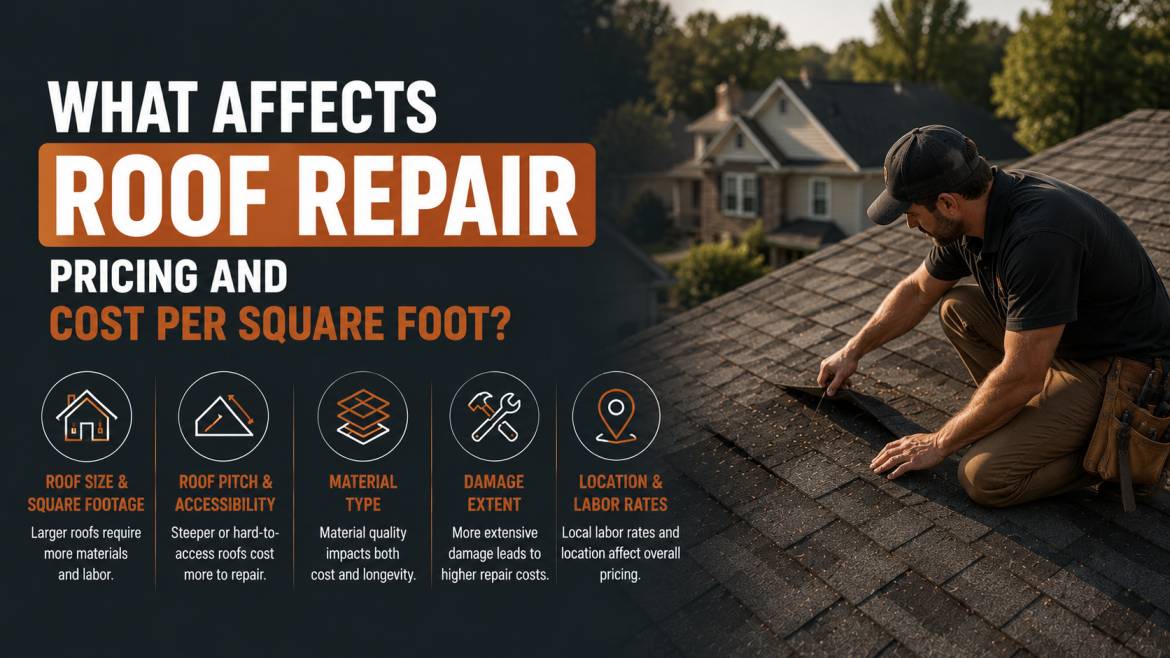
A quote for "fixing a few damaged shingles" can come back anywhere from a couple hundred dollars to well over a thousand, and the damage description alone rarely explains why. Pricing depends on a set of variables that have little to do with how the damage looks and everything to do with how hard it is to reach, what it is made of, and what might be hiding underneath it.
Homeowners comparing two quotes for what seems like the same job often find themselves comparing two entirely different scopes instead, priced against different assumptions about access, material availability, and what the crew expects to find once they actually start. Understanding those variables turns a confusing quote into something genuinely comparable.
This guide covers the core factors driving roof repair pricing, why access changes the number more than most homeowners expect, and when a quoted price ends up costing more than the number on paper. The roof repair services directory covers pricing and scheduling for the full range of repair options.
What Affects Roof Repair Pricing?
Every roof repair quote, regardless of contractor, is built from the same handful of variables, and understanding them is what actually makes two quotes comparable.
The Core Pricing Factors
Factor | Why It Moves the Price |
|---|---|
Access and pitch | Steep or hard-to-reach roofs require more labor and staging |
Material type | Covering cost varies significantly across material families |
Damage extent | Isolated damage costs less per square foot than a full section |
Material matching | Discontinued or hard-to-source products add cost and delay |
Minimum service charge | Most contractors apply a minimum regardless of job size |
Regional labor market | Rates vary considerably by metro area and local demand |
In practice: a repair quoted at a low per-unit price can still cost more overall than a higher per-unit quote once the minimum charge, access fees, and mobilization costs are factored into the total rather than just the line-item unit price. Comparing the full repair scope, not just the bottom-line number, is what actually makes two quotes comparable.
Why a Minimum Service Charge Exists?
Most contractors apply a minimum charge regardless of how small the actual repair is, since mobilizing a crew, loading a truck, and traveling to the site carries a fixed cost independent of the job's size. A repair that seems disproportionately expensive for "just a few shingles" is usually reflecting that fixed mobilization cost rather than an inflated material or labor rate.
Why Per-Square Pricing Drops as Job Size Increases?
Larger repairs typically cost less per square than smaller ones, which surprises homeowners comparing a small patch quote against a per-unit figure quoted for a full section. The explanation is straightforward once the fixed-cost structure is understood: mobilization, staging, and cleanup cost roughly the same whether the crew is replacing ten shingles or an entire slope, so that fixed cost gets spread across more material and labor on a larger job, lowering the effective per-unit price.
Job Size | Fixed Cost Share of Total | Typical Per-Square Price Trend |
|---|---|---|
Very small, isolated patch | High relative to total job cost | Highest effective per-square price |
Moderate section repair | Moderate | Middle range |
Full slope or full replacement | Low relative to total job cost | Lowest effective per-square price |
This is also why combining several smaller planned repairs into a single visit, where the roof's condition allows it, often produces meaningful savings compared to scheduling each one separately over time.
How Regional Labor Markets Shift the Same Job's Price?
The identical repair, same damage, same material, same crew size, can cost meaningfully more in a high-demand metro area than in a smaller regional market, purely from labor rate differences.
Urban and coastal metros typically carry higher base labor rates than rural or inland markets
Permit fees and inspection scheduling also vary by local jurisdiction
Material delivery costs rise with distance from the nearest supply yard
Local competition among contractors can offset some, though rarely all, of these regional differences
That variation is part of why a national average price means very little for any specific homeowner's quote, and why comparing local quotes against each other matters more than comparing against a published national figure.
Why Does Access Change the Price So Much?
Access difficulty moves pricing more than almost any other single variable, since it directly determines how much labor time a repair requires independent of the damage itself.
The Walkability Threshold
Most crews treat a roof as walkable up to roughly a 7:12 pitch. Beyond that point, safety requirements shift meaningfully, and the added labor shows up directly in the quote.
Pitch Range | Typical Access Impact |
|---|---|
Under 4:12 | Minimal access concerns, standard rates apply |
4:12 to 7:12 | Standard walkable range for most crews |
7:12 to 9:12 | Harnesses and roof jacks required, labor rates increase |
Over 9:12 | Significant staging, considerably slower production |
Foot traffic damage risk also rises on difficult-access roofs, since crews working under time pressure on a steep or brittle surface are more likely to cause incidental damage during the repair itself than on an easily walkable roof.
Site Access Beyond the Roof Itself
Landscaping, driveway width, and dumpster placement all factor into access pricing well before anyone climbs a ladder. A repair requiring material to be hand-carried a significant distance from the nearest truck access point adds labor time that a straightforward driveway staging area would not.
How Roof Complexity Compounds Access Cost?
A roof with multiple valleys, dormers, and varying pitches on the same structure takes considerably longer to work on than an equivalent square footage of simple, uninterrupted slope. Cut waste increases with complexity too, since each hip, valley, and transition requires custom-fitted material rather than straightforward full-length courses.
Roof Complexity | Typical Cost Impact |
|---|---|
Simple gable, single pitch | Baseline pricing |
Multiple slopes, one or two valleys | Moderate increase, more cut waste |
Dormers, skylights, complex hips | Significant increase, considerably slower production |
Does Material Matching Add Cost?
Matching existing material to new repair work is frequently more expensive and more time-consuming than homeowners expect, and the reasons are structural to how roofing products are manufactured.
The Matching Cost Problem
Matching roofing materials covers the full mechanics of why this happens, but the pricing impact specifically comes down to sourcing difficulty. A discontinued product may require searching secondary suppliers at a premium, while a still-current product can still show visible dye lot variation between the original installation and new material from a different manufacturing batch.
Discontinued products often cost more to source even when technically available
A close but imperfect match may still satisfy the repair while a poor one forces a larger scope
Sun and UV exposure on the existing roof changes its color enough that even current-production material rarely matches perfectly
Some insurance policies and state regulations address matching directly, which can expand the covered scope specifically to resolve a mismatch
Metal and Commercial Roofing Matching Costs
Metal roofing repair carries a distinct matching consideration, since panel profiles and coatings vary by manufacturer and production run in ways that can make sourcing an exact match considerably harder than with asphalt shingles. Commercial roofing membrane repairs face a related but different challenge, where matching membrane thickness and seam compatibility matters more than surface color.
When Do Repairs Cost More Than Quoted?
Hidden decking damage discovered once the covering is removed is the most common reason a final invoice exceeds the original estimate, and a reputable quote addresses this possibility directly rather than presenting a fixed price that assumes sound decking throughout.
The Decking Discovery Problem
Estimates typically carry a per-sheet allowance for sheathing replacement
Actual decking condition is confirmed only once tear-off begins
A reputable contract specifies the per-sheet rate rather than leaving it open-ended
Widespread decking damage can shift a project's total cost considerably above the original quote
Ice dams are a particularly common source of this kind of hidden damage, since prolonged water exposure at the eave can saturate decking in a way that stays completely invisible until the covering above it is removed.
Storm-Driven Price Spikes
Roofing costs rise measurably in any region recently hit by a major storm, as available crews become stretched across a sudden surge in demand. Industry reporting has documented price increases of 20% to 30% for months following a significant regional storm event, independent of any change in underlying material costs. Storm damage repair scheduled during this window often costs more than the identical job would in a slower season.
How Does Repair Pricing Compare to Replacement Pricing?
Understanding where repair pricing tops out helps homeowners recognize when a quote has effectively crossed into replacement territory rather than staying a true repair.
When the Math Shifts Toward Replacement?
Whether a roof repair needs a permit becomes relevant here too, since the same 25% code threshold that triggers a permit requirement often also marks the point where repair pricing, once code upgrades are included, approaches or exceeds what a full section replacement would cost.
In practice: repairing 30% of a covering with only a few years of remaining service life rarely produces the lower cost per year of actual service, even when the immediate repair quote looks smaller than a replacement estimate.
Getting Quotes That Are Actually Comparable
Two quotes for the same job are only genuinely comparable when they price the same scope against the same assumptions. A quote that skips an attic walkthrough cannot account for decking condition, which means it is incomplete regardless of how competitive the bottom-line number looks.
Confirm both quotes cover the identical scope, not just a similar total price
Ask whether either estimate included an attic or interior walkthrough
Check whether material specifications match, not just the general product category
Request the per-sheet decking allowance in writing for both quotes before comparing totals
Which States See the Most Distinctive Repair Pricing Dynamics?
Repair pricing varies considerably by state, shaped by regional labor markets, access difficulty, and typical housing stock.
Washington, where sustained high regional labor costs affect roofing rates broadly
West Virginia, where mountainous terrain and rural access add genuine logistical cost
Connecticut, sharing New England's generally elevated regional labor market
California, spanning a wide range of pricing depending on the specific metro area
Illinois, where seasonal demand spikes following derecho events affect regional pricing
Roof repair pricing across Washington reflects the Pacific Northwest's consistently higher labor and permit cost structure relative to national averages. Emergency leak repair across West Virginia often carries an access premium tied to the state's mountainous terrain, where reaching some properties adds genuine time and cost beyond the repair itself.
Roof repair cost factors in Connecticut track closely with the broader New England regional labor market. Roof replacement and repair pricing across California spans an unusually wide range given the state's diverse metro cost structures, from coastal high-demand markets to more moderate inland pricing. Storm damage repair across Illinois rounds out the group, where post-derecho demand spikes have documented measurable, temporary price increases in affected regions.
Frequently Asked Questions About Roof Repair Pricing
How Much Does It Cost to Fix a Roof Leak?
Cost varies enormously based on the leak's source, whether it is a straightforward flashing reseal or a more involved section replacement with hidden decking damage. Access difficulty, material type, and regional labor rates all move the final number beyond what the visible damage alone would suggest.
What Is the Minimum Charge for Roof Repair?
Most contractors apply a minimum service charge regardless of job size, reflecting the fixed cost of mobilizing a crew and traveling to the site. This minimum explains why a very small repair can cost more per unit than a larger job might suggest.
Does Roof Pitch Really Affect Repair Pricing That Much?
Yes, considerably. Roofs beyond roughly a 7:12 pitch require harnesses, roof jacks, and slower, more careful production, all of which add labor cost independent of the actual damage size.
Why Would a Repair Cost More Than I Was Originally Quoted?
The most common reason is hidden decking damage discovered once the old covering is removed, since this condition is invisible until tear-off begins. A reputable estimate specifies how this contingency gets priced in advance rather than leaving it open-ended.
Does Matching Existing Shingles Really Add to the Cost?
Yes, particularly if the original product is discontinued or shows visible dye lot variation from current production. Sourcing a closer match, or expanding the scope to avoid a visible mismatch entirely, both add cost beyond a straightforward same-material repair.
Is It Cheaper to Get a Roof Repaired Right After a Storm?
Generally no. Regional demand spikes following a significant storm event have been documented to increase pricing by 20% to 30% for months afterward, as available crews become stretched thin across a sudden surge in local demand.
Should I Always Choose the Lowest Quote?
Not automatically. A significantly below-market quote sometimes reflects a crew cutting corners on fastener count, underlayment overlap, or the per-sheet decking allowance, which can produce a lower initial number followed by a costly correction later. Comparing scope and specifications matters more than comparing the bottom-line total alone.
Do Roofing Warranties Affect Repair Pricing?
Indirectly. Repairs performed by a contractor certified for a specific manufacturer's product can access enhanced warranty coverage, which sometimes carries a modest premium over an uncertified installer's pricing but provides meaningfully stronger protection if a defect surfaces later.