
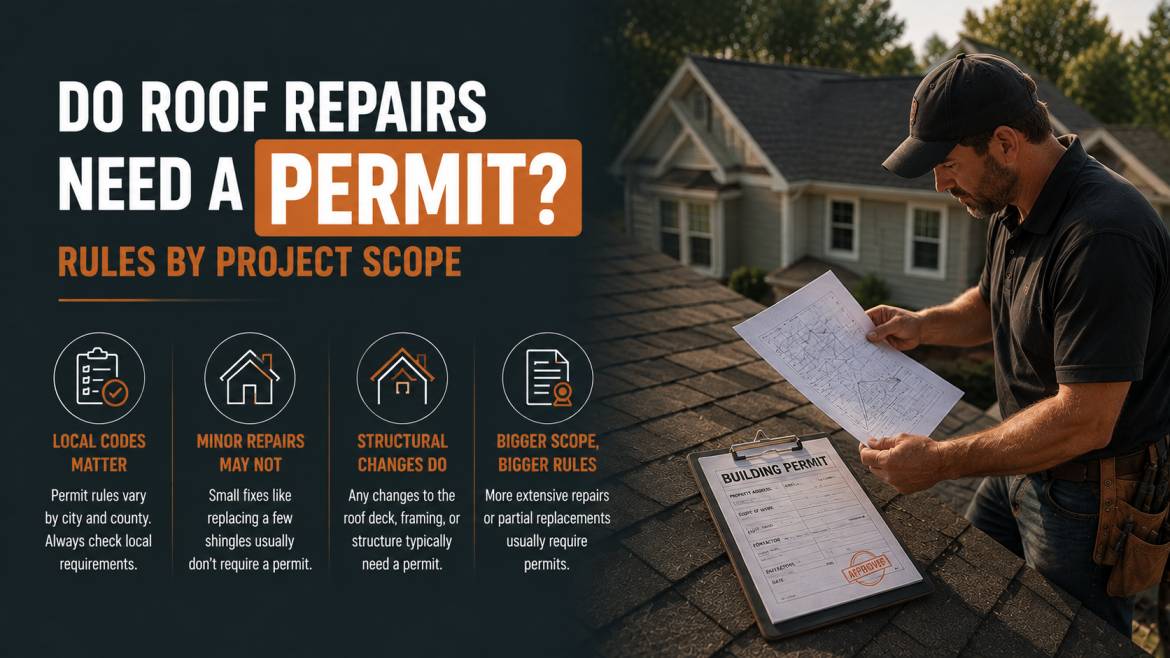
"Do I need a permit for this" is a question with a genuinely unsatisfying answer: it depends, and not just on the state, but on the specific scope of the specific job. A single shingle swap and a full section replacement can sit on opposite sides of the permit requirement even when both trace back to the identical storm.
That variability frustrates homeowners looking for a simple yes or no, but the underlying logic is consistent once the actual trigger is understood. Permit requirements track scope and structural involvement, not damage severity or cause, which is why the same storm can produce one permitted job and one unpermitted job on neighboring properties.
This guide covers what typically triggers a permit requirement, who is responsible for pulling it, and what happens when work that should have been permitted proceeds without one. It connects to the broader roof repair process, and the roof repair services directory covers repair and replacement options across every scope level.
Do Roof Repairs Require a Permit?
Permit requirements vary by jurisdiction, but a consistent pattern holds across most of the country: the larger and more structurally involved the work, the more likely a permit applies.
The General Pattern by Scope
Scope | Typical Permit Requirement |
|---|---|
Minor spot repair, small area | Often exempt in most jurisdictions |
Section replacement | Frequently requires a permit |
Full replacement | Almost universally requires a permit |
Any structural repair | Requires a permit in virtually every jurisdiction |
In practice: "minor" is defined locally, not universally, and the same repair that is exempt in one municipality may require a permit in the next town over. Checking directly with the local building department, rather than assuming based on a general rule of thumb, is the only reliable way to confirm status for a specific address.
How to Check Requirements for a Specific Address?
Most local building departments publish permit thresholds directly, and confirming status takes only a short call or website search before committing to a repair plan.
Search the local building department's website for roofing-specific permit thresholds
Call directly if the published information does not clearly address the specific scope planned
Ask specifically whether the threshold is measured by area, cost, or percentage of the roof
Confirm whether historic district or HOA rules add any additional layer beyond the standard building code
Why Structural Involvement Changes the Answer Immediately?
Any work touching the roof's structural framing, rafters, trusses, or the decking itself, crosses into permit territory almost everywhere, regardless of how the surrounding jurisdiction treats routine covering repairs. Roof snow load damage that has affected framing is a clear example, since structural repair carries safety implications a simple covering swap does not.
What Triggers a Permit Requirement?
Several specific factors, beyond simple job size, determine whether a given repair crosses into permit territory.
The Common Triggers
Total repair area exceeding a locally defined threshold
Any work affecting structural framing or decking
Full or near-full covering replacement
Cumulative repair work crossing the 25 percent rule within a rolling 12-month period
Any change to the roof's material class, such as switching from asphalt to metal
Wildfire ember damage repairs in fire-prone jurisdictions frequently carry additional permit scrutiny specific to material fire rating compliance, layered on top of whatever general scope-based trigger already applies.
How the 25 Percent Rule Connects to Permits?
Most jurisdictions following the International Building or Residential Code tie a specific threshold to both code compliance and permitting simultaneously: once more than 25% of a roof section is repaired within 12 months, the section must be brought up to current code, and that upgrade requirement typically triggers the permit process at the same time.
Jurisdiction | 25% Rule Application |
|---|---|
Florida | Origin jurisdiction under the Florida Building Code |
Texas | Applied per slope or section under the state's IRC adoption |
Minnesota | Enforced under the state's own building code |
In practice: a homeowner who completed a smaller repair earlier in the year, then needs additional work on the same slope, can find themselves crossing this threshold unexpectedly, triggering both a code compliance requirement and a permit process neither repair would have required on its own.
Who Pulls the Permit?
A licensed contractor typically handles the permit process as part of the project scope, though the specific responsibility can vary depending on the arrangement and the jurisdiction.
The Typical Process
The contractor determines whether the specific scope requires a permit
The contractor submits the permit application, usually including project details and materials
Work proceeds once the permit is approved
A final inspection is scheduled once the visible work is complete
Insurance claim documentation sometimes intersects with the permit process directly, since some carriers require proof of a pulled permit before releasing final payment on a claim involving structural or full-replacement scope.
When a Homeowner Might Need to Pull Their Own Permit?
In some jurisdictions, particularly for smaller, homeowner-performed repairs, the property owner can pull an owner-builder permit directly rather than through a contractor. This path typically carries more personal liability and responsibility for code compliance than working through a licensed contractor's permit process.
What the Final Inspection Actually Checks?
A permit is not complete once the physical work finishes. The final inspection of roof damage repair quality confirms the work meets code before the permit officially closes, and skipping this step, even after doing the repair correctly, leaves the permit technically open and unresolved.
Correct fastening pattern and nailing zone compliance
Proper flashing installation at any affected penetrations
Ventilation ratios where the work involved the attic or roof deck
General workmanship matching the approved scope of work
What Happens if Work Is Unpermitted?
Skipping a required permit creates consequences that often surface well after the repair itself is complete, sometimes years later during an unrelated transaction.
The Practical Consequences
Unpermitted work complicates or delays a future home sale, since it surfaces during a standard inspection or title search
An insurer can potentially contest a later claim on the same roof, citing unpermitted prior work
Local building departments can require retroactive permitting, sometimes with additional fees or required corrections
Any warranty tied to certified, code-compliant installation can be jeopardized by unpermitted work
Insurance claim help becomes considerably more complicated when a prior repair on the same roof was performed without a required permit, since that history can affect how a subsequent claim gets evaluated. This complication shows up most often on hail damage roof repair claims specifically, since hail claims already draw closer adjuster scrutiny than most other cause types.
Why the Risk Often Surfaces Years Later?
The consequence of skipping a required permit rarely appears immediately, which is part of why it happens in the first place. A homeowner selling a property years after an unpermitted repair, or filing a subsequent storm claim on the same roof, is the point where the earlier shortcut typically becomes a real problem rather than a theoretical one.
Retroactive Permitting as a Corrective Path
Where unpermitted work is discovered, most jurisdictions offer a retroactive permitting process rather than requiring the work be undone entirely. This path typically involves an inspection of the existing work, correction of any code deficiencies found, and payment of the permit fee along with any applicable penalty. It is rarely pleasant, but it resolves the underlying problem more completely than leaving unpermitted work in place indefinitely.
The homeowner or a contractor applies for a permit covering the already-completed work
An inspector assesses whether the existing work meets current code
Any deficiencies found must be corrected before the permit can close
Penalty fees typically apply on top of the standard permit cost
How Do Permits Interact With Repair Timing and Scope?
Permit requirements do not exist in isolation from the rest of the repair process, and they connect directly to both scheduling and how a job's final scope gets defined.
Permits and Timeline
Repair timeline for permitted work runs longer than an equivalent unpermitted repair, since permit approval and the final inspection both add scheduling steps beyond the physical work itself. A homeowner planning around a tight timeline should confirm upfront whether the scope requires a permit and factor that processing time into expectations.
Permits and Scope
Roof repair scope and permit requirements are frequently determined together, since the same inspection that establishes what work is needed also typically identifies whether that work crosses a permit threshold. A contractor who confirms permit status early, rather than after work has already started, avoids the complication of stopping mid-project to file for one retroactively.
Which States See the Most Distinctive Permit Requirements?
Permit enforcement and thresholds vary considerably by state, shaped by each jurisdiction's specific code adoption and enforcement priorities.
Massachusetts, where strict building codes and historic district rules add complexity to permit requirements
Connecticut, sharing similar New England code stringency across much of the state
West Virginia, where rural county-level variance makes permit requirements considerably less predictable
Florida, the origin jurisdiction for the 25% rule with correspondingly strict statewide enforcement
California, operating under one of the more established statewide contractor licensing and permitting structures
Why Historic Districts Add a Second Layer of Review?
A repair that clears the standard building code permit threshold can still face a separate, additional review if the property sits within a designated historic district. That second layer typically evaluates visible material choice, color, and profile against a preservation standard, independent of the structural code compliance a standard permit already covers.
Historic district review often applies even to a repair that would otherwise be permit-exempt by size alone
Approved material lists in these districts can be narrower than what a standard building code permit would allow
Timeline for historic district approval frequently runs longer than a standard permit, sometimes requiring a scheduled board review rather than administrative sign-off
A homeowner in a historic district should confirm both layers of requirement before finalizing a repair plan, not just the structural permit
Permit guidance for roof repair in Massachusetts frequently involves exactly this two-layer review, given how many of the state's older municipalities carry historic district designations alongside standard building code enforcement. Roof repair permit guidance across Connecticut follows a related pattern given comparable New England code stringency and a similarly high concentration of protected historic properties.
Emergency leak repair across West Virginia sometimes proceeds under considerably more variable permit expectations than more centralized states, since rural county-level administration can differ meaningfully from one jurisdiction to the next within the same state. Roof replacement and permit compliance in Florida operates under the origin jurisdiction for the 25% rule, with correspondingly strict and well-established statewide enforcement. Roof repair permit guidance across California rounds out the group, where the state's established statewide contractor licensing structure shapes permit processing more predictably than in states with heavier county-level variance.
Frequently Asked Questions About Roof Repair Permits
Do You Need a Permit to Repair a Roof?
It depends on the scope. Minor, isolated repairs are often exempt in many jurisdictions, while section replacement, full replacement, and any structural work generally require a permit. Local building department requirements vary enough that direct confirmation is the only reliable answer for a specific address.
Do I Need a Permit to Replace My Roof?
Almost universally, yes. Full roof replacement crosses into permit territory in virtually every jurisdiction, given the scope of work involved and the code compliance requirements that typically accompany a complete covering replacement.
What Triggers a Permit Requirement on a Roof Repair?
Common triggers include total repair area, any work affecting structural framing or decking, a full covering replacement, cumulative repair work crossing the 25% threshold within 12 months, and any change in roofing material class.
Who Is Responsible for Pulling the Permit?
Typically the licensed contractor handles the permit process as part of the overall project. In some jurisdictions, a homeowner can pull an owner-builder permit directly for smaller, self-performed work, though this generally carries more personal liability for code compliance.
What Happens if I Skip a Required Permit?
Consequences include complications during a future home sale, potential insurance claim disputes on the same roof later, possible retroactive permitting requirements with additional fees, and jeopardized manufacturer warranty coverage tied to certified installation.
Does Every State Have the Same Permit Rules for Roofing?
No. Permit thresholds, enforcement, and even which level of government administers them vary considerably by state and sometimes by individual municipality or county within the same state, which is why direct confirmation with the local building department matters more than relying on a general national rule.
Does Insurance Require Proof of a Permit Before Paying a Claim?
Some carriers do, particularly for claims involving structural work or a full replacement, since a permit and its associated final inspection serve as third-party confirmation that the work meets code. Confirming this requirement with the specific carrier before work begins avoids a payment delay tied to missing documentation later.
Can a Permit Application Be Denied?
Yes, though it is uncommon for standard residential roof repair. A denial typically stems from an incomplete application, a proposed scope that does not meet current code, or an unresolved prior violation on the same property that needs to be addressed first.