
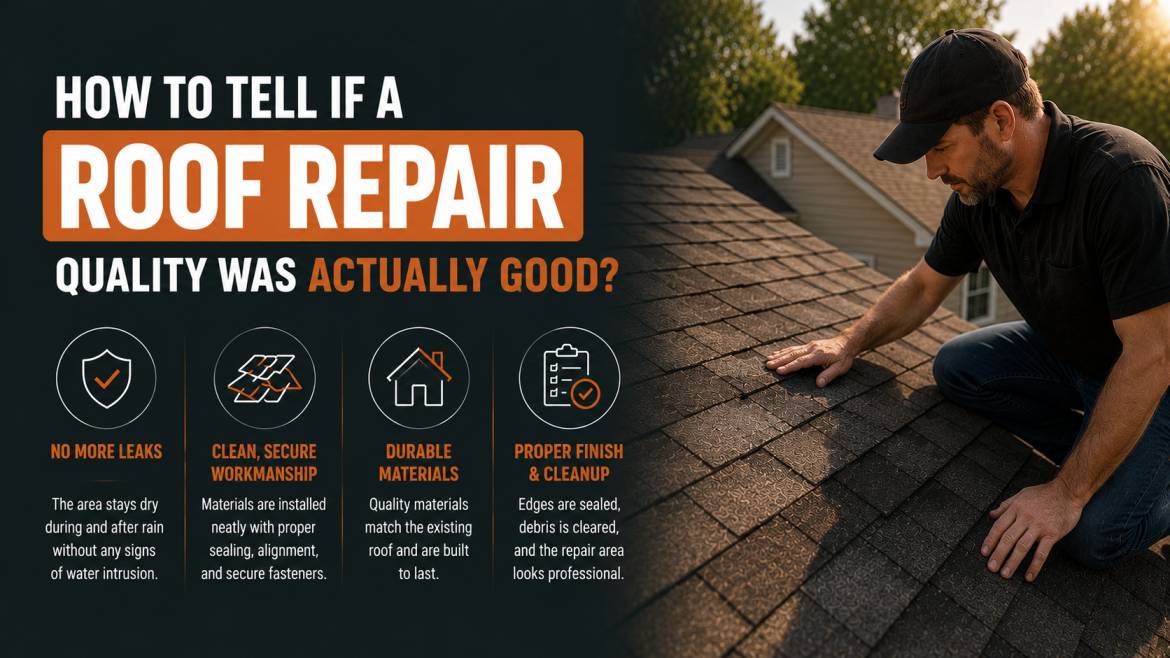
A finished roof repair looks complete to almost anyone standing in the yard. New shingles are in place, the color mostly matches, and nothing looks obviously wrong. That visual impression, unfortunately, tells a homeowner very little about whether the work underneath actually meets a real standard, since most of what determines a repair's durability is either too small to see from the ground or already covered by the finished surface.
The good news is that judging quality does not require climbing onto the roof or having a contractor's training. A handful of specific, checkable details, most visible with a careful look from the ground or a ladder, separate a properly executed repair from one that will likely need attention again within a year or two.
This guide covers exactly what to check, what documentation a transparent contractor should provide, and how to interpret what you find. It connects to the broader roof repair process, and the services directory covers a second opinion or follow-up work where quality concerns arise.
What Should You Check From the Ground?
Several quality indicators are visible without ever leaving the ground, using nothing more than a careful look and, ideally, a pair of binoculars.
The Core Visual Checks
Check | What It Should Look Like |
|---|---|
Shingle exposure | Consistent width across every course in the repaired section |
Alignment | Straight, even courses with no visible waviness |
Overhang past drip edge | Roughly 1 to 1.5 inches, neither excessive nor insufficient |
Fastener visibility | No exposed nail heads on the finished surface |
Roofline continuity | No dip or wave where the repair meets the original covering |
In practice: the overhang measurement is one of the more precise, checkable details available to a homeowner without any special equipment. Too little overhang lets water track back under the drip edge; too much creates an uneven, vulnerable edge prone to wind catch.
A Simple Ground-Level Checklist
Walking the perimeter of the house with binoculars, rather than a single glance from the driveway, catches more than most homeowners expect.
Stand at each corner of the house and sight along the roofline at a shallow angle
Check the repaired section against an undamaged section of the same slope for consistency
Look specifically at the transition point where new roofing repair material meets old
Photograph anything that looks uncertain, with a date, for later reference or a follow-up question
Why Alignment Problems Signal Deeper Issues?
Inconsistent shingle exposure or wavy alignment rarely stays purely cosmetic. It typically indicates the underlying courses were not laid to the correct reveal measurement, which can affect how well the overlapping system actually sheds water across the repaired section. Curling shingles appearing shortly after a repair, in the repaired section specifically rather than elsewhere on the roof, often traces back to alignment or fastening errors from the repair itself.
What Should the Contractor Show You?
Some of the most important quality indicators are permanently hidden once the job is finished, which is why documentation of concealed work matters as much as the visible result.
Documentation a Transparent Contractor Provides
Photographs of the decking condition before the new covering went on
Photographs of the underlayment installation, particularly at any penetrations
A written summary specifying exactly what was repaired and what materials were used
Clear terms for both the manufacturer and workmanship warranty on the completed work
Roof snow load repairs specifically should include confirmation that any structural reinforcement was actually completed, not just the visible covering above it, since a homeowner has no way to verify structural work once it is covered without this kind of documentation. The same verification standard applies whether the underlying cause was snow load, wind damage roof repair following a severe storm, or any other structural trigger.
Why This Documentation Matters More Than a Verbal Assurance?
A contractor's verbal statement that "everything underneath is fine" carries little weight in a future dispute, whether that dispute involves a warranty claim or an insurance evaluation after a subsequent storm. Photographic documentation, dated and specific to the actual job, gives a homeowner something concrete to reference later.
Requesting Documentation After the Fact
A homeowner who did not think to request documentation before the covering went back on is not entirely without options afterward. Some contractors retain job-site photographs as standard practice even without a specific request, and asking directly, even after completion, sometimes surfaces documentation that already exists but was not proactively shared.
How Do You Check Flashing and Sealing Quality?
Flashing and sealant quality are harder to judge visually than shingle alignment, but a few specific checks still apply without requiring roof access.
What to Look For?
Flashing should appear layered into the water path, not simply caulked over a gap
Visible sealant should look neat and controlled, not smeared or excessive
No gaps should be visible where flashing meets the adjoining shingle courses
Valley and penetration areas should be clear of construction debris, not just the general roof surface
Ice dams recurring in the same location after a repair intended to address that exact issue is one of the clearer signals that flashing or ice barrier work was not correctly executed, since a properly addressed ice dam problem should show meaningful improvement rather than an identical recurrence.
A Simple Water Test
Where safely possible and with the contractor's knowledge, running a garden hose over a suspected repair area, working from the bottom up in stages, can help confirm whether a specific flashing or sealing point is actually watertight. This should never substitute for a professional assessment on structural or extensive repairs, but it offers a reasonable homeowner-level check for a smaller, localized concern.
How to Run a Basic Hose Test Safely?
Start at the lowest point of the suspected leak area, testing only that section first
Run water for several minutes before moving upward, checking the interior for any sign of intrusion between each stage
Never climb onto the roof to perform this test; work from ground level or a stable ladder
Stop immediately and contact the contractor if any water intrusion appears at any stage
This staged approach isolates which specific section is responsible if water does appear, rather than soaking the entire area at once and losing that diagnostic information.
How Do You Verify Structural Repair Quality?
Structural repairs carry higher stakes than surface-level work, and verification here benefits from professional confirmation rather than relying on visual inspection alone.
Why Structural Work Needs Independent Verification?
Reinforcement, sistered rafters, or replaced decking sections are entirely hidden once the covering goes back on, which means a homeowner has no direct way to confirm the work meets code without either trusting the contractor's documentation or arranging independent verification. An emergency roof inspection performed by a party independent of the repair contractor provides that verification, particularly worthwhile on any repair involving confirmed structural work.
What an Independent Inspection Checks?
Confirmation that reinforcement matches what was actually specified and paid for
Verification that fastening patterns meet code requirements
General condition assessment of areas adjacent to the repair, not just the repair itself
A written report that can serve as documentation independent of the original contractor
When the Extra Cost of Independent Verification Is Worth It?
Independent verification adds a modest cost on top of the repair itself, and that cost is easiest to justify on larger, structural, or insurance-involved repairs where the stakes of an undiscovered problem are highest. A small, isolated cosmetic repair rarely warrants this additional step, while a repair involving reinforced framing or a full section rebuild often does.
What Warranty Terms Should Accompany Quality Work?
A properly executed repair should come with clearly stated warranty terms covering both the workmanship and, where applicable, the material itself.
The Two Warranty Types to Confirm
Roofing quality warranties split into two genuinely separate instruments: a workmanship warranty from the contractor, typically covering two to ten years, and a manufacturer warranty covering roofing repair material defects, often running considerably longer but requiring the work to meet certification standards.
Why Certification Status Determines Warranty Strength?
Not every contractor installing a given product qualifies for that product's strongest available warranty tier. Manufacturers reserve their best-backed warranties, ones that cover both material and labor rather than material alone, for contractors who have completed specific training and maintain an active certification.
An uncertified installation typically qualifies only for the base material warranty, with no labor coverage if a defect surfaces
A certified installer can register an enhanced warranty covering both material and workmanship under one manufacturer-backed policy
Certification status is independently verifiable through most major manufacturers' public contractor directories
Asking directly which warranty tier a specific repair qualifies for, before work begins, avoids discovering the limitation only after a problem occurs
Confirming which warranty type applies to a specific repair, and what would void it, is worth doing before signing off on the completed work rather than assuming the strongest available coverage automatically applies.
Which States See the Most Distinctive Repair Quality Standards?
Quality expectations and enforcement vary by state, shaped by local licensing requirements and typical claim documentation standards.
Washington, where sustained rainfall makes flashing and sealing quality especially consequential
North Dakota, where extreme cold makes correct sealant cure timing critical to long-term performance
New Jersey, where coastal storm exposure raises the stakes on flashing quality specifically
Illinois, where freeze-thaw cycling tests repair quality more aggressively than milder climates
Pennsylvania, where older housing stock makes matching prior repair quality to current standards a common concern
Roof repair quality assessment across Washington places particular weight on flashing and sealing verification, given how directly the region's sustained rainfall tests any weak point in that work. Wind damage roof repair across North Dakota contends with a narrow weather window where correct sealant cure timing becomes especially critical to a repair's actual long-term performance.
Storm damage repair across New Jersey raises the stakes on flashing quality specifically, given the coastal exposure to sustained wind-driven rain during nor'easter season. Roof repair services across Illinois tests repair quality more aggressively than milder climates, given the state's significant annual freeze-thaw cycling. Roof repair coverage across Pennsylvania rounds out the group, where a substantial base of older housing stock means repair quality assessment often involves comparing new work against inconsistent prior repair standards already present on the roof.
Frequently Asked Questions About Roof Repair Quality
How Do I Know if My Roof Was Done Right?
Check for consistent shingle exposure and alignment, correct overhang past the drip edge, no visible gaps or exposed fasteners, and a straight roofline where the repair meets the original covering. A transparent contractor also provides documentation of any concealed work.
What Are Signs of a Bad Roofing Job?
Warning signs include inconsistent shingle spacing, visible nail heads, flashing that appears caulked rather than properly layered, debris left on the property after completion, and any new issues, such as curling or a recurring leak, appearing in the repaired area shortly afterward.
Should I Ask for Photos of the Work Before It Was Covered?
Yes, and a transparent contractor should offer this without needing to be asked. Photographs of the decking and underlayment condition before the final covering went on are the only way to verify concealed work after the fact.
How Long Should I Wait Before Judging if a Repair Was Successful?
A repair should show its true performance across at least one full season of weather, including a significant rain event, since some quality issues, like a marginal flashing seal, only reveal themselves under real conditions rather than immediately after completion.
Is a Water Test a Reliable Way to Check Repair Quality?
It can offer a useful homeowner-level check for a smaller, localized concern, run carefully from the bottom up with the contractor's knowledge. It should not replace professional assessment for anything involving structural work or a more extensive repair.
What Should I Do if I Suspect My Repair Was Done Poorly?
Document the specific concern with photographs, contact the original contractor to request a warranty inspection, and consider an independent second opinion if the response is unsatisfactory or if the concern involves work you cannot verify yourself, such as structural reinforcement.
Can I Judge Repair Quality From Photos Alone Without Ever Seeing the Work in Person?
Photos help but have real limits, particularly for texture-based issues like sealant application or fastener seating that are hard to judge from a flat image. Where possible, a brief in-person walk of the finished work, even from ground level, adds confidence that photos alone cannot fully provide.
Does a Longer Warranty Automatically Mean Better Repair Quality?
Not necessarily on its own, though it is a reasonable positive signal. A workmanship warranty is only as reliable as the contractor's continued existence to honor it, which is why verifying the contractor's business longevity and licensing status matters alongside the warranty term itself.