
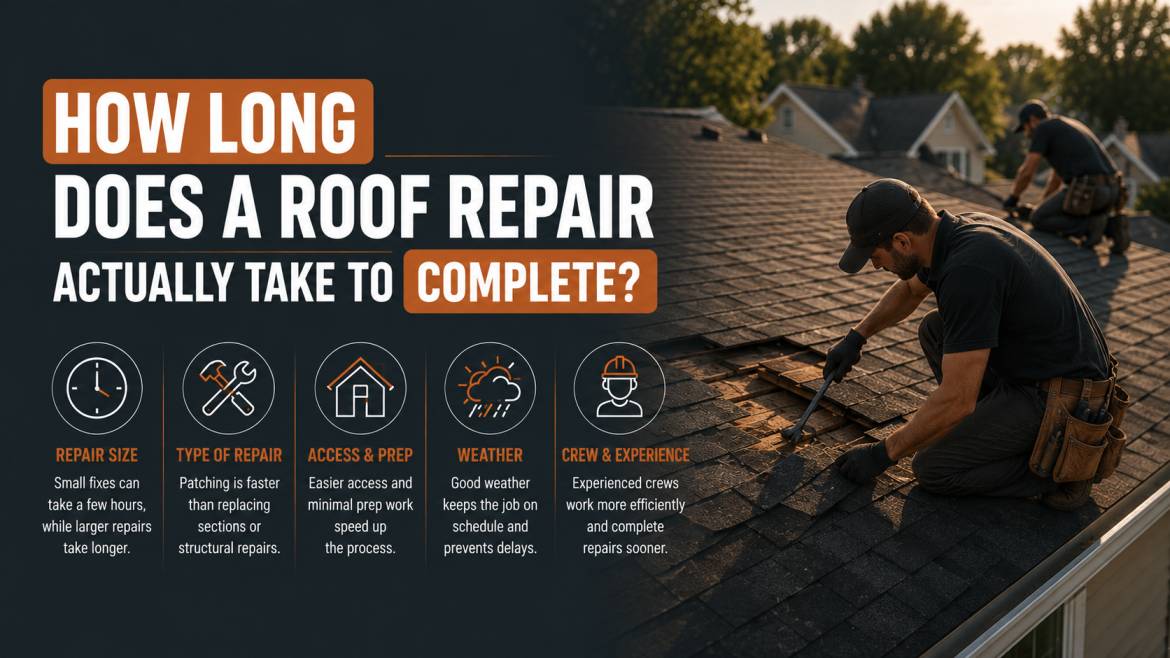
"How long will this take" is one of the first questions homeowners ask once a repair is scheduled, and it is also one of the hardest to answer with a single number. A repair timeline depends on scope, weather, material availability, and what the crew finds once work actually begins, not just the visible damage that prompted the call.
That uncertainty frustrates homeowners trying to plan around a repair, particularly when a job initially described as "a day, maybe two" stretches into a longer project. Understanding what genuinely drives a timeline, rather than treating the initial estimate as a fixed promise, makes that stretch far less surprising when it happens.
This guide covers realistic timeframes by scope, the specific factors that extend a repair, and when a straightforward job turns into a multi-day project. The services directory covers scheduling for the full range of repair and replacement options.
How Long Does a Typical Repair Take?
Timeline varies primarily with scope within the broader roof repair process, and a few general benchmarks help set realistic expectations before work begins rather than after.
Typical Timelines by Scope
Scope | Typical Duration |
|---|---|
Isolated spot patch | A few hours |
Flashing or valley reseal | A single day |
Section replacement | One to two days |
Full replacement, average home | Two to five days |
In practice: these figures assume favorable weather and no significant hidden damage. Any repair estimate that presents a single fixed timeframe without qualifying it against those two variables is describing a best-case scenario rather than a guaranteed one.
How Roof Access Affects Scheduling Beyond the Work Itself?
Steep, complex, or hard-to-reach roofs do not just cost more, they also often take longer to schedule in the first place, since fewer crews carry the specific staging equipment needed for difficult access. A homeowner with a straightforward, walkable roof typically has a wider pool of available contractors and correspondingly shorter scheduling lead times than one with a steep or complex roofline.
Why Method Affects Timeline as Much as Damage Size?
Repair methods matter as much for timeline as for pricing, since a small area requiring reflashing can take longer than a larger area suited to straightforward spot patching. Reflashing requires removing surrounding shingles to reach the flashing, rebuilding the lap sequence correctly, and reinstalling the covering, which adds steps a simple shingle swap does not require.
What Extends a Repair Timeline?
Several factors push a repair beyond its original estimate, and most of them share a common thread: they involve something the initial inspection could not fully confirm in advance.
The Main Timeline Extenders
Weather delays, particularly for adhesive-dependent work requiring specific temperature conditions
Hidden decking damage discovered once the old covering is removed
Material lead times on less common products or discontinued lines
Permit inspection scheduling, which can add days depending on local building department capacity
Scope changes triggered once the 25 percent rule is crossed mid-project
Tree and debris damage repairs specifically can extend further when a fallen limb needs professional removal before the actual roof work can even begin safely, adding a full separate stage to the project that a straightforward storm patch would not require.
How Permit Scheduling Adds Time?
Permit requirements vary by jurisdiction and scope, and where one applies, the inspection scheduling itself can add days to a timeline that would otherwise be complete. A final inspection often needs to be scheduled after the visible work is done but before the project is considered fully closed, which means the crew finishing the physical repair is not always the same moment the project timeline actually ends.
How Weather Specifically Delays Timelines?
Asphalt shingle seal strips activate through solar heat, and most sealants specify a minimum application temperature. Cold or wet weather does not just slow the physical work, it can prevent the repair from curing correctly even once installed, which sometimes means rescheduling rather than simply working through the conditions.
How Long Do Materials Take to Arrive?
Material availability varies enormously by product, and a repair timeline built around an in-stock material can look very different from one requiring a special order.
Availability by Material Type
Material Situation | Typical Lead Time |
|---|---|
Common, in-stock asphalt shingle | Often available same day or next day |
Less common color or profile | A few days to a couple weeks |
Discontinued product requiring sourcing | Highly variable, sometimes weeks |
Specialty materials like slate or tile | Frequently the longest lead times |
Matching roofing materials covers why this sourcing difficulty happens in the first place, but the timeline impact specifically comes down to how far a contractor has to search once the immediate local supply does not have an acceptable match.
Why Custom or Specialty Material Extends Lead Time?
Matching roofing materials is the single biggest driver of an extended timeline, and the mechanism is worth understanding fully rather than treating it as a vague sourcing delay. A product still in current production but discontinued in the specific color or profile originally installed requires a supplier search that can add days to weeks depending on how common the alternative is. A fully discontinued product removes the straightforward option entirely, forcing a choice between secondary-market sourcing, an accepted mismatch, or an expanded scope that resolves the matching problem by replacing a full slope rather than a section.
That search process happens in parallel with, not instead of, the physical repair scheduling, which is why a contractor facing a sourcing delay will often complete every other portion of the job first and return specifically for the delayed material once it arrives, rather than holding the entire project until the last item is in hand.
Planning Around Material Lead Times
A homeowner facing a lead time on a specific material has a few practical options worth discussing with the contractor directly rather than simply waiting.
Ask whether a temporary, weather-safe covering can protect the area while the correct material is sourced
Confirm whether a close but imperfect match is acceptable as an interim or permanent solution
Check whether the contractor can source from an alternate supplier at a different price point
Weigh whether waiting for an exact match is worth the delay versus accepting a visible but minor mismatch
When Does a Repair Become a Multi-Day Job?
A repair that seemed like a single-day project during the initial estimate can expand once specific conditions reveal themselves partway through the work.
The Common Triggers
Hidden decking damage requiring sheet-by-sheet replacement before the covering can go back on
Scope crossing the 25% threshold, converting a section repair into a full slope replacement
Weather interrupting work mid-project, particularly for adhesive-dependent steps
Discovery of additional damage at a second location once the crew has full roof access
A required permit inspection that cannot be scheduled until the visible work is already complete
Wind damage following a severe storm often triggers this pattern, since damage visible from the ground during the initial estimate frequently turns out to extend further once a crew has direct access to the full roof surface.
How Contractors Communicate Timeline Changes?
A reputable contractor updates the homeowner as soon as a timeline-extending condition is discovered, rather than simply finishing later than promised without explanation. A repair timeline should be treated as an estimate with defined contingencies, not a fixed commitment independent of what the work actually reveals. Asking directly what specific conditions could extend a quoted timeline, before work begins, gives a homeowner a more realistic picture than the headline number alone.
How Does Urgency Interact With Timeline?
Not every repair needs to move at the same speed, and matching urgency to actual risk changes how a timeline gets prioritized against other scheduled work.
Which roof damage needs immediate repair is a distinction worth making early, since active water intrusion warrants same-day mobilization regardless of how it affects the broader project schedule, while cosmetic or isolated damage can reasonably wait for a standard scheduling slot.
Emergency Work Versus Scheduled Work
Storm damage repair following a significant regional event often means longer wait times for non-emergency work, since crews prioritize active leaks and structural concerns first. A homeowner with isolated, non-urgent damage during a busy post-storm period should expect a longer scheduling window than the same repair would take during a slower season.
Wind damage roof repair specifically sees this prioritization pattern most clearly after a widespread windstorm, when dozens of homes in the same area all need attention within the same narrow window.
Setting Realistic Expectations With a Contractor
The most useful question a homeowner can ask when scheduling a repair is not simply "how long will this take," but what specific conditions could extend that estimate and by how much. A contractor who can answer that question with specifics, rather than a vague reassurance, is generally giving a more honest timeline from the start.
Ask what the estimate assumes about weather during the scheduled window
Confirm whether the quoted timeline includes permit inspection scheduling where applicable
Request a specific contingency plan for hidden decking damage if discovered
Clarify how the contractor communicates delays once they occur, not just whether they might
Which States See the Most Distinctive Repair Timeline Patterns?
Repair timelines vary by state, shaped by climate constraints, storm frequency, and typical permit processing speed.
North Dakota, where a genuinely short weather window limits the practical repair season each year
Washington, where sustained rainfall extends timelines for adhesive-dependent work considerably
Nebraska, where spring hail season creates a compressed period of high demand affecting scheduling broadly
Minnesota, sharing a similarly short seasonal window to North Dakota for weather-dependent work
Colorado, where Front Range hailstorms create concentrated periods of elevated repair demand
Wind damage roof repair across North Dakota operates within one of the shortest practical repair seasons in the country, given how quickly the state's weather window closes each fall. Storm damage repair across Washington contends with sustained regional rainfall that genuinely narrows the annual window for reliable adhesive cure conditions.
Hail season roof repair across Nebraska sees scheduling timelines extend considerably during the state's peak spring storm period, when demand spikes faster than local crew capacity. Roof repair services across Minnesota shares that same compressed seasonal constraint tied to the state's short warm-weather window. Emergency leak repair across Colorado rounds out the group, where concentrated post-hailstorm demand along the Front Range regularly extends timelines for non-emergency work during peak season.
Frequently Asked Questions About Roof Repair Timelines
How Long Does It Take to Repair a Roof?
It depends heavily on scope. An isolated spot patch often takes a few hours, a flashing reseal typically takes a single day, and section replacement usually runs one to two days. These figures assume favorable weather and no significant hidden damage discovered along the way.
How Many Days Does a Roof Replacement Take?
A full replacement on an average home typically takes two to five days, though larger, more complex rooflines with multiple valleys and dormers can extend that timeline further, and specialty materials like slate or tile generally take longer than standard asphalt.
What Is the Biggest Cause of Repair Delays?
Hidden decking damage discovered once the old covering is removed is one of the most common delay sources, since it requires additional material and labor that could not be confirmed before work began. Weather and material lead times are the other two leading factors.
Can a Repair Timeline Change After Work Has Started?
Yes, and this happens more often than homeowners expect. Discovered decking damage, a scope change triggered by the 25% rule, or a mid-project weather interruption can all extend an original estimate, and a reputable contractor communicates these changes as they arise.
Does Weather Really Affect How Long a Repair Takes?
Yes, considerably. Cold weather slows or prevents adhesive seal strips from curing correctly, and wet conditions can halt work entirely for safety and material performance reasons, sometimes requiring a full rescheduling rather than a brief pause.
Should I Expect a Faster Timeline for a Smaller Repair?
Generally yes, but not always proportionally. A very small repair still requires the same mobilization, safety setup, and cleanup as a larger one, which means the timeline does not always scale down as much as the visible damage size might suggest.
Does Getting Multiple Quotes Slow Down the Repair Timeline?
Not meaningfully in most cases, and the small delay is usually worth it. Most contractors can provide an inspection and written estimate within a few days, and comparing two or three quotes before committing rarely adds more than a week to the overall process, a modest tradeoff against the risk of committing to a scope or price that turns out to be incomplete.