
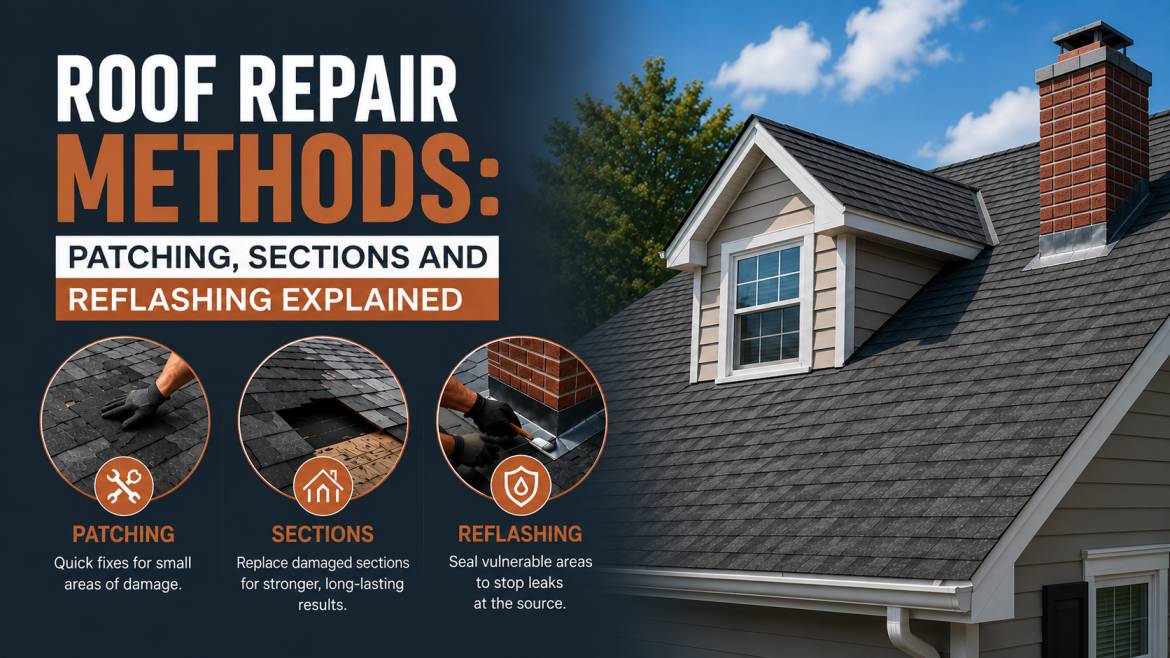
A contractor's first real decision on any repair job is not what material to use or what the invoice will say. It is which method actually fits the damage in front of them: a quick patch, a section rebuild, or a flashing detail that never involved the shingle field at all. Get that decision wrong and the visible fix can look complete while the underlying problem returns within a season.
Homeowners rarely see this decision get made, since it happens during the initial walkthrough before any contract is signed. Understanding it anyway changes how a homeowner reads a quote, since a repair priced for spot patching and a repair priced for section replacement describe two genuinely different scopes of work, not just two price points for the same job.
This guide covers the three core repair methods, when each one is appropriate, and how a repair actually gets matched to the damage in front of it. The roof repair services directory covers the full range of repair and replacement options once a method is identified.
What Are the Main Roof Repair Methods?
Three methods cover the overwhelming majority of residential roof repair work, and each addresses a genuinely different category of damage rather than representing three price tiers for the same fix.
The Three Core Methods Compared
Method | Scope | Typical Duration |
|---|---|---|
Spot patching | Individual shingles or a small cluster | A few hours |
Section replacement | A defined portion of one slope | One to two days |
Resealing and reflashing | A specific joint or penetration | Half a day to a full day |
In practice: these methods are not mutually exclusive within a single job. A repair addressing storm damage might combine spot patching on one slope with a flashing rebuild at the chimney, priced and scheduled as two distinct line items within the same visit. Roof repair scope of work covers how a contractor documents that kind of combined job so the pricing reflects both methods clearly.
Why Method Selection Happens Before Pricing?
A contractor who prices a job before confirming which method actually applies is guessing, and that guess shows up later as a supplemental invoice once the real scope becomes clear. Wind damage illustrates why this matters: a roof missing shingles along one entire edge needs section replacement, while the same roof missing three isolated shingles scattered across different slopes needs spot patching instead, even though both scenarios might look similarly serious from the ground.
When Is Spot Patching Enough?
Spot patching, removing and replacing individual shingles or tiles, works when damage stays isolated and the surrounding covering remains sound enough to support a clean, durable repair.
The Conditions That Favor Patching
Damage is limited to a small, well-defined area rather than spread across a slope
The surrounding shingles remain flexible, not curled or brittle
A reasonably close material match is available
The underlying cause has been identified and is not actively ongoing
Roof wear and aging is the variable that most often disqualifies an otherwise reasonable patching candidate. Patching three shingles on a five-year-old roof produces a durable fix. Patching the same three shingles on a twenty-year-old roof, where the surrounding material is already brittle, often fails again within a year as the patch's edges become the new weak point.
How Patching Is Actually Performed?
The damaged unit is carefully lifted, and adjacent fasteners are released
The damaged shingle or tile is removed without disturbing surrounding units further than necessary
A replacement unit, matched as closely as available, is set and fastened
Sealant is applied at the replacement's edges to restore the water-shedding overlap
Brittle surrounding material complicates this process considerably, since lifting an adjacent shingle to access the damaged one can crack it in the process, particularly on aged asphalt or any tile product. Matching roofing materials covers why finding a close replacement is often harder than the patching work itself.
An emergency roof inspection ahead of scheduling any patch confirms whether the surrounding material can actually support one, rather than discovering mid-repair that the scope needs to expand.
When Is Section Replacement Needed?
Section replacement removes and rebuilds a contiguous portion of a single slope rather than addressing individual units, and it becomes the more sensible choice once damage spreads beyond what patching can cleanly address.
The Threshold Between Patching and Section Work
There is no universal percentage that cleanly separates the two, though many contractors informally treat damage covering more than a small fraction of a single slope as a section candidate rather than a patching one. Foot traffic damage concentrated along a single access path, for example, often stays well within patching territory even when it looks extensive, since the damage follows a narrow line rather than spreading across the full slope width.
Factor | Favors Patching | Favors Section Replacement |
|---|---|---|
Damage pattern | Isolated, scattered points | Concentrated along an edge or area |
Surrounding material condition | Flexible, undamaged | Already aging or brittle |
Visual expectation | Blending is less critical | Uniform appearance across the section matters |
The Visual Tradeoff Section Work Still Carries
Section replacement produces a cleaner, more uniform result than scattered patches, but it does not eliminate the matching problem entirely. The new section still reads visibly against the weathered slope surrounding it, which is why sections are typically squared off at a natural boundary, a valley, ridge, or wall line, rather than left as an irregular patch shape.
Section Work on Metal and Commercial Roofing
Metal roofing section replacement follows a somewhat different logic than asphalt, since individual panels typically run the full length of a slope rather than stacking in overlapping courses. Replacing a damaged section often means swapping full panels rather than a partial-width repair, which changes both the visual result and the labor involved.
Commercial roofing section work carries its own considerations beyond residential jobs, since low-slope membrane systems and larger contiguous areas change how a "section" gets defined in the first place, often by drainage zone rather than by a visible slope boundary.
What Is Resealing and Reflashing?
Resealing and reflashing address leaks originating at a joint or penetration rather than damage to the open field of shingles, and the two terms describe related but distinct scopes of work.
The Difference Between the Two
Resealing typically refers to renewing sealant at a penetration where the underlying flashing remains sound. Reflashing means removing and rebuilding the actual metal flashing sequence, a more invasive repair that requires lifting surrounding shingles to reach the flashing underneath.
Resealing suits minor sealant deterioration around an otherwise correctly installed penetration
Reflashing is necessary once the flashing itself has corroded, shifted, or was installed incorrectly
A repair limited to sealant over a genuinely failed flashing joint typically fails again within a season
Ice dams frequently reveal flashing problems at the eave that a sealant-only fix cannot resolve
Why This Method Gets Chosen Incorrectly More Than the Others?
Resealing costs less and takes less time than a proper reflash, which creates pressure toward the cheaper option even when the underlying flashing has actually failed. A repair that addresses only the visible sealant, without confirming the metal beneath it is still sound, is one of the more common reasons a homeowner pays for the same leak twice. Storm damage repair following a significant wind or hail event should always confirm flashing condition directly rather than assuming sealant alone will hold through the next storm.
How Do You Know Which Method a Specific Repair Needs?
Matching the method to the damage starts with an accurate diagnosis, not with a homeowner's initial guess about severity based on how alarming the damage looks.
A Practical Diagnostic Sequence
Confirm the cause, not just the visible symptom, since the cause determines whether the damage is likely to recur
Assess whether the damage is isolated or spread across a defined area
Check the condition of the surrounding material, not just the damaged section itself
Determine whether the issue originates in the open field or at a specific joint or penetration
Curling shingles near a patching candidate is a useful early warning sign, since it indicates the surrounding material may not support a clean, durable patch even if the immediate damage looks minor.
How Pricing Follows the Method?
Roof repair cost factors vary considerably depending on which method applies, since patching, section work, and reflashing each carry a different labor and material profile. A quote that lists a method without pricing it separately from the diagnosis makes it harder to evaluate whether the scope actually matches the damage.
When the Method Changes Mid-Repair?
A repair that begins as a planned patch sometimes reveals additional damage once work is underway, shifting the method to section replacement partway through. A reputable contractor communicates this change and its cost implications before proceeding, rather than treating the expanded scope as an unavoidable surprise revealed only on the final invoice.
Confirming the Finished Work
How to tell if a roof repair was done right applies regardless of which method was used, since the verification checks, alignment, sealing, and matching, all still apply whether the job was a small patch or a full section rebuild.
Which States See the Most Distinctive Repair Method Patterns?
Repair method selection varies by region, shaped by each state's dominant weather exposure and the resulting damage patterns local contractors see most often.
Missouri, where tornado alley wind exposure drives frequent section-level repair work
Nebraska, sharing that same central severe-weather corridor and its associated damage patterns
Connecticut, where older housing stock complicates the choice between patching and section work
Massachusetts, sharing similar aging housing stock across much of the state
Texas, where high hail frequency produces a mix of both isolated and section-level damage
Storm damage repair across Missouri sees a disproportionate share of section-level work tied to the state's tornado and severe wind exposure, where damage tends to concentrate along a single edge rather than scattering randomly. Metal roofing and repair services in Nebraska follows a related pattern, with metal's distinct denting behavior adding a further wrinkle to method selection during hail season specifically.
Roof repair services across Connecticut frequently navigates the patching-versus-section decision on housing stock old enough that surrounding material condition, not just the immediate damage, drives the final call. Roof repair coverage across Massachusetts shares that same dynamic, given comparably aged regional construction. Hail damage roof repair across Texas rounds out the group, where the state's leading national hail frequency produces both isolated patching candidates and full section replacements within the same storm season.
Frequently Asked Questions About Roof Repair Methods
What Are the Different Roof Repair Methods?
The three core methods are spot patching for isolated damage, section replacement for damage spread across a defined portion of one slope, and resealing or reflashing for leaks originating at a specific joint or penetration rather than the open field of shingles.
How Do You Repair a Section of Roof?
Section replacement squares off the damaged area at a natural boundary, such as a valley or ridge line, removes the covering within that boundary down to the underlayment, and rebuilds it with new material, matched as closely as possible to the surrounding roof.
Is Spot Patching a Permanent Fix?
It can be, provided the surrounding material is still flexible and sound and the underlying cause has been correctly identified and addressed. Patching an isolated area on an otherwise aging or brittle roof often produces only a temporary fix, since the patch's edges become a new weak point.
What Is the Difference Between Resealing and Reflashing?
Resealing renews sealant around a penetration where the underlying flashing remains structurally sound. Reflashing removes and rebuilds the actual metal flashing sequence, which is necessary once the flashing itself, not just the surface sealant, has failed.
Can a Repair Method Change Once Work Has Started?
Yes, and this is a common and legitimate occurrence rather than a sign of a problem. Damage discovered once a patch is underway, such as brittle surrounding material or hidden decking issues, can shift the appropriate method to section replacement partway through the job.
How Do I Know if My Roof Needs Patching or a Full Section Replacement?
The deciding factors are how widespread the damage is, whether it is isolated or concentrated along an edge, and whether the surrounding material remains flexible enough to support a clean patch. A professional inspection is the most reliable way to confirm which category a specific repair falls into.
Does the Roofing Material Change Which Method Applies?
Yes, considerably. Asphalt shingles support all three methods depending on damage extent, while metal panels often favor full-panel replacement over partial patching, and membrane roofing on flat sections typically requires a different seam-based repair approach entirely rather than the shingle-based methods this guide covers.
Will My Insurance Cover Section Replacement if the Damage Looks Minor?
Coverage depends on the documented cause and extent rather than the method itself. An insurer may approve section replacement over patching specifically when matching existing material proves impossible, since several states have regulations addressing reasonably uniform appearance following a covered repair.