
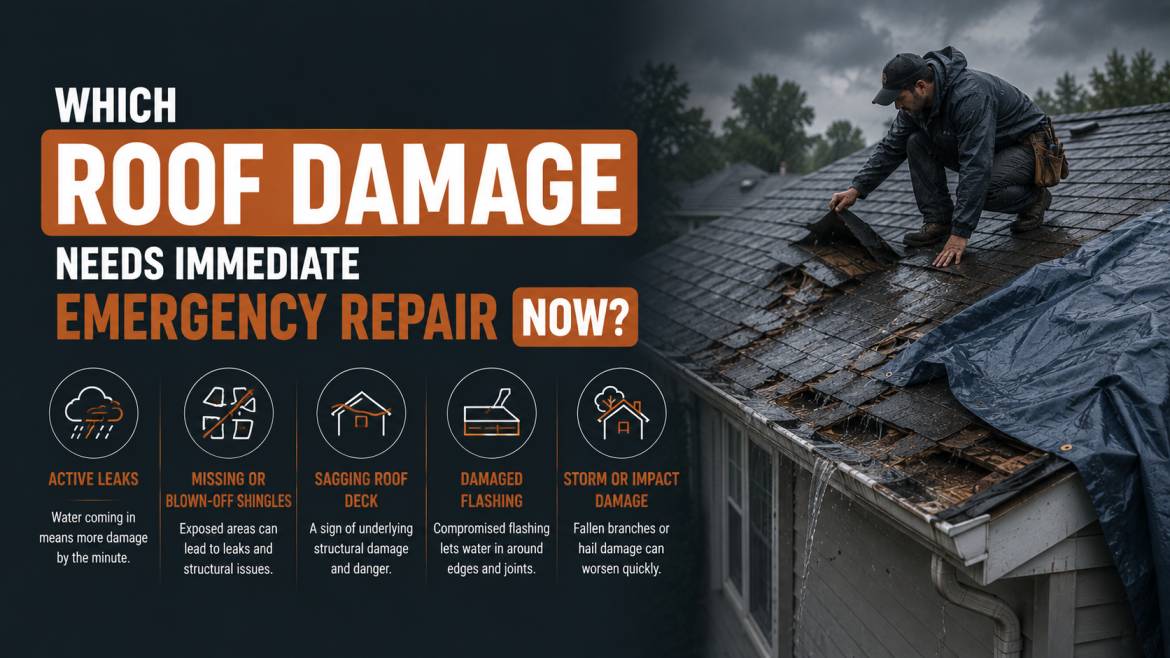
A missing shingle on a Tuesday afternoon with clear skies for the next week is not the same situation as a missing shingle with a storm forecast for that night. Both look identical from the ground. The correct response to each is completely different, and confusing the two wastes either money on an unnecessary emergency dispatch or, worse, time on damage that genuinely could not wait.
Contractors see this confusion constantly in both directions. Some homeowners call every finding an emergency, straining scheduling and sometimes paying a premium rate for work that could have waited a week. Others sit on genuinely urgent damage, assuming it can wait for a routine appointment, and end up with a much larger repair once delay compounds the original problem.
This guide covers which damage genuinely needs same-day attention, what can safely wait, and how weather changes that calculation. It connects to the broader roof repair process, and the services directory covers both emergency and scheduled repair options.
Which Roof Damage Is Genuinely Urgent?
A short, specific list of conditions actually warrants same-day response, and recognizing them clearly is what separates a genuine emergency from a finding that merely looks alarming.
The Genuine Emergency List
Condition | Why It Cannot Wait |
|---|---|
Active water intrusion reaching living space | Water damage compounds by the hour once inside a home |
Exposed decking with no covering over it | Fully unprotected against the next rain event |
Structural deflection or visible sagging | Indicates the framing itself may be compromised |
Compromised chimney or wall flashing with wet weather forecast | A confirmed pathway with an imminent trigger |
Any breach large enough to admit wind directly | Wind-driven rain can exploit the opening rapidly |
In practice: the common thread across every genuine emergency on this list is an active or imminent pathway for water or structural failure, not simply visible damage. A large, ugly-looking hail bruise with intact granules is not on this list, even though it can look far more dramatic than a small missing shingle exposing bare decking.
How to Tell an Emergency From a Dramatic-Looking Non-Emergency?
Visual severity and genuine urgency are not the same measurement, and confusing them is the most common reason homeowners misjudge which damage actually needs same-day attention.
A large area of missing granules looks alarming but rarely threatens the roof's function immediately
A small gap exposing bare decking looks minor but represents an active, unprotected pathway
Widespread cosmetic staining from algae looks neglected but carries no urgency at all
A single displaced ridge cap looks insignificant but can admit wind-driven rain directly into the attic
Why Structural Signs Escalate Urgency Immediately?
Roof sagging belongs on the emergency list regardless of how it presents, since it indicates the framing beneath the covering may no longer reliably support load. Unlike surface damage, structural deflection carries safety implications that extend beyond the roof itself, which is why it warrants immediate professional assessment even without any accompanying leak.
What Can Safely Wait?
A considerably longer list of findings, while worth addressing, does not require emergency dispatch and can reasonably be scheduled during a normal appointment window.
Findings That Rarely Require Emergency Response
Isolated granule loss without any accompanying structural or water sign
Cosmetic blistering on an otherwise intact roof
Minor curling confined to a small area of an otherwise sound roof
Missing shingles on a detached structure during dry, stable weather
Moss or algae growth, which develops over months rather than posing any immediate risk
Moss growth is a useful example of damage that looks like it demands attention but genuinely does not on any urgent timeline, since it develops gradually over multiple seasons and poses no immediate structural or water intrusion risk on its own.
Why Pricing Routine Work as an Emergency Is a Common Upsell?
Some contractors, particularly following a widely publicized storm, present routine findings using emergency language to justify premium pricing or immediate scheduling. Recognizing the roof repair timeline emergency list above helps a homeowner push back on that framing when the actual damage does not match it.
What Happens if You Delay Genuinely Urgent Repair?
Delay on damage that actually belongs on the emergency list rarely stays proportional to the wait time, since water and structural problems compound rather than remaining static.
The Compounding Cost of Delay
Active water intrusion left unaddressed saturates insulation and begins affecting drywall within days
Prolonged saturation can progress to mold growth within 24 to 48 hours in warm, humid conditions
Structural deflection left unassessed can worsen with each subsequent load, including ordinary wind
Most homeowners policies place a duty on the policyholder to prevent further loss, and delay can affect claim coverage
Water intrusion illustrates this compounding effect clearly. What begins as a contained drip can, within a relatively short window, spread across a much larger area of ceiling and wall, turning a modest repair into a significantly larger remediation project.
The Insurance Consequence of Delay
Standard homeowners policies typically require the policyholder to take reasonable steps preventing further loss once damage is discovered. Delaying an available, genuine emergency repair can give an insurer grounds to decline coverage for the portion of damage that spread specifically because of that delay, separate from the original covered event.
A Real-World Example of Compounding Delay
A missing shingle exposing a small area of decking, left unaddressed through a single moderate rain event, might produce a small area of localized staining. The same gap left through several subsequent storms, without any interim protection, can progress to saturated insulation, a compromised ceiling, and in the more severe cases, active mold growth requiring separate remediation. The repair cost at each stage compounds considerably faster than the delay itself might suggest, since water damage rarely stays contained to its original footprint once it has an established path.
How Does Weather Change Urgency?
The same physical damage carries different urgency depending entirely on what weather is approaching, which is why urgency assessment has to account for the forecast, not just the current condition.
A Practical Weather-Adjusted Framework
Situation | Dry Weather Forecast | Wet Weather Forecast |
|---|---|---|
Small missing shingle, sound decking beneath | Can typically wait for scheduling | Warrants prompt temporary protection |
Moderate flashing gap | Schedule within the week | Address within days |
Any active leak | Always urgent regardless of forecast | Always urgent, more so |
Ice dams demonstrate this weather-dependent urgency clearly. An ice dam without any accompanying interior staining is a developing risk worth monitoring closely, while the same ice dam with fresh ceiling staining has already become an active emergency, and a forecast of continued cold weather makes that distinction more urgent still.
Interim Protection While Waiting for Scheduled Work
Roof tarping bridges the gap between a moderate issue and an approaching storm, providing temporary protection while a permanent repair gets scheduled around weather, roof damage repair material availability, and contractor capacity. This is frequently the correct response to damage that is not itself a full emergency but sits close enough to one that waiting without protection carries real risk.
How Do You Get an Accurate Urgency Assessment?
A homeowner uncertain whether specific damage qualifies as urgent benefits from a structured check rather than a purely subjective judgment based on how alarming the damage looks.
A Quick Self-Assessment Sequence
Check the attic for any active dripping or fresh staining, not just the exterior damage
Confirm whether the damage exposes bare decking or only affects the surface covering
Check the forecast for the coming 48 to 72 hours
If any doubt remains, request a same-day professional assessment rather than guessing
Emergency leak repair exists specifically for the confirmed cases on this list, and contacting that service directly is the right move once active water intrusion or an open breach is confirmed, rather than waiting through a standard scheduling queue.
Storm damage repair covers the broader response once a storm has passed and multiple properties in the same area need assessment, where dispatch is typically prioritized by genuine urgency rather than by the order calls came in. Wind damage roof repair follows this same triage pattern most visibly, since a single windstorm often generates dozens of simultaneous urgent calls across the same neighborhood.
How This Connects to Timeline and Scope?
Repair timeline for genuinely urgent work moves considerably faster than scheduled work, since emergency mitigation proceeds the same day regardless of weather or normal scheduling constraints. How repair scope gets decided for an emergency often starts narrower, focused on stopping the immediate loss, with the full permanent repair scope determined once conditions allow a complete assessment.
Which States See the Most Distinctive Urgent Repair Patterns?
Urgency patterns vary by state, shaped by each region's dominant storm type and the resulting demand for immediate response.
Missouri, where tornado alley severe weather produces sudden, widespread urgent repair needs
Nebraska, sharing that same central corridor's exposure to fast-developing severe storms
New Jersey, where nor'easter wind-driven rain creates urgent conditions along the coast
Colorado, where Front Range hailstorms generate concentrated emergency demand
Texas, combining tornado risk with coastal hurricane exposure across a long storm season
Emergency leak repair across Missouri sees demand spike sharply and suddenly following severe thunderstorm activity, given how quickly tornado-producing systems develop in the state. Storm damage repair across Nebraska follows a closely related pattern tied to the same central severe weather corridor.
Wind damage roof repair across New Jersey addresses urgent conditions driven specifically by sustained coastal wind-driven rain during nor'easter season. Hail-related emergency repair in Colorado reflects the Front Range's history of sudden, severe hailstorms that generate concentrated same-day demand. Emergency roof repair across Texas rounds out the group, where the combination of inland tornado risk and coastal hurricane exposure keeps urgent demand elevated across a longer season than single-risk states experience.
Frequently Asked Questions About Urgent Roof Repair
When Is a Roof Leak an Emergency?
A leak is a genuine emergency when it involves active water reaching living space, exposed decking with no covering, visible structural sagging, or any breach large enough to admit wind directly, particularly with wet weather in the forecast.
How Urgent Is a Roof Leak Really?
It depends on what is actively happening, not just that a leak exists. A slow, contained drip during dry weather is less urgent than the same leak during an approaching storm, and any leak reaching electrical fixtures or showing signs of ceiling bulging should be treated as immediately urgent regardless of forecast.
What Are the Signs a Roof Repair Cannot Wait?
Active dripping, a bulging or soft ceiling, visible daylight through the roof deck, structural sagging, and exposed decking are the clearest signs that a repair needs same-day attention rather than standard scheduling.
Is It Ever an Emergency if There Is No Active Leak Yet?
Yes. Exposed decking, a large breach, or structural deflection all warrant urgent attention even before water has actively entered the home, since the conditions that would allow it are already present and only a matter of time or the next storm away from becoming one.
Will Insurance Cover Damage That Worsened Because I Waited?
It depends on the circumstances, but delay can genuinely affect coverage. Most policies require the homeowner to take reasonable steps preventing further loss once damage is discovered, and an insurer may decline to cover the portion of damage that resulted specifically from an unreasonable delay.
How Do I Know if a Contractor Is Overstating the Urgency of My Repair?
Compare the specific damage against the genuine emergency criteria: active water intrusion, exposed decking, structural sagging, or a large breach with wet weather approaching. Routine findings like isolated granule loss or cosmetic blistering do not meet that bar, and a second opinion is reasonable if a recommendation feels disproportionate to what is actually present.
Does the Time of Year Change What Counts as Urgent?
Yes, indirectly. The same moderate damage carries more risk heading into a season with a higher chance of severe weather than it does during a typically calmer stretch, which is why urgency assessment should account for the coming forecast and season, not just the current condition in isolation.
Should I Pay a Premium for Same-Day Service if My Damage Is Genuinely Urgent?
If the damage meets the genuine emergency criteria, same-day or expedited service is generally worth the premium most contractors charge for it, since the cost of delay on active water intrusion or structural risk typically exceeds any rush fee by a wide margin.