
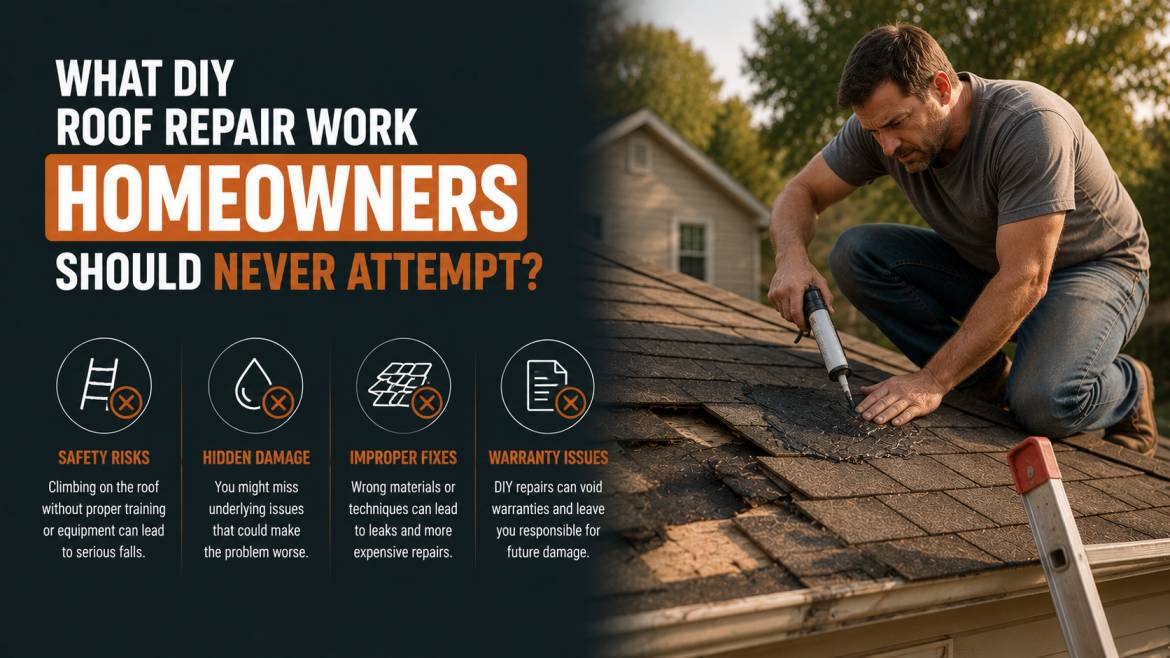
Roof repair sits in an unusual category of home improvement. Painting a room badly still leaves a paintable wall. A poorly executed roof repair can fail catastrophically, void a warranty on work unrelated to the repair itself, and in the more serious cases, send the person attempting it to the hospital.
That combination, genuine physical risk plus a task that looks more straightforward than it is, explains why DIY roof work causes disproportionate harm relative to how simple it appears from the ground. The CDC has documented that over 150,000 Americans require medical treatment every year for roofing-related injuries, and the overwhelming majority of those incidents happen at home rather than on a professional job site.
This guide covers what a homeowner can genuinely handle safely, why the real risk often lies in what cannot be seen from the surface, and what specifically voids a warranty. It connects to the broader roof repair process, and the services directory covers professional options for everything beyond the safe DIY boundary.
What Can a Homeowner Safely Handle?
A genuinely narrow set of tasks falls within reasonable DIY territory, and staying within that boundary is what separates sensible home maintenance from unnecessary risk.
The Safe DIY Boundary
Task | Why It Is Reasonable |
|---|---|
Ground-level visual inspection with binoculars | No roof access required |
Clearing accessible gutters from a stable ladder | Limited height, controlled conditions |
Minor caulking on already-sound penetrations | Low-risk maintenance, not structural |
Interior water containment during an active leak | Addresses the immediate problem, not the roof itself |
In practice: every task on this list shares a common trait. None of them require standing on the roof surface itself. That distinction, roof access versus ground or ladder-based work, is the single clearest line separating reasonable DIY activity from activity that carries genuine risk.
A Practical Self-Check Before Attempting Any Task
Before starting even a task that appears to fall within the safe boundary, a few quick questions help confirm it genuinely does.
Does this task require me to stand on the roof surface itself, even briefly?
Am I working alone, with no one aware of what I am doing or when to expect me finished?
Is the weather currently dry, calm, and free of any approaching storm?
If something went wrong right now, could I call for help easily from where I am standing?
A "no" to any of these questions is a reasonable signal to stop and reconsider, even for a task that otherwise sits within the general safe category.
Why Even "Simple" Tasks Deserve Caution?
Foot traffic damage applies to homeowners walking their own roof exactly as it applies to a professional crew, and an untrained foot placement on a brittle or aged surface can turn a minor inspection into new damage requiring its own repair. Even accessible ladder work benefits from stable footing, a second person aware of the activity, and appropriate weather conditions.
Why Is Roof Access the Real Risk?
Falls account for the leading cause of fatal injury in construction generally, and the physical hazards do not change simply because the person on the roof is a homeowner rather than a licensed professional.
The Documented Scale of the Risk
Over 150,000 Americans require medical treatment annually for roofing-related injuries, according to CDC data
Over 97% of roofing-related accidents happen at home rather than on professional job sites
OSHA's fall protection standard, 29 CFR 1926 Subpart M, requires protection systems at heights of 6 feet or more for professional work, a threshold that applies to virtually every residential roof
Homeowners performing their own work are not subject to OSHA enforcement, but the physical hazard remains identical
Roof sagging specifically should never prompt a homeowner to climb onto the roof for a closer look, since a structural concern is precisely the scenario where the surface may not reliably hold weight, independent of the visible damage that originally prompted the concern.
Why the Risk Is Often Invisible Until It Is Too Late?
Visible damage frequently indicates more extensive underlying issues than the surface alone reveals, which means a homeowner assessing risk based purely on what they can see is working with incomplete information. A soft spot in decking, invisible from above, can give way under weight that a sound section would support without issue.
Why Professional Training Changes the Calculation?
Licensed roofing crews develop an instinct for weight distribution, weak-spot recognition, and safe movement across a roof surface through sustained, repeated exposure to the work. That instinct is not something a homeowner develops from a single repair attempt, regardless of how carefully the task is approached, which is part of why the injury statistics skew so heavily toward home-based incidents rather than professional job sites.
The Equipment Gap Most Homeowners Do Not Account For
Professional fall protection is not simply a matter of caution, it depends on specific equipment most homeowners do not own and would not know how to use correctly even if they did. OSHA's fall protection standard for construction work at heights of 6 feet or more typically requires a full system, not a single item, and understanding what that system actually includes clarifies why a ladder alone does not meaningfully address the risk.
Equipment | What It Does |
|---|---|
Roof anchor points | Permanently or temporarily secured attachment points rated for fall arrest |
Full-body harness | Distributes fall-arrest force across the body rather than a single point |
Lanyard or lifeline | Connects the harness to the anchor, limiting fall distance |
Roof jacks and toe boards | Provide stable footing on steep pitches beyond a comfortable walking angle |
A homeowner without this full system is not simply taking on slightly more risk than a professional crew, they are working with essentially no fall protection at all, regardless of how careful or experienced they feel on a given day.
What Does DIY Repair Risk Beyond Physical Injury?
Beyond the immediate safety concern, self-performed repair work carries financial and legal consequences that surface later, sometimes well after the work itself is complete.
Warranty Voidance
Most manufacturer warranties require certified professional installation, and self-performed repair work on an otherwise warrantied roof frequently voids that coverage entirely, even for damage unrelated to the DIY work itself. Roof wear and aging elsewhere on the roof, completely separate from the DIY repair area, can lose warranty protection purely because unauthorized work occurred anywhere on the same covering.
Insurance Documentation Problems
When an insurance adjuster inspects storm damage and finds evidence of prior DIY repair work, it creates a documentation complication that can affect how the current claim gets evaluated. Insurance claim help becomes considerably more complicated when a homeowner's own prior repair work is discovered during an adjuster's inspection, since it can raise questions about causation that a fully professional repair history would not.
Liability if Someone Else Is Injured
Homeowners directing their own repair work generally bear full responsibility for medical costs and potential legal liability if anyone else, a family member, a neighbor, or a helper, is injured during the work. Professional contractors carry liability insurance and workers compensation specifically to cover this risk, protection a DIY project does not have.
Comparing Liability: DIY Versus Professional Work
Scenario | Who Bears the Cost |
|---|---|
Homeowner injured during DIY work | The homeowner, personally, in almost every case |
Helper or family member injured assisting DIY work | Typically the homeowner, absent separate insurance |
Professional crew member injured on the job | The contractor's workers compensation, not the homeowner |
Property damage caused by a professional crew | The contractor's general liability insurance |
This comparison is why verifying a contractor's insurance matters as much as verifying their pricing. A professional repair transfers risk away from the homeowner in a way DIY work simply cannot.
When Does a DIY Repair Cost More Than a Professional One?
The apparent savings from DIY work frequently disappear once the full roof repair cost of a failed attempt is counted, not just the original repair itself.
How DIY Costs Compound?
A DIY patch that misses an underlying cause requires a second, professional repair later
Moss or other retained moisture beneath a DIY patch can cause hidden damage that costs more to correct than the original issue
A fall injury during the attempt carries medical costs that dwarf any professional repair estimate
A voided warranty removes protection that would have covered a future legitimate defect
In practice: a DIY repair that saves a few hundred dollars and results in even a minor fall injury costs considerably more than professional repair would have from the start. This is not a rare edge case; it is the most common adverse outcome of DIY roof work nationally.
What Should You Do Instead of DIY Roof Access?
For anything beyond the safe boundary covered earlier, professional assessment and repair remain the more sensible path, both financially and physically.
Getting a Professional Assessment Without Committing to Full Repair
An emergency roof inspection provides a professional assessment without necessarily committing to a full repair contract on the spot, which addresses the core reason many homeowners attempt DIY work in the first place: uncertainty about whether the situation genuinely warrants a paid service call.
When Emergency Mitigation Is Different From Repair?
Emergency leak repair for active water intrusion is distinct from a DIY attempt at the underlying cause. Interior containment, moving belongings, and catching drips are reasonable homeowner actions precisely because they do not involve roof access, while the actual source repair belongs with a professional.
Which States See the Most Distinctive DIY Risk Patterns?
DIY risk and typical homeowner behavior vary by state, shaped by terrain, climate, and rural versus urban access to professional services.
West Virginia, where mountainous terrain and rural access sometimes make DIY attempts more common out of necessity
North Dakota, where extreme winter conditions add cold-weather injury risk on top of standard fall hazards
Washington, where wet, slick roof surfaces add a distinct hazard beyond dry-climate risks
Colorado, where steep mountain-adjacent rooflines compound the standard access risk
Minnesota, sharing similar cold-weather DIY risk factors with North Dakota
Emergency leak repair across West Virginia serves communities where rural access sometimes makes a DIY attempt more tempting simply due to distance from professional services, even though the underlying safety risk remains identical. Wind damage roof repair across North Dakota contends with a genuine additional hazard layer, since cold-weather conditions add hypothermia and slip risk on top of the standard fall hazard.
Storm damage repair across Washington deals with consistently wet roof surfaces that add slip risk beyond what drier climates present. Emergency roof inspection services in Colorado addresses terrain where steep, mountain-adjacent rooflines compound standard access difficulty. Roof repair services across Minnesota rounds out the group, sharing North Dakota's cold-weather risk profile across a similarly short seasonal window.
Frequently Asked Questions About DIY Roof Repair
Can I Repair My Own Roof?
Limited tasks are reasonable, including ground-level inspection, accessible gutter clearing, minor caulking on already-sound penetrations, and interior water containment during an active leak. Anything requiring roof access carries genuine fall risk and is better left to a licensed professional.
Is DIY Roof Repair a Good Idea to Save Money?
Rarely, once the full picture is considered. Falls, voided warranties, and missed underlying causes all carry costs that frequently exceed what a professional repair would have cost from the start, and the CDC has documented over 150,000 annual roofing-related injuries requiring medical treatment nationally.
What Roof Tasks Are Genuinely Safe for a Homeowner?
Tasks that do not require standing on the roof surface itself: ground-level visual inspection, gutter clearing from a stable ladder, minor caulking on sound penetrations, and interior water containment during a leak.
Will DIY Repair Void My Roof Warranty?
Frequently, yes. Most manufacturer warranties require certified professional installation, and unauthorized DIY work can void coverage even for damage unrelated to the specific area repaired, since it occurred anywhere on an otherwise warrantied roof.
What Is the Biggest Hidden Risk of DIY Roof Repair?
Visible damage often indicates more extensive underlying issues than the surface reveals, meaning a homeowner working from a visual assessment alone lacks the full picture a trained inspection would provide, including hidden decking damage that could give way under weight.
Is It Ever Safe to Climb on My Roof at All?
Only under specific, favorable conditions: dry weather, a roof pitch within a comfortable walking range, no suspected structural concern, and ideally a second person aware of the activity. Even then, the activity should be limited to inspection and documentation rather than actual repair work.
What Should I Tell a Contractor if I Already Attempted a DIY Fix?
Disclose it honestly rather than leaving it for the contractor to discover independently. A professional inspecting a roof with prior DIY work benefits from knowing what was attempted, when, and with what roof damage repair materials, since that context helps them assess whether the DIY work contributed to or masked the current problem, and it avoids any confusion during a later warranty or insurance conversation.
Does Homeowners Insurance Cover Injuries From DIY Roof Work?
It depends on the specific policy and circumstances, and coverage for the homeowner's own injury during self-performed work is far from guaranteed. Liability coverage for a third party injured while helping is a separate question from the homeowner's own medical costs, and neither should be assumed without confirming directly with the insurance carrier beforehand.